
Customized medications aren’t just a convenience-they’re a lifeline for patients who can’t take standard pills. Maybe they’re allergic to dyes, need a tiny dose for a child, or can’t swallow tablets. But when these medications are made wrong, the consequences can be deadly. In 2012, a contaminated steroid injection from a compounding pharmacy caused over 60 deaths. Since then, the system has changed-but errors still happen. The good news? Most of them are preventable.
Why Compounding Errors Are So Dangerous
Unlike factory-made drugs, compounded medications don’t go through FDA clinical trials. That means there’s no safety net. If a pharmacist miscalculates a dose, uses the wrong ingredient, or contaminates the batch, there’s no external check before it reaches the patient. A 2021 study found that 3% to 15% of compounded preparations had significant deviations from the intended strength. That might sound small, but for a child on a microdose of levothyroxine or a cancer patient on a potent chemotherapy compound, even a 10% error can be life-threatening. One real case involved a geriatric patient given a compounded tramadol solution. The label said ‘50 mg per container’-but the pharmacist meant ‘50 mg per mL.’ The patient took the whole container, thinking it was a single dose. Result? Serotonin syndrome. ICU stay. Three days in the hospital. All because of a poorly written label.The Core Rules: USP <795>, <797>, and <800>
The gold standard for safety in compounding comes from the United States Pharmacopeia (USP). These aren’t suggestions-they’re the baseline for legal and safe practice.- USP <795> covers non-sterile compounding: things like creams, liquids, capsules. The workspace must be clean, with air quality at ISO Class 8 or better. No open windows. No food. No jewelry. And every ingredient must be verified by two people.
- USP <797> is for sterile products: injections, IV bags, eye drops. This is where things get serious. The compounding area must be an ISO Class 5 cleanroom. That’s like an operating room. Staff wear full sterile gowns, masks, gloves. Every step is documented. Media fill tests-where they test if the environment stays sterile-are required twice a year for every technician.
- USP <800> handles hazardous drugs: chemotherapy, hormones, antivirals. These require special ventilation, spill kits, and disposal procedures. One slip-up here can expose staff and patients to toxic chemicals.
Dual Verification: The Two-Person Rule
No one should calculate or measure a compounded dose alone. Ever. The American Society of Health-System Pharmacists (ASHP) says: Two qualified professionals must independently verify every step. One pharmacist prepares the batch. A second pharmacist-no exceptions-checks:- The prescription order
- The ingredient amounts
- The chemical identity of each powder or liquid
- The final concentration
- The beyond-use date
Technology That Actually Works
You can’t rely on pen and paper anymore. The best compounding pharmacies now use software built for this exact purpose. Tools like Compounding.io and PharmScript don’t just store recipes. They:- Auto-calculate dosages based on patient weight, age, and renal function
- Flag incompatible ingredients (e.g., mixing a drug with a preservative it reacts with)
- Require electronic signatures for each verification step
- Generate batch records that can’t be altered after signing
Labeling: The Silent Killer
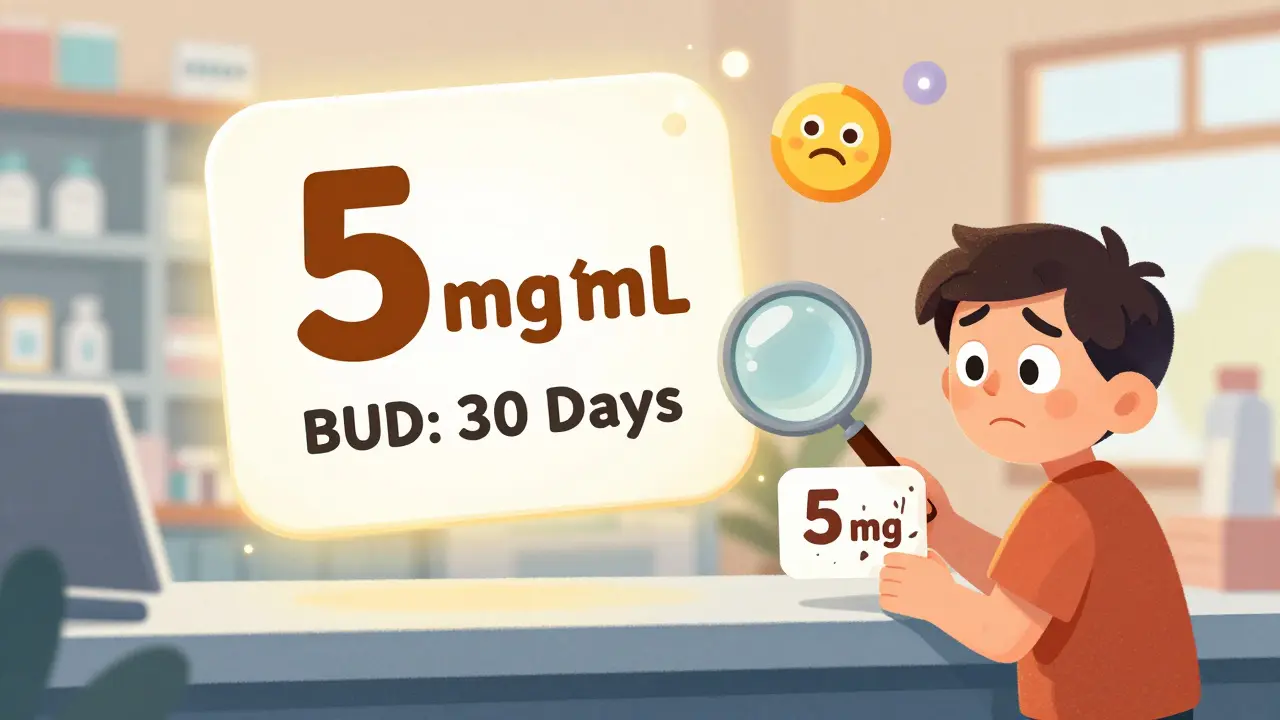
Bad labeling kills. It’s not dramatic. No alarms. No fire. Just a patient taking the wrong amount because the label was unclear. Between 2018 and 2022, the FDA recorded 27 fentanyl overdose incidents linked to mislabeled compounded medications. Why? Labels said ‘10 mg’-but didn’t say ‘per mL’ or ‘per capsule.’ Some pharmacists wrote ‘10 mg/mL’; others wrote ‘10 mg.’ Patients and nurses assumed the same thing. They weren’t wrong. The system was. The FDA’s 2023 draft guidance now requires all compounded labels to use standardized units: mg/mL, not ‘mg.’ Always include the total volume. Always specify concentration. No abbreviations. No vague terms like ‘as directed.’ And don’t forget the beyond-use date (BUD). Non-sterile compounds can last 30 to 180 days. Sterile ones? From 3 hours to 45 days, depending on how they’re made and stored. If the BUD is missing or wrong, the medication could be contaminated or degraded. That’s not a risk-it’s a guarantee of failure.Training Isn’t Optional
You can have the best equipment, the cleanest room, the smartest software-but if your staff doesn’t know how to use them, it’s all for nothing. The International Academy of Compounding Pharmacists (IACP) says quarterly competency assessments are the single most effective way to prevent errors. That means:- Every technician must pass a hands-on test on aseptic technique at least every three months
- Every pharmacist must demonstrate accurate calculations under timed conditions
- Everyone must show they can identify ingredients using FTIR or HPLC tools
Accreditation: The Gold Standard
Not all compounding pharmacies are equal. The Pharmacy Compounding Accreditation Board (PCAB) is the only independent body that certifies compounding pharmacies to the highest standards. As of 2023, only 18% of U.S. compounding pharmacies are PCAB-accredited-up from 8% in 2018. Getting accredited isn’t easy. It takes 12 to 18 months. Costs $15,000 to $25,000. Requires 20 to 40 hours a month just to keep up with documentation. But here’s the thing: accredited pharmacies have error rates below 2%. Non-accredited ones? Up to 25%. If you’re a patient or a prescriber, ask: Is this pharmacy PCAB-accredited? If they don’t know what you’re talking about, walk away.
What Patients and Doctors Should Do
You don’t have to be a pharmacist to help prevent errors. For patients:- Ask for the label to be written clearly: concentration (mg/mL), total volume, and beyond-use date.
- Compare the color, smell, and texture of your new prescription to your last one. If it’s different, ask why.
- Don’t assume ‘compounded’ means ‘safe.’ Always verify the pharmacy’s credentials.
- Prescribe using exact concentrations: ‘5 mg/mL’ not ‘5 mg.’
- Only send prescriptions to PCAB-accredited pharmacies.
- Ask your pharmacist: ‘What steps do you take to verify this compound?’
The Bottom Line
Compounded medications save lives. But they also carry risk-risk that’s entirely avoidable with the right systems. It’s not about having the fanciest lab. It’s about discipline. Verification. Training. Documentation. And never cutting corners. The tools exist. The standards are clear. The data proves it works. So why do errors still happen? Because some pharmacies still treat compounding like a side hustle instead of a high-stakes medical procedure. You deserve better. Your patients deserve better. Demand it. Check the accreditation. Ask the questions. Make sure the label says mg/mL-not just mg.Frequently Asked Questions
What’s the difference between a 503A and a 503B compounding pharmacy?
A 503A pharmacy is a traditional compounding pharmacy that makes medications for individual patients based on a prescription. They’re regulated by state boards and follow USP standards, but aren’t inspected by the FDA. A 503B outsourcing facility is registered with the FDA, follows Current Good Manufacturing Practices (CGMPs), and can produce larger batches without individual prescriptions. 503B facilities have a 22% lower error rate than 503A pharmacies because of stricter oversight and mandatory FDA inspections.
How do I know if my compounded medication is safe?
Check if the pharmacy is PCAB-accredited. Look for a clear label that includes concentration (e.g., mg/mL), total volume, beyond-use date, and the pharmacy’s contact info. Ask the pharmacist how they verify ingredients and calculations. If they can’t explain their dual-check process or don’t mention USP standards, it’s a red flag.
Can I trust a compounding pharmacy that’s not accredited?
Some non-accredited pharmacies follow best practices, but there’s no way to verify it. Accreditation means an independent team has audited their processes, training, equipment, and records. Without it, you’re relying on their word. With a 2% to 25% error rate gap between accredited and non-accredited pharmacies, the risk isn’t worth it-especially for high-risk medications like hormones, chemotherapy, or pediatric doses.
Why are compounded medications more prone to dosing errors than commercial drugs?
Commercial drugs are made in controlled factories with automated systems, strict quality controls, and FDA approval for every batch. Compounded medications are made one at a time, often by hand, with manual calculations and variable ingredients. There’s no pre-market testing. A small error in weighing a powder or misreading a decimal can lead to a 10x overdose-something that’s nearly impossible in mass-produced medications.
What should I do if I suspect a compounding error?
Stop taking the medication immediately. Contact your pharmacist and doctor. Report the issue to the pharmacy’s quality control team. If you believe you’ve been harmed, file a report with the FDA’s MedWatch program and your state board of pharmacy. Keep the medication and packaging as evidence. Most pharmacies have error reporting systems-but they won’t fix the problem unless you speak up.

Comments (15)
Charlotte N
So many pharmacies still treat compounding like it's just mixing syrup in a kitchen
One wrong decimal and a kid gets a lethal dose
I've seen labels that say '5mg' and mean '5mg/mL' and no one catches it until it's too late
It's not even about training-it's about culture
People are scared to speak up because they'll get yelled at
And then the next day, same thing happens
USP standards exist for a reason
But if the owner just wants to turn a profit, who cares?
I worked in a compounding pharmacy for three years
They skipped dual verification on weekends to save time
And yes, we had PCAB accreditation on the wall
But the audit was done once a year and everyone knew how to fake it
It's a system designed to fail unless someone actually enforces it
Catherine HARDY
Did you know the FDA doesn't inspect 503A pharmacies unless someone dies?
That's not oversight-that's a death sentence waiting to happen
And the 'accredited' ones? They're all owned by the same private equity firms
They hire cheap techs, cut corners on cleanrooms, and slap a PCAB sticker on the door
It's all a scam
They want you to think you're safe
But the real danger is the paperwork
The whole system is built to look legitimate while quietly killing people
And the 'AI tools' they brag about? Just fancy calculators that don't know when a human is drunk or tired
They're not fixing the problem-they're hiding it
Allen Ye
There's a deeper philosophical tension here that no one wants to acknowledge
Medicine is supposed to be a covenant between healer and patient
But compounding has become a logistical exercise in risk mitigation
We've replaced trust with checklists, and humility with compliance
USP standards are necessary but insufficient
They treat symptoms, not the disease
The disease is the commodification of care
When a pharmacy's bottom line matters more than a child's life, we've lost something fundamental
It's not about more software or more audits
It's about remembering that every vial contains a human being's hope
And when we reduce that to a barcode and a double-check, we've already failed
Maybe the real solution isn't in protocols
But in restoring the sacredness of the act of healing
mark etang
It is imperative that all stakeholders recognize the gravity of this issue.
Compounding pharmacies must adhere to the highest standards of professional integrity.
The implementation of dual verification, adherence to USP guidelines, and utilization of validated software systems are not optional-they are non-negotiable.
Failure to comply constitutes a breach of the Hippocratic Oath.
Healthcare institutions must mandate accreditation and conduct unannounced audits.
Patients deserve nothing less than excellence.
Let us not be complicit in negligence.
Act now. Save lives.
josh plum
Let me tell you something-this whole system is rigged
You think the FDA cares? They don't
They're busy protecting big pharma while letting small pharmacies get slaughtered by regulations
And PCAB? That's just another money grab
They charge you $20k to 'certify' you, then let you cut corners as long as the paperwork looks good
Meanwhile, the real problem? The same people who make the rules are the ones who profit from them
And you think AI is gonna fix this?
Ha!
AI doesn't know if your tech is on meth or just didn't sleep for 36 hours
It just prints out numbers
And if the label says '5mg' instead of '5mg/mL'? That's not an AI problem-that's a human problem
And the humans? They're being paid $15/hour to risk kids' lives
So yeah, call it 'preventable' all you want
But it's actually just capitalism with a white coat
John Ross
The operational risk architecture surrounding non-sterile and sterile compounding remains fundamentally brittle due to persistent human-factor vulnerabilities and insufficient system-level redundancy
USP <795> and <797> are necessary but not sufficient conditions for safety
What's missing is a closed-loop validation framework integrating barcode-scanned API verification, real-time concentration analytics via Raman spectroscopy, and mandatory electronic chain-of-custody documentation
Current software platforms like Compounding.io represent a paradigm shift, yet adoption remains suboptimal due to legacy infrastructure inertia and regulatory arbitrage
Moreover, the absence of mandatory continuous competency assessment-beyond annual checklists-creates dangerous cognitive drift
Until we move from compliance theater to engineered resilience, we're merely delaying inevitable failure
And let's be clear: the 2% error rate in PCAB facilities isn't luck-it's systems design
Clint Moser
did you know that the fda lets compounding places use the same air filters as starbucks?
no one talks about this but its true
i read a leak from 2021 where a tech admitted they reused gloves for 3 days because 'it was fine'
and the software? it just auto-fills if you type '5 mg' and dont catch it
and the pcab auditors? they get free vacations from the pharmacies they 'inspect'
its all a cover up
they dont want you to know how bad it really is
and dont even get me started on the 503b outsourcing places
they're just big pharma in disguise
they make batches for 50 hospitals at once
one mistake and you got a whole city sick
why dont they test every batch?
because it costs money
and money > lives
its that simple
Ashley Viñas
Oh honey, if you’re using a pharmacy that isn’t PCAB-accredited, you’re basically playing Russian roulette with your hormones
And don’t even get me started on those 'compounded' thyroid meds
I’ve seen patients on 112.5 mcg of levothyroxine because the label said '112.5' and no one wrote 'mcg'
That’s not a mistake-that’s negligence dressed up as convenience
And if your pharmacist can’t explain the difference between USP <795> and <800> in under 30 seconds? Run
Because if they don’t know the basics, they’re not just incompetent-they’re dangerous
And yes, I’ve filed complaints
And yes, I’ve changed pharmacies
And no, I won’t apologize for demanding safety
My child’s life isn’t a cost center
Brendan F. Cochran
Look, I get it-some people think this is just 'pharmacy stuff'
But this is America
We don't let some guy in a lab coat guess doses like it's a game of chance
PCAB? That's the bare minimum
Any pharmacy that doesn't have it shouldn't be allowed to operate
And why are we letting foreign techs run these places? I'm not saying anything racist but if you're not a real American pharmacist, how do you know what a US patient needs?
And AI? That's just code written by some kid in Silicon Valley who's never held a vial
Real medicine is done by hand, with two pairs of eyes, and a heart
Not some app that says 'all good'
We need real people, real standards, real accountability
Not this woke, tech-bro nonsense
jigisha Patel
Based on the data presented, the 3-15% deviation rate in compounded preparations is statistically significant at p<0.01
However, the article fails to account for confounding variables such as regional regulatory variance, technician-to-pharmacist ratios, and seasonal staffing fluctuations
Furthermore, the 87% reduction attributed to CompoundingGuard AI lacks peer-reviewed validation
The cited JAPhA study had a sample size of n=12, which is underpowered for generalization
Additionally, the 92% drop in misidentification at UTHSC was observed over a six-month period with enhanced supervision-likely a Hawthorne effect
Until longitudinal, multi-center RCTs are conducted, these claims remain anecdotal
And PCAB accreditation? A marketing tool with no proven mortality benefit
Correlation ≠ causation
Jason Stafford
They’re lying to you
Every single one of them
USP standards? A joke
PCAB? A front for the pharmaceutical cartel
The real reason they push all this 'tech' and 'accreditation' is to make you think you’re safe while they quietly control the entire supply chain
They want you to believe that if you just use the right pharmacy, you’re protected
But what if the software is rigged?
What if the AI is trained on bad data?
What if the 'dual verification' is just two people nodding at each other?
And the labels? They’re printed by the same company that prints your credit card statements
They know exactly how to make you overlook the tiny print
They’ve been doing this for decades
And now they’ve got you hooked on the illusion of safety
Wake up
They don’t care if you live or die
They care about your insurance payments
Mandy Kowitz
So let me get this straight-after a 60-person death scandal, the solution is... more paperwork?
Wow.
Real innovative.
Instead of fixing the root problem-letting unregulated shops make life-or-death meds-they just made the forms prettier.
And now we’re supposed to be impressed because some AI caught a decimal error?
That’s like giving a drunk driver a seatbelt and calling it safety.
Meanwhile, my grandma got a 10x overdose because the label said '5mg' and the tech thought '5mg' meant '5mg/mL'-and no one checked because 'it looked right'.
So yeah, keep your checklists.
I’ll keep my funeral expenses.
Justin Lowans
This is one of the most important pieces I’ve read all year.
It’s easy to overlook compounding-until it’s your child’s medication.
But the truth is, behind every compounded dose is a human being trusting someone with their life.
And the people doing this work? Most of them are exhausted, underpaid, and doing their best.
We need to support them-not just with better tools, but with respect.
Training isn’t a cost-it’s an investment in trust.
Accreditation isn’t a checkbox-it’s a promise.
And every time we demand better, we’re not being difficult.
We’re being human.
Thank you for writing this.
It’s a call to action-not just for pharmacists, but for all of us.
Michael Rudge
You people are adorable.
You really think following USP standards is enough?
Let me tell you something-when I worked at a 'PCAB-accredited' pharmacy, the owner had his nephew-19 years old, no experience-doing sterile compounding because 'he’s reliable'
The audit? He paid a consultant to 'prepare' the staff for two weeks
Then they got certified
And guess what? The same guy was still making IV bags with dirty gloves
So yes, you can have all the AI, all the barcodes, all the dual checks
But if the person at the top doesn’t care? None of it matters
And you know what’s worse?
You’re all so proud of yourselves for 'reading the article'
But you won’t do a thing to change it
Because it’s easier to nod along than to demand accountability
So keep your checklists.
I’ll be over here, waiting for the next headline about another child dying because someone didn’t care enough to look
Charlotte N
They’re still doing it.
I just got a refill last week.
The label says '5mg/mL'-but the bottle’s half-full.
And the beyond-use date? Written in pencil.
I called the pharmacy.
They said, 'Oh, sorry, our tech was new.'
And that’s it.
No apology.
No recall.
No nothing.
Just... 'sorry'.
That’s the system.
It’s not broken.
It’s working exactly as designed.