
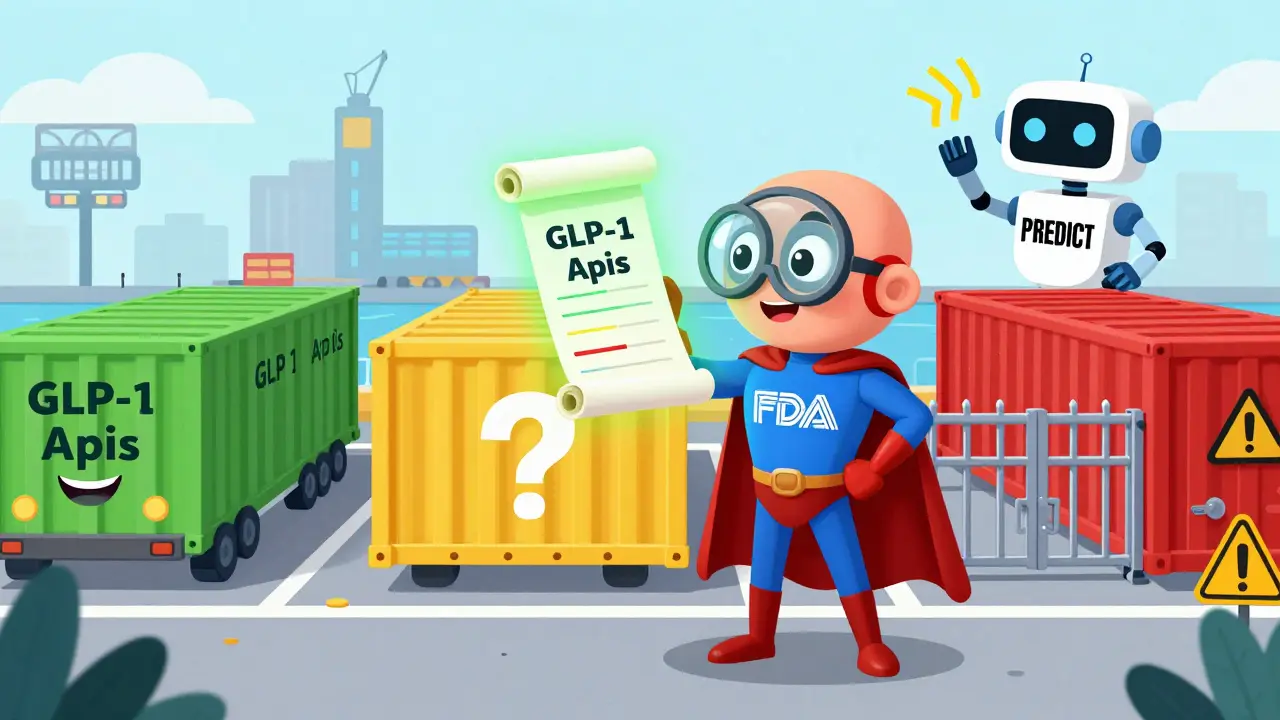
The U.S. Food and Drug Administration (FDA) doesn’t wait for a single bad batch of medicine to reach pharmacy shelves before acting. Instead, it uses a powerful, automated system called Import Alerts to stop entire shipments from manufacturers with a history of violations. This isn’t about one-off mistakes. It’s about patterns. And if your facility has been flagged, your drugs won’t even make it past U.S. customs.
Since 1995, this system has evolved into one of the most effective tools the FDA has to protect Americans from unsafe drugs. By September 2025, there were 238 active Import Alerts covering everything from antibiotics to heart medications. But the biggest shift came with Import Alert 66-80, launched on September 19, 2025, targeting active pharmaceutical ingredients (APIs) for weight-loss drugs like semaglutide and tirzepatide. This wasn’t just another warning-it was a full-scale crackdown on the flood of unapproved, poorly made GLP-1 products flooding into the country.
How Import Alerts Work: No Inspection Needed
Most people think customs inspectors physically check every shipment. They don’t. The FDA’s system works differently. If a manufacturer has been caught violating quality standards before-whether it’s dirty equipment, falsified test results, or unapproved ingredients-their future shipments are flagged automatically. This is called Detention Without Physical Examination (DWPE).
Once flagged, every shipment from that facility is held at the port of entry. No inspection. No delay for paperwork review. Just a hard stop. The importer must prove the product is safe and compliant before it can be released. That means submitting detailed documents: Certificates of Analysis (CoA), third-party audit reports, facility inspection records, and full traceability from raw materials to finished product.
The system runs on the FDA’s PREDICT algorithm, which scans over 150 data points: past inspection results, refusal rates, facility location, product type, and even the importer’s history. If the algorithm flags a shipment, it gets detained within five business days of arrival. In October 2025, 98.7% of non-compliant GLP-1 API shipments were refused. That’s not a mistake-it’s by design.
The Green, Yellow, and Red List: A Graduated System
Unlike simple blacklists, the FDA uses a color-coded system to give manufacturers a path forward:
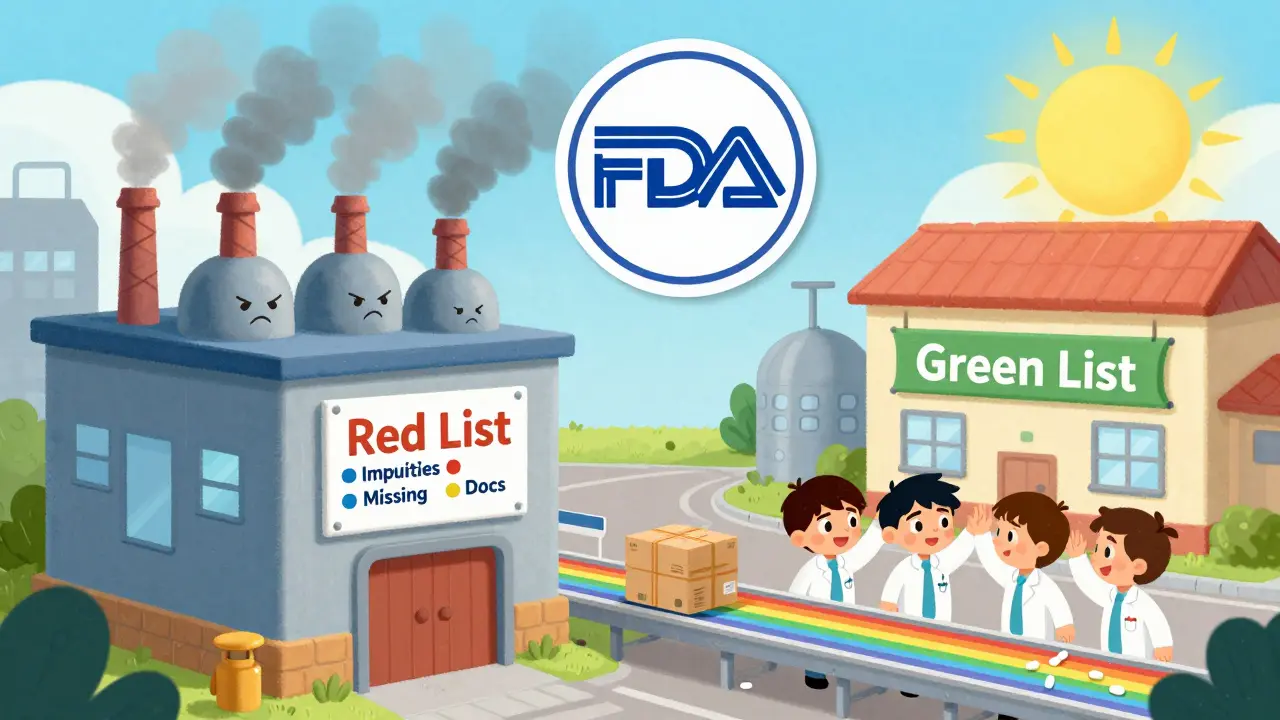
- Green List: Manufacturers with verified compliance. Their shipments are cleared automatically. Only 11% of GLP-1 API facilities made this list as of November 2025.
- Yellow List: Facilities with past violations but showing improvement. Shipments are held and reviewed case-by-case.
- Red List: Facilities with repeated or severe violations. Automatic detention with no exceptions.
For GLP-1 APIs, the difference is stark. Green List manufacturers saw 99.2% clearance rates. Non-listed facilities? Just 1.3% made it through. This isn’t random. It’s based on real data. A November 2025 study found that 68.4% of refused GLP-1 shipments contained impurities exceeding international safety limits. But 22.1% were actually chemically sound-they just lacked proper documentation.
Who Gets Hit the Hardest?
The crackdown didn’t spread evenly. According to FDA enforcement data from October 2025, 73 of the 89 affected facilities (82%) were in India. Nine were in China. Seven in Europe. Why? Because India is the world’s largest supplier of generic APIs, including those used in weight-loss drugs. Many of these factories operate on thin margins, cutting corners on cleaning, testing, or record-keeping to stay competitive.
One manufacturer on a compliance forum reported losing $1.2 million in a single shipment because their auditor wasn’t on the FDA’s approved list-even though they had ISO 9001 certification. That’s the harsh reality: global standards don’t cut it. Only FDA-recognized audits do.
And it’s not just small players. Big names like Viatris reported a $417 million revenue hit in Q3 2025. Meanwhile, Novo Nordisk’s partners gained 18.7% market share in six weeks. The import alert didn’t just block bad drugs-it reshaped the entire supply chain.
The Cost of Getting Banned
Getting caught isn’t just a delay. It’s financial ruin.
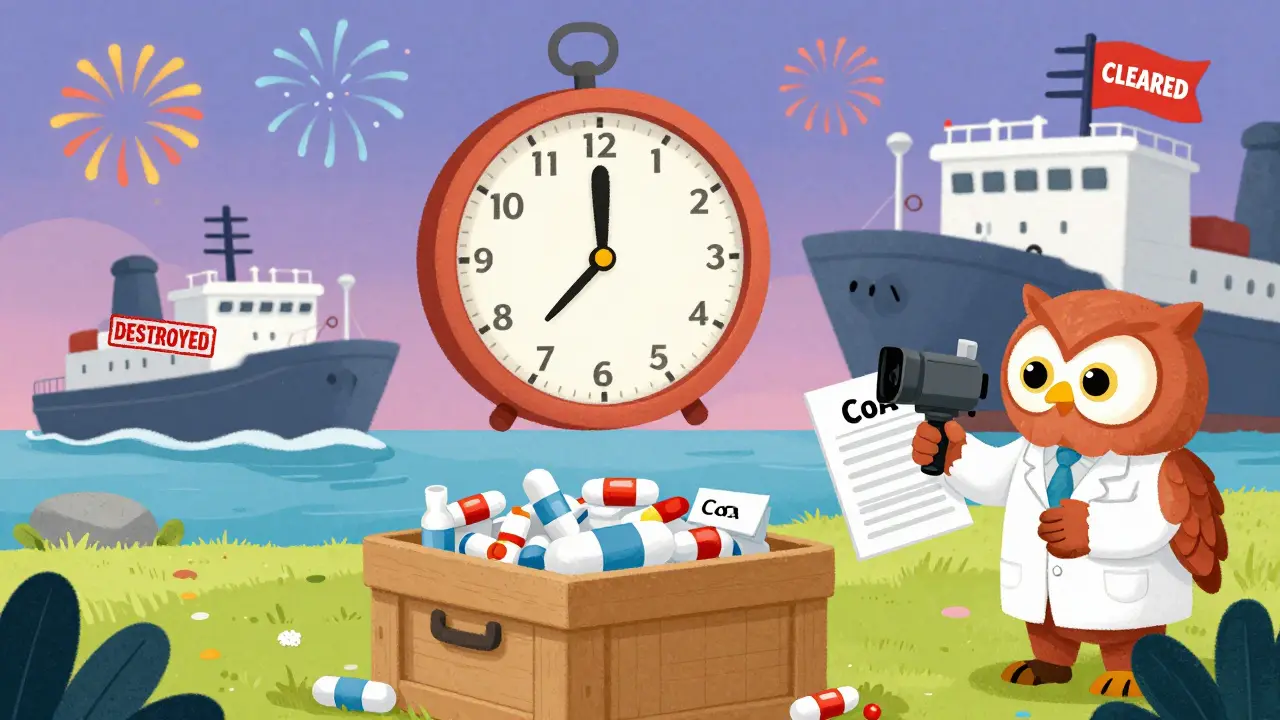
Refused shipments must be exported or destroyed within 90 days. If the importer doesn’t act, Customs and Border Protection (CBP) can seize the goods and impose liquidated damages up to three times the value of the shipment. A $900,000 shipment could cost over $2.7 million in penalties.
And getting off the list? That’s a marathon. The average time to get removed from an Import Alert is 11.7 months. Some companies wait over two years. To even apply, you need:
- A full FDA inspection of your facility (minimum 5 days)
- A root cause analysis with a detailed corrective action plan (CAPA)
- Three consecutive compliant shipments verified by the FDA
- Executive certification that all systems are fixed
And even then, most fail the first time. FDA data shows companies need an average of 2.3 submissions before approval. The most successful ones? They included video proof of clean rooms, equipment calibration, and staff training. Document-only applications had a 42% approval rate. Video submissions? 87%.
What Happens When Companies Can’t Comply?
Some manufacturers are trying to game the system. ProPublica found 157 products have received enforcement discretion since 2013-even while their facilities continued to violate rules. One company was exempted 14 times despite ongoing issues.
And then there’s the dark side. Some firms are paying brokers to falsify export paperwork, pretending shipments are going to Canada or Mexico when they’re actually being rerouted back into the U.S. The FDA issued a warning letter in October 2025 to a Singapore-based intermediary caught doing exactly that.
For smaller suppliers, the pressure is brutal. The Indian Pharmaceutical Alliance estimates 28,500 jobs are at risk. Many factories are shutting down. Others are selling out. Catalent’s $980 million acquisition of Novasep’s peptide business was directly tied to the new import rules. Big players are buying up compliant capacity.
Global Ripple Effects
This isn’t just an American issue anymore.
China’s National Medical Products Administration (NMPA) announced in November 2025 that all API exporters to China must now meet FDA-equivalent standards starting January 1, 2026. The European Medicines Agency (EMA) is following suit, planning to adopt similar API screening protocols by Q2 2026.
Companies are investing millions to adapt. Pfizer deployed the MediLedger blockchain network across 17 API suppliers. Their Green List acceptance rate jumped to 99.8%. Others are installing real-time batch tracking systems costing $200,000 to $500,000. The goal? Prove every step of production-from raw powder to final pill-is traceable and compliant.
The GLP-1 market, worth $35.2 billion in 2024, saw API imports from non-compliant sources drop 92.4% in just one month. CBP reported $1.84 billion in refused shipments through October 2025. Prices for compounded GLP-1 formulations in U.S. pharmacies rose 14.3% in November.
What Comes Next?
The FDA isn’t stopping with GLP-1 drugs. In November 2025, Commissioner Dr. Robert Califf confirmed the system will expand to all high-risk biologics starting in Q1 2026-starting with monoclonal antibodies used in cancer and autoimmune treatments.
By 2027, McKinsey predicts 65-75% of global API manufacturers will need to spend $500,000 to $2 million to upgrade their facilities, testing labs, and documentation systems just to keep selling to the U.S. market.
Legal challenges are mounting. Four Indian pharmaceutical associations filed a lawsuit in November 2025, arguing the Green List violates international trade rules. But for now, the FDA’s system is working exactly as intended: it’s forcing manufacturers to stop cutting corners.
If you’re making drugs for the U.S. market, there’s no such thing as "good enough." Only compliant-or blocked.
What happens if a drug shipment is detained under an FDA Import Alert?
If a shipment is detained under an FDA Import Alert, it is held at the U.S. port of entry without physical inspection. The importer must submit detailed documentation-including Certificates of Analysis, third-party audit reports, and facility compliance records-to prove the product meets FDA standards. If the documentation is insufficient or the manufacturer remains on a non-compliant list, the shipment must be exported or destroyed within 90 days. Failure to act can lead to liquidated damages of up to three times the product’s value.
How can a manufacturer get off an FDA Import Alert?
To get removed from an FDA Import Alert, a manufacturer must complete four steps: (1) pass a full FDA facility inspection, (2) submit a root cause analysis and corrective action plan (CAPA), (3) have three consecutive shipments cleared by the FDA, and (4) obtain executive certification that all compliance issues are resolved. Most companies need multiple attempts-on average, 2.3 submissions-before approval. Including video evidence of facility improvements increases approval odds from 42% to 87%.
Why are Indian manufacturers most affected by the GLP-1 Import Alert?
Indian manufacturers supply the majority of global generic APIs, including those used in GLP-1 weight-loss drugs. As of October 2025, 82% of the 89 facilities affected by Import Alert 66-80 were located in India. Many of these factories operate on tight margins and have historically cut corners on cleaning, testing, or documentation. The FDA’s strict new requirements-especially the need for FDA-recognized audits and full traceability-have exposed long-standing quality gaps, leading to widespread detentions.
What’s the difference between an FDA Import Alert and a blacklist?
A traditional blacklist bans a facility permanently. The FDA’s Import Alert system uses a color-coded approach: Green (compliant, cleared automatically), Yellow (under review), and Red (detained). This gives manufacturers a path to compliance. A Green List manufacturer can be cleared within weeks, while a Red List facility must prove long-term change before being reconsidered. Unlike a permanent ban, this system encourages reform rather than just exclusion.
Will the FDA expand Import Alerts to other drugs?
Yes. In November 2025, FDA Commissioner Dr. Robert Califf announced the GLP-1 Import Alert framework will be extended to all high-risk biologics starting in Q1 2026, beginning with monoclonal antibodies. This means manufacturers of cancer drugs, autoimmune treatments, and other complex biologics will soon face the same rigorous screening, documentation, and compliance requirements already in place for GLP-1 APIs.

Comments (9)
Aisling Maguire
So basically the FDA just went full corporate enforcer and said 'nope, not this time' to every sketchy API lab? I love it. My cousin works in pharma logistics and said they’ve been scrambling to get their docs in order since September. One factory in Kerala just started filming their cleanroom walkthroughs on TikTok to prove they’re legit. 🤯
Martin Halpin
Let’s be real - this isn’t about safety, it’s about protecting Big Pharma’s monopoly. The FDA’s system is a tariff in disguise. India produces 40% of the world’s generic drugs - now they’re being systematically squeezed out so Novo Nordisk can jack up prices on semaglutide to $1,200 a vial? And don’t get me started on how CBP is just a customs arm of the pharmaceutical lobby. This is economic colonialism dressed up as public health. You think a factory in Chennai can afford a $500k blockchain system? Of course not. But Pfizer? They’ve got three of them. This isn’t regulation - it’s a wealth transfer.
Eimear Gilroy
Wait - so if a facility is chemically sound but lacks documentation, they still get detained? That seems insane. Like, what if it’s just a paperwork error? Did the FDA consider that maybe some labs don’t have the staff to manage 150 data points? I’m not saying they should get a pass, but is there any flexibility? Like, maybe a grace period for first-time offenders? Or a help desk? This feels like punishing the small guy while the big guys just pay consultants to game the system.
Ajay Krishna
I understand the FDA’s stance - safety is non-negotiable. But let’s not forget that Indian manufacturers supply over 80% of the world’s generic insulin and antibiotics. This isn’t just about weight-loss drugs - it’s about global access to medicine. Many small labs aren’t cutting corners out of greed; they’re doing it because they’re under pressure from distributors to lower costs. The solution isn’t just detention - it’s collaboration. Training programs, shared audit systems, technical support from the FDA itself. We can protect patients and still lift up global suppliers. It’s not an either/or - it’s a both/and.
Charity Hanson
YESSSS! Finally someone’s standing up for real quality control! I work in a hospital pharmacy and we’ve seen too many batches of metformin with weird clumps and off-colors. This is LONG OVERDUE. Stop pretending 'global standards' mean anything - if it doesn’t pass FDA scrutiny, it shouldn’t be in American medicine cabinets. Period. No more compromises. Protect the people, not the profit margins.
Noah Cline
The PREDICT algorithm is a masterpiece of regulatory engineering. Leveraging over 150 deterministic variables - including facility geolocation, historical refusal velocity, and audit trail entropy - it’s essentially a Bayesian classifier for pharmaceutical integrity. The 98.7% refusal rate for non-compliant GLP-1 APIs isn’t punitive - it’s statistically optimal. Any deviation from this model represents a systemic risk vector. If you’re not compliant, you’re not just non-conforming - you’re a latent threat to pharmacovigilance infrastructure.
Lisa Fremder
America first. If you can’t meet our standards, go sell your junk somewhere else. We don’t need your cheap drugs with impurities. Our people deserve safe medicine. No more outsourcing safety. No more excuses. Shut it down. Full stop.
Justin Ransburg
I truly believe this is a turning point for global pharmaceutical quality. The FDA’s approach is not just regulatory - it’s visionary. By creating a transparent, data-driven pathway to compliance, they’ve incentivized innovation rather than just punishment. The fact that video documentation increased approval rates from 42% to 87% proves that transparency builds trust. This isn’t about exclusion - it’s about elevation. Every manufacturer that rises to meet these standards will be better for it. The world will follow. This is leadership.
Sumit Mohan Saxena
The data presented in the post is largely accurate, though it should be noted that the 11% Green List figure for GLP-1 APIs as of November 2025 is consistent with FDA public dashboards. However, the assumption that all non-listed facilities are inherently non-compliant is misleading. Several facilities, particularly in India and China, operate under legacy regulatory frameworks that predate FDA equivalence, and their documentation gaps are often administrative rather than technical. The absence of a formalized technical assistance program for low-resource manufacturers remains a critical gap in the current framework. A harmonized, tiered audit protocol - similar to WHO prequalification - could reduce refusal rates by up to 30% without compromising safety. The FDA’s system is robust, but not yet optimal.