
5-HTP Medication Safety Checker
Medication Interaction Checker
This tool helps you determine if 5-HTP is safe to take with your current medications. Based on your selection, it will indicate whether combining 5-HTP with your medications is dangerous due to the risk of serotonin syndrome.
Serotonin Syndrome Info
Serotonin syndrome is a medical emergency
Symptoms can include:
- Shivering, sweating, diarrhea
- Muscle rigidity, high fever (above 104°F)
- Seizures, confusion, loss of coordination
- Blood pressure spikes or crashes
Safety Results
Combining 5-HTP with SSRIs isn't just a bad idea-it can land you in the emergency room. Thousands of people take 5-HTP supplements hoping to boost mood, sleep, or reduce anxiety, often without realizing they're mixing it with prescription antidepressants. What they don't know could kill them. Serotonin syndrome isn't rare. It's underreported, misunderstood, and terrifyingly preventable.
What Happens When 5-HTP Meets SSRIs?
5-HTP is a natural compound your body uses to make serotonin. It's sold in bottles labeled as "natural mood support" or "sleep aid." SSRIs like fluoxetine (Prozac), sertraline (Zoloft), or escitalopram (Lexapro) work by stopping your brain from reabsorbing serotonin, leaving more of it floating around in your synapses. On their own, both are relatively safe. Together? They create a perfect storm.
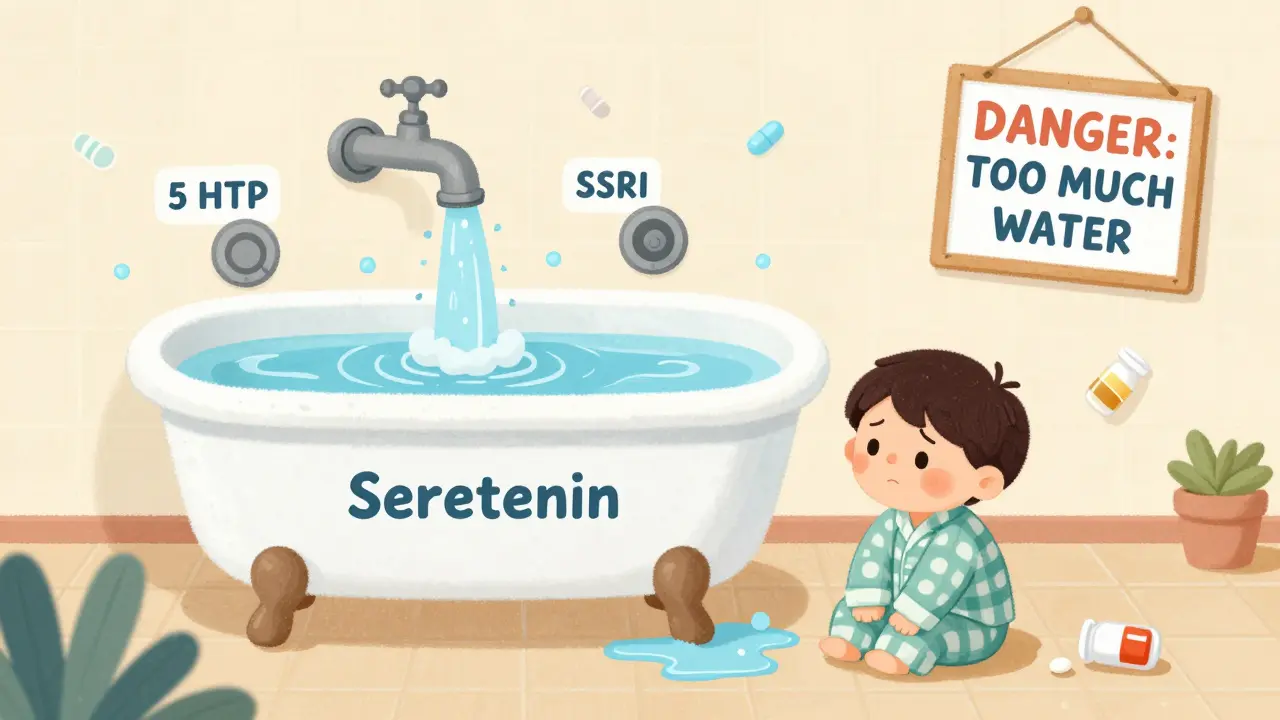
Think of serotonin like water in a bathtub. SSRIs turn off the drain. 5-HTP turns the faucet on full blast. The water doesn't just rise-it overflows. That overflow is serotonin syndrome. It's not a mild side effect. It's a medical emergency.
What Does Serotonin Syndrome Look Like?
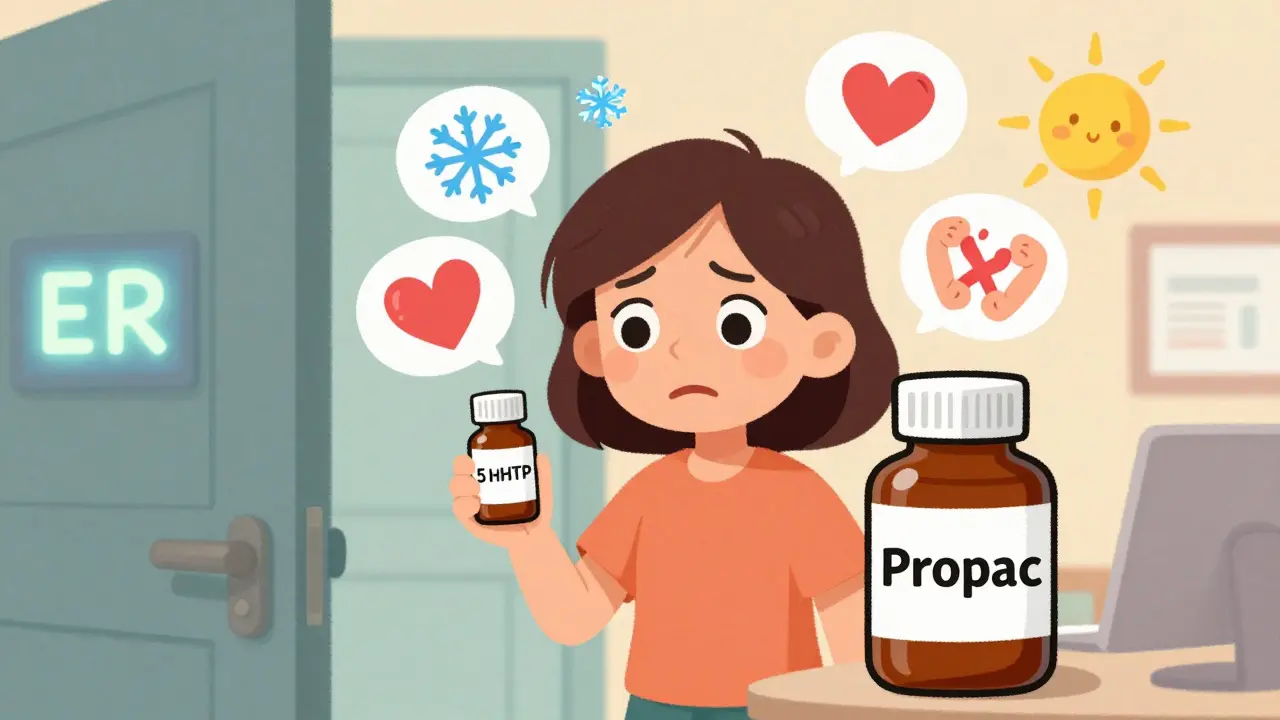
Symptoms start small and spiral fast. Early signs include shivering, sweating, diarrhea, restlessness, or a racing heartbeat. These are easy to ignore-maybe you're just anxious, or it’s the flu. But if you’re taking both 5-HTP and an SSRI, and you start feeling this way, don’t wait.
Within hours, it can escalate. Muscle rigidity. High fever above 104°F. Seizures. Uncontrollable twitching. Confusion. Loss of coordination. Blood pressure spikes or crashes. These aren’t side effects. These are signs your nervous system is being overwhelmed by too much serotonin.
Doctors use the Hunter Criteria to diagnose it-over 96% accurate. If you have one of these symptoms plus one of these: tremor, muscle rigidity, or hyperreflexia, and you’ve taken a serotonin-elevating drug, you likely have serotonin syndrome. Time matters. The longer it goes untreated, the higher the risk of organ failure or death.
The Numbers Don’t Lie
SSRIs alone cause serotonin syndrome in about 1 out of every 2,000 people per year. Add 5-HTP? That risk jumps 10 to 20 times. Some studies compare the danger to mixing SSRIs with MAOIs-another combo doctors strictly forbid.
Between 2015 and 2019, the FDA recorded 127 adverse events involving 5-HTP and SSRIs. Nine people died. These aren’t outliers. They’re predictable.
And it’s getting worse. In 2010, supplement-drug interactions made up 7% of serotonin syndrome cases. By 2020, that number jumped to 22%. Why? Because 5-HTP is easy to buy. No prescription. No warning label. No pharmacist asking if you’re on antidepressants.
Supplements Aren’t Regulated Like Drugs
Under the Dietary Supplement Health and Education Act of 1994, companies don’t need to prove 5-HTP is safe before selling it. They don’t have to test for purity, consistency, or interactions. A 2022 ConsumerLab test found 31% of 5-HTP supplements contained doses that were way off-some had 28% less than labeled, others had 28% more. You think you’re taking 100mg? You might be getting 72mg. Or 128mg. And you won’t know until it’s too late.
Even worse, most supplement labels don’t mention SSRIs at all. They say "natural," "safe," and "supports mood." They don’t say "can cause fatal overdose when taken with antidepressants." That’s not an accident. It’s a loophole.
Who’s at Risk?
Women between 35 and 54 are the most likely to use 5-HTP while on SSRIs. They’re often trying to manage anxiety, depression, or insomnia without increasing their medication dose. They read online that 5-HTP "works like an SSRI but without the side effects." That’s a myth. It doesn’t work like an SSRI-it amplifies it.
Reddit threads are full of stories: "I added 100mg of 5-HTP to my 20mg Prozac and ended up in the ER with a fever of 104°F." "My hands wouldn’t stop shaking for three days." "I thought it was just anxiety, but my doctor said it was serotonin syndrome. I almost died."
One study found that 41% of supplement users believe "natural" means "safe with medications." That’s not just ignorance-it’s deadly.
What Do Experts Say?
The American College of Medical Toxicology says it plainly: "Concurrent use of 5-HTP with serotonergic medications is contraindicated." The FDA issued a warning in 2020. The American Psychiatric Association now requires doctors to ask patients directly about 5-HTP and similar supplements during mental health evaluations.
There’s one outlier: Dr. Kent Holtorf claims you can safely combine them under "medical supervision." But he’s alone. No major medical organization supports this. No peer-reviewed study proves it. The 2023 pilot study that suggested it was tiny, experimental, and the lead researcher called it "not generalizable."
The truth? There’s no safe way to mix them. Not yet. Not with current evidence. And until there is, the only safe choice is to avoid the combination entirely.
What If You’re Already Taking Both?
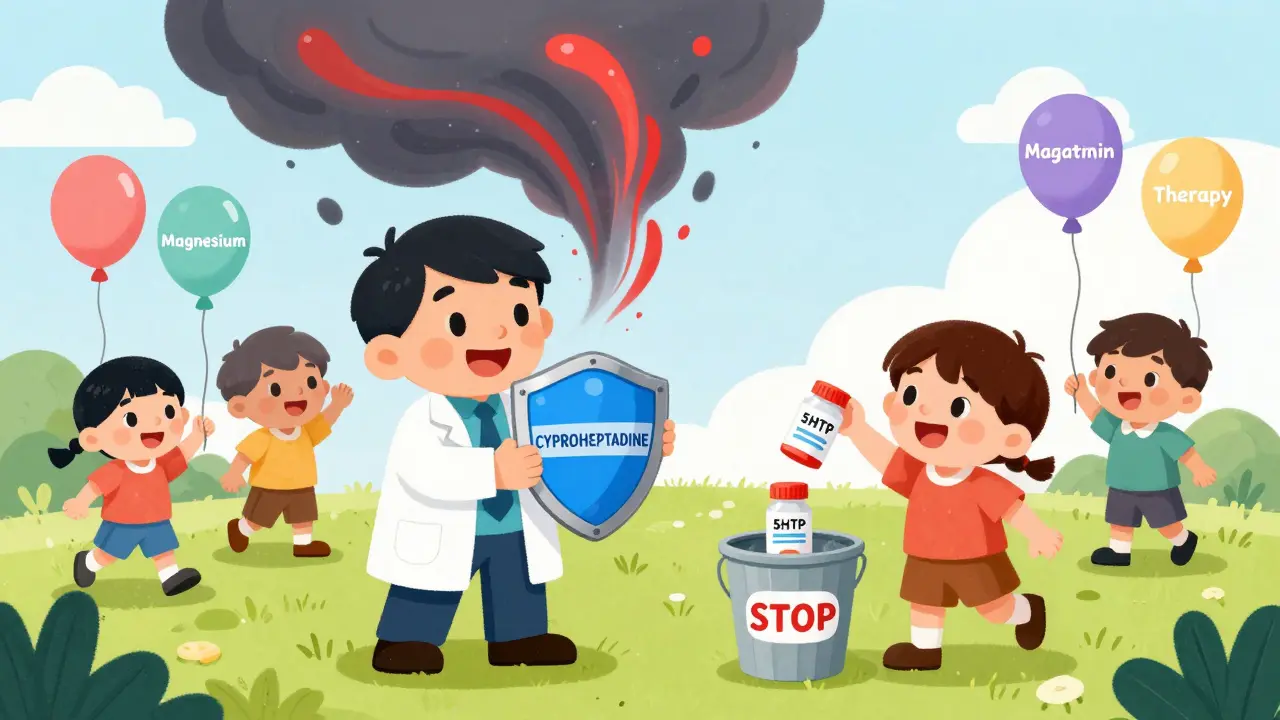
If you’re currently using 5-HTP and an SSRI, stop the supplement immediately. Do not stop your SSRI cold turkey-that can cause withdrawal. But stop the 5-HTP now.
Call your doctor. Tell them exactly what you’ve been taking, how much, and for how long. If you’re experiencing any symptoms-shivering, sweating, tremors, fast heart rate, confusion-go to the ER. Don’t wait. Don’t call your therapist. Don’t Google it. Go to the hospital.
There’s an antidote: cyproheptadine. It’s an antihistamine that blocks serotonin receptors. But it only works if given quickly. In mild cases, symptoms fade within 24 to 72 hours after stopping the combo. In severe cases, you might need ICU care, muscle relaxants, or cooling treatments.
What Can You Do Instead?
If you’re on an SSRI and feel like you need more help, talk to your doctor. There are safer ways to adjust your treatment: changing the SSRI dose, switching to a different medication, adding therapy, or trying non-serotonergic supplements like omega-3s or vitamin D-both have evidence supporting mood support without serotonin risks.
For sleep, try magnesium glycinate or melatonin. For anxiety, consider mindfulness, exercise, or cognitive behavioral therapy. These don’t carry the same risk. They don’t require you to gamble with your life.
How to Prevent This
1. Never take 5-HTP if you’re on an SSRI, SNRI, MAOI, or any antidepressant. It doesn’t matter if it’s "natural."
2. Ask your doctor about every supplement you take. Even if it’s "just a vitamin."
3. Check your labels. If a supplement says "supports serotonin" or "boosts mood," it’s likely 5-HTP, tryptophan, or St. John’s Wort. All risky with antidepressants.
4. Wait at least two weeks after stopping an SSRI before starting 5-HTP. For paroxetine, wait four weeks-it stays in your system longer.
5. Know the symptoms. If you feel off after starting a new supplement, assume it’s the cause until proven otherwise.
6. Report adverse events. If you or someone you know had a reaction, report it to the FDA’s MedWatch program. It helps protect others.
Frequently Asked Questions
Can I take 5-HTP with a low dose of an SSRI?
No. Even low-dose SSRIs like 5mg of escitalopram or 10mg of sertraline still block serotonin reuptake. 5-HTP increases serotonin production. The combination doesn’t care about the dose-it only cares that both are active. There is no safe threshold. The risk is real at any dose.
Is St. John’s Wort safer than 5-HTP with SSRIs?
No. St. John’s Wort also increases serotonin and carries its own risk-about 2.3% for serotonin syndrome when combined with SSRIs. 5-HTP is even riskier, at roughly 4-5 times that rate. Neither is safe. Both should be avoided entirely.
How long does serotonin syndrome last?
Mild cases usually resolve in 24 to 72 hours after stopping the triggering substances. Severe cases can last days to weeks and require hospitalization. Recovery depends on how quickly treatment starts. Delaying care increases the chance of permanent damage or death.
Can I switch from an SSRI to 5-HTP to avoid side effects?
No. Switching from an SSRI to 5-HTP isn’t a safer alternative-it’s dangerous. You can’t just replace one with the other. You need a supervised taper, and even then, 5-HTP isn’t proven to work as well as SSRIs for depression. The FDA has not approved 5-HTP as a treatment for any mental health condition.
Why don’t supplement labels warn about SSRIs?
Because they don’t have to. The Dietary Supplement Health and Education Act of 1994 doesn’t require supplement manufacturers to prove safety or list drug interactions. The FDA only steps in after harm occurs. That’s why 5-HTP labels say "natural" and "supports mood"-not "can cause fatal overdose with antidepressants."
Final Word
5-HTP isn’t the villain. SSRIs aren’t the villain. The problem is the silence around their interaction. People aren’t being warned. Doctors aren’t always asking. And the supplement industry is profiting from that gap.
You don’t need another supplement to feel better. You need accurate information. You need to talk to your doctor. And you need to stop treating natural as safe. Because in this case, natural doesn’t mean harmless. It means unregulated. Unpredictable. Deadly.
Choose safety over guesswork. Your brain isn’t a lab experiment. Don’t risk it.

Comments (14)
Nancy Kou
Just read this and my stomach dropped. I’ve been taking 5-HTP for sleep while on sertraline for three months. I thought it was helping. Now I’m terrified. Going to my doctor tomorrow. No more supplements without a script.
Connie Zehner
Oh my god I’m so glad someone finally said this. My cousin died from this exact combo. They didn’t even know 5-HTP was dangerous. The label said "natural mood booster" - like that means it’s harmless? I’m screaming into the void here but someone needs to hear this. RIP Sarah.
Kitt Eliz
YESSSS. This is the exact kind of public health education we NEED. 5-HTP is not a vitamin. It’s a pharmacologically active compound with zero regulatory oversight. And the supplement industry is literally betting on your ignorance. We need mandatory interaction warnings on every bottle. #StopTheSilence
Dikshita Mehta
I work in a pharmacy in Delhi. We see this all the time. Patients buy 5-HTP online, take it with fluoxetine, then come in with tremors and say "I felt better at first." We have to educate them daily. No one listens until it’s too late.
Monte Pareek
Stop buying into the natural = safe myth. It’s the biggest lie in wellness culture. Your body doesn’t care if a molecule comes from a plant or a lab. If it affects serotonin, it’s a drug. Period. If you’re on an SSRI, don’t touch 5-HTP. Not even a little. Your brain isn’t a buffet.
Kelly Mulder
It’s not merely irresponsible-it’s a systemic failure of governance. The DSHEA of 1994 is a legislative abomination that permits corporate malfeasance under the guise of consumer freedom. The FDA’s reactive posture is tantamount to negligence. Until supplements are held to pharmaceutical-grade standards, we will continue to bury people who trusted the label.
Hussien SLeiman
Look, I get it. You want to feel better without drugs. But you’re not "natural" if you’re hijacking your neurotransmitters with unregulated chemicals. You’re just self-medicating with a side of delusion. And now you’re putting your life at risk because you read a blog that called it "gentle serotonin support." Wake up. There’s no gentle way to overload your CNS.
pascal pantel
127 adverse events? That’s nothing. The real number is 10x higher because most cases never get reported. Doctors don’t connect the dots. Patients don’t mention supplements. And the FDA only acts when someone dies. This isn’t a crisis-it’s a waiting room for the next fatality.
holly Sinclair
It makes me wonder about the ethics of selling something that’s essentially a serotonin bomb with no warning. Is it fraud? Or just capitalism exploiting the gap between scientific literacy and consumer vulnerability? We treat food labels like sacred texts but let supplement labels be lawless. Why? Because we’ve outsourced our responsibility to a market that profits from ignorance.
Kathryn Featherstone
I’ve been on citalopram for 8 years. I started 5-HTP last winter because I thought my sleep was getting worse. I didn’t feel anything dramatic-just a bit jittery. I thought it was stress. Now I realize it was the beginning of serotonin syndrome. I stopped it immediately. Thank you for this post. I feel less alone.
Sahil jassy
bro just stop taking random shit from amazon. if you want to feel better talk to a therapist or go for a walk. 5-htp is not magic. your brain is not a vending machine. you dont put in coins and get happiness. its biology. respect it.
Erica Vest
For those asking about alternatives: magnesium glycinate (200-400mg before bed) and 1000-2000 IU vitamin D3 daily have robust evidence for mood and sleep support without serotonergic risk. Omega-3s (EPA >1000mg) are also clinically validated. These are safe, measurable, and don’t require guessing.
Kinnaird Lynsey
So… the FDA didn’t ban this because it’s "natural"… but they’d ban a pill with the exact same molecule if it came from a lab? How is that not absurd? We’ve built a system where the only difference between a drug and a death trap is the packaging.
Gloria Parraz
I’m a nurse in the ER. I’ve seen serotonin syndrome. It’s not dramatic like in the movies. It’s quiet at first-just a little tremor, a sweaty forehead, a patient saying "I think I’m going crazy." Then it escalates. And when it does, it’s too late for the family to say "we didn’t know." You knew. You just didn’t care enough to check. Please. Stop.