
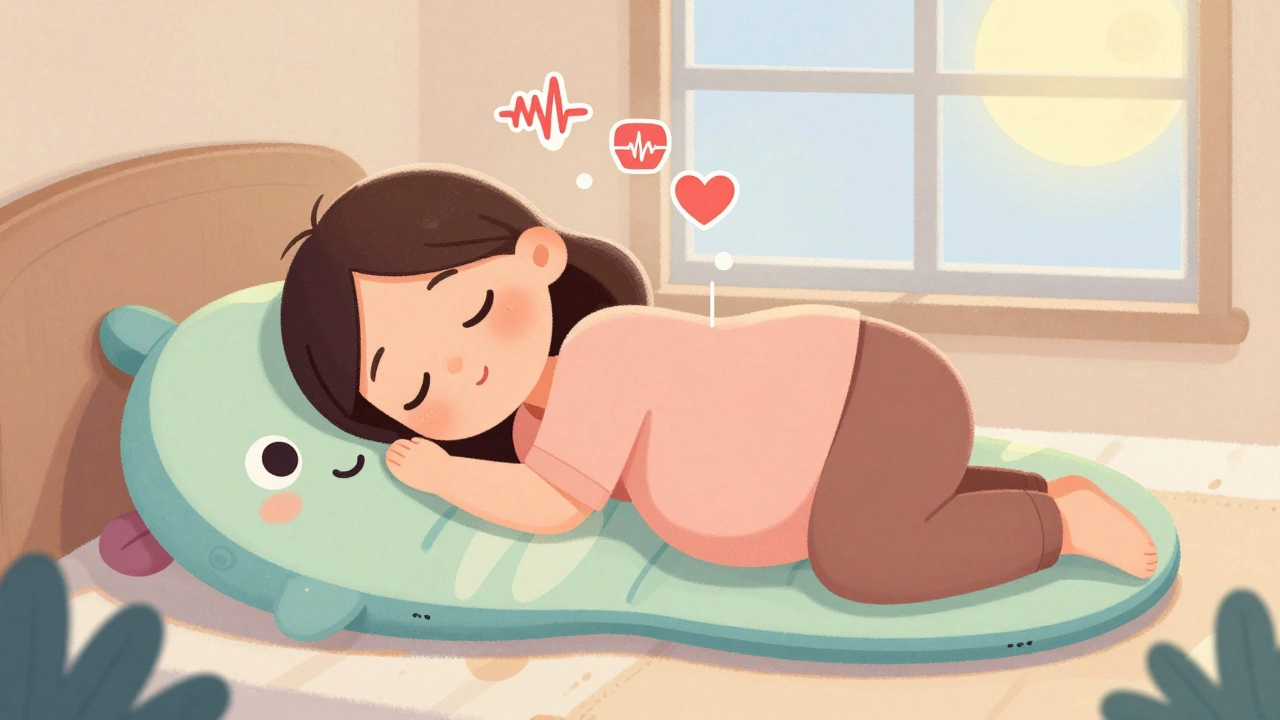
Why Sleep Gets So Hard During Pregnancy
By the third trimester, falling asleep shouldn’t feel like a battle. But for nearly 1 in 10 pregnant women, it is. Snoring that’s louder than ever, waking up gasping, heartburn that keeps you upright-all of it is connected to changes your body is going through. Hormones relax the muscles in your throat, your growing belly pushes up on your diaphragm, and fluid retention swells your nasal passages. These aren’t just inconveniences. They’re signs of sleep-disordered breathing, especially obstructive sleep apnea (OSA), which affects up to 27% of pregnant women with higher body weight.
Left untreated, this isn’t just about tiredness. OSA raises your risk of preeclampsia by more than double, increases your chance of gestational diabetes, and makes cesarean delivery more likely. The good news? You can fix this. And the earlier you act, the better the outcome-for you and your baby.
What Sleep Apnea Looks Like in Pregnancy
It’s not just snoring. If you’re waking up with a dry mouth, headaches in the morning, or feeling exhausted even after 8 hours in bed, you might have sleep apnea. During apnea episodes, your airway collapses briefly, cutting off oxygen. Your brain jolts you awake just enough to breathe-but you don’t remember it. That’s why many women don’t realize they have it until their partner notices the pauses in breathing.
Research shows that by 28 weeks, the risk spikes. Your neck gets thicker, your nasal passages swell, and your body holds onto more fluid. These changes make your airway narrower. Obese pregnant women (BMI over 30) face the highest risk-nearly 1 in 4 develop OSA. And here’s the kicker: if you had sleep apnea before pregnancy, it’s likely to get worse.
The American College of Obstetricians and Gynecologists now recommends screening all pregnant women using the STOP-Bang questionnaire at your 28-week checkup. It asks simple questions: Do you snore? Do you feel tired during the day? Has anyone noticed you stop breathing? If you answer yes to three or more, you need a sleep study.
CPAP Therapy: The Most Effective Treatment
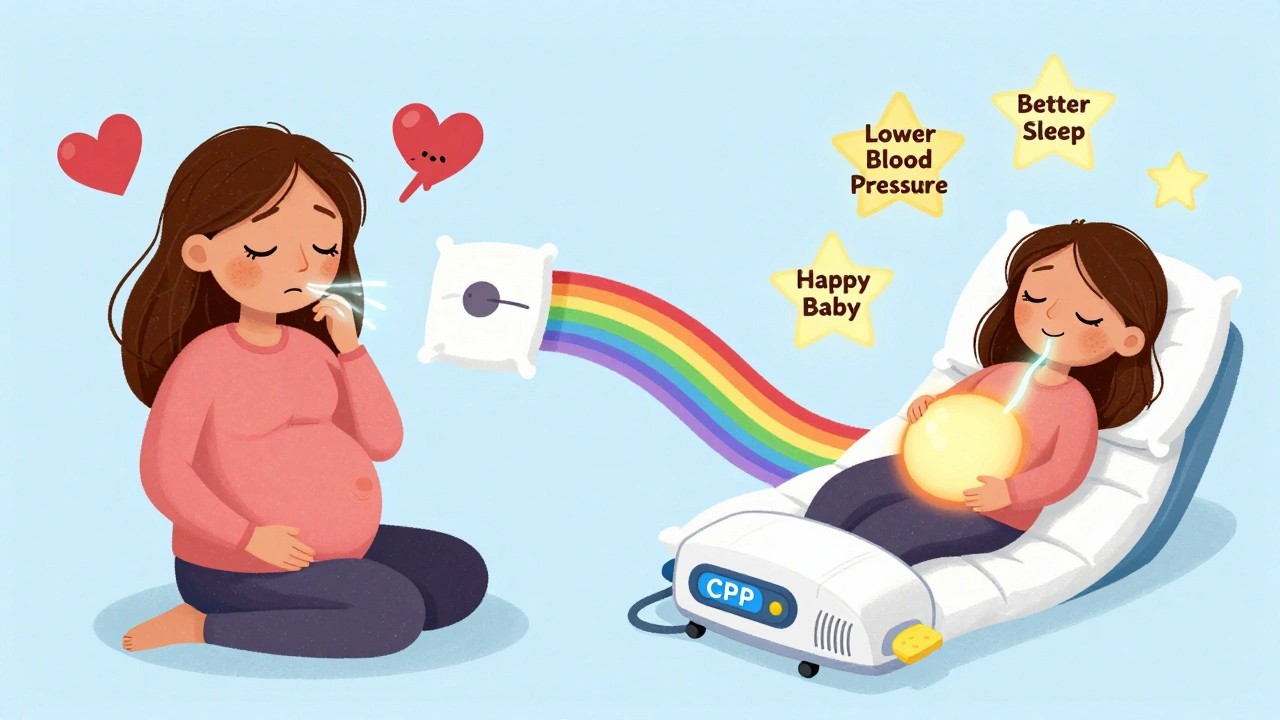
If you’re diagnosed with moderate to severe sleep apnea (AHI over 15), CPAP is the gold standard. It’s not optional-it’s preventive care. A CPAP machine delivers gentle air pressure through a mask, keeping your airway open all night. Studies show that starting CPAP between 24 and 28 weeks cuts your risk of preeclampsia by 30% and gestational hypertension by 35%.
But it’s not one-size-fits-all. Many women quit because the mask is uncomfortable. That’s why new models are designed specifically for pregnancy. The ResMed AirSense 11 Pregnancy Mode auto-adjusts pressure as your body changes. The AirTouch F20 Pregnancy Edition has a softer silicone cushion that doesn’t dig into swollen cheeks. Humidifiers set to 37°C help with nasal congestion-something that affects 80% of pregnant women.
Adherence is the biggest hurdle. Only 62% of women stick with it past four weeks. But when clinics offer personalized coaching-like fitting the mask while you’re pregnant, teaching you how to clean it, and adjusting pressure at each visit-adherence jumps to 82%. Don’t give up after a rough first week. Most women say it gets easier after 7-14 days.
Positioning: The Simple Fix That Works
If your apnea is mild (AHI under 15), changing how you sleep can make a big difference. Sleeping on your back is the worst position-it lets your tongue and soft tissues collapse into your airway. Sleeping on your left side is the best. It improves blood flow to your baby, reduces pressure on your liver, and opens up your airway.
A 2022 study from Brown Health found that left-side sleeping alone reduced the apnea-hypopnea index by nearly 23% in women with mild OSA. But staying on your side all night? That’s hard without help. That’s where pregnancy pillows come in. Full-body pillows like the Leachco Snoogle or the Boppy Noggin CPAP Pillow are designed to cradle your belly, support your back, and gently hold you on your side. One user reported her AHI dropped from 18 to 6 in two weeks after switching to the Boppy pillow.
Don’t just stack regular pillows under your belly. That can twist your spine. Use a wedge pillow under your upper body-7 to 8 inches high-to elevate your head without bending your neck. This helps with both apnea and reflux.
Taming Heartburn and Reflux at Night
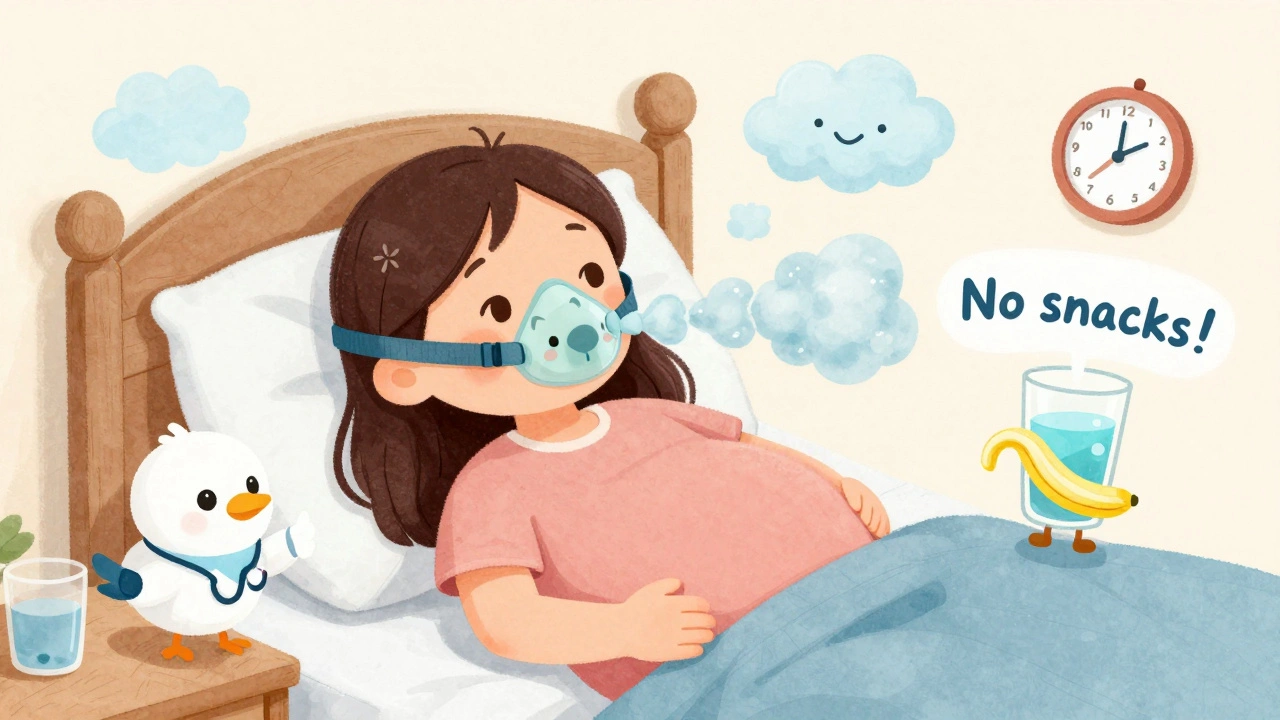
Heartburn during pregnancy isn’t just spicy food. It’s hormones relaxing the valve between your stomach and esophagus, plus your baby pressing up from below. Lying flat makes it worse. The solution isn’t just antacids-it’s positioning and timing.
First, elevate the head of your bed by 6 to 8 inches. Not just your head with pillows-your whole upper body. Pillows alone can bend your neck and make apnea worse. Use bed risers or a wedge under the mattress legs.
Second, stop eating at least three hours before bed. Even light snacks like crackers or yogurt can trigger reflux. Avoid citrus, chocolate, caffeine, and fried foods in the evening.
Third, use Gaviscon Advance. Unlike regular antacids, it forms a gel barrier on top of your stomach contents that stays put. It’s safe during pregnancy, doesn’t get absorbed into your bloodstream, and works for up to four hours. A 500ml bottle costs about $15 and lasts a month.
What Doesn’t Work (And Why)
Some solutions sound great but aren’t safe or proven for pregnancy. Mandibular advancement devices-mouthpieces that push your jaw forward-are common for non-pregnant adults. But pregnancy changes your jaw and TMJ. There’s no safety data. The Society of Anesthesia and Sleep Medicine advises against them.
Weight loss isn’t recommended during pregnancy. But staying within Institute of Medicine guidelines helps. If you’re normal weight, aim for 11.5-16 kg total gain. If you’re overweight, 7-11 kg is enough. Losing weight isn’t the goal-gaining the right amount is.
And don’t rely on apps or smartwatches alone. The Apple Watch Series 9 can detect sleep apnea with 89% accuracy, but it’s not a diagnostic tool. It’s a warning sign. If it flags you, get a formal sleep study.
When to Get Help-and What to Expect
If you’re snoring loudly, waking up choking, or exhausted all day, don’t wait. Talk to your OB-GYN. Ask for a referral to a sleep specialist. A home sleep test is often enough for pregnant women. It’s a small device you wear overnight that measures breathing, oxygen levels, and heart rate. No needles. No hospital stay.
Once diagnosed, your care team should help you choose the right CPAP mask, set up humidification, and schedule follow-ups. Some clinics offer free mask fittings and even loaner machines while you wait for insurance approval.
And yes, you can use CPAP during labor and delivery. Hospitals are starting to recognize this. Untreated sleep apnea increases anesthesia risks by over three times. If you’re planning a C-section or epidural, tell your anesthesiologist you use CPAP. They’ll need to know.
What Happens After Baby Arrives
Many women think their sleep apnea disappears after delivery. For some, it does. But not all. A 2023 study found that 58% of women who had pregnancy-related OSA developed chronic high blood pressure within 10 years-even if their apnea seemed to vanish.
That’s why the Brown Health clinic recommends a follow-up sleep study 12 weeks after birth. If your AHI is still high, you may need ongoing CPAP therapy. This isn’t just about sleep-it’s about your long-term heart health.
And if you’re breastfeeding? CPAP is safe. The machine doesn’t affect milk supply. In fact, better sleep helps with milk production and emotional resilience.
Real Stories, Real Results
"I thought I was just tired because I was pregnant," says Maria, 32, from Melbourne. "I was waking up 5-6 times a night, dizzy in the morning. My OB asked if I snored. I said yes-but I didn’t think it mattered. They sent me for a sleep test. My AHI was 22. I started CPAP at 26 weeks. Within two weeks, my blood pressure dropped. I slept through the night for the first time in months. I didn’t realize how much I’d been suffering." "I tried the pregnancy pillow first," says Lisa, 29, who had mild OSA. "It helped a little, but I still woke up gasping. I was scared of the mask. But after a 30-minute demo at the sleep clinic, I got used to it. Now I can’t sleep without it. My baby was born healthy, and I didn’t get preeclampsia." "I waited until 34 weeks," says one Reddit user. "By then, I was exhausted, my headaches were constant. My doctor said, 'You should’ve come sooner.' Don’t make my mistake."
What You Can Do Today
- If you snore loudly or wake up gasping, ask your OB-GYN for a sleep screening at your next visit.
- Start sleeping on your left side with a full-body pregnancy pillow.
- Elevate your head with a wedge under your mattress-not pillows on top.
- Avoid eating within 3 hours of bedtime.
- Keep a sleep diary: note snoring, fatigue, morning headaches.
- Don’t wait for symptoms to get worse. Early action protects your baby and your future health.
Is sleep apnea dangerous during pregnancy?
Yes. Untreated sleep apnea during pregnancy increases the risk of preeclampsia by more than double, raises the chance of gestational diabetes, and makes cesarean delivery more likely. It also reduces oxygen flow to your baby, which can affect growth. The good news? Treating it with CPAP or positional changes significantly lowers these risks.
Can I use a CPAP machine while pregnant?
Absolutely. CPAP is the first-line treatment for moderate to severe sleep apnea during pregnancy. Newer machines have pregnancy-specific settings that adjust pressure automatically as your body changes. Humidifiers help with nasal swelling, and masks designed for facial edema make it more comfortable. Many women report better sleep, lower blood pressure, and more energy within weeks.
What’s the best sleep position during pregnancy?
Left side sleeping is the most effective. It improves circulation to your baby, reduces pressure on your liver, and opens your airway to reduce apnea episodes. Use a full-body pregnancy pillow to help you stay in this position. Avoid sleeping on your back-it can compress major blood vessels and worsen both apnea and reflux.
Do pregnancy pillows really help with sleep apnea?
For mild sleep apnea (AHI under 15), yes. A 2022 study found that using a pregnancy pillow to maintain left-side positioning reduced apnea episodes by nearly 23%. But for moderate or severe cases, it’s not enough on its own. It works best as a first step or alongside CPAP. Look for pillows that cradle your belly and back-like the Boppy Noggin or Leachco Snoogle.
How do I know if I have sleep apnea or just normal pregnancy fatigue?
Normal pregnancy fatigue fades with rest. Sleep apnea doesn’t. If you wake up gasping, have morning headaches, feel exhausted despite sleeping 8 hours, or your partner says you stop breathing at night, you likely have sleep apnea. Snoring alone isn’t enough-combine it with daytime tiredness and other symptoms. Use the STOP-Bang questionnaire: if you answer yes to three or more questions, get tested.
Can reflux cause sleep apnea?
Not directly, but they often happen together. Reflux irritates your throat and airway, making it more likely to collapse during sleep. Lying flat makes both worse. Elevating your upper body helps both conditions. Use a wedge under your mattress-not pillows under your head. Avoid eating close to bedtime, and try Gaviscon Advance, which forms a protective barrier without being absorbed.
Will my sleep apnea go away after I have the baby?
It might-but not always. About half of women who develop sleep apnea during pregnancy still have it 12 weeks after delivery. Even if symptoms disappear, you’re at higher risk for chronic high blood pressure later in life. A follow-up sleep study at 12 weeks postpartum is recommended to check if you still need treatment.

Comments (15)
Ella van Rij
Oh wow. Another article that treats pregnancy like a medical emergency you didn’t sign up for. Next they’ll tell me to wear a CPAP while breastfeeding my baby in a left-side fetal position. At least I can still laugh while crying into my third cup of coffee. 🤡
Paul Keller
The clinical evidence presented here is both comprehensive and compelling. The correlation between untreated obstructive sleep apnea and adverse obstetric outcomes is well-documented in peer-reviewed literature, including meta-analyses published in the American Journal of Obstetrics & Gynecology. The implementation of CPAP therapy during the second trimester represents not merely a therapeutic intervention but a proactive measure in maternal-fetal risk mitigation. I commend the author for emphasizing adherence protocols and the importance of early screening via the STOP-Bang instrument. This is precisely the kind of evidence-based guidance that ought to be standard in prenatal care.
Shannara Jenkins
I was so tired during my third trimester I thought it was just 'pregnancy exhaustion'-turns out I was stopping breathing 20+ times an hour. Started CPAP at 27 weeks and honestly? My baby was born at 38 weeks, healthy, and I didn't get preeclampsia. The mask felt weird at first, but the clinic gave me a free fitting and a 14-day trial. Don't wait until you're crying from exhaustion-ask for the test. You're worth the effort. 💕
Elizabeth Grace
I tried the pregnancy pillow and it made my back hurt worse. Then I tried sleeping on my back because I was so tired I didn't care anymore. Woke up gasping like a fish. Now I'm on CPAP and my husband says I'm not snoring anymore. I still cry sometimes from stress but at least I'm not waking up with my mouth dry and my head pounding. This article didn't fix me but it made me feel less alone.
Steve Enck
The entire premise of this article is a neoliberal biopolitical apparatus designed to pathologize normal physiological adaptation. Pregnancy is not a pathology to be managed with medical devices. The rise in OSA diagnosis correlates directly with the commodification of maternal health and the expansion of the sleep medicine industrial complex. CPAP machines are not 'preventive care'-they are profit-driven interventions that displace holistic, embodied wisdom. Your body is not broken. You are not failing. The system is.
Jack Dao
LOL you people actually believe this? CPAP during pregnancy? Next they'll be hooking you up to oxygen tanks while you nap. You're not dying, you're pregnant. Sleep on your side, drink water, stop eating tacos at midnight. Stop spending $1000 on a machine that makes you look like a cyborg. 🤖
dave nevogt
There's something quietly profound about how pregnancy forces us to confront the fragility of our own bodies. We spend so much time trying to control every variable-the diet, the exercise, the sleep position-that we forget we're not machines. The fact that our airways collapse under the weight of change... it's not a failure. It's biology. And yet, we're told to fix it. I wonder if the real question isn't how to treat apnea, but how to create a world where women aren't expected to endure it alone.
Jay Everett
Guys. I used to think I was just a heavy sleeper. Then my husband recorded me snoring like a chainsaw in a tin can. 😱 I got the STOP-Bang done at 28 weeks-yes to 4 questions. Started CPAP at 30 weeks. First night? I cried because I actually slept. No more 3am panic gasps. My OB said my BP dropped 15 points. I didn't think I could feel this good while pregnant. Also, the Boppy Noggin pillow? Worth every penny. It's like a hug that holds you in place. 🤗
मनोज कुमार
OSA in pregnancy common. CPAP effective. Pillow helps mild cases. Stop eating late. Gaviscon good. Screening needed. Done.
Joel Deang
I’m from India and my mom said ‘sleep on your side, eat light, don’t stress’ and that’s it. No machines. No tests. Just chai and a pillow. But now I see the article and I’m like… maybe she was right but also… maybe not? I used a pillow and it helped a bit. But I still wake up choking. Maybe I need the machine. 🤔
Roger Leiton
I didn't even know sleep apnea could happen during pregnancy until I read this. My partner snores like a foghorn and I assumed it was just 'normal'. But the part about morning headaches and waking up with a dry mouth? That's me. I'm going to ask my OB about the STOP-Bang test tomorrow. Thank you for writing this. I feel less dumb for not knowing. 🙏
Laura Baur
I find it deeply concerning that this article normalizes the medicalization of pregnancy without addressing systemic failures. Why are women expected to self-manage life-threatening conditions with $1500 devices while underinsured? Why is the burden placed on the pregnant person to 'fix' their body rather than on healthcare systems to provide accessible, non-stigmatizing care? This is not empowerment-it's victim-blaming dressed in clinical language. You are not broken. The system is.
Arun kumar
i was sleeping on my back and i didnt even know i was snoring. my wife told me i stop breathing. i thought she was exaggerating. then i read this and i got tested. ahi was 19. started cpap. now i sleep like a baby. my wife says i dont snore anymore. i feel like a new person. thanks for the info
Zed theMartian
So let me get this straight. We're supposed to strap a mask to our face, sleep on one side like a pretzel, avoid all joy foods, and pay $2000 for a machine that sounds like a jet engine-just to avoid the *possibility* of preeclampsia? Meanwhile, the real problem is that we're expected to carry a human being while being treated like a defective appliance. I’ll take my 8 hours of restless sleep over your corporate-approved sleep protocol any day.
ATUL BHARDWAJ
Sleep apnea real. CPAP works. Left side good. No need overthink. Just do it.