

When you live with an autoimmune disease like lupus, rheumatoid arthritis, or Sjögren’s syndrome, the pain and fatigue aren’t just physical-they chip away at your ability to do the things you need or want to do. Buttoning a shirt. Carrying groceries. Getting out of bed without help. These aren’t minor inconveniences. They’re daily battles. And the truth is, most people with autoimmune conditions don’t get the right kind of support early enough. That’s where rehabilitation and occupational therapy come in-not as afterthoughts, but as essential tools to keep you living your life.
Why Functional Impairment Happens in Autoimmune Diseases
Autoimmune diseases don’t just attack joints or skin. They disrupt your whole body’s balance. Inflammation doesn’t stop at the site of damage. It spreads, triggering fatigue, muscle weakness, and brain fog. Medications help, but they often come with side effects: weight gain, bone loss, or nerve damage. Over time, if you stop moving because it hurts, your muscles weaken, your joints stiffen, and your stamina drops. This isn’t laziness. It’s deconditioning-a downward spiral that’s easy to fall into and hard to climb out of.Studies show that 5-8% of people worldwide have some form of autoimmune condition, and three times as many are women. For many, functional decline starts within months of diagnosis. Without intervention, the Health Assessment Questionnaire Disability Index (HAQ-DI)-a standard tool used to measure daily function-can climb from 0.5 (mild difficulty) to over 2.0 (severe limitations). That’s the difference between managing your own hygiene and needing help to dress.
How Physical Therapy Helps: Movement as Medicine
Physical therapy isn’t about pushing through pain. It’s about moving smart. During a flare, when joints are swollen and feverish, the goal isn’t to get stronger-it’s to keep circulation going without making things worse. That’s why therapists start with isometric exercises: muscle contractions without joint movement. Think of squeezing a ball or tightening your thigh muscle while lying down. These keep muscle tone alive without stressing inflamed tissues.As symptoms settle, the focus shifts. Aerobic training at 40-60% of your heart rate reserve becomes key. That might mean 20 minutes on a stationary bike at a pace where you can still talk but not sing. Research from the Journal of Autoimmunity (2022) found that people who stuck with this approach improved their functional capacity by 35-42% over six months. That’s not just a number-it’s being able to walk to the mailbox, stand while cooking, or play with your grandkids without needing two days to recover.
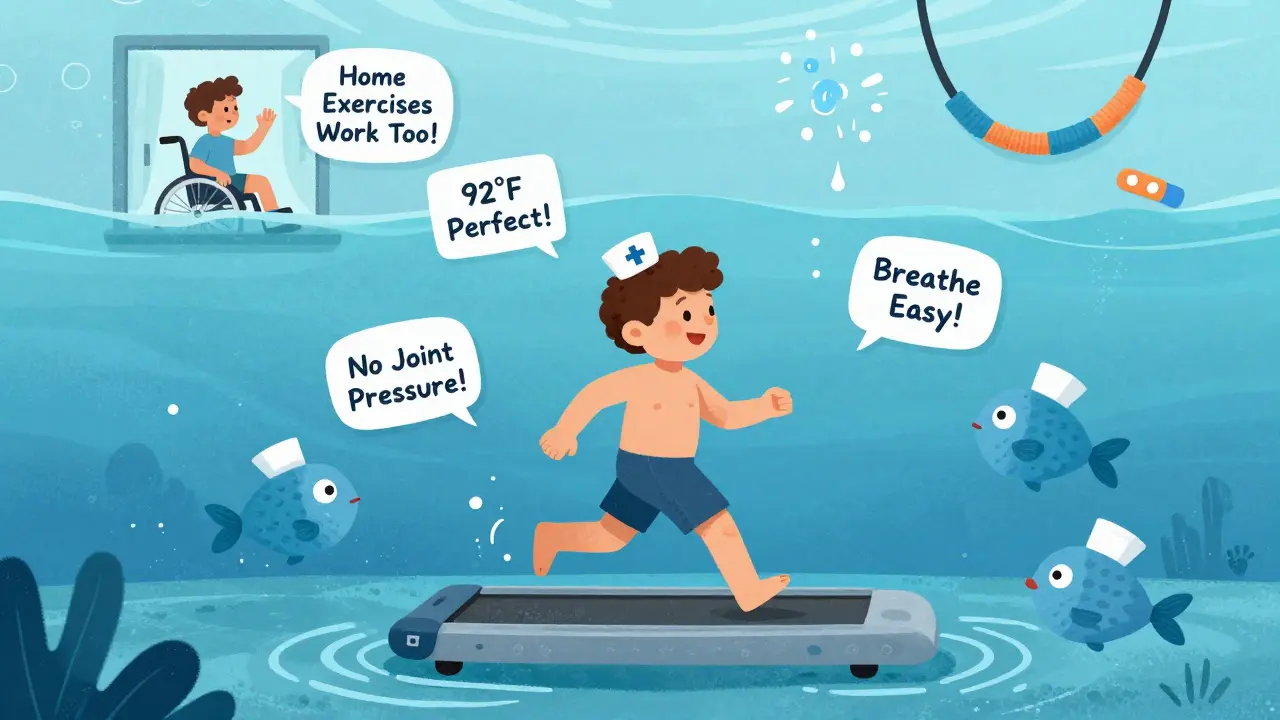
Hydrotherapy is one of the most effective tools. Water at 92-96°F reduces joint pressure, eases stiffness, and lowers pain scores by 22% compared to land-based exercise. But here’s the catch: 68% of rural clinics don’t have underwater treadmills or heated pools. That’s why home-based programs using resistance bands, bodyweight moves, and guided video sessions have become vital alternatives.
How Occupational Therapy Helps: Reclaiming Daily Life
If physical therapy gets you moving, occupational therapy gets you doing. It’s about adapting your environment and your habits so you don’t have to give up the things that matter.Therapists teach the 4 Ps: Prioritize, Plan, Pace, Position. That means:
- Prioritize: Do the most important tasks when you have the most energy-usually morning.
- Plan: Break big tasks into smaller steps. Laundry? Don’t do it all at once. Fold one load, rest 15 minutes, then do the next.
- Pace: Never work longer than 15-20 minutes without a 5-10 minute break. Even if you feel fine. That’s the rule.
- Position: Use tools like reachers, long-handled sponges, or ergonomic kitchen tools to reduce strain on hands and wrists.
One patient, a 52-year-old teacher with rheumatoid arthritis, couldn’t hold a pen for more than 10 minutes. Her OT fitted her with a weighted pen grip, taught her to dictate notes using voice-to-text software, and redesigned her classroom desk for seated use. Within three months, she returned to teaching two days a week. That’s the power of occupational therapy.
Adaptive tech also makes a huge difference. Voice-activated smart home systems-like controlling lights, thermostats, or door locks with your voice-boost independence by 31% in people with hand impairments. Simple changes, like switching from a traditional doorknob to a lever handle, can cut wrist strain in half.

PT vs OT: What Each One Does Best
People often think physical therapy and occupational therapy are the same. They’re not. Here’s how they differ:| Focus Area | Physical Therapy (PT) | Occupational Therapy (OT) |
|---|---|---|
| Primary Goal | Improve strength, endurance, and joint mobility | Improve ability to perform daily tasks |
| Best For | Walking, climbing stairs, balance | Dressing, cooking, writing, using a computer |
| Key Tool | Timed Up and Go test | Arthritis Hand Function Test |
| Efficacy Advantage | 28% better for lower body function | 33% better for upper body and ADLs |
| Common Equipment | Resistance bands, goniometers, treadmills | Adaptive utensils, reachers, voice assistants |
PT helps you get from the bed to the door. OT helps you open the door, turn on the light, and make coffee. Both are needed-and they work best together.
When Therapy Works Best (and When It Doesn’t)
Rehabilitation isn’t magic. It has limits. It thrives in stable phases. When your Disease Activity Score (DAS28) is above 5.1-meaning severe, active inflammation-exercise can do more harm than good. That’s when rest is the treatment.Therapy shines when started early. Studies show the biggest gains happen within the first 12 months after symptoms begin. Delaying rehab by even six months cuts effectiveness in half. That’s why doctors need to refer patients sooner, not later.
But here’s the problem: 41% of patients stop therapy during flares because their therapists don’t adjust the plan. Pushing through pain leads to crashes. One Reddit user wrote: "My therapist said, ‘Just push through.’ I ended up in bed for three weeks." That’s not motivation-that’s harm.
Experts now say: Exercise must be dosed like medication. That means:
- Frequency: 2-3 times a week during flares, then 1-2 times for maintenance
- Intensity: Never exceed 70% of your perceived effort
- Time: Sessions capped at 30-45 minutes
- Type: Low-impact, non-jarring movements only
And it’s not just about movement. Central fatigue-fatigue that comes from the brain and nervous system, not muscles-is real. It’s common in lupus and MS. If your therapist ignores it, you’ll burn out. Heart rate variability monitoring is now being used to detect this. If your heart doesn’t recover quickly after light activity, it’s a sign to rest, not push.
Barriers to Getting Help
You might be ready for rehab. But can you get it?Insurance is a huge hurdle. Most plans cover only 12-15 sessions a year. But experts recommend 24-30 to see real change. That leaves many patients paying out of pocket-$80-$120 per session. In rural areas, there’s often no specialist nearby. And even when there is, not all therapists are trained in autoimmune care.
Specialized certification exists. The Academy of Pelvic Health Physical Therapy offers a 120-hour autoimmune certification program. But only 1 in 5 therapists has it. That’s why you need to ask: "Have you worked with people with my condition before?" If the answer is vague, keep looking.
Telehealth has helped. Since 2020, 68% of patients now use virtual sessions. You can get guided exercises, energy pacing coaching, and adaptive equipment recommendations without leaving home. It’s not perfect-but it’s better than nothing.
What Success Looks Like
Real improvement isn’t about running a marathon. It’s about small wins:- Getting dressed without help
- Standing at the sink to brush your teeth
- Carrying your own purse
- Working part-time again
- Playing with your dog without needing a nap afterward
One woman with lupus started with a HAQ-DI score of 2.1. After six months of graded exercise and energy pacing, she dropped to 0.8. She returned to part-time work. She didn’t cure her disease. But she got her life back.
That’s the goal. Not perfection. Not cure. Just control. And that’s what rehab and occupational therapy deliver: the tools to live well, even when your body is fighting itself.
What to Ask Your Therapist
Don’t just accept any therapist. Ask these questions:- Have you been trained specifically in autoimmune conditions?
- Do you use the Canadian Occupational Performance Measure (COPM) to track progress?
- How do you adjust sessions during flares?
- Do you teach the 70% effort rule and the 4 Ps of energy conservation?
- Can you coordinate with my rheumatologist to align therapy with my disease activity?
If they can’t answer these, find someone who can.
Can occupational therapy help with fatigue in autoimmune diseases?
Yes. Occupational therapy doesn’t just focus on movement-it teaches energy conservation. Techniques like the 4 Ps (Prioritize, Plan, Pace, Position) help you stretch your energy across the day. Therapists also recommend activity diaries and heart rate monitors to identify your personal fatigue triggers. Studies show patients who use these tools reduce post-activity crashes by up to 40%.
Is hydrotherapy better than land-based exercise for autoimmune patients?
During active flares, yes. Hydrotherapy reduces joint pressure and pain by 22% compared to land-based exercise. The warm water (92-96°F) relaxes muscles and improves circulation without strain. But if you don’t have access to a pool, home-based programs with resistance bands and seated exercises can be just as effective-especially when guided by a therapist trained in autoimmune care.
How often should I attend rehab sessions?
It depends on your disease activity. During a flare, 1-2 sessions per week are enough to maintain mobility without overexertion. In remission, 2-3 sessions per week for 4-6 weeks help build strength, then you switch to biweekly maintenance sessions for 6 months. Most patients need 24-30 sessions total to see lasting improvement, but insurance often covers only 12-15.
Can I do rehab at home?
Absolutely. Many effective programs are now delivered via telehealth. You’ll get personalized exercise videos, adaptive equipment recommendations, and coaching on pacing. Home-based rehab works best when combined with regular check-ins with a certified therapist. The key is consistency-not location.
What if my therapist pushes me too hard?
Stop. Pushing through pain in autoimmune conditions often leads to crashes that last days or weeks. A good therapist uses the 70% effort rule: never exceed 70% of your perceived maximum capacity. If they ignore your fatigue, don’t tolerate it. Find a therapist trained in autoimmune care. Your body isn’t broken-you just need the right approach.
Next Steps
If you’re living with an autoimmune disease and struggling with daily tasks:- Ask your rheumatologist for a referral to a therapist with autoimmune specialization.
- Look for clinics that use the Canadian Occupational Performance Measure (COPM) or HAQ-DI to track progress.
- Start with energy pacing-use the 4 Ps even before formal therapy begins.
- Consider telehealth if in-person sessions aren’t accessible.
- Track your symptoms and energy levels in a journal. This helps your therapist tailor your plan.
You don’t need to wait until you’re crippled to seek help. Start now. Small steps, taken consistently, can change everything.
Comments (11)
Full Scale Webmaster
Okay so let me get this straight-5-8% of the global population has an autoimmune disease and we’re talking about rehab like it’s some kind of miracle cure? Bro. It’s 2024. The healthcare system is a dumpster fire. Insurance won’t cover more than 12 sessions? You’re telling me a woman with lupus who can’t button her shirt is supposed to magically ‘get her life back’ after three months of PT when she’s got three kids, a part-time job, and no car? This whole post reads like a pharmaceutical ad disguised as advocacy. Real talk: if you’re not rich or have a trust fund, you’re screwed. And don’t even get me started on telehealth. Try doing a guided resistance band workout while your kid screams because the AC broke and you’re too fatigued to move. This isn’t empowerment. It’s capitalism with a smiley face.
Ajay Krishna
Hey, I really appreciate you breaking this down. As someone from India who’s seen family members struggle with RA, I can say that even basic access to therapists is a luxury. But I’ve also seen how simple things-like using a wooden spoon instead of a metal one for cooking, or sitting on a stool while washing dishes-make a huge difference. You don’t need fancy equipment. Just someone who listens. I’m glad you mentioned the 4 Ps. That’s the kind of practical wisdom that actually helps. Keep sharing these insights-they matter.
Charity Hanson
Yessss! I’ve been living with Sjögren’s for 7 years and this is the first time I’ve read something that actually gets it. The fatigue isn’t ‘just tired’-it’s like your soul got drained and your body forgot how to reboot. I started using voice-to-text for emails and it changed my life. Also, the 70% rule? GAME CHANGER. I used to push until I crashed. Now I stop at 70. And guess what? I’ve been able to walk my dog every day for 3 months straight. Small wins, y’all. Keep showing up.
Noah Cline
Let’s be real: this entire framework is built on the assumption that patients have agency, access, and cognitive capacity to self-manage. But autoimmune diseases often impair executive function. Brain fog isn’t a buzzword-it’s neuroinflammation. You can’t ‘pace’ if you can’t remember what ‘pace’ means. And hydrotherapy? Sure, great if you live in a metro area with a medical spa. In rural Ohio? Not happening. This reads like a white, middle-class fantasy. Real-world patients need systemic change, not motivational bullet points.
Justin Ransburg
This is one of the most thoughtful and clinically grounded pieces I’ve read on autoimmune care in years. The distinction between PT and OT is critical-and too often blurred. The emphasis on early intervention is spot on. I’ve seen too many patients wait until they’re wheelchair-bound before seeking help. The data you cited-35-42% functional improvement with aerobic training-is compelling. Also, the 70% effort rule is gold. We need more therapists trained in this model. Thank you for highlighting the importance of coordination with rheumatologists. That’s the missing link.
Brandon Vasquez
I’ve been doing this for 12 years. I’ve had lupus since I was 19. I’ve had PT. I’ve had OT. I’ve done the bands. I’ve done the pools. I’ve done the voice assistants. What helped most wasn’t the equipment or the exercises. It was having someone who didn’t tell me to ‘push through’ and didn’t treat me like a project. Just someone who said, ‘Let’s try this tomorrow.’ Consistency over intensity. That’s the secret.
Miranda Anderson
It’s wild how much of this is about perception. People think if you’re not in a wheelchair, you’re fine. But the invisible stuff-the brain fog that makes you forget your kid’s name for 30 seconds, the joint pain that makes you cry when you open a jar-that’s the real war. I love that you included the HAQ-DI score drop from 2.1 to 0.8. That’s not just data. That’s a woman who can hug her grandson without crying. That’s the win. We need more stories like that. Not ‘you can cure yourself’ nonsense. Just… real, quiet, daily victories.
Gigi Valdez
The paragraph about central fatigue and heart rate variability monitoring was the most valuable part of this entire post. Most therapists still treat fatigue as laziness. The fact that we now have objective biomarkers to validate it is revolutionary. I wish every rheumatology clinic had access to HRV trackers. It’s not about motivation-it’s about physiology. If your heart doesn’t recover after light activity, your nervous system is in distress. That’s not ‘being weak.’ That’s your body screaming. This needs to be standard protocol.
Brandie Bradshaw
Let’s not pretend this is about healthcare. This is about capitalism’s war on disabled bodies. The fact that insurance caps therapy at 12 sessions while charging $120/hour is not an oversight-it’s intentional. The pharmaceutical industry profits from chronic illness. Rehab is a threat to that model. Why? Because if you can manage your condition without drugs, you stop being a customer. And the system hates that. The 4 Ps? The 70% rule? These are tools of resistance. They’re not ‘therapy’-they’re survival tactics in a system designed to make you dependent. Don’t be fooled. This isn’t help. It’s rebellion.
Angel Wolfe
Who funded this? Big Pharma? WHO? The WHO says 5-8% have autoimmune disease but they also said masks worked. I’ve seen my cousin go to ‘rehab’ and come back worse. They made her do squats with swollen knees. She ended up in the ER. This whole thing is a scam. Rehab is just another way to drain your bank account while the government laughs. And don’t get me started on ‘telehealth’-they’re using AI bots to replace real therapists. You’re not getting care. You’re getting a script. Wake up.
Sophia Rafiq
Hydrotherapy’s 22% pain reduction? Yes. But I’ve also seen people waste months on heated pools they can’t afford. The real game-changer? Resistance bands + YouTube tutorials + a supportive FB group. I did 10 minutes a day, seated, no equipment, no therapist. No crashes. No pressure. Just consistency. You don’t need a certified specialist. You need a routine. And a friend who texts you: ‘Did you do your bands today?’ That’s the therapy I needed.