
Most people don’t realize they have COPD until it’s already advanced. By then, simple tasks like walking to the mailbox or getting dressed leave them breathless. But COPD doesn’t suddenly appear out of nowhere. It creeps in slowly-stage by stage-and if you catch it early, you can change the course of the disease. The key is understanding what each stage means, how it affects your body, and what you can actually do about it.
What COPD Stages Really Are
COPD isn’t just one condition. It’s a group of lung diseases-mostly emphysema and chronic bronchitis-that make it harder to breathe over time. The GOLD staging system, used by doctors worldwide, breaks COPD into four stages based on a simple breathing test called spirometry. This test measures how much air you can force out of your lungs in one second (FEV1). That number, compared to what’s normal for someone your age, height, and sex, tells your doctor how far the disease has progressed.
It’s not just about numbers, though. Two people with the same FEV1 can feel completely different. One might still walk two miles a day. The other might struggle to tie their shoes. That’s why the GOLD system now also looks at symptoms and how often you get sick with lung infections. This gives a fuller picture than FEV1 alone.
Stage 1: Mild COPD - You Might Not Even Notice
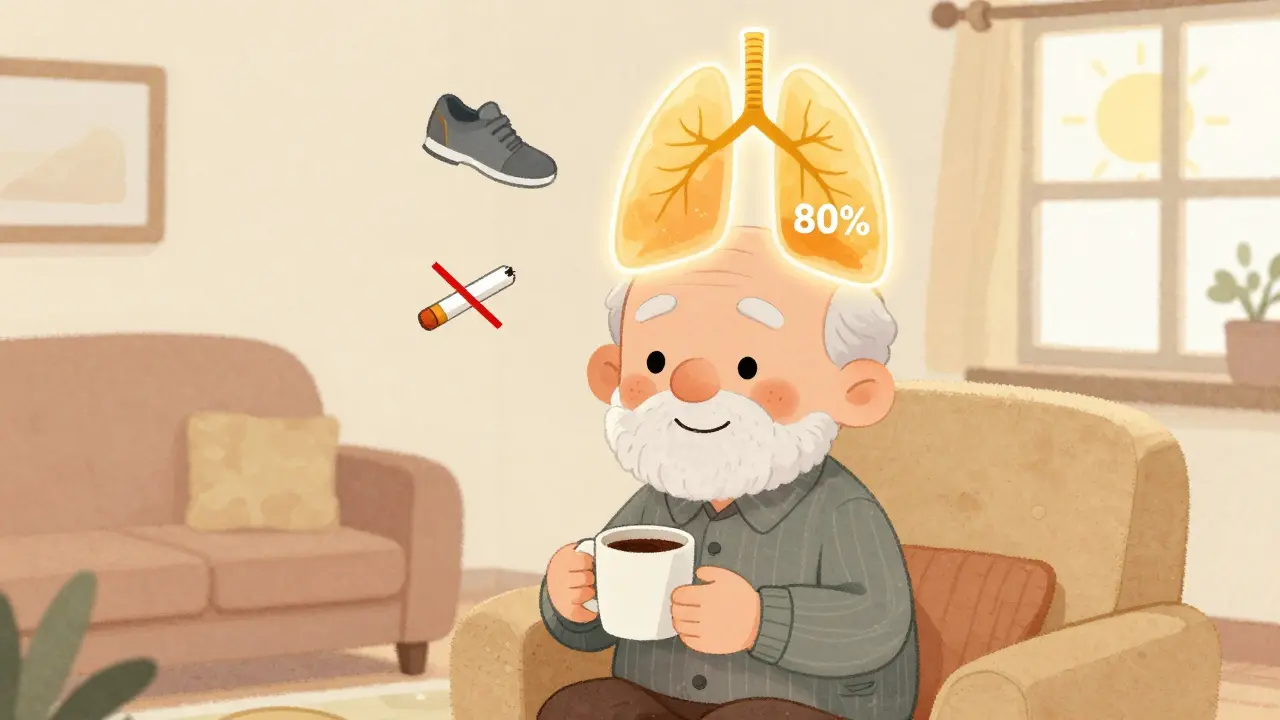
If your FEV1 is 80% or higher of what’s normal, you’re in Stage 1. Sounds harmless, right? But here’s the catch: most people in this stage don’t know they have COPD. They think they’re just out of shape. Or they blame it on getting older. A 2021 study found that 65% of people with Stage 1 COPD only feel short of breath when walking fast or climbing hills. That’s easy to ignore.
But there are signs if you pay attention. A persistent morning cough with phlegm? That’s not just a "smoker’s cough." It’s your lungs trying to clear out damage. About 42% of Stage 1 patients report this. And here’s the thing-this stage is the best time to act. Quitting smoking now can cut the rate of lung decline in half. In the Lung Health Study, people who quit saw their FEV1 drop from 60 mL per year to just 30 mL. That’s not just slowing it down-it’s almost stopping it.
Doctors don’t usually prescribe meds at this stage unless you’re having trouble. But if you do need relief, a quick-relief inhaler like albuterol can help when you’re exerting yourself. The real treatment? Stop smoking. Get moving. Start pulmonary rehab if you can. This isn’t about fixing your lungs. It’s about protecting what’s left.
Stage 2: Moderate COPD - The Point of No Return
Now your FEV1 drops to between 50% and 79%. This is where things start to feel real. You’re not just out of breath during intense activity anymore. You’re stopping every few minutes on a flat walk. Eighty-three percent of Stage 2 patients say they have to pause just to catch their breath. Mucus builds up more. You’re coughing more. You might start avoiding stairs or skipping outings because you know you’ll pay for it later.
This is the stage most people finally get diagnosed-usually after years of ignoring symptoms. The average delay? Over five years. That’s because many doctors don’t order spirometry unless you’re clearly sick. But here’s the problem: by the time you’re diagnosed, you’ve already lost a lot of lung function.
Treatment changes here. You’ll likely be on a long-acting inhaler-either LABA or LAMA. These keep your airways open for 12 to 24 hours. The UPLIFT trial showed they can improve FEV1 by 100-150 mL on average. That might not sound like much, but it means you can walk farther, climb stairs without stopping, and sleep better.
Pulmonary rehab is a game-changer. It’s not just exercise. It’s breathing techniques, nutrition advice, and emotional support. People who do it can walk 45-75 meters farther in six minutes. That’s the difference between staying home and going to your grandchild’s soccer game. And don’t skip the flu shot. It cuts your risk of a bad flare-up by 32%.
Stage 3: Severe COPD - Life Changes Forever
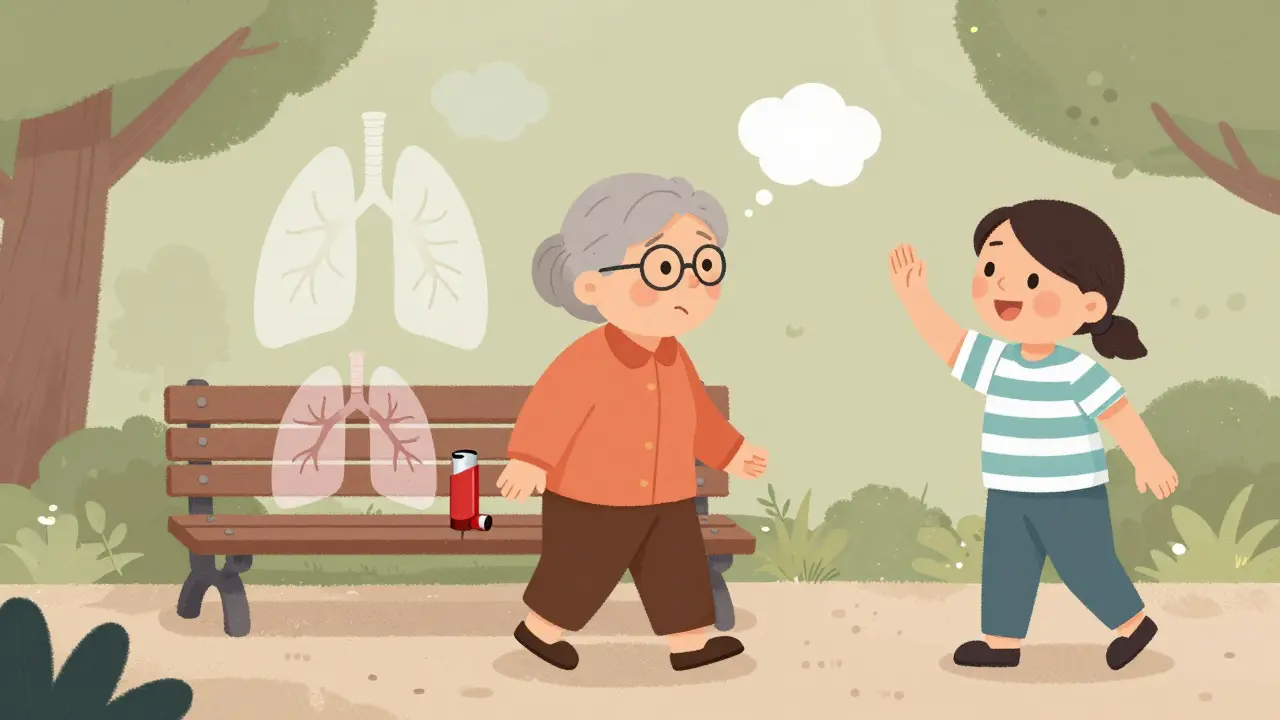
FEV1 between 30% and 49%? You’re in Stage 3. This is where breathing becomes a constant battle. Ninety-two percent of people here get out of breath just doing basic things-putting on clothes, washing their face, making a cup of tea. Oxygen levels drop during daily tasks. Some people need oxygen on the go.
Medications get stronger. You’ll probably be on a combo inhaler-LAMA + LABA. Studies show this reduces flare-ups by 14% compared to using just one. If you have high eosinophils (a type of white blood cell), your doctor might add an inhaled steroid. The WISDOM trial showed this cuts exacerbations by 25% in the right patients.
But meds alone aren’t enough. You’ll need regular check-ups, maybe a 6-minute walk test every year to track how well you’re doing. And you’ll start thinking about oxygen therapy. If your blood oxygen falls below 88% during activity, your doctor may recommend it-even if you’re not on it full-time yet.
Here’s what patients say: "I used to love gardening. Now I can’t even stand for five minutes." One Reddit user wrote, "I can’t walk to my mailbox without stopping. My doctor says I’m only Stage 3, so I must be exaggerating." That’s the cruel part. The numbers don’t always match how you feel. And when your body betrays you like that, isolation follows.
Stage 4: Very Severe COPD - The Fight for Every Breath
FEV1 under 30%. This is the most advanced stage. Breathing isn’t just hard-it’s exhausting. Eighty-nine percent of patients need oxygen for at least 15 hours a day. Some use it all the time. Even sitting still can leave them breathless. Hospitalizations for flare-ups are common. And each one carries a 22% risk of dying within the year.
Long-term oxygen therapy isn’t optional here-it’s life-saving. The NOTT trial showed that using oxygen 15+ hours a day boosts one-year survival from 73% to 90%. Non-invasive ventilation (like a CPAP machine) can help too, cutting hospital readmissions by 28%.
But the real burden isn’t just medical. Forty-four percent of Stage 4 patients say social isolation is their worst symptom. They can’t visit friends. They can’t go to family dinners. Oxygen tanks are bulky. Masks are uncomfortable. And the cost? Even with Medicare, many pay $287 a month out of pocket for equipment and supplies. That’s not a luxury. It’s survival.
There’s hope, though. Some patients stabilize for years with the right plan. It’s not about curing COPD. It’s about living as fully as possible within its limits.
Why the Numbers Don’t Tell the Whole Story
Here’s something most people don’t know: your FEV1 doesn’t always match how you feel. A 2020 study found that 38% of people classified as "high risk" (GOLD Group D) actually have Stage 2 COPD based on their lung test. They’re just more sensitive to breathlessness. Their symptoms are worse than the numbers suggest.
And here’s another blind spot: your heart. Dr. Don Sin’s 2023 study found that 65% of Stage 2 COPD patients already have heart problems-high blood pressure, irregular heartbeat, even heart failure. These aren’t side effects. They’re part of the disease. COPD doesn’t just damage your lungs. It strains your whole body.
That’s why some experts are pushing for a new kind of staging-one that includes heart health, muscle strength, and even mental health. Because if you’re exhausted, anxious, and can’t walk to the bathroom without stopping, it doesn’t matter if your FEV1 is 55%. You’re still severely affected.
What You Can Do Right Now
Whether you’re in Stage 1 or Stage 4, there are things you can control:
- Stop smoking. No matter how far you’ve come, quitting still helps. It’s the single most effective thing you can do.
- Get tested. If you’re over 40, have smoked, and feel short of breath-ask for spirometry. Most doctors won’t offer it unless you ask.
- Do pulmonary rehab. Even if you think you’re too weak, it works. It’s not about strength. It’s about learning to breathe smarter.
- Get vaccinated. Flu, pneumonia, and COVID-19 shots are non-negotiable. They keep you out of the hospital.
- Track your symptoms. Keep a journal. Note when you feel worse, what triggers it, and how long it lasts. That helps your doctor adjust your plan.
And if you’re caring for someone with COPD? Don’t wait for them to say they’re struggling. Watch for signs: skipping meals because breathing is too hard, avoiding social events, or giving up hobbies they used to love. Those are red flags.
What’s Next for COPD?
Science is moving fast. Researchers are testing blood tests that can predict how fast COPD will worsen. One marker, fibrinogen, shows that levels above 3.5 g/L mean your lungs are declining 2.3 times faster. That could mean earlier, more targeted treatment.
Artificial intelligence is helping too. At Massachusetts General Hospital, AI tools now analyze spirometry results and catch misdiagnoses 35% better than human doctors alone. That’s huge-because right now, 42% of primary care providers misread the test.
But the biggest challenge isn’t technology. It’s access. In low-income countries, 80% of COPD deaths happen because people never get tested. Even in wealthy places like Australia or the U.S., only 12% of at-risk people ever get a spirometry test. That’s a failure of the system-not the patient.
Early detection saves lives. Stage 1 COPD doesn’t have to become Stage 4. But you have to know what to look for-and act before it’s too late.
Can COPD be reversed?
No, COPD cannot be reversed. The lung damage is permanent. But progression can be slowed-sometimes dramatically-by quitting smoking, taking prescribed medications, doing pulmonary rehab, and avoiding triggers like pollution and infections. In Stage 1, some people stabilize their lung function for years after quitting smoking.
What’s the difference between mild and moderate COPD?
Mild COPD (Stage 1) means your FEV1 is 80% or higher of normal. You may only feel short of breath during intense activity. Moderate COPD (Stage 2) means your FEV1 is between 50-79%. You’ll likely need to stop walking every few minutes to catch your breath. Symptoms are more constant, and treatment usually includes long-acting inhalers and pulmonary rehab.
Do I need oxygen if I have severe COPD?
Not always-but if your blood oxygen drops below 88% during activity or sleep, your doctor will likely recommend it. Oxygen therapy isn’t just for end-stage COPD. Many Stage 3 patients use it during exercise or at night. For Stage 4, 15+ hours daily is often necessary to survive. Studies show it improves life expectancy by up to 20%.
Why do I feel fine even though my FEV1 is low?
COPD affects people differently. Some with low FEV1 adapt by moving slower, resting more, or using breathing techniques. Others develop muscle weakness or heart problems that mask the lung symptoms. Your body may be compensating-but that doesn’t mean the disease isn’t progressing. Regular testing and symptom tracking are essential.
Is COPD the same as asthma?
No. Asthma is usually reversible with medication and often starts in childhood. COPD is progressive, caused mostly by smoking or long-term exposure to irritants, and typically appears after age 40. While both cause wheezing and shortness of breath, COPD doesn’t respond as well to asthma inhalers. Spirometry is the only way to tell them apart.
How often should I get tested for COPD progression?
If you’re diagnosed, get spirometry at least once a year. If you’re in Stage 3 or 4, your doctor may want to check every 6 months. Also, do a 6-minute walk test annually to track your functional ability. Symptoms can change faster than lung numbers, so keep a log of your daily breathing and activity levels.
Comments (15)
Harriet Hollingsworth
Stop smoking. That’s it. That’s the whole article. No magic pills, no miracle cures-just quit. If you can’t do that, don’t waste anyone’s time.
linda permata sari
OMG I JUST REALIZED MY MOM HAS STAGE 2 AND SHE’S BEEN LYING TO US FOR YEARS 😭 She says she’s ‘just getting old’ but she’s been coughing up a lung since 2018 and won’t go to the doctor. I’m taking her this week. No more excuses.
Brandon Boyd
Listen up. If you’re reading this and you smoke-stop. Right now. Not tomorrow. Not next week. TODAY. I’ve seen guys in their 60s turn their lives around after quitting. Pulmonary rehab saved my dad’s life. He went from barely walking to the porch to hiking with his grandkids. It’s not easy-but it’s possible. You got this.
John Chapman
YESSSSSS 🙌🙌🙌 This is the most real thing I’ve read all year. I’m Stage 3 and I’ve been using oxygen for 6 months now. People think it’s the end-but it’s not. It’s a new normal. I still cook, I still laugh, I still dance with my wife in the kitchen. Life doesn’t end. It just changes. And guess what? It’s still beautiful. 💪❤️
Urvi Patel
Why do Americans always think quitting smoking is enough. In India we have 40% of COPD cases from biomass smoke. No one talks about that. You people are so self centered. Also FEV1 is useless without context. Basic science literacy needed here.
Joy Nickles
Okay so I just read this whole thing and like… I think I might have COPD? I’m 47, smoked for 15 years, and I get winded walking up my driveway… but I’ve been telling myself it’s just ‘bad lungs from the city’… wait… is that… is that what this is? I’m gonna cry. And also I think my doctor is a liar because she never mentioned spirometry. Like… why not? Why not just test me? I’m so mad right now.
Emma Hooper
Let me tell you something, honey. COPD ain’t a death sentence-it’s a wake-up call. And if you’re still puffin’ on that cigarette like it’s your best friend, you ain’t got no business calling yourself a human. I’ve seen people turn their lives around after Stage 2. You think your lungs are broken? Nah. They’re just begging you to listen. Start moving. Start breathing right. Start living. Not surviving. LIVING.
Martin Viau
As a Canadian, I find it laughable that this article ignores the role of air pollution and industrial exposure. In Alberta, we’ve got pipeline workers with Stage 2 COPD who’ve never smoked. And the U.S. healthcare system? A joke. You need oxygen? Good luck affording it without a second mortgage. This is systemic failure dressed up as personal responsibility.
Marilyn Ferrera
Early detection saves lives. That’s not a slogan. It’s data. Spirometry is cheap, non-invasive, and underused. If you’re over 40 and smoked-ask. Don’t wait. Don’t hope. Ask. Your future self will thank you.
Robb Rice
I appreciate the thorough breakdown. I’ve been managing Stage 2 for three years now. One thing I wish was emphasized more: mental health. The anxiety of not being able to breathe is worse than the physical symptoms. Therapy helped me more than any inhaler.
Branden Temew
So… we’re supposed to believe that quitting smoking in Stage 1 cuts decline in half? That’s like saying ‘if you stop eating pizza, your cholesterol won’t go up.’ Well duh. But what about the 65% of Stage 1 patients who never knew they had it? That’s not their fault-it’s the system. Doctors don’t screen. Insurance won’t pay. And now we’re blaming the patient? Classic.
Frank SSS
I’m Stage 4. I’ve been on oxygen for 8 years. My wife says I’m stubborn. I say I’m alive. Every day I wake up and I choose to breathe. Not because I want to. Because I can. And that’s enough. I don’t need your pity. I need you to stop pretending this doesn’t happen to real people.
Brady K.
Let’s be real: the GOLD system is outdated. It’s 2024. We’ve got biomarkers, AI diagnostics, and wearable lung monitors. But no-let’s keep using a 1980s spirometry chart like it’s the Bible. Meanwhile, people in rural Ohio die because their clinic doesn’t even have a spirometer. This isn’t medicine. It’s bureaucracy with a stethoscope.
Lawver Stanton
Okay so I read this whole thing and I’m just sitting here thinking… why is no one talking about the fact that 70% of COPD patients are on Medicaid or Medicare? This isn’t about willpower. It’s about poverty. You think a single mom working two jobs has time for pulmonary rehab? Or the money for oxygen? Or the transportation to get there? This article reads like it was written by a doctor who’s never met a patient who actually lives in the real world. Quitting smoking? Sure. But what if you’re stressed, depressed, and your only comfort is a cigarette? Then what? Tell me. Go ahead.
Sara Stinnett
Let me just say this: the idea that COPD is ‘reversible’ in any way is dangerously misleading. The damage is permanent. Period. No amount of ‘pulmonary rehab’ or ‘breathing techniques’ will regenerate alveoli. This article is sugarcoating a terminal illness to make people feel better. That’s not healthcare. That’s emotional manipulation. And it’s unethical.