
Anticoagulant Bleeding Risk Calculator
Risk Assessment
Calculate your personalized bleeding risk while taking anticoagulant medication. Based on your age, kidney function, and other factors, this tool estimates your risk of major bleeding events.
Your Bleeding Risk Assessment
Recommended Actions
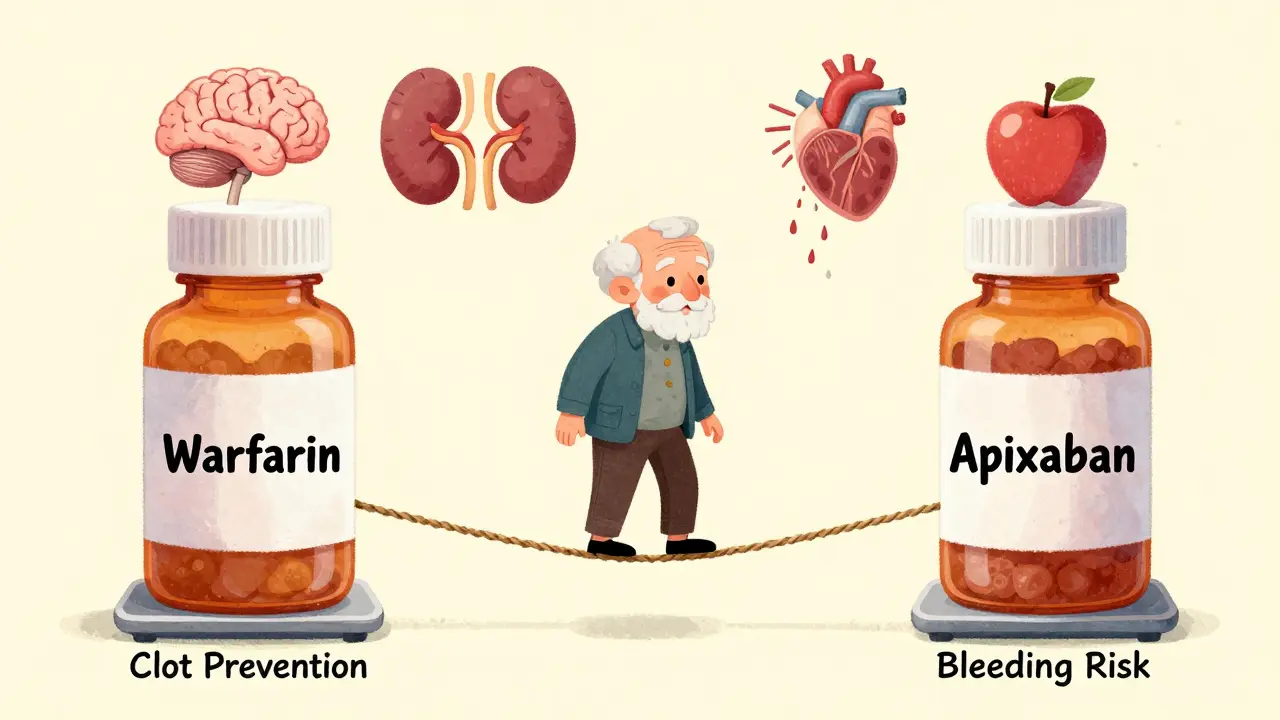
When you're on blood thinners, the goal isn't to stop clots completely - it's to keep them from forming in the wrong places. But every time you take a dose, you're walking a tightrope between preventing a stroke or pulmonary embolism and risking a dangerous bleed. For millions of people, especially those over 65, this balance is daily reality. The question isn't whether bleeding can happen - it's how to keep it from becoming life-threatening.
Why Blood Thinners Are Necessary - and Dangerous
Anticoagulants don't actually thin your blood. They interfere with the clotting process, slowing down how quickly your blood forms clots. That’s critical for people with atrial fibrillation, deep vein thrombosis, or mechanical heart valves. Left untreated, these conditions can trigger strokes, heart attacks, or fatal lung clots. But the same mechanism that protects you can also cause bleeding inside the brain, gut, or joints - sometimes without warning.
Warfarin, the oldest oral anticoagulant, has been used since the 1950s. It works by blocking vitamin K, which your liver needs to make clotting factors. But it’s finicky. Food, other medications, even changes in your liver function can throw off your dose. That’s why regular INR tests are required. The target range? Usually 2.0 to 3.0. Go above 4.0? Your bleeding risk jumps sharply. Stay below 1.5? You’re not protected enough.
Today, most new prescriptions go to DOACs - direct oral anticoagulants like apixaban, rivaroxaban, dabigatran, and edoxaban. These are simpler: fixed doses, no routine blood tests. But they’re not safer for everyone. In people with poor kidney function, DOACs can build up in the body. A 78-year-old with a creatinine clearance of 35 mL/min on rivaroxaban is at double the risk of major bleeding compared to someone with normal kidney function.
Who’s at Highest Risk for Bleeding?
Not everyone on anticoagulants bleeds. But certain factors make it much more likely:
- Age over 75 - Bleeding rates jump 2 to 3 times higher than in younger adults.
- Chronic kidney disease - CrCl below 50 mL/min doubles major bleeding risk.
- History of prior bleeding - Especially GI bleeds or intracranial hemorrhage.
- Concurrent use of antiplatelets - Taking aspirin or clopidogrel with warfarin or a DOAC increases bleeding risk by 50-70%.
- Uncontrolled high blood pressure - A systolic pressure over 160 mmHg raises the chance of brain bleeds.
- Alcohol abuse or liver disease - Impairs clotting factor production and increases drug metabolism issues.
One study tracked 12,000 patients on anticoagulants over five years. Those with three or more of these risk factors had a 1 in 4 chance of a major bleed within two years. That’s not rare - it’s predictable.
Choosing the Right Anticoagulant - It’s Not One-Size-Fits-All
DOACs are popular because they’re easier. No weekly INR checks. No dietary restrictions. But they’re not always the best choice.
Warfarin still wins for three specific cases:
- Mechanical heart valves - Especially mitral valves. DOACs have higher rates of clots forming on these devices.
- Antiphospholipid syndrome - An autoimmune disorder that causes repeated clots. Warfarin is far more effective here.
- Severe obesity (BMI >40) - DOAC levels are unpredictable in very high-weight patients. Warfarin dosing can be adjusted more precisely.
Among DOACs, apixaban has the best safety record. In the ARISTOTLE trial, it cut major bleeding by 31% compared to warfarin. It’s also less affected by kidney function - dose reduction only needed if CrCl is below 25 mL/min. Rivaroxaban and edoxaban need dose adjustments at CrCl below 50 mL/min. Dabigatran, while effective, is mostly cleared by the kidneys - risky in advanced kidney disease.
And cost? Warfarin costs about $4 a month. Apixaban? Around $550 without insurance. But here’s the catch: warfarin’s real cost includes lab tests, dietary counseling, missed work, and ER visits. When you add it all up, the total annual cost is often similar.
Preventing Bleeds Before They Happen
Most serious bleeds aren’t accidents - they’re preventable.
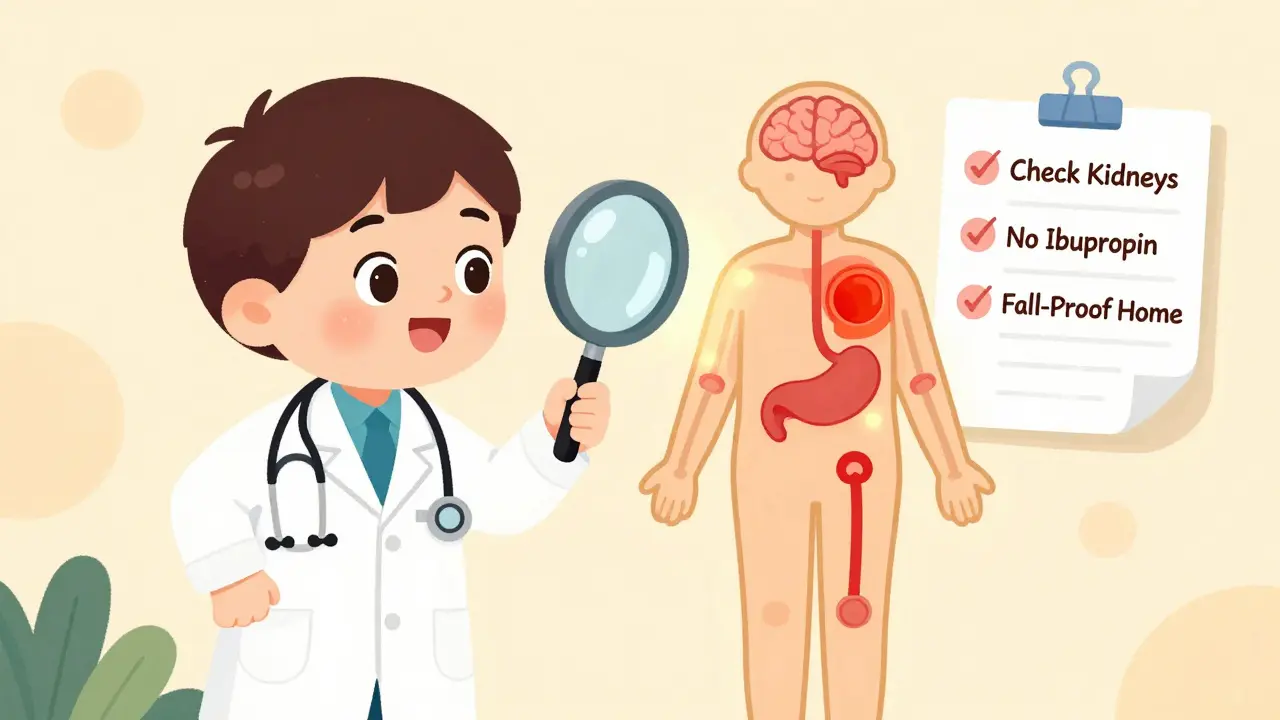
- Review all medications - NSAIDs like ibuprofen and naproxen are major culprits. Even occasional use increases bleeding risk. Use acetaminophen instead for pain.
- Check kidney function every 3-6 months - Especially if you’re over 65 or have diabetes or hypertension. A simple blood test for creatinine can catch declining kidney function before it becomes dangerous.
- Use the lowest effective dose - For DOACs, guidelines recommend dose reduction in elderly patients, even if kidney function is normal. For example, apixaban 2.5 mg twice daily is approved for those over 80 or weighing under 60 kg.
- Eliminate dual therapy unless necessary - If you’re on aspirin just because “it’s good for the heart,” ask if it’s still needed. In most cases, anticoagulant alone is enough.
- Prevent falls - Half of all intracranial bleeds in older adults on anticoagulants happen after a fall. Remove rugs, install grab bars, get vision checked.
For warfarin users, time in therapeutic range (TTR) is everything. If your INR stays between 2.0 and 3.0 for 70% of the time, your bleeding risk drops dramatically. Each 10% drop in TTR raises bleeding risk by 15%. That means regular testing isn’t just paperwork - it’s life-saving.
What to Do If You Bleed
Not every nosebleed or bruise needs an ER trip. But some signs are urgent:
- Head injury with headache or confusion
- Dark, tarry stools or vomiting blood
- Sudden weakness, numbness, or trouble speaking
- Unexplained swelling or pain in joints or abdomen
- Heavy vaginal bleeding (especially if you’re on anticoagulants)
If you have one of these, don’t wait. Go to the hospital. Time matters.
Reversal agents exist - but they’re not magic bullets.
- For warfarin - 4f-PCC (four-factor prothrombin complex concentrate) works in minutes. Vitamin K takes hours. Never wait for vitamin K alone in active bleeding.
- For dabigatran - Idarucizumab (Praxbind) reverses it completely. One IV dose, given in ER.
- For apixaban, rivaroxaban, edoxaban - Andexanet alfa (Andexxa) is approved, but it costs about $13,000 per dose and isn’t always available. In its absence, activated charcoal (if taken within 2 hours) and supportive care are used.
- For heparin - Protamine reverses unfractionated heparin, but only partially works for low-molecular-weight heparins like enoxaparin.
Many hospitals now have anticoagulant reversal protocols. Ask your doctor if yours does. And keep a card in your wallet listing what you take - and what to do if you bleed.
Restarting Anticoagulation After a Bleed
This is one of the hardest decisions in medicine. Stop the drug, and you risk a stroke. Restart it, and you might bleed again.
Guidelines now say: restart as soon as it’s safe - unless your risk of clotting is very low.
- If you had a provoked DVT (like after surgery) and it’s been over 3 months, you might not need to restart.
- If you have atrial fibrillation with a CHA₂DS₂-VASc score of 4 or higher, restarting within 7-14 days is often recommended.
- After a GI bleed, many doctors restart anticoagulants after 1-2 weeks if the source is controlled.
A 2023 study of 8,000 patients found those who restarted within two weeks had 60% fewer strokes than those who stayed off anticoagulants - with no increase in rebleeding.
What’s Next? The Future of Bleeding Prevention
Scientists are working on better tools. One promising drug, ciraparantag, could reverse multiple anticoagulants with one injection. Point-of-care tests for DOACs are in development - imagine a device that checks your anticoagulant level like a glucose meter. Early models suggest they could reduce bleeding events by 15-20%.
For women, especially those who are pregnant or having abortions, anticoagulation is tricky. Studies show that with proper management, blood loss during first-trimester abortions is often under 100 mL - less than a heavy period. But it requires planning: switching to heparin during pregnancy, avoiding DOACs, and coordinating with specialists.
The real breakthrough isn’t a new drug. It’s better communication. Patients who understand their risk, know their medication, and have a clear plan for bleeding are far less likely to end up in the ER.
Final Thought: It’s About Control, Not Fear
Anticoagulants aren’t dangerous because they’re bad. They’re dangerous because they’re powerful. The goal isn’t to avoid them - it’s to use them wisely. Know your kidney function. Review your meds. Ask about dose adjustments. Keep your INR in range. Have a plan for bleeding. That’s how you stay protected - not just from clots, but from the risks of treatment itself.

Comments (14)
Amrit N
Man, this post is a goldmine. I'm on rivaroxaban for AFib and just found out my creatinine clearance is 42. Had no idea I was doubling my bleed risk. Gonna schedule a chat with my doc ASAP. Thanks for laying this out so clearly.
Ashley Paashuis
I appreciate how thorough this is. Many patients don't realize anticoagulants aren't 'thinners'-they're modulators. The emphasis on kidney function is critical. I've seen too many elderly patients on DOACs with declining renal function, and no one's monitoring it. This should be standard education for all prescribing clinicians.
Michaela Jorstad
I just turned 78, and I'm on apixaban 2.5 mg BID. My doctor said it's because I weigh under 60 kg. I didn't even know that was a thing. This article confirmed I'm doing everything right. Also, I removed all my rugs last month after reading about falls. No more trips for me!
James Roberts
Let’s be real-warfarin is still the OG for a reason. I’ve been on it for 12 years. My TTR is 78%. I get my INR checked every 3 weeks. Yes, it’s a hassle, but I’ve never bled. DOACs? Too many unknowns. And $550/month? That’s not healthcare-that’s a luxury tax. Plus, if you’re over 80, your liver’s not what it used to be. Warfarin’s metabolism is predictable. DOACs? Not so much.
John Cena
I’ve been a nurse for 20 years. One thing I’ve learned: patients who know their numbers-INR, CrCl, CHA₂DS₂-VASc-do way better. It’s not about fear. It’s about ownership. I hand out little cards to my patients: medication, dose, reversal agent, emergency number. Simple. Effective. If you’re on an anticoagulant, you owe it to yourself to know this stuff.
Caleb Sciannella
The notion that DOACs are universally superior is a marketing myth. In patients with mechanical mitral valves, the data is unequivocal: warfarin reduces thromboembolic events by nearly 40% compared to dabigatran. This is not a matter of preference-it’s a matter of survival. The guidelines are clear. Yet, many primary care providers still default to DOACs. We must stop treating anticoagulation like a one-size-fits-all prescription. It is precision medicine, not convenience medicine.
Ellen Spiers
The statistical framing here is misleading. The assertion that 'three risk factors yield a 1 in 4 chance of major bleed' conflates incidence with probability. The study referenced employed a Cox regression model with competing risks-this is not a cumulative incidence estimate. Moreover, the term 'predictable' implies determinism, which is epistemologically unsound in complex physiological systems. One must question the clinical utility of probabilistic heuristics in high-stakes decision-making.
aine power
Apixaban wins. Period. Data speaks. Everything else is noise.
Davis teo
I had a GI bleed last year. My doctor wanted to stop everything. I said no. Two weeks later, I was back on apixaban. Now I’m fine. Stroke risk is worse than bleeding. My dad died of a stroke on warfarin because they were too scared to restart. Don’t let fear win. You can live with a bleed. You can’t live with a stroke.
Marie Crick
If you're taking blood thinners and you're not terrified, you're not paying attention. This isn't medicine-it's Russian roulette with a prescription.
Benjamin Fox
USA has the best meds in the world. Why are we even talking about warfarin? DOACs are the future. Also, stop using ibuprofen. It's a communist drug. Use Tylenol. 💪🇺🇸
Oana Iordachescu
I don’t trust DOACs. They’re controlled by Big Pharma. Why no routine blood tests? Why so expensive? Why no long-term data? I’ve read about 37 cases where people died after taking rivaroxaban and no one talked about it. The FDA is asleep at the wheel. I keep a vial of vitamin K in my purse. Just in case. 🧠💉
Irish Council
They say warfarin is better for mechanical valves. But what if the valve is titanium? What if the patient is vegan? What if the INR fluctuates because of kale? We’re all just lab rats. I stopped all meds. Now I drink apple cider vinegar. My clotting time is perfect. 🍎
madison winter
I read this. I thought about it. I didn't comment. I just stared at the ceiling. The truth is, I'm scared. But I don't know who to ask. So I didn't.