
When Your Eyes Go Dark
You walk into a room you've known your whole life, but it looks different. The colors seem dull, like watching an old movie on a scratched screen. A flicker of light overhead blinds you temporarily, making you squint until your eyes sting. This isn't just tired eyes; this is Cataracts, a condition that clouds the natural lens inside your eye. It is a slow, silent thief of sight, affecting roughly 24.4 million Americans aged 40 and older according to data from the National Eye Institute.
For decades, people lived with this blur, thinking it was just part of getting older. We've accepted that our vision fades naturally. But today, the reality is quite different. We know exactly why it happens, how to fix it, and what to expect when you go under the operating microscope. The good news is that cataract surgery is the most frequently performed surgical procedure in the United States, with nearly 4 million procedures happening annually.
The Science Behind the Blur
To understand the solution, we first need to look at the problem. Your eye works like a camera. Light enters through the cornea, passes through the pupil, and hits the lens. The lens focuses that light onto your retina to create a sharp image. Inside that lens, protein fibers are arranged so precisely they let light pass through perfectly.
As you age, these proteins start to clump together. Imagine leaving milk out on a counter; eventually, it sours and curdles. That is essentially what happens inside your lens. These clumps scatter the light instead of letting it through cleanly. For years, we didn't have much choice but to cope. Ancient texts mention "couching," a method where surgeons would push the cloudy lens back so patients could see through the gap behind it. It sounds barbaric, but it was the best option available for centuries.
Everything changed in 1949. Sir Harold Ridley, working at St Thomas' Hospital in London, successfully implanted the first artificial intraocular lens (IOL). This wasn't just pushing the bad lens away; it was replacing the broken part with a new one. Today, this concept forms the backbone of modern ophthalmology. While the underlying issue-clouded proteins-is often tied to aging, other factors play a role too. UV radiation from the sun, smoking, diabetes, and even high doses of steroids can speed up this protein breakdown significantly.
The Procedure: More Than Just Cutting
If you decide to schedule surgery, don't picture the heavy, invasive cuts of the past. The standard technique used in 95% of cases today is called phacoemulsification.
| Feature | Phacoemulsification | Extracapsular (Older) |
|---|---|---|
| Incision Size | 2.2-2.8 mm | 10-12 mm |
| Anesthesia | Local drops/numbing injections | General or Local |
| Lens Removal | d>Sonicated to liquid and sucked out | Lensed removed whole piece |
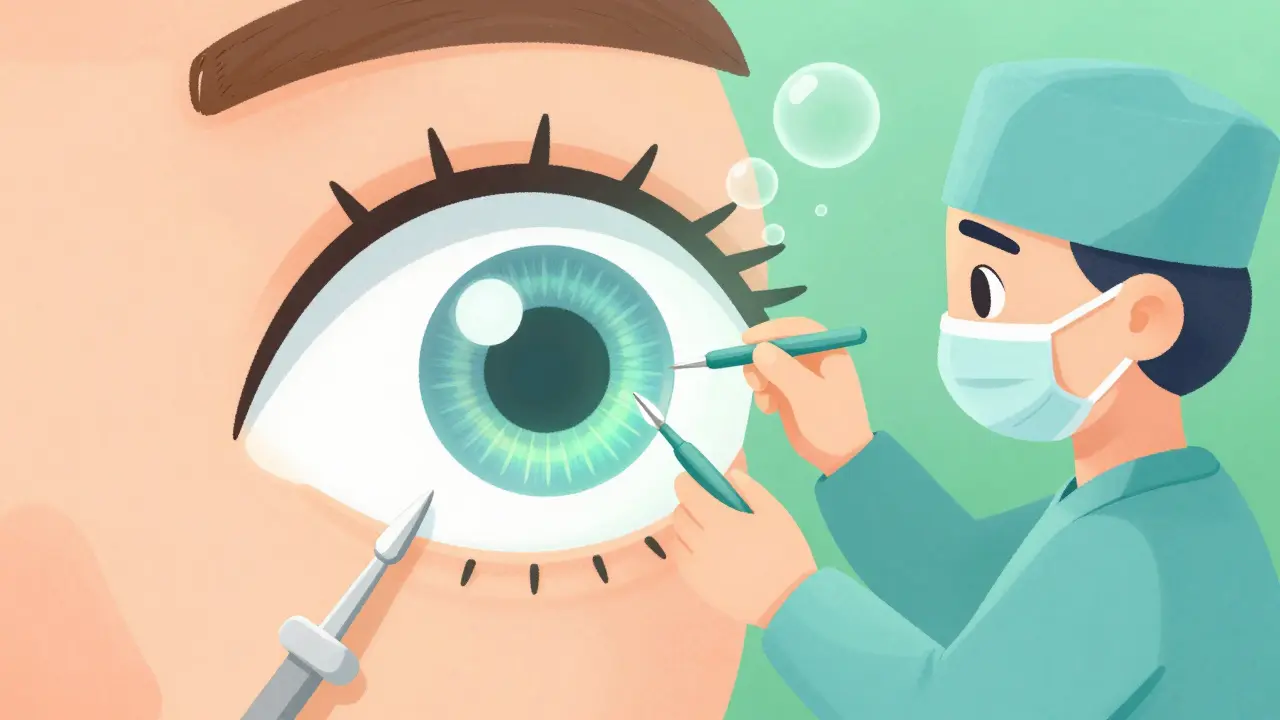
In this procedure, the surgeon makes a tiny opening in your cornea, barely larger than a pencil eraser. Through this slit, an ultrasonic probe breaks the cloudy lens into microscopic pieces. Think of it like shattering a window with a high-tech sound wave rather than smashing it with a hammer. Once the old lens is cleared away, a fresh lens is inserted.
This surgery typically takes less than 15 minutes. You will likely remain awake but totally relaxed thanks to numbing eye drops. There is minimal pain during the operation. Most clinics perform this as an outpatient visit, meaning you arrive, get the surgery, rest for a bit, and go home the same day. According to surveys by the American Society of Cataract and Refractive Surgery (ASCRS), satisfaction rates hover around 98%. Why the excitement? Because 90% of patients regain their visual acuity immediately. You aren't just seeing again; you are seeing color and depth in a way you might not have experienced since your 20s.
Picking Your New Lens
Once the cloudy lens is gone, you need a replacement. This is the Intraocular Lens (IOL). It's not something you buy off a shelf; your doctor will help you choose the right type based on how you live your life.
Most basic surgeries include a monofocal IOL. This corrects distance vision well, but you will likely still need reading glasses for things close up. If you want to ditch your glasses almost entirely, you can opt for a premium lens. Multifocal lenses, like Alcon's PanOptix, offer near, intermediate, and far vision in a single unit. Toric lenses correct astigmatism alongside the cataract.
These upgrades come with a price tag that standard Medicare doesn't cover. Based on 2023 pricing trends, standard monofocal lenses range from $1,500 to $3,000 per eye out-of-pocket if insurance doesn't cover them, which is rare. Premium options like the multifocal or toric lenses run anywhere from $2,500 to $4,500 per eye extra. However, newer designs like the Zeiss AT LISA tri, approved recently, focus heavily on intermediate vision, which is crucial for computer work and driving. It pays to ask your surgeon which technology fits your lifestyle, whether that means gardening, reading fine print, or playing sports.
What Happens When You Wake Up?
Recovery isn't instant, but improvements happen faster than you might think. Most people notice better vision within 1 to 3 days. But here is the catch: you aren't "healed" yet. Your eye feels scratchy or sticky. It might itch. You might feel mild discomfort for a couple of days.
Different clinics offer slightly different timelines for full recovery. Some say four weeks, others say up to three months for the complete visual stabilization. West Boca Eye Center notes it takes 6-8 weeks fully, while NYU Langone Health adds that adjustments continue for a few months. Why the variation? It depends on your body. If you have conditions like glaucoma or diabetes, your healing might take longer or result in less dramatic improvement.
During those first few weeks, you have to treat your eye gently. Avoid rigorous exercise and heavy lifting. Do not rub your eye. Water cannot enter your eye (so, showers only, no swimming) for at least a week. Driving is strictly off-limits until your doctor clears you. One of the strangest parts many patients report is their brain trying to relearn depth perception. Depth cues change when you have a new lens, and it can feel like walking in zero gravity.

Life After Surgery: Drops and Maintenance
You won't leave surgery empty-handed. You'll get a bottle of antibiotic drops, usually moxifloxacin (Vigamox), taken four times a day for a week to prevent infection. You'll also get steroid drops like prednisolone acetate (Pred Forte) to reduce inflammation. These need to be used precisely as prescribed over several weeks. Skipping doses can lead to complications.
There is also a long-term consideration. Even after successful surgery, a scar membrane called posterior capsule opacification can develop on the back of the new lens in about 20-30% of people within five years. It's not the cataract coming back-the old lens is gone forever-but the capsule holding the new lens gets cloudy again. This is easily fixed with a YAG laser capsulotomy, a quick laser treatment done in the office without any incision.
For some, visual rehabilitation is necessary. Vision therapy involves specific eye exercises to help the brain adapt to the new visual inputs. Exercises like shifting focus between near and far objects can begin as early as 24 hours after surgery. This is particularly helpful if you have a weak eye or significant differences between your two eyes.
Frequently Asked Questions
Will I need glasses after cataract surgery?
It depends on the lens chosen. With standard monofocal lenses, yes, you will likely need reading glasses. Premium options like multifocal or trifocal lenses reduce dependence on glasses significantly, with some achieving 81-89% spectacle independence, but you might still need glasses occasionally for specific tasks.
How long does full recovery take?
Most people see better within 3 days. Full stability takes about 4 weeks according to many clinics, but some sources note visual adjustments continuing for up to 3 months. Complete internal healing usually stabilizes by week 6 to 8.
Is cataract surgery painful?
During the surgery, you should feel nothing due to numbing drops and sedation. Immediately after, your eye may feel gritty, scratchy, or itchy for a few days, which is normal post-operative inflammation managed by prescription drops.
Can my cataract come back?
You cannot get cataracts in your new lens because the original tissue is removed. However, the pocket holding the lens can scar over (posterior capsule opacification) in 20-30% of patients over 5 years. This is treated easily with a YAG laser.
Does insurance cover premium lenses?
Generally, no. Insurance and Medicare cover the basic monofocal lens surgery. Premium lenses like Toric or Multifocal IOLs are considered cosmetic upgrades and must be paid for out-of-pocket, typically costing $2,500 to $4,500 extra per eye.
- Written by Orlando Barrington, 26 Mar 2026
- Health and Medicine
- 0 Comments
- Share this post