
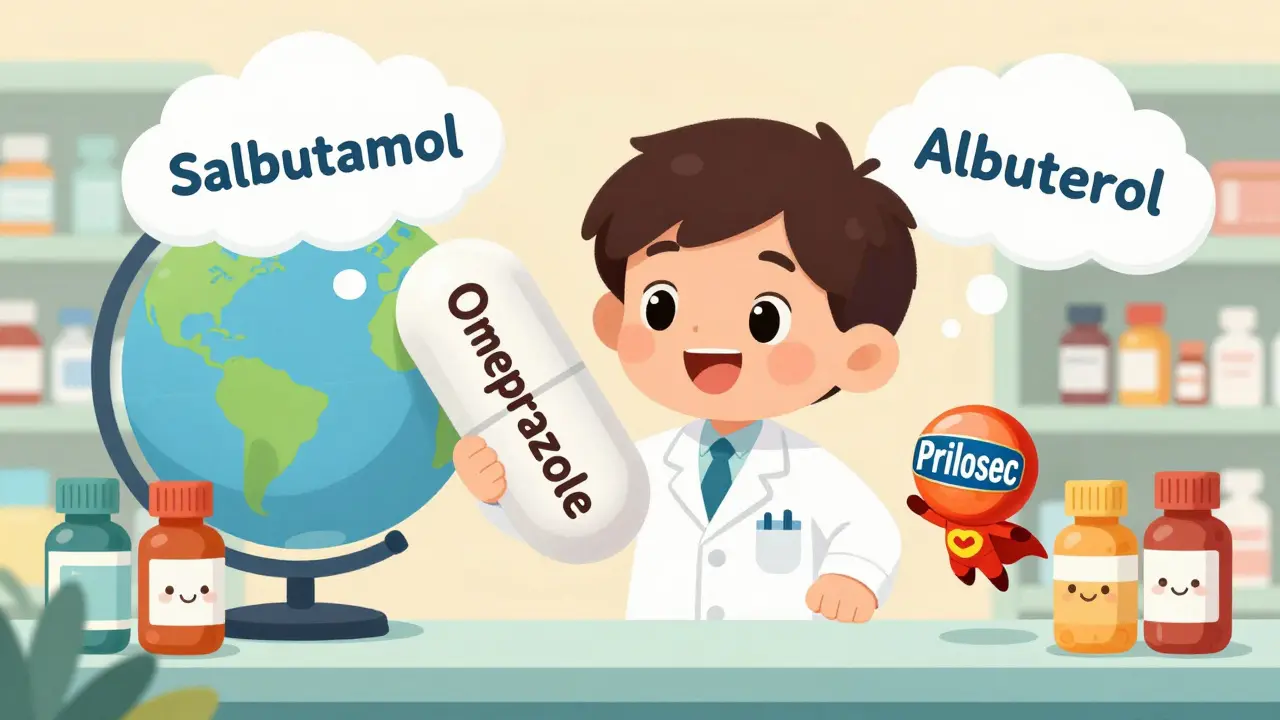
Ever wonder why some drugs have two different names? One sounds like a science experiment - albuterol - and another, like a word from a different language - salbutamol? Or why omeprazole is sold as Prilosec, but also as a cheap generic? It’s not random. Behind every drug name - whether it’s on your prescription, in a hospital chart, or on a pharmacy shelf - is a carefully designed system built to keep you safe.
Why Drug Names Matter More Than You Think
A drug name isn’t just a label. It’s a safety tool. In hospitals, nurses scan barcodes. Pharmacists read handwritten scripts. Doctors dictate prescriptions over the phone. One wrong letter - albuterol vs. salbutamol - can mean the wrong dose, the wrong drug, or even a dangerous interaction. That’s why the U.S. and the world don’t let drug companies just pick any name they like. The U.S. uses USAN (United States Adopted Names). The rest of the world mostly uses INN (International Nonproprietary Names). Both are public, free-to-use names for the active ingredient. They’re not brands. They’re the scientific backbone of every pill, injection, and inhaler you take. The system exists because, without it, you’d have 10 different names for the same drug. One company calls it “LungEase-200.” Another calls it “BronchoFix.” A third calls it “AirClear.” Patients get confused. Pharmacies mix them up. Doctors prescribe the wrong one. And people get hurt.What Is USAN? The U.S. System
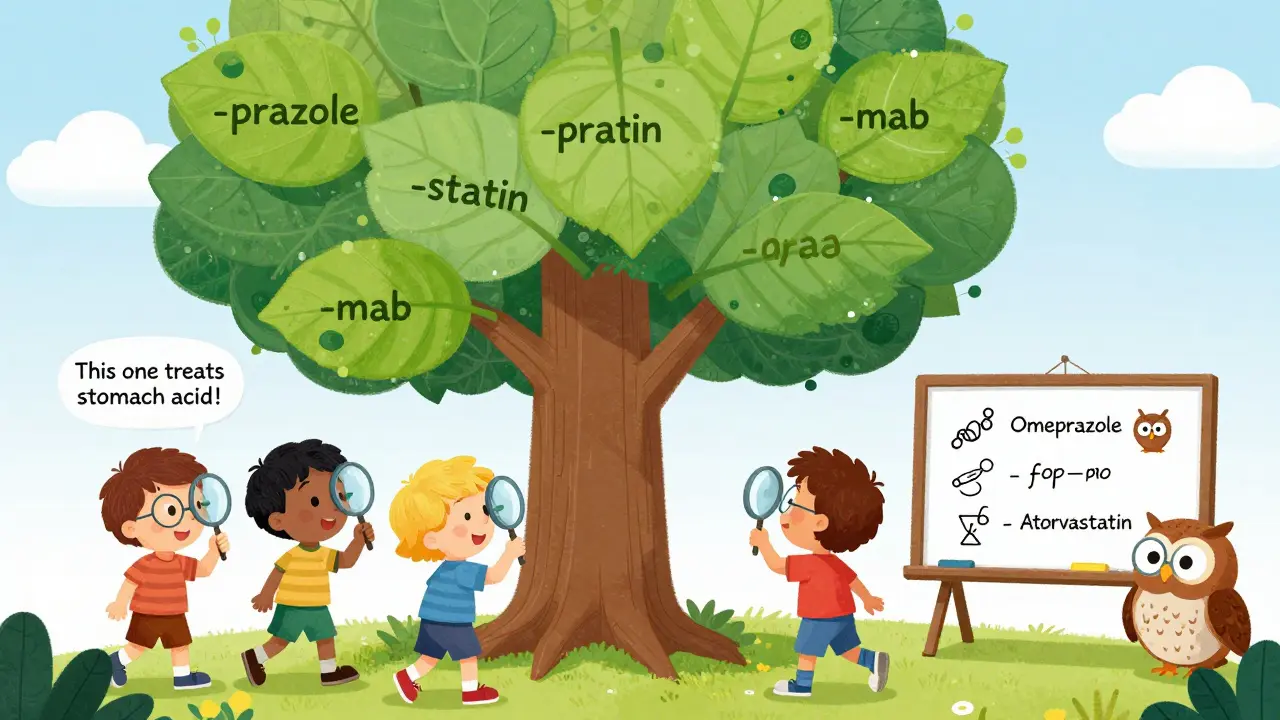
USAN is run by a council made up of the American Medical Association, the U.S. Pharmacopeia, and the American Pharmacists Association. It started in 1964. Every drug that wants to be sold in the U.S. must have a USAN name approved by the FDA before it hits the market. The USAN team doesn’t just accept whatever name a drug company suggests. They check for conflicts. They test how it sounds. They make sure it doesn’t look or sound like another drug. If a name could be mistaken for “Lopressor” when it’s actually “Lopid,” it gets rejected. That’s not paranoia - it’s protocol. USAN names follow a pattern. Most end in a stem - a suffix that tells you what the drug does. For example:- -prazole = proton pump inhibitors (omeprazole, pantoprazole)
- -statin = cholesterol-lowering drugs (atorvastatin, rosuvastatin)
- -mab = monoclonal antibodies (rituximab, adalimumab)
- -virdine = HIV antivirals (lamivudine, emtricitabine)
What Is INN? The Global Standard
INN is managed by the World Health Organization. It’s been around since 1950. Nearly every country outside the U.S. uses INN names on prescriptions, packaging, and medical records. INN and USAN are designed to match. About 95% of the time, they do. But there are stubborn exceptions - the ones that cause real confusion.- USAN: acetaminophen | INN: paracetamol
- USAN: albuterol | INN: salbutamol
- USAN: rifampin | INN: rifampicin
How Brand Names Fit In
Now, here’s where things get messy. The USAN and INN names are the generic names. They’re what the drug is called when it’s not branded. The brand name? That’s what the company sells it under. Like:- Generic: omeprazole | Brand: Prilosec
- Generic: atorvastatin | Brand: Lipitor
- Generic: sertraline | Brand: Zoloft
The Naming Process: How a Drug Gets Its Name
It doesn’t happen overnight. A drug company can’t just pick a name and call it done. Here’s how it works:- During early clinical trials (Phase 1 or 2), the company starts thinking about names.
- They brainstorm 15-20 possible names. Some are silly. Some are too close to existing drugs. Most get thrown out.
- They pick their top 6 and submit them to both USAN and INN.
- USAN checks for conflicts: Does it sound like another drug? Is it already trademarked? Does it mean something weird in another language?
- INN does the same - but for global use.
- Both groups may suggest alternatives. The company can accept or push back.
- After 18-24 months, the name is approved.
- It’s published. For four months, anyone can object. (Rarely happens.)
Why the Stems Are So Important
Stems aren’t just for show. They’re lifesavers. Imagine you’re a nurse in a busy ER. You see a drug ending in “-virdine.” You know instantly: it’s an HIV drug. You don’t need to look it up. You know it’s not for high blood pressure. You know it’s not an antibiotic. You know it’s likely to interact with other antivirals. That’s the power of stems. They turn a random word into a medical clue. For monoclonal antibodies, the stems got even more specific:- -ximab = chimeric (part mouse, part human)
- -zumab = humanized (mostly human)
- -umab = fully human
The Real Problem: When Names Don’t Match
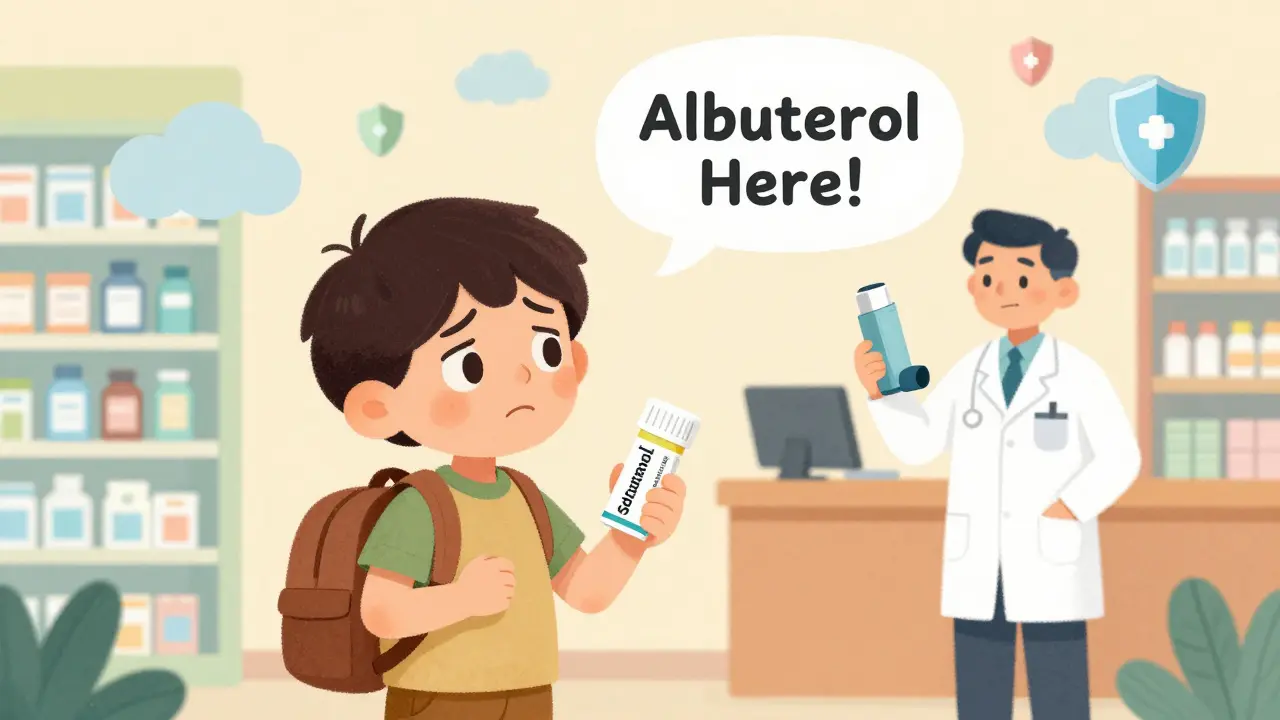
The biggest risk isn’t the system itself. It’s the gap between USAN and INN. A patient from Europe comes to the U.S. with a prescription for salbutamol. The doctor doesn’t recognize it. They look it up. They think it’s a different drug. They prescribe albuterol - which is the same thing - but the patient didn’t know that. They panic. They stop taking it. Their asthma flares up. That’s not hypothetical. It’s happened. And it’s why the WHO and FDA keep pushing for alignment. But they can’t force it. Cultural habits die hard. Even within the U.S., confusion happens. “Rifampin” and “rifampicin” are the same drug. But if a patient brings a bottle labeled “rifampicin” from abroad, the pharmacist might hesitate. Is this the right one? Is it expired? Is it fake?What’s Next for Drug Naming?
New drugs are getting more complex. Gene therapies. RNA treatments. CRISPR-based edits. These don’t fit neatly into “-mab” or “-statin.” The USAN Council says it will only create new stems if the science demands it - and if there’s enough data to justify it. That’s smart. Too many stems? Too confusing. But the pressure is growing. Biologics - complex protein-based drugs - now make up 42% of global drug sales. They need better naming. The system is adapting, slowly. The goal? Less confusion. Fewer errors. More safety. And right now, that system - messy as it is - still works.What You Should Know
You don’t need to memorize every stem. But you should know this:- Always check the generic name on your prescription - not just the brand.
- If you’re traveling, know the INN name of your meds - especially if you’re from the U.S.
- Don’t assume “similar-sounding” drugs are the same. “Omeprazole” and “esomeprazole” are close - but one’s a mirror image of the other. That matters.
- Generic drugs aren’t “weaker.” They’re the same active ingredient, just cheaper.
What’s the difference between a generic name and a brand name for a drug?
The generic name (like USAN or INN) is the official scientific name for the active ingredient in a drug. It’s the same no matter who makes it. The brand name (like Lipitor or Zoloft) is what the company calls it for marketing. It’s trademarked and only used by that company. Generic names tell you what the drug does. Brand names tell you who sells it.
Why does the same drug have different names in the U.S. and other countries?
The U.S. uses USAN names, while most other countries use INN names. While they’re usually the same, some names differ due to historical usage. For example, acetaminophen (U.S.) is called paracetamol elsewhere. These differences aren’t mistakes - they’re legacy choices. But they can cause confusion, especially for travelers or international prescriptions.
How do drug names help prevent medication errors?
Drug names use standardized stems that reveal the drug’s class and function. For example, any drug ending in “-prazole” is a stomach acid reducer. Any ending in “-mab” is a monoclonal antibody. This lets doctors and pharmacists quickly recognize what a drug does - even if they’ve never seen the brand name before. This reduces mix-ups, especially with look-alike or sound-alike names.
Can a drug have more than one generic name?
No - each active ingredient has only one official generic name in a given system. But the same drug can have two different generic names depending on the system: USAN in the U.S., INN elsewhere. For example, albuterol (U.S.) and salbutamol (global) are the same drug with two names. Only one is used per country.
Why do some drug names have prefixes like “es-” or “dex-”?
Those prefixes indicate the drug’s molecular structure. “Es-” means it’s the more active form of a molecule (esomeprazole is the S-isomer of omeprazole). “Dex-” means it’s the right-handed version (dexmethylphenidate). These aren’t marketing tricks - they’re scientific distinctions. One form may work better or have fewer side effects.

Comments (12)
Christina Bilotti
Oh wow, another post pretending this system isn’t a glorified mess of bureaucratic inertia. USAN and INN? Please. It’s like having two different traffic light systems in the same city and calling it ‘standardization.’ And don’t get me started on ‘albuterol’ vs. ‘salbutamol’ - one’s American pride, the other’s global sanity. Meanwhile, nurses are still Googling drug names at 3 a.m. because someone thought ‘-prazol’ was ‘too European’ for the FDA.
At this point, the only thing more dangerous than a misnamed drug is the people who defend this system like it’s sacred scripture.
brooke wright
I had a friend in med school who mixed up ‘rifampin’ and ‘rifampicin’ and almost gave a patient the wrong dose. Like, she was so tired, she just saw ‘rifam-’ and went with it. It was terrifying. And this isn’t some rare glitch - it happens all the time. I work in pharmacy now and I still double-check every time I see a foreign script. The stems help, sure, but the gaps? Those gaps kill.
And don’t even get me started on patients bringing in bottles from abroad labeled ‘paracetamol’ and acting like it’s some illegal drug. It’s just Tylenol. With a different accent.
Nick Cole
This is actually one of the most important things nobody talks about. I’ve seen too many ER cases where a patient’s international prescription got misread because the doctor didn’t know ‘salbutamol’ = ‘albuterol.’ No one’s to blame - it’s just a system that never caught up with globalization.
But the stems? Genius. I remember the first time I saw ‘-mab’ and realized ‘oh, this is an immunotherapy drug’ - it was like learning a secret code. That’s how you prevent errors. Not by memorizing brand names, but by understanding the language behind them. This system, flawed as it is, saves lives daily.
Jody Fahrenkrug
Just read this after my mom’s doctor switched her from Lipitor to generic atorvastatin. She was convinced the generic was ‘weaker.’ I showed her the exact same chemical structure. She still didn’t believe me until I pointed out the ‘-statin’ at the end and said, ‘That’s the part that actually works.’
So yeah. Stems matter. Even if your grandma thinks ‘Zoloft’ sounds fancier than ‘sertraline.’
john Mccoskey
Let’s deconstruct this with a philosophical lens. The entire naming paradigm is a symptom of late-capitalist fragmentation - where corporate branding supersedes epistemic clarity, and national sovereignty overrides scientific unity. USAN and INN are not merely administrative constructs; they are ideological battlegrounds. The fact that ‘acetaminophen’ persists in the U.S. while the rest of the world uses ‘paracetamol’ is not an accident - it’s a cultural assertion of linguistic hegemony.
The stems, yes, are elegant - they represent a failed utopia of universal medical intelligibility. But the very existence of these stems is predicated on a false premise: that language can be standardized without power. It cannot. The WHO is not a neutral arbiter; it is a geopolitical actor. And every time a drug company submits a name, they are negotiating not just nomenclature, but cultural dominance.
So when you ask ‘why doesn’t the U.S. just adopt INN?’ - you’re not asking about drug safety. You’re asking why America refuses to surrender linguistic control to a global apparatus. And the answer? Because control is the only thing keeping this system from collapsing into chaos. And chaos, my friends, is the only true universal language.
Ryan Hutchison
Look, I get it - the rest of the world thinks they know better. But we’re the U.S. We don’t follow the EU’s rules just because they’ve been around longer. USAN was built by American doctors, for American patients. If you can’t handle ‘albuterol’ instead of ‘salbutamol,’ maybe you shouldn’t be taking prescription meds.
And don’t even start with ‘paracetamol.’ That’s just a British word for Tylenol. We don’t say ‘lorry’ or ‘biscuit’ - why should we say ‘paracetamol’? It’s not a global conspiracy, it’s American independence. And if you think we’re wrong, go live in Canada and see how many people there still say ‘hydrocodone’ instead of ‘Vicodin.’
Chelsea Harton
stems are cool but why does esomeprazole even exist? like its just omeprazole but backwards? why not just call it the right thing and move on
Corey Chrisinger
It’s wild how something so technical can feel so human. The stems? They’re like musical notes in a symphony - each one tells you the instrument before you hear the note.
And honestly? I love that we’re still adding new ones for CRISPR and RNA drugs. It means we’re not stuck in the past. We’re evolving with science. 🧬✨
Even if ‘-virdine’ still makes me think of a 90s sci-fi villain.
Bianca Leonhardt
Of course you wrote a 2000-word essay on drug naming. Of course you did. This isn’t a Wikipedia page, it’s a Reddit post. Nobody asked for a PhD thesis on how the FDA decided that ‘-mab’ was better than ‘-mib.’
And yet here we are. Again. With the stems. Again. With the ‘global standard.’ Again. With the ‘cultural legacy.’
Can we just agree that ‘albuterol’ is fine and move on?
Travis Craw
Man, I used to work in a pharmacy and we’d get these prescriptions from Canada with ‘paracetamol’ and everyone would just stare. Like, we knew what it was, but the computer system didn’t recognize it. So we’d have to call the doctor. And they’d be like ‘oh yeah, Tylenol.’
It’s weird how something so simple can cause so much paperwork. I just wish the names matched. Not because I’m lazy - but because I didn’t sign up to be a translator for global meds.
Kasey Summerer
So the U.S. has ‘albuterol’ and the rest of the world has ‘salbutamol’…
Meanwhile, in the UK, they call it ‘salbutamol’ and the Americans call it ‘albuterol’…
And somehow, this is still a thing?
😂
At this point, I’m just waiting for the next drug to be called ‘vibramycin’ in the U.S. and ‘doxycycline’ everywhere else. Then we’ll have a real international crisis.
Also, ‘rifampin’ vs. ‘rifampicin’? That’s not a difference. That’s a typo with a passport.
Allen Davidson
Hey, I just want to say - this was actually really well explained. I’m not a doctor or pharmacist, but I’ve had to switch between brand and generic meds a few times, and I always felt lost. This post helped me understand why the names are the way they are - and why it matters.
Thanks for taking the time to break it down. Even the ‘-mab’ stuff made sense now. And I’ll definitely check the generic name on my next prescription. Not because I’m scared, but because I’m smarter now.