
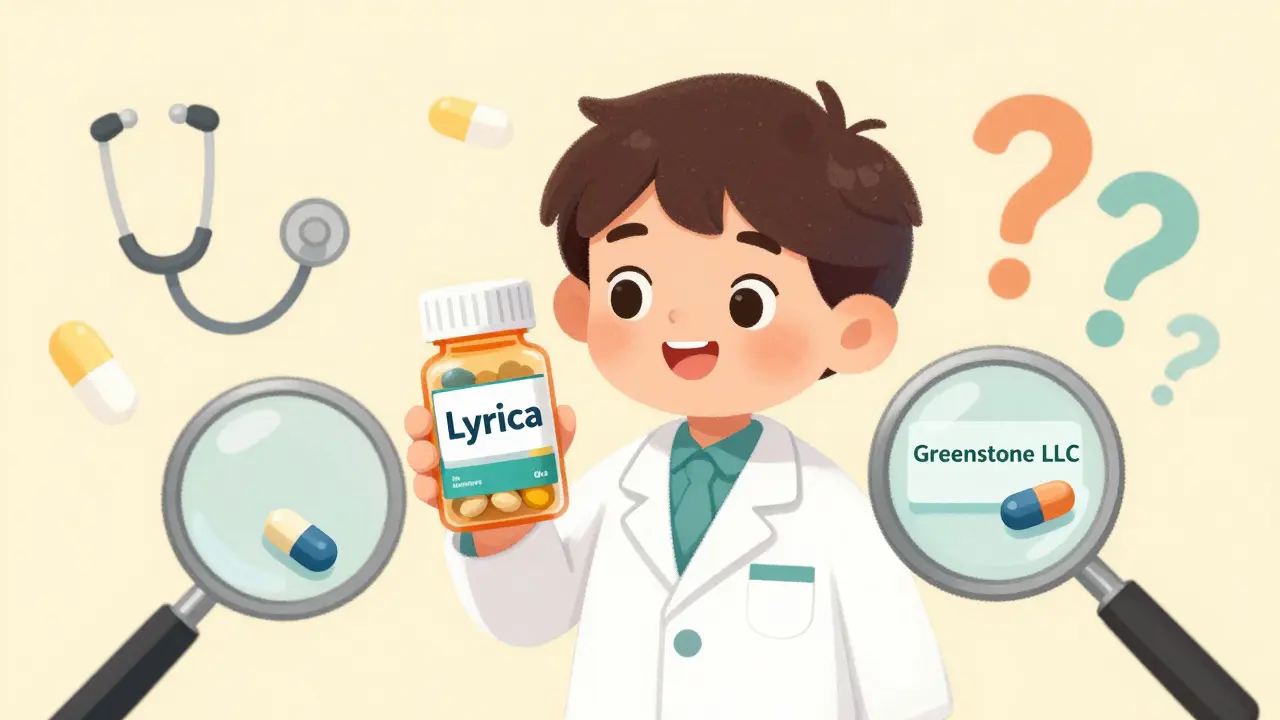
What Exactly Is an Authorized Generic?
An authorized generic isn’t just another cheap version of a brand-name drug. It’s the exact same pill, capsule, or liquid - made in the same factory, with the same ingredients, using the same process - but sold under a different label. Think of it like a car manufacturer making the same model but selling it under a subsidiary’s name. The FDA defines it clearly: an authorized generic is a brand-name drug that’s marketed without the original brand name, trademark, or promotional claims. It’s not a copy. It’s the real thing, just repackaged.
This isn’t a loophole. It’s a legal pathway created by the Medicare Prescription Drug, Improvement, and Modernization Act of 2003. The first one hit the market in 2004 when AstraZeneca released an authorized generic of Prilosec (omeprazole). Since then, the FDA has tracked over 147 active authorized generics as of October 2023. These aren’t rare. They’re a strategic part of how brand-name companies compete when their patents expire.
Why Packaging and Labeling Are Your Best Clues
If you’re trying to spot an authorized generic, don’t look at the pill color or shape. That’s misleading. Many traditional generics change the color or markings to avoid trademark issues. But authorized generics? They often look identical to the brand version - because they are the same product. The real differences are on the box, bottle, or blister pack.
First, check the manufacturer or distributor name. If you see a name like Greenstone LLC instead of Pfizer on the label of a drug that’s normally sold as Lyrica, that’s a red flag - in a good way. Greenstone is Pfizer’s subsidiary. That’s an authorized generic. The same goes for Dr. Reddy’s Laboratories distributing Protonix. The brand manufacturer is still behind it, but they’re using a different name to sell it.
Second, look for the absence of the brand name. No trademark symbols (™ or ®). No marketing slogans like “The #1 Prescribed Acid Reflux Medication.” Authorized generics have clean, clinical labeling. They include all safety info required by the FDA - side effects, warnings, dosage - but nothing that sounds like an ad.
The NDC Code: Your Most Reliable Tool
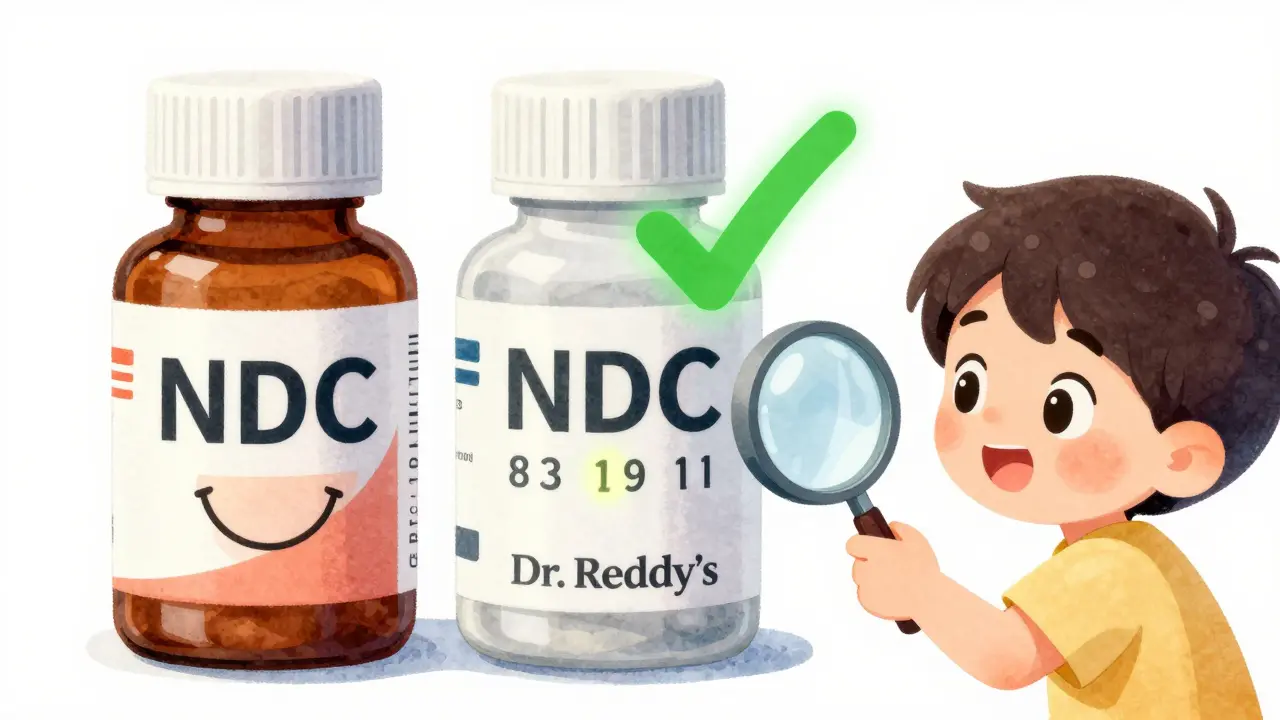
The National Drug Code (NDC) is a 10- or 11-digit number printed on every prescription bottle. It’s broken into three parts: labeler code, product code, and package code. For authorized generics, only the labeler code changes. The product and package codes stay exactly the same as the brand-name version.
Take Protonix (pantoprazole). The brand version has an NDC like 00071-0055-10. The authorized generic distributed by Dr. Reddy’s? It’s 55111-0055-10. Same product code (0055), same package size (10), different labeler (55111 instead of 00071). That’s the pattern. Traditional generics? They’ll have a completely different product code - because they’re made by a different company using different formulas or manufacturing lines.
Pharmacists use this trick every day. If you’re unsure, ask your pharmacist to check the NDC against the FDA’s Quarterly Authorized Generic List. It’s updated every January, April, July, and October. The October 2023 update listed 147 active authorized generics. That’s your official source.
How Authorized Generics Differ from Traditional Generics
Not all generics are the same. Traditional generics go through the Abbreviated New Drug Application (ANDA) process. They must prove they’re bioequivalent to the brand drug - meaning they work the same way in your body. But they can have different inactive ingredients, different fillers, different coatings. Sometimes that causes minor differences in how fast the drug absorbs.
Authorized generics? They don’t need to prove bioequivalence. Why? Because they’re made by the brand company. Same facility. Same equipment. Same batch. The only difference is the label. That’s why patients report identical results - 92.6% in a 2022 Medscape survey said they felt no difference between the brand and the authorized generic.
Also, labeling updates are automatic. If the brand updates its safety info, the authorized generic gets it too - no delay. Traditional generics have 30 days to update their labels after the brand changes. That’s a big deal for drugs with serious side effects.
What to Watch Out For: Common Mistakes
Even pharmacists get confused. A 2021 survey found that 37% of them misidentified authorized generics as traditional ones - just because the packaging looked similar. Others mistake them for counterfeit drugs when they see unfamiliar manufacturer names.
Some authorized generics include subtle clues like “AG” or “Authorized Generic” on the label - but that’s not required. Don’t rely on it. Some brands use packaging that looks almost identical to the original. That’s intentional. The goal is to keep patients from switching to cheaper, non-authorized generics.
Another trap: confusing authorized generics with “authorized brand” products. That’s when a generic company buys the brand-name drug, repackages it, and sells it as a “brand” version. That’s not an authorized generic. That’s a gray-market trick. The FDA doesn’t regulate that the same way.
How to Verify an Authorized Generic - Step by Step
- Look at the label. Is the brand name missing? Is there a different company listed as distributor (e.g., Greenstone, Dr. Reddy’s, Mylan)?
- Find the NDC number. Write it down.
- Check the FDA’s Quarterly Authorized Generic List (updated January, April, July, October). Search by the product code - the middle segment of the NDC.
- If the product code matches a brand-name drug on the list, and the labeler code is different, it’s an authorized generic.
- Ask your pharmacist: “Is this an authorized generic?” They have access to databases like First Databank or Medi-Span that flag these automatically.
It takes about 2.7 minutes per prescription for pharmacists to confirm this manually - but once you know the pattern, you can spot it in seconds.
Why It Matters for Your Health and Wallet
Authorized generics cost less than the brand name - usually 15-25% cheaper - but they’re often 5-15% more expensive than traditional generics. Why? Because they’re not competing with other manufacturers. The brand company still controls the supply.
But here’s the real benefit: consistency. If you’ve been on a brand-name drug for years and your doctor says you need to switch, an authorized generic is the safest transition. No new formulation. No new absorption profile. No surprise side effects. Just the same drug, in a cheaper package.
For patients with chronic conditions - high blood pressure, epilepsy, depression - that stability matters. A 2022 study by the American Pharmacists Association found that patients who switched to authorized generics reported fewer complaints about effectiveness than those who switched to traditional generics.
What’s Changing in 2024
The FDA plans to integrate authorized generic identifiers directly into the National Drug Code Directory by Q2 2024. That means pharmacy systems will automatically flag them - no manual lookup needed. This should cut down the 8.3% of dispensing errors currently caused by confusion over authorized generics.
Also, more specialty drugs are entering this space. In 2022, authorized generics in specialty categories grew 24.6% year-over-year. That includes drugs for multiple sclerosis, rare cancers, and autoimmune diseases - where even small changes in formulation can cause big problems.
So if you’re taking a high-cost medication, always ask: Is there an authorized generic? It could save you money without risking your health.
Frequently Asked Questions
Are authorized generics as safe as brand-name drugs?
Yes. Authorized generics are made in the same facility, with the same ingredients, and under the same quality controls as the brand-name drug. The FDA inspects these facilities just like any other drug manufacturer. There’s no difference in safety or effectiveness.
Can I trust an authorized generic if the label looks different?
Absolutely. The label looks different because it’s not supposed to carry the brand name or trademark. But the active ingredients, dosage, and manufacturing process are identical. The FDA requires all safety information to be included - just without marketing language.
How do I know if my pharmacy is giving me an authorized generic?
Ask for the NDC number on your prescription bottle. Compare it to the brand’s NDC. If the first part (labeler code) is different but the middle and last parts are the same, it’s an authorized generic. You can also ask your pharmacist directly - most pharmacy systems now flag these automatically.
Why aren’t authorized generics cheaper than traditional generics?
Because they’re not competing with other manufacturers. The brand company still controls production and pricing. Traditional generics have multiple companies making the same drug, driving prices down. Authorized generics are priced to compete with the brand, not with other generics.
Do authorized generics show up in the FDA’s Orange Book?
No. The Orange Book only lists drugs approved under the ANDA pathway. Authorized generics are marketed under the original New Drug Application (NDA), so they’re not listed there. That’s why you need to use the FDA’s separate Authorized Generic List to identify them.

Comments (14)
Bradford Beardall
I never realized authorized generics were just the exact same drug with a different label. My pharmacist showed me my blood pressure med was one last month - saved me $40 a month. Mind blown.
Now I check every script.
McCarthy Halverson
NDC is the key. Labeler code changes, product code stays same. That’s it.
Michael Marchio
Let me tell you something. The pharmaceutical industry is a total scam. They make the exact same pill, slap a different label on it, and call it an 'authorized generic' to pretend they're not gouging you. They know most people won't check the NDC. They count on your ignorance. And now they're pushing this as some kind of 'patient benefit'? Please. It's a profit retention strategy disguised as transparency. The FDA's list? Just a PR tool. They don't regulate pricing. They don't force discounts. They just let the same company charge less to avoid antitrust trouble. This isn't saving you money. It's just the company deciding which pocket to put your cash in. You think they're doing this out of kindness? They're just hedging against generic competition. Don't be fooled.
Jake Kelly
This is super helpful. I’ve been switching to generics for years but never knew there was a middle ground like this. Going to ask my pharmacist next refill.
Ashlee Montgomery
The NDC breakdown makes total sense. Same product code means same manufacturing. Same batch. Same quality. Why would anyone risk a traditional generic when the authorized one is nearly identical and often cheaper than brand? It’s not just about cost. It’s about peace of mind.
neeraj maor
You think this is about transparency? Wake up. The FDA’s list is outdated by months. The NDC system is manipulated by Big Pharma to create false distinctions. They control the labeler codes. They control the distribution. They even let some generics use the same packaging to confuse you. And now they want you to trust a 10-digit number? That’s not safety. That’s surveillance. They’re tracking your prescriptions through the NDC. Every time you switch to an 'authorized generic' you’re feeding their database. They know your condition. They know your habits. They know when you’re vulnerable. This isn’t medicine. It’s data harvesting with a pill inside.
Ritwik Bose
Thank you for this clear breakdown 🙏
As someone from India where counterfeit meds are a real concern, this helps me understand how regulated systems like the FDA protect patients even when branding changes.
It’s reassuring to know the same factory produces both versions. Safety first always.
Paul Bear
Technically speaking, authorized generics are marketed under the original NDA, not the ANDA pathway, which is why they’re excluded from the Orange Book. This distinction is critical for pharmacovigilance and regulatory compliance. The labeler code modification is the only legally permissible differentiation under 21 CFR 207.33. Any deviation from this structure constitutes a misbranding violation. You’re not just saving money-you’re engaging with a compliant, FDA-inspected manufacturing process. Don’t confuse this with gray-market re-packaging, which lacks regulatory oversight entirely.
lisa Bajram
OMG I just checked my insulin and it’s an authorized generic!! 😱 I’ve been paying $500 a month for this and now I see the label says 'Greenstone' instead of 'Lilly'-but the pill looks identical! I’m crying happy tears. This is the kind of info that saves lives AND wallets. Everyone please, please, please ask your pharmacist about NDC codes. Don’t just take what they hand you. Be a detective! 💪💊
Jaqueline santos bau
I swear this is why my anxiety got worse last year. I switched to an 'authorized generic' for my antidepressant and suddenly I felt like a zombie. My doctor said it was 'the same thing' but I KNOW it wasn’t. I started tracking my sleep, my mood, my headaches-everything. Turns out, the inactive ingredients changed. The label said 'same' but the truth? They swapped out the fillers. Now I only take brand. I don’t trust 'authorized' anything anymore. They’re all lies wrapped in FDA paperwork.
Kunal Majumder
This is gold. In India we don’t have this system, but I’ve seen people pay double for branded meds when generics work fine. This post made me realize maybe we need something like this here too.
Aurora Memo
I appreciate how you laid this out. So many people panic when they see a different label. But if the NDC product code matches, it’s literally the same medicine. That’s not just smart-it’s empowering.
chandra tan
I work in a pharmacy in Delhi and we get a lot of patients asking about 'American generics'. This post would help them understand the difference between real generics and these authorized ones. Good job explaining.
Mario Bros
Just checked my cholesterol med-yep, Greenstone. Saved $35 this month 🎉
Pharmacist didn’t even mention it. Glad I read this. Thanks!