
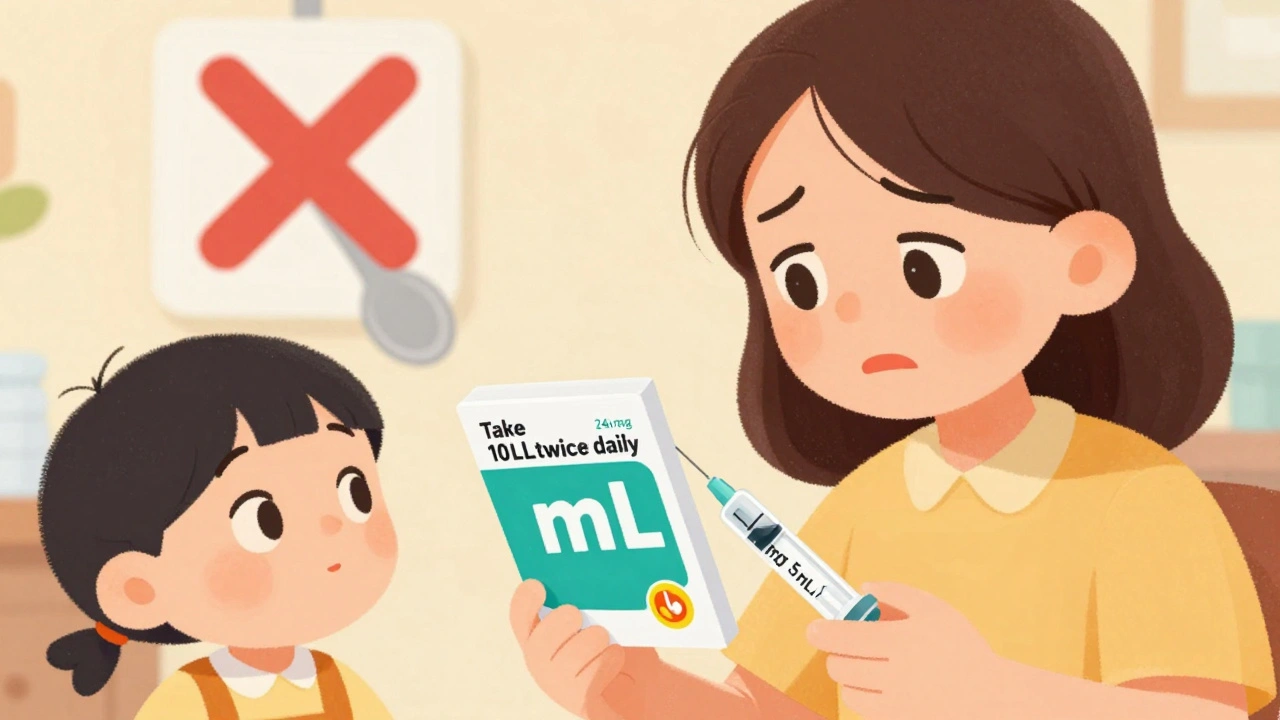
Getting the right dose of liquid medicine isn’t just about reading numbers-it’s about staying safe. Every year, over a million people in the U.S. are injured because they misread liquid prescription labels. Most of these mistakes happen when people use kitchen spoons instead of proper measuring tools. The good news? You don’t need to be a doctor to get it right. You just need to know what to look for on the label.
Look for the Unit: Milliliters (mL) Only
Modern liquid medication labels should only show doses in milliliters (mL). No teaspoons, no tablespoons. That’s not a suggestion-it’s a safety rule. The FDA and the National Council for Prescription Drug Programs (NCPDP) made this mandatory because household spoons vary wildly in size. A teaspoon you use for coffee might hold 4 mL one day and 7 mL the next. That’s a 75% difference. For a baby, that could mean the difference between a safe dose and a dangerous overdose.
Check the label. If you see “tsp” or “tbsp,” it’s outdated. Pharmacies in the U.S. have been required since 2016 to use mL only. If your label still uses non-metric units, ask the pharmacist to re-label it. They’re legally required to provide accurate, standardized instructions.
Understand the Concentration: mg per mL
Just because the label says “10 mL” doesn’t mean that’s the total amount of medicine in the bottle. The key is the concentration. Look for a line like: 240 mg / 5 mL. This means every 5 milliliters of liquid contains 240 milligrams of the active drug.
Let’s say your child’s prescription says: Take 10 mL twice daily. You see the concentration is 240 mg / 5 mL. That means each 10 mL dose contains 480 mg of medicine. If you misread this and think the whole bottle is 240 mg, you’ll give half the dose you need. Always calculate: How much medicine is in each mL? Divide the first number by the second. In this case: 240 ÷ 5 = 48 mg per mL. So 10 mL = 480 mg.
Watch Out for Decimal Points
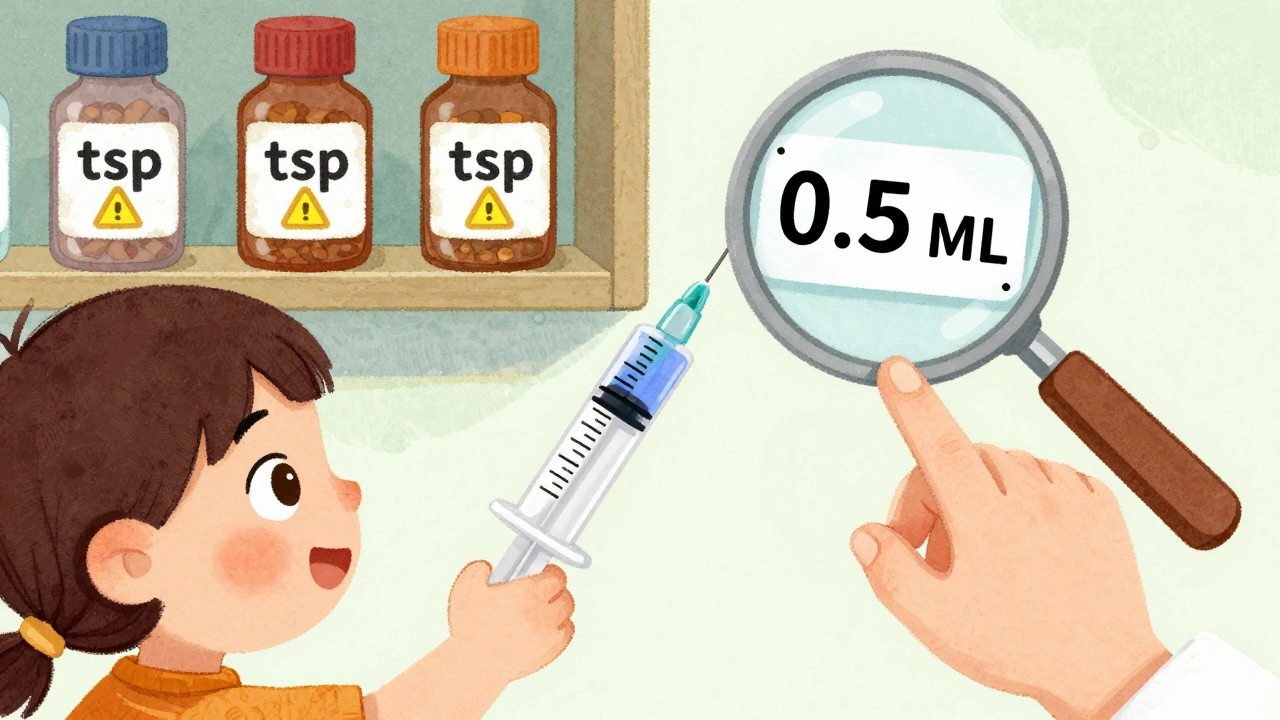
Decimal errors are one of the deadliest mistakes. A label that says 0.5 mL is not the same as 5 mL. That’s a tenfold difference. That’s why labels must always include a leading zero: 0.5 mL, never .5 mL. And they must never show trailing zeros: 5 mL, never 5.0 mL. The extra zero can make someone think it’s a different strength.
Johns Hopkins researchers found that using proper decimal formatting reduced 10-fold dosing errors by 47%. That’s nearly half the mistakes prevented just by changing how numbers are written. If you see 5.0 mL on a label, it’s outdated-and potentially dangerous. Ask for a corrected version.
Use the Right Measuring Tool
Never use a kitchen spoon, even if the label used to say “teaspoon.” Always use the tool that came with the medicine. It’s usually a syringe, cup, or dropper marked in mL. These tools are calibrated to match the label exactly.
Some bottles come with a measuring cup that has both mL and tsp markings. That’s okay-only if the mL numbers are bigger and clearer. The tsp markings are there for reference, not for use. Always go by mL. If the tool doesn’t have mL markings, or if the markings are faded, ask the pharmacy for a new one. They’re required to give you one free of charge.
Pro tip: Oral syringes are the most accurate for small doses-especially under 5 mL. They’re easier to control than cups, and you can see exactly how much you’ve drawn up. For infants, use a syringe without a needle. Gently squirt the medicine into the side of the mouth, not straight down the throat.
Check the Total Volume and Expiration Date
Don’t confuse the total volume of the bottle with the dose. A 120 mL bottle doesn’t mean you take 120 mL at once. That’s the whole bottle. Your dose might be 5 mL per use. The label should clearly say: Take 5 mL every 6 hours. The total volume just tells you how long the medicine will last.
Also, always check the expiration date. Liquid medicines break down faster than pills. Once opened, many last only 14 to 30 days, even if the bottle says “expires in 2026.” Ask the pharmacist how long it’s good after opening. Store it as directed-some need refrigeration, others don’t.
What If the Label Is Confusing?
Over 43% of patients misread even perfectly labeled prescriptions, according to Dr. Michael Wolf’s research. Why? Health literacy. If you’re unsure, don’t guess. Ask the pharmacist to explain it to you. Then, use the “teach-back” method: “So, just to make sure I got it right-you’re saying I give 2.5 mL twice a day using the syringe, not the cup?” If you can say it back correctly, you’re good.
Pharmacies are required to offer this counseling. If they don’t, ask again. Or call the pharmacy back later. You’re not being annoying-you’re protecting your child or yourself.
Common Mistakes and How to Avoid Them
- Mistake: Thinking “5 mL” means the whole bottle. Solution: Look for the word “dose” or “take.” That’s your amount per use.
- Mistake: Using a kitchen spoon because “it’s close enough.” Solution: Use the tool that came with the medicine-or get a new one from the pharmacy.
- Mistake: Reading “240 mg/5 mL” as “240 mg total.” Solution: Always calculate: 240 mg per 5 mL. So 10 mL = 480 mg.
- Mistake: Assuming all liquid medicines are the same strength. Solution: Never use leftover medicine from a previous illness. Doses vary by condition, weight, and age.
What’s New in 2025?
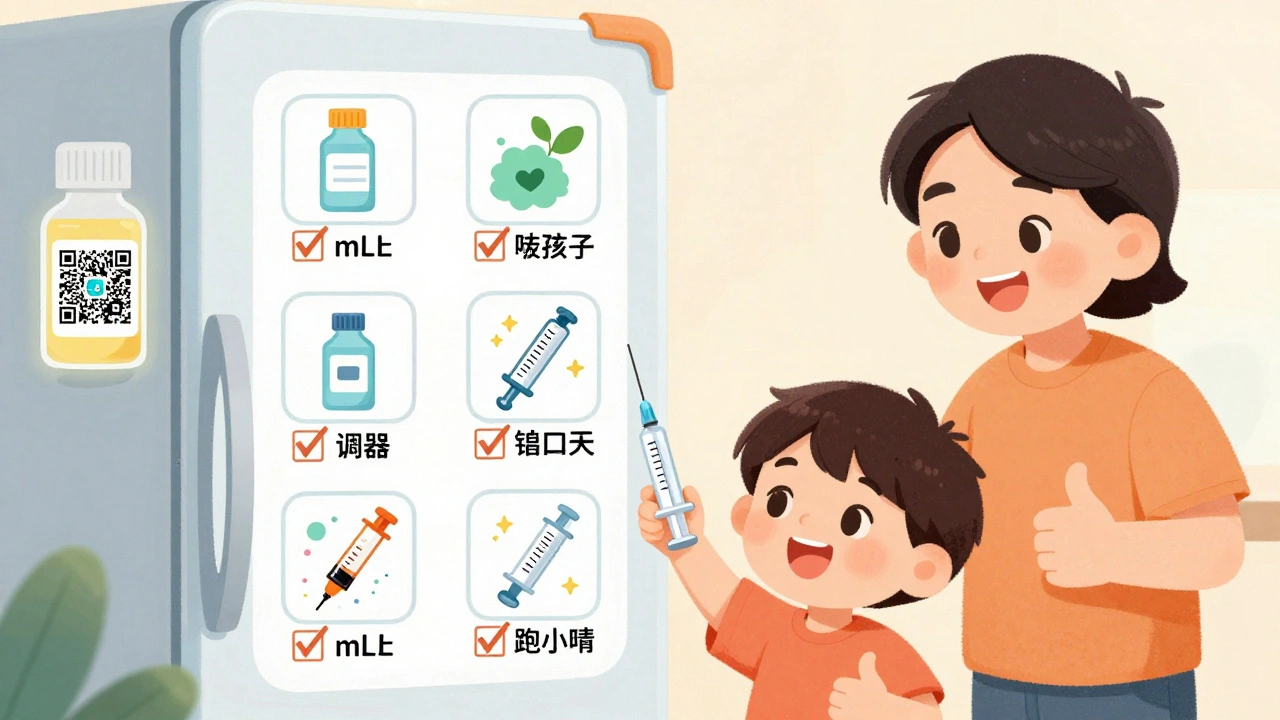
The FDA is rolling out new labeling rules this year. By 2025, all liquid prescription labels must include a simple pictogram showing how to use the measuring device. Think of it like a traffic sign-just a picture of a syringe with a line at 5 mL. Early tests show this cuts errors by 37%.
Some pharmacies, like Amazon Pharmacy and Medly, now include QR codes on labels. Scan it with your phone, and a short video shows exactly how to measure the dose. It’s not everywhere yet, but it’s coming fast.
Also, pediatricians are now trained to talk about medication safety during routine check-ups. If your child’s doctor hasn’t mentioned it, ask: “Do you have a quick tip on how to give this liquid medicine safely?”
Final Checklist Before Giving the Dose
- Is the dose written in mL only? (No tsp or tbsp)
- Is there a concentration listed? (e.g., 125 mg / 5 mL)
- Are decimal points formatted correctly? (0.5 mL, not .5 mL or 5.0 mL)
- Are you using the tool that came with the medicine?
- Have you checked the expiration date and storage instructions?
- Can you explain the dose back in your own words?
If you answered yes to all six, you’re doing it right. Medication errors are preventable. You don’t need to be perfect-just careful. One extra second reading the label can save a trip to the ER.
Can I use a kitchen spoon if I don’t have a measuring cup?
No. Kitchen spoons are not accurate. A teaspoon can hold anywhere from 2.5 mL to 7.5 mL. That’s a huge range. Even if you think your spoon is “standard,” it’s not reliable. Always use the tool that came with the medicine-or ask your pharmacy for a free oral syringe or dosing cup. It’s safer and just as easy.
Why does the label say 240 mg/5 mL but I only need to give 10 mL?
The concentration (240 mg/5 mL) tells you how strong the medicine is. If you give 10 mL, you’re giving twice that amount: 480 mg. The total dose (10 mL) is based on your weight, age, or condition. Always follow the “Take ___ mL” instruction, not the concentration. The concentration is just there so you understand how much medicine is in each part of the dose.
Is it safe to mix liquid medicine with juice or food?
Only if the pharmacist or doctor says it’s okay. Some medicines lose their effectiveness when mixed with certain foods or drinks. Others taste terrible and are meant to be given straight. If you’re unsure, ask. Never assume it’s fine-especially with antibiotics or heart medications.
What if the label is faded or hard to read?
Don’t guess. Take the bottle back to the pharmacy. They can reprint the label or give you a new bottle with a clear one. Pharmacies are required to provide legible labels. If they refuse, ask to speak to the pharmacist-in-charge. Your safety matters more than their convenience.
Do I need to keep the original bottle after transferring the medicine?
Yes. Always keep the original bottle with the label until the medicine is finished. Even if you pour it into a different container, the label has the concentration, expiration date, and instructions. If you lose it, you won’t know how much to give. Many people think transferring to a pill organizer is fine-but liquid medicine isn’t like pills. Always keep the original.
What to Do Next
If you’re caring for a child, elderly person, or someone with low health literacy, take 2 minutes right now and review the label with them. Use the checklist above. Ask them to explain it back. If they can’t, help them. Don’t wait for an accident to happen.
Pharmacies are getting better. But the final step always comes down to you. Read the label. Use the right tool. Ask questions. You’re not just following instructions-you’re preventing harm.

Comments (15)
parth pandya
man i just gave my kid 5ml of amoxicillin with a dinner spoon last week... thought it was close enough. now im sweating bullets reading this. thanks for the wake-up call. gonna grab a syringe from the pharmacy tomorrow.
shalini vaishnav
It’s appalling that Americans still rely on kitchen utensils for medicine. In India, we’ve used calibrated droppers since the 1990s. This isn’t rocket science-it’s basic hygiene. The FDA should have mandated this decades ago.
vinoth kumar
Just had a convo with my mom about this-she’s 72 and still uses teaspoons because ‘that’s how we’ve always done it.’ I printed out the checklist and taped it to her medicine cabinet. She’s not thrilled but she’s using the syringe now. Small wins, right?
bobby chandra
Let’s be real-this isn’t just about dosage. It’s about dignity. When you fumble with a sloppy spoon while your kid cries because the medicine tastes like burnt plastic, you’re not just risking health-you’re risking trust. The syringe? It’s not a tool. It’s a promise: ‘I won’t let you down.’
Archie singh
Typical. Another overwrought article pushing government mandates. People have been giving kids medicine since before the printing press. If you can’t read 5 mL, maybe you shouldn’t be parenting. Also, 5.0 mL is perfectly fine. Stop being so anal.
Gene Linetsky
Did you know the FDA’s ‘mL-only’ rule was pushed by Big Pharma? They make more money selling syringes than pills. And those QR codes? They’re tracking your phone. That’s how they know you’re giving your kid the wrong dose-so they can upsell you the ‘premium’ version next time.
Ignacio Pacheco
So… if I see ‘0.5 mL’ on a label, I’m safe. But if it’s ‘.5 mL’-I’m basically playing Russian roulette with my toddler? And nobody thought to put a warning on the bottle like ‘DO NOT TRUST YOUR EYES’? Huh.
Jim Schultz
Oh, wonderful. Another ‘educational’ post from someone who clearly never had to give medicine to a screaming 2-year-old at 3 a.m. while holding a cat and a half-eaten burrito. The ‘teach-back’ method? Try teaching back when your kid’s spitting it out and your dog just licked the syringe. Reality doesn’t come with bullet points.
Kidar Saleh
I work in a London pharmacy. We’ve had mL-only labels since 2004. We also give every patient a free syringe and a laminated card with the checklist. One elderly lady told me, ‘I used to give my grandkids medicine with a teaspoon until I almost lost one.’ She now keeps the syringe on her keychain. That’s the power of clarity.
Chloe Madison
I’m a nurse and I’ve seen this go wrong too many times. I keep a stash of free oral syringes in my bag. I hand them out like candy at school clinics. One mom cried because she’d been giving her son 5x too much for months. We don’t need more rules-we need more hands-on help. This post? It’s a start.
Vincent Soldja
Interesting. But where’s the data on compliance rates? Also, did you account for non-English speakers? This feels like a solution for a problem that doesn’t exist in most households.
Makenzie Keely
My cousin’s baby got sick last month-she used a spoon because the label was smudged. Took her to the ER. They gave her a new bottle, a syringe, AND a video QR code. She’s now the neighborhood’s go-to person for med safety. Sometimes, one person’s mistake becomes someone else’s lifeline.
Francine Phillips
Yeah, I read it. Makes sense. I’ll probably forget all of it next time I’m tired.
Katherine Gianelli
To anyone who’s ever stared at a label at 2 a.m. with a crying baby: you’re not dumb. You’re exhausted. This isn’t about being perfect-it’s about having tools that make it easier to be safe. Thank you for making those tools visible. I’m printing this out for my mom’s drawer.
Joykrishna Banerjee
Of course, the ‘mL-only’ rule was forced by bureaucrats who’ve never held a baby. In traditional Ayurvedic practice, we use ‘tola’ and ‘masha’-precise, culturally rooted units. Why impose Western metric dogma? And why does this post ignore that 78% of pediatric dosing errors occur in hospitals, not homes? You’re blaming the patient while the system fails.