
When you take a pill, use an inhaler, or eat packaged food, you assume it’s safe. But how do you know it really is? The answer lies in a quiet, unpredictable force: the unannounced FDA inspection. These surprise visits aren’t about catching companies off guard for the sake of it. They’re about finding the truth - the real, everyday state of a manufacturing facility - before something goes wrong.
Why surprise inspections matter
The U.S. Food and Drug Administration doesn’t call ahead. Not usually. That’s by design. If a factory knows inspectors are coming, they clean up. They fix what’s broken. They hide what’s not. But real life doesn’t pause for inspections. Real safety means checking how things run on a Tuesday morning in March, not on the day after someone gets a heads-up.
Before May 2025, this rule mostly applied to factories in the U.S. Foreign facilities - the ones making 80% of the active ingredients in American medicines - got weeks of notice. They arranged translators, pulled records, and rehearsed answers. Meanwhile, domestic plants faced random visits. That wasn’t fair. And it wasn’t safe.
The FDA saw the numbers: when foreign facilities were given advance notice, inspectors found serious problems more than twice as often as during unannounced visits to U.S. sites. That’s not a coincidence. It’s a system that rewarded deception.
The May 2025 shift: equal rules for everyone
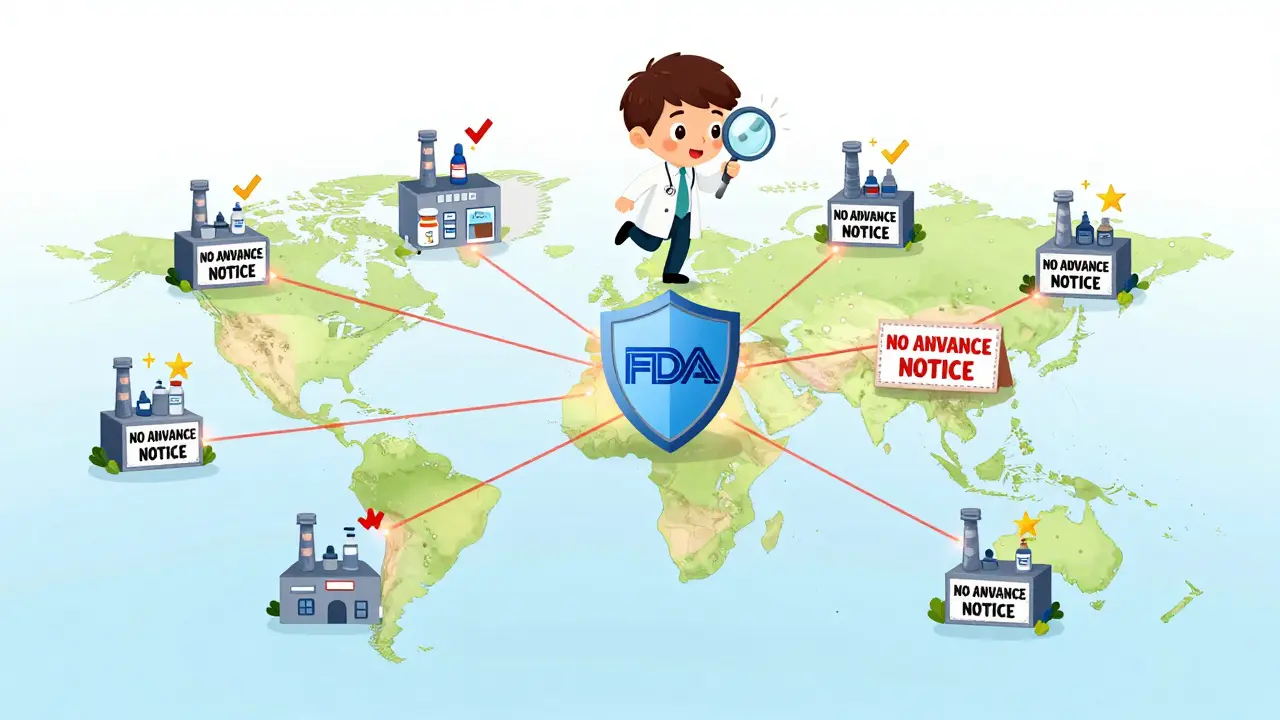
On May 6, 2025, the FDA made a historic move. They extended unannounced inspections to all foreign manufacturing facilities that supply products to the U.S. No more warnings. No more prep time. If you make medicine, food, or medical devices for American consumers, you’re subject to the same rules as a plant in Ohio or California.
This wasn’t a small tweak. It was a full overhaul of global oversight. The FDA had been testing this in India and China for years. Now, it’s the rule everywhere. Around 3,000 foreign facilities are affected annually, across more than 90 countries. The goal? Regulatory parity. Same standards. Same surprise. Same accountability.
It also ties directly to President Trump’s May 5, 2025 executive order, which demanded stronger oversight of overseas manufacturing. The FDA didn’t just comply - they expanded it. They now say this marks “a new era in FDA enforcement - stronger, smarter, and unapologetically in support of the public health and safety of Americans.”
What happens during an unannounced visit
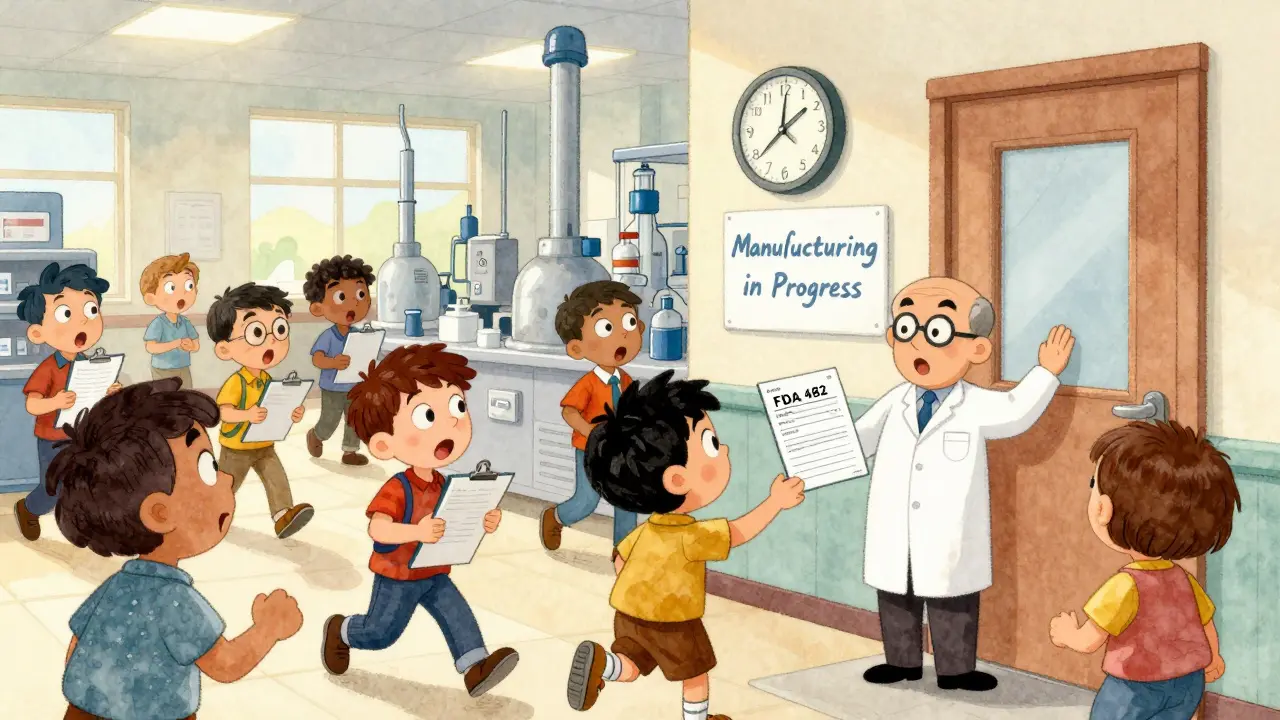
Imagine it: you’re running production. A knock on the door. Two people in suits show ID. One hands you Form FDA 482 - the official Notice of Inspection. No warning. No time to call your lawyer. You have to respond, right then.
The inspectors don’t come to chat. They come to look. They’ll ask for:
- Standard Operating Procedures (SOPs) - and proof they’re actually followed
- Manufacturing records - from batch logs to environmental monitoring
- Quality control data - including raw material testing and finished product results
- Facility maintenance logs - HVAC, water systems, cleaning schedules
- Employee training records - not just certificates, but proof of competency
They might walk into a sterile room mid-production. They might pull a random batch and demand the full chain of documentation. They don’t care if you’ve been “cleaning up.” They care if you’re always clean.
Inspections can last hours or days. It depends on the size of the facility, the complexity of the processes, and what they find. Even if they issue a “No Action Indicated,” that’s still valuable intel. It tells the FDA the facility is operating properly - and that’s a win for public safety.
Who gets inspected - and who doesn’t
Not every facility is treated the same. The FDA uses a risk-based system.
Class II and Class III medical devices usually get announced inspections every two years. But quality system inspections - the ones that check if your whole manufacturing process is built to last - are always unannounced. So are “for cause” inspections. That’s when the FDA gets a tip, sees a pattern of failures, or gets a complaint. No warning. Just show up.
Pharmaceutical manufacturers? Unannounced visits are the norm. Especially if you’re making injectables, sterile products, or high-risk generics. One Bioprocess International report described an inspector walking into a sterile manufacturing area mid-run. No notice. No pause. Just a question: “Can I see your environmental monitoring logs for the last 30 days?”
Food producers? Same deal. If you’re making baby formula, peanut butter, or packaged meals for the U.S. market, you’re on the list. The FDA doesn’t care if you’re in Bangalore or Baltimore. If it ends up on an American shelf, it’s fair game.
How companies prepare - because you can’t wait
You can’t prepare for a surprise. But you can prepare for the possibility of one.
Companies that survive these inspections don’t panic. They don’t scramble. They’ve built systems that work every day - not just on inspection day.
- Use a quality management system (QMS) that tracks everything automatically - not a spreadsheet that gets updated when someone remembers
- Train staff daily on SOPs - not once a year during orientation
- Run mock inspections every quarter - with no warning, just like the real thing
- Designate a response team: who answers the door? Who retrieves records? Who speaks to inspectors?
- Keep all documentation digital, searchable, and backed up - physical files can be lost, damaged, or “conveniently” missing
Greenlight Guru put it bluntly: “You won’t always have time to duct-tape your legacy system tools before they walk through your door.” That’s the truth. If your records are messy, your training is outdated, or your cleaning logs are fake - inspectors will find it. And they’ll write it down.
The FDA has the power to block shipments, shut down production, or even issue warning letters that make investors run. A single Form 483 observation can cost millions. So why gamble?
The global ripple effect
Before 2025, the FDA often coordinated with foreign regulators. They’d notify the local health authority, invite them to observe, and share inspection plans. That helped build trust. But under the new unannounced policy, that’s unclear.
Lawyers at Hogan Lovells are asking: Will the FDA still call ahead to foreign authorities? Or will they show up cold, like they do in the U.S.? The answer could change how global regulators work together - and whether foreign governments feel their sovereignty is being respected.
For now, the FDA hasn’t said. But companies can’t wait for clarity. They need to assume the worst: that inspectors will arrive without warning, without coordination, and without mercy.
The bottom line
Unannounced inspections aren’t punishment. They’re protection. They’re how the FDA makes sure that the medicine you rely on isn’t just labeled right - it’s made right.
For manufacturers, it’s not about fear. It’s about discipline. It’s about building a culture where compliance isn’t a checklist - it’s a habit. Because when the door knocks, you won’t have time to fix what’s broken. You’ll only have time to show what you’ve already built.
The FDA’s message is clear: if you want to sell to Americans, you play by American rules. No exceptions. No advance notice. Just truth.
Are all FDA inspections unannounced?
No. While most inspections are unannounced, there are exceptions. For example, the FDA sometimes gives advance notice to foreign facilities if they’re coordinating with local authorities, or for certain programs where records need to be prepared. Class II and Class III medical device manufacturers often receive scheduled visits every two years. But quality system inspections - the ones that check your entire manufacturing process - are always unannounced. So are inspections done "for cause," like after a complaint or a pattern of violations.
What happens if a company refuses an FDA inspection?
Refusing an FDA inspection is a serious violation. The FDA is legally authorized to take action against any facility that delays, denies, or limits access. This can include seizing products, issuing warning letters, or blocking imports. In extreme cases, the FDA can pursue criminal charges. Companies that resist inspections are seen as high-risk, and their products are likely to be flagged for future scrutiny or even banned from the U.S. market.
Do unannounced inspections only target foreign facilities?
No. Unannounced inspections have always been the standard for U.S.-based facilities. The big change in May 2025 was extending this practice to foreign manufacturers. Before that, foreign sites usually got weeks of notice. Now, both domestic and international facilities face surprise visits. The goal is to eliminate a double standard and ensure all products entering the U.S. meet the same safety standards.
How often do unannounced inspections happen?
There’s no fixed schedule. The FDA uses a risk-based approach. High-risk facilities - like those making sterile injectables or active pharmaceutical ingredients - are inspected more frequently. Low-risk facilities might go years without one. But since the May 2025 policy change, the FDA has signaled it will increase the frequency of unannounced inspections at foreign sites. The exact timing depends on inspection history, product type, and regulatory priorities.
What documents do FDA inspectors usually request?
Inspectors typically ask for Standard Operating Procedures (SOPs), manufacturing batch records, quality control test results, equipment maintenance logs, environmental monitoring data (especially for sterile areas), employee training records, and complaint handling logs. They want to see if procedures are documented, followed, and consistent - not just on paper, but in daily practice. Digital records that are time-stamped and auditable are far more valuable than handwritten logs.

Comments (13)
Skilken Awe
Let’s be real - the FDA’s ‘unannounced’ inspections are just corporate theater. You think they’re catching bad actors? Nah. They’re catching the ones too lazy to fake their logs properly. Meanwhile, the big players? They’ve got entire teams on standby 24/7, ready to scrub digital trails and deploy PR spin the second a knock sounds. This isn’t safety - it’s a compliance arms race where the only winners are the consultants charging $800/hour to teach you how to lie better.
And don’t get me started on ‘regulatory parity.’ You think India’s factories are suddenly going to start running like Medtronic? Please. They’re still using 1998 Excel sheets and praying to Ganesha for clean air. The FDA’s just shifting blame overseas so Americans can keep feeling safe while their pills are made by people who’ve never seen an OSHA poster.
Real solution? Ban all foreign pharma. Build domestic capacity. Stop pretending surveillance is a substitute for sovereignty.
andres az
Unannounced inspections? More like unannounced extortion. Who authorized the FDA to start acting like a mob boss? No warning? No due process? You think this stops counterfeits? Nah. It just makes companies hire ex-CIA to intercept inspectors before they even land. I’ve seen the reports - half these inspections are triggered by competitors filing anonymous tips. It’s not about safety. It’s about market control.
And don’t even get me started on Trump’s ‘executive order.’ That wasn’t public health. That was a tax on globalization. Now every small manufacturer in Vietnam has to pay $50k just to get a single batch approved. Meanwhile, the big boys? They’ve got lobbyists writing the inspection checklists. This isn’t oversight. It’s a cartel.
Steve DESTIVELLE
The door knocks and the truth walks in not as a visitor but as a mirror
What is safety if not the absence of pretense
When we prepare for inspection we prepare for performance
But when we live without warning we live as we are
Pharmaceuticals are not products they are promises made in molecules
The factory floor is not a stage it is a covenant
And the inspector does not judge the facility he judges the soul of the system
We speak of compliance as if it is a law but it is a habit
A habit forged in silence not in spectacle
What is truth but the daily repetition of what is right
And what is governance but the refusal to allow illusion to become routine
The FDA does not seek evidence they seek authenticity
And we have forgotten that authenticity cannot be scheduled
It must be lived
Stephon Devereux
This is actually one of the most important public health moves in decades - and nobody’s talking about it right. The shift to unannounced inspections globally isn’t about punishment. It’s about integrity.
Think about it: if you’re making insulin or baby formula, the margin for error is zero. You can’t have a facility that’s clean on inspection day but dusty the rest of the year. That’s not negligence - that’s manslaughter waiting to happen.
Companies that survive these inspections aren’t the ones with the fanciest SOPs. They’re the ones who trained their staff to treat every shift like it’s inspection day. That’s culture. That’s discipline. That’s what safety looks like when it’s not performative.
The FDA didn’t just change a policy - they changed the incentive structure. Now, quality isn’t a checkbox. It’s the default. And that’s how you stop tragedies before they start. This is leadership. Not perfect, but necessary.
If you’re a manufacturer reading this - stop looking for loopholes. Start building systems that work even when no one’s watching. That’s the only thing that matters.
Reggie McIntyre
Imagine walking into a kitchen and the chef says ‘oh hey, we just cleaned up for you’ - but you smell burnt garlic from last week, the sink’s full of mold, and the meat’s been sitting out for three days.
That’s what pre-2025 inspections were like. The FDA finally said: ‘Nope. We’re not here for the show. We’re here for the food.’
And honestly? It’s about damn time. I’ve seen too many news stories about tainted meds and baby formula recalls - all because someone thought ‘we’ll fix it when they come.’
Now? Every facility - whether in Ohio or Odisha - has to run like it’s always being watched. No more ‘we’ll get to it tomorrow.’ No more ‘it’s just a small issue.’
This isn’t bureaucracy. It’s basic respect for human life. And yeah - it’s gonna cost companies money. But not as much as a lawsuit, a shutdown, or a funeral.
Carla McKinney
Let’s not pretend this is about safety. It’s about control. The FDA has become a regulatory empire, and this move is just another power grab. Why unannounced? Because it removes accountability. No paper trail. No oversight of the inspectors. Who decides who gets inspected? Who audits the auditors?
And let’s talk about the hypocrisy. Domestic facilities are inspected more frequently than foreign ones - but now that they’re ‘equal,’ we’re just doubling down on an already bloated system. No one asked if this is efficient. No one asked if it reduces risk. They just said ‘do it because it sounds tough.’
Meanwhile, the real problem - underfunded labs, outdated tech, lack of staff - is ignored. This is performative regulation. It looks scary. It does nothing.
Ojus Save
this is cool and all but like… how do they even pull this off? like i live in india and i heard some factory got visited and the guy just walked in and said ‘show me your temp logs’ and they were like ‘uhhh we dont have those’ and then boom - shipment blocked. wild. also why is everyone so scared of a knock on the door? just do your job right lol
Jack Havard
Unannounced inspections? Sure. But let’s be honest - the FDA doesn’t even inspect 5% of foreign facilities. The ‘3,000 facilities annually’ claim is marketing. Real numbers? More like 120. And they pick the ones with the shiniest websites. Meanwhile, the real problem - the factories with no internet, no English-speaking staff, and no hope of compliance - fly under the radar.
This isn’t reform. It’s theater. A distraction from the fact that the FDA is chronically understaffed and overpromising. You can’t inspect your way out of a broken supply chain. You need investment. You need transparency. You need cooperation.
Instead, we get ‘surprise’ raids that look great in press releases but do nothing to stop the next crisis.
Jim Johnson
Look - I get the fear. But here’s the truth: if your facility can’t handle an unannounced visit, you shouldn’t be making medicine.
That’s not harsh. That’s common sense.
Think about it - you don’t get a heads-up before your kid’s school inspection. Or your car’s safety check. Or your house’s fire code. Why should a factory that’s literally feeding or healing people get special treatment?
Mock inspections? Quarterly? Yes. That’s smart. Not because you’re scared - because you’re professional.
And if you’re reading this and you’re stressed? Good. That means you care. Now go fix your records. Train your team. Stop hoping the inspector won’t come. Start hoping they’ll say ‘no action needed.’
That’s not fear. That’s responsibility.
Vamsi Krishna
Let me tell you something about power - it doesn’t knock. It bursts in.
The FDA doesn’t ask for access. They demand it. And the global south? They’re expected to bow to a system built in Washington, with documents written in English, by people who’ve never smelled a sterile room in monsoon season.
Is this safety? Or is it cultural imperialism wrapped in a clipboard?
You want compliance? Then pay for translators. Fund training. Hire local inspectors. Don’t send a guy from Ohio with a checklist and expect a village factory in Kerala to meet your standards when they don’t even have running water.
This isn’t oversight. It’s extraction. And the real victims? The patients who never even get to the pharmacy because the shipment got stuck in customs while someone in Maryland checked a box.
Brad Ralph
knock. no warning. just truth. 🤷♂️
Suzette Smith
Okay but… what about the workers? The ones who actually run the machines? Are they trained? Are they paid? Are they protected? Or are we just turning this into a game where the factory gets punished but the CEO walks away with a bonus?
I’ve worked in pharma. The people on the floor? They’re the ones who notice the broken HVAC. The leaky seal. The missing log. But they’re told to keep quiet. ‘Don’t make waves.’
So now we’re punishing the system… while ignoring the people who could’ve prevented it all?
Maybe we need inspections… but also whistleblower protections. And raises. And dignity.
Autumn Frankart
Unannounced inspections? Sounds great. Until you realize the FDA’s entire budget for foreign inspections is less than what Apple spends on logo redesigns.
They’re not inspecting. They’re performing. They show up once every three years in China and take photos with the plant manager. The rest? Paperwork. Self-reporting. PR stunts.
This isn’t about safety. It’s about optics. The American public wants to feel like their government is ‘tough on foreign manufacturers.’ So they give them a shiny new policy - and call it reform.
Meanwhile, the real threat? Counterfeit pills from dark web labs. And those? They don’t even have factories. They have WhatsApp groups.
Stop chasing ghosts. Start fighting monsters.