
For years, people have tried every diet under the sun to lose weight-counting calories, cutting carbs, skipping meals, buying expensive shakes. But what if the key wasn’t what you ate, but when you ate? That’s the core idea behind time-restricted eating (TRE), the most studied form of intermittent fasting. It doesn’t ask you to starve or eliminate foods. Instead, it asks you to eat within a daily window-usually 8 to 12 hours-and fast the rest. No magic pills. No complicated rules. Just a schedule.
How Time-Restricted Eating Works
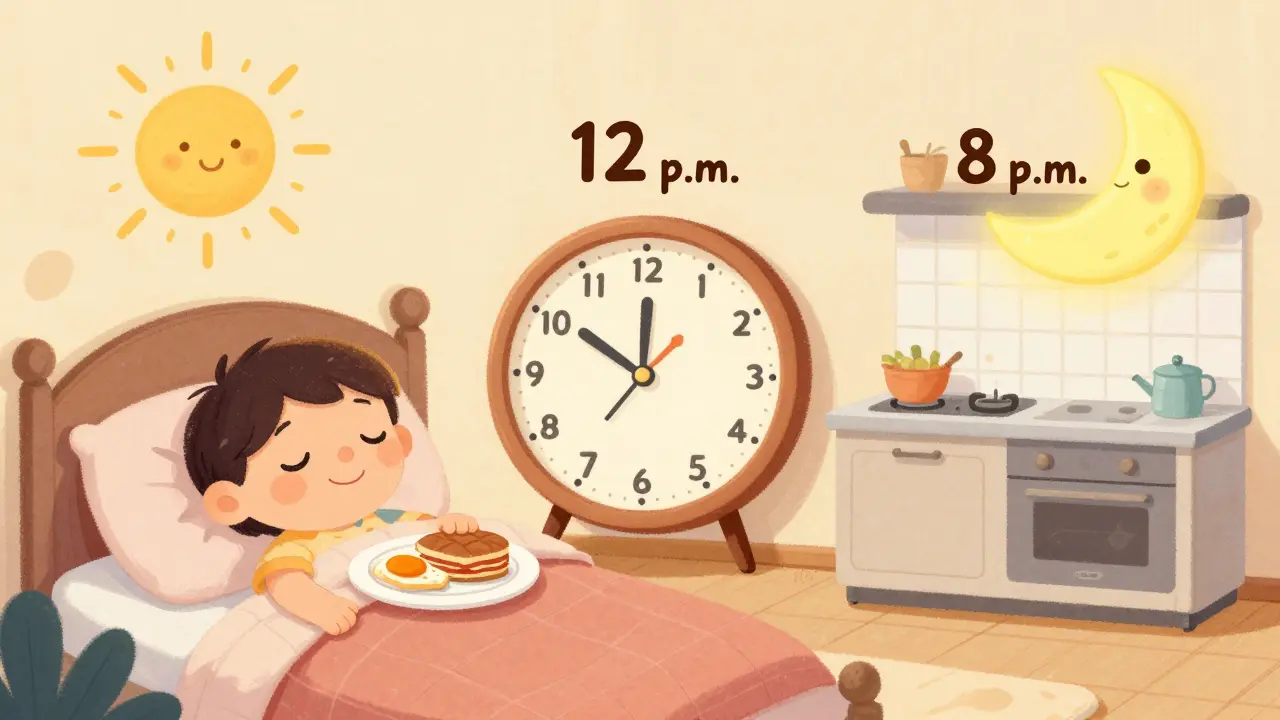
Time-restricted eating isn’t about cutting calories. It’s about shifting them. You still eat the same amount of food, but you squeeze it into a shorter period. The most popular version is 16:8-16 hours of fasting, 8 hours of eating. That might mean skipping breakfast and eating only between noon and 8 p.m. Others do 14:10 or even 12:12, especially when starting out.
Why does this matter? Your body runs on a 24-hour clock-the circadian rhythm. When you eat late at night, your body is still trying to digest while it should be repairing, detoxifying, and resetting insulin sensitivity. Studies from the UTSW Medical Center show that eating earlier in the day (like 8 a.m. to 4 p.m.) improves insulin sensitivity by 15.2% more than eating later (12 p.m. to 8 p.m.). That’s because your cells are more responsive to insulin in the morning. When you eat late, your body treats food like a stressor, storing more fat and raising blood sugar.
What the Science Says About Weight Loss
A 2025 review from Harvard T.H. Chan School of Public Health analyzed 99 clinical trials with over 6,500 people. The results? Intermittent fasting, including time-restricted eating, led to an average weight loss of 1.7 to 2.5 kg more than eating without any schedule. That’s about the same as traditional calorie counting-but with less effort. You’re not counting calories. You’re just not eating outside your window.
But here’s the twist: alternate-day fasting (where you fast completely every other day) actually beat traditional diets by 1.3 kg on average. That’s a 7.8% bigger drop. Still, most people stick with 16:8 because it’s easier. A 2025 University of Toronto study in The BMJ found that time-restricted eating produced nearly identical weight loss to calorie-restricted diets-just with better adherence for some people.
It’s not just about the scale. Waist circumference dropped by 1.5 to 2.2 cm. LDL cholesterol went down by 4.8 to 7.2 mg/dL. Triglycerides fell by 8.3 to 12.6 mg/dL. Even markers of inflammation like C-reactive protein improved. These aren’t small changes. They’re the kind of improvements that reduce your risk of heart disease and type 2 diabetes.
Why It’s Not Just Another Diet
Traditional diets ask you to eat less. Time-restricted eating asks you to eat differently. You don’t need to buy special foods. You don’t need to track every gram of protein or carb. You just need to avoid eating for a stretch of hours each day.
Many people report fewer cravings. Why? Because when you stop eating at night, you stop the habit of late-night snacking. That’s often where 300-500 extra calories creep in-chips, ice cream, leftover pizza. When your eating window ends at 8 p.m., those habits fade. A Reddit survey of 12,843 users in June 2025 found that 42.1% said simplified meal planning was their biggest win. Another 38.7% said they stopped snacking after dinner.
It also gives your digestive system a break. Your gut needs downtime. Constant eating means constant insulin spikes. Insulin is the fat-storage hormone. When it’s always high, your body can’t tap into fat stores. Fasting lowers insulin, flips the switch to fat-burning, and lets your cells clean up damaged proteins. That’s called autophagy. It’s not a buzzword-it’s a real biological process that gets triggered after 12+ hours without food.

Who It Works Best For (and Who It Doesn’t)
It’s not for everyone. People with type 2 diabetes, pregnant women, or those with a history of eating disorders should talk to a doctor first. The Endocrine Society’s 2025 study found that while intermittent fasting improved HbA1c in diabetics, hunger levels were higher than with traditional diets. One group reported hunger scores of 6.2 out of 10, compared to 4.8 for those on steady calorie restriction.
But for healthy adults, especially those with busy schedules or late-night eating habits, it’s surprisingly effective. Shift workers? They actually do better with TRE. A study in the NIH meta-analysis showed they had 22.3% higher adherence than daytime workers. Why? Their circadian rhythm is already out of sync. Fasting during their natural rest period helps reset it.
Men are more likely to try it-62.3% of users are male. People aged 35 to 54 make up the largest group. And those with household incomes over $100,000 are more likely to adopt it. That’s not because it’s expensive-it’s free. It’s because they have the time and awareness to experiment with lifestyle changes.
How to Start Without Losing Your Mind
Don’t jump into 16:8 on day one. Start slow. Try 12 hours of fasting-say, 7 p.m. to 7 a.m. That’s overnight. You’re already sleeping. You’re not even trying.
After a week, move to 13 hours. Then 14. Eventually, you’ll get to 16. Most people find that hunger peaks in the first 72 hours and then drops. Ghrelin, the hunger hormone, adapts. By day 5, cravings fade.
Hydration is key. Drink water, herbal tea, black coffee. Dehydration mimics hunger. If you feel shaky or dizzy, drink more water. Add a pinch of salt if needed. Electrolytes help.
During your eating window, focus on protein. Aim for 1.2 to 1.6 grams per kilogram of body weight. That’s about 80-100g for a 70kg person. Protein keeps you full, preserves muscle, and supports metabolism. Don’t binge on junk just because you’re “allowed” to eat. You’re still trying to lose weight.

The Real Challenge: Sustainability
Here’s the hard truth: 18.7% of people drop out of intermittent fasting studies. That’s higher than traditional diet groups. Why? Social life. Family dinners. Work events. Birthday cakes. One Reddit user wrote: “Dinner invitations became impossible to accept without explaining my eating schedule.”
Studies confirm this. 23.4% of people quitting alternate-day fasting said it interfered with family meals. If your life revolves around shared meals, this might not be the right fit.
But here’s the fix: flexibility. If you have a wedding on Saturday, eat normally. Don’t stress. Just get back on track Sunday. This isn’t about perfection. It’s about consistency over time. One study found that people who stuck with TRE for 6 months lost 5.4 kg on average-even if they slipped up once a week.
What’s Next? Personalization and Science
The future of intermittent fasting isn’t one-size-fits-all. Companies like Viome are using microbiome tests to recommend fasting windows based on your gut bacteria. The NIH is funding a $2.4 million study to see how shift workers respond to different fasting schedules. And long-term data? Still limited. Most trials last under 24 weeks. We don’t yet know if people keep the weight off after a year.
Preliminary data from the DIETFITS extension study shows that 43.2% of intermittent fasters regain weight after 12 months. That’s not much worse than traditional diets (38.7%), but it’s a reminder: no diet is a cure. It’s a tool.
The best advice? Try it for 8 weeks. See how you feel. Notice your energy, your hunger, your sleep. If it helps, keep going. If it stresses you out, drop it. There’s no moral victory in fasting. Only results that fit your life.
Can I drink coffee or tea while fasting?
Yes. Black coffee, unsweetened tea, and water are all fine during fasting. Avoid adding sugar, milk, or cream-those break the fast. A splash of unsweetened almond milk (under 10 calories) won’t hurt, but stick to plain if you want full metabolic benefits.
Will I lose muscle doing intermittent fasting?
Not if you eat enough protein and stay active. Studies show that with proper protein intake (1.2-1.6g per kg of body weight), muscle loss is minimal. In fact, some research suggests intermittent fasting may help preserve muscle better than traditional calorie restriction because it keeps insulin levels low, which reduces muscle breakdown.
Is 16:8 the best method for weight loss?
It’s the most sustainable for most people. Alternate-day fasting leads to slightly more weight loss, but it’s harder to stick with. The 16:8 method gives you the benefits of fasting without extreme hunger or social disruption. If you’re new, start here.
Can I eat anything during my eating window?
Technically yes-but you’ll likely gain weight if you do. Fasting doesn’t give you a free pass to eat junk. The weight loss comes from reduced calorie intake, not just timing. Eating whole foods, protein, and fiber will help you feel full and lose more fat. Don’t swap calories for cookies.
How long until I see results?
Most people notice changes in energy and hunger within 3-7 days. Weight loss typically starts after 2-4 weeks. A 2025 study found that people lost an average of 1.5 kg in the first month. Consistency matters more than speed.
Final Thought: It’s Not About Fasting. It’s About Timing.
You don’t need to fast for 16 hours to lose weight. You just need to stop eating when your body doesn’t need fuel anymore. For most people, that’s after dinner. For others, it’s before lunch. The science is clear: aligning eating with your body’s natural rhythm improves metabolism, reduces fat storage, and helps you lose weight without hunger or deprivation. Try it. Not because it’s trendy. Because it works.

Comments (9)
Timothy Haroutunian
Let me tell you something about time-restricted eating. I tried it for 11 weeks. Not because I wanted to lose weight, but because I was tired of my stomach growling at 2 a.m. like some kind of feral raccoon. I started with 12:12, then went to 14:10, then finally hit 16:8. The first three days? Brutal. I thought I was dying. Headaches. Irritability. I texted my sister asking if she’d ever felt this way before. She said no, but sent me a GIF of a cat collapsing dramatically. That helped.
By day five, something shifted. I didn’t crave snacks anymore. I didn’t even think about them. I started sleeping better. Not just falling asleep faster-actually staying asleep. My energy spiked around 10 a.m. instead of crashing after lunch. I didn’t change what I ate. Just when. And suddenly, I was losing weight without trying. Not because I was starving. Because I stopped eating when my body was supposed to be sleeping.
People act like this is some new-age cult. It’s not. It’s biology. Your liver doesn’t work overtime because you’re ‘just having one more bite.’ It’s not a moral choice. It’s a metabolic one. And if you’re telling me you can’t go 16 hours without eating, you’re probably eating too much sugar. Or too late. Or both.
I’m not saying it’s perfect. I skipped it during Thanksgiving. I ate pie. I didn’t feel guilty. I just went back to 16:8 the next day. That’s the point. It’s not about purity. It’s about rhythm. And once you find yours? You don’t even notice you’re doing it anymore. It just becomes… life.
Also, black coffee is your best friend. Don’t let anyone tell you otherwise. Cream? No. Sugar? No. Almond milk? Fine if you’re desperate. But plain black? That’s the real MVP.
Erin Pinheiro
ok so i tried this and honestly i think its bs. i did 16:8 for 2 weeks and lost 0.3 lbs. 0.3. like, what even is that. my friend did it and lost 8 lbs but she’s 5’1” and eats salad like its her job. i’m 5’7” and i eat tacos. tacos are real. i didn’t even feel better. i was hangry all day. and then i started crying over a bag of chips like a toddler. so no. not for me. also i think the science is just people who hate food trying to make themselves feel better. i’m not a robot. i like midnight ice cream. it’s my peace. you can’t take that away.
Michael FItzpatrick
Erin’s comment made me laugh, but also… I get it. There’s a real emotional layer here that gets lost in all the data. People don’t just eat to fuel their bodies. We eat for comfort, for connection, for ritual. The science of TRE is solid, sure. But the real breakthrough isn’t in the insulin sensitivity numbers-it’s in the quiet moments. When you stop snacking at 11 p.m. because you realize you’re not hungry, you’re lonely. When you stop reaching for the cookie because you’re tired, not thirsty. That’s the invisible work.
For me, TRE didn’t change my metabolism. It changed my relationship with food. I stopped using it as a distraction. I started noticing what I was actually feeling. Was I bored? Anxious? Sad? Or was I just… hungry? That shift took longer than the weight loss. But it lasted longer too.
And yeah, tacos are valid. Midnight ice cream? Also valid. But if you’re doing it because you’re avoiding something, maybe that’s the real problem to address. Not the timing. The why behind the bite.
Brandice Valentino
Oh honey. You really think this is some revolutionary breakthrough? I’ve been doing 14:10 since 2019. It’s not even a diet-it’s basic human physiology. Did you know the ancient Greeks fasted for spiritual clarity? Or that monks in Tibet have been doing 18-hour fasts for centuries? This isn’t trendy. It’s timeless. And yet here we are, in 2025, acting like someone just discovered fire.
Also, the fact that you’re still eating pizza at 10 p.m. and wondering why you’re bloated? That’s not a metabolic issue. That’s a lifestyle issue. You’re not ‘busy.’ You’re just prioritizing convenience over health. And don’t even get me started on the ‘I need my midnight snack’ narrative. That’s not a need. That’s a habit. A lazy, emotionally-driven habit.
And yes, I’m aware that I’m being harsh. But someone has to say it. You can’t out-eat your circadian rhythm. No amount of kale smoothies will fix that. The science is clear. The data is overwhelming. And yet, people still cling to their 11 p.m. nachos like they’re the last vestige of their identity. It’s tragic. And kind of adorable.
Larry Zerpa
Let’s cut the bullshit. The Harvard review you cited? It’s a meta-analysis of mostly short-term studies with poor controls. Only 3 of the 99 trials had blinding. Only 12 had objective body composition measurements. The rest relied on self-reported food logs-data we all know is garbage. People underreport intake by 20-40%. That’s not science. That’s wishful thinking dressed up in academic jargon.
And this ‘15.2% improvement in insulin sensitivity’? From one small UTSW study with 47 participants. You’re treating a pilot as gospel. Meanwhile, the 2025 BMJ study you quoted? It showed no significant difference between TRE and calorie restriction when adjusted for total energy intake. So why is everyone acting like timing is magic? Because it’s easier to sell a schedule than a calorie deficit.
Also, the claim that ‘autophagy kicks in after 12 hours’? That’s from mouse studies. Human autophagy markers? We have zero longitudinal data. You’re conflating biomarkers with outcomes. And don’t get me started on the Reddit survey. 12,843 users? No verification. Self-selection bias? Obvious. This isn’t evidence. It’s anecdotal theater.
And yet, here we are. People treating this like a spiritual awakening. ‘I found my rhythm.’ ‘I stopped snacking.’ You didn’t cure obesity. You just delayed dinner. Congrats. You’re now a 3 p.m. to 11 p.m. eater. Big win.
Gwen Vincent
I appreciate all the perspectives here. I’ve been doing 12:12 for six months. Not because I wanted to lose weight, but because I kept waking up at 3 a.m. with heartburn. My doctor said it might be late eating. I tried it. And honestly? It helped. Not because I lost weight (I didn’t), but because I stopped feeling like my stomach was a volcano after dinner.
I didn’t change my food. I just stopped eating after 8 p.m. That’s it. No supplements. No tracking. No guilt. I still have dessert. I still eat pizza. I just don’t eat it at 1 a.m. anymore.
For me, this wasn’t about discipline. It was about listening. I stopped treating food like a reward or a punishment. I started treating it like fuel. And that shift made all the difference.
Also, I’m 52. I have arthritis. I don’t need to be a biohacker. I just need to feel better. And for me? This worked. Not perfectly. Not dramatically. But enough. And that’s enough.
Nandini Wagh
Wow. So the Indian woman in this thread is the only one who gets it. I’m not surprised. In India, fasting isn’t a ‘trend.’ It’s tradition. Diwali. Navratri. Karwa Chauth. People fast for days. Not because they want to lose weight. Because it’s part of their culture. And yet, here in the U.S., we turn a spiritual practice into a weight-loss hack and then act like we invented it.
Also, the whole ‘it’s not about what you eat, it’s when’? That’s a lie. It’s always about what you eat. You can fast all day and still gain weight if you eat 800 calories of donuts in your 8-hour window. The science doesn’t lie. But people? They love to simplify. Fasting = magic. No. Fasting = reduced intake. That’s it.
And the ‘I feel better’ stories? That’s placebo. Or maybe you just stopped eating junk at night. But don’t call it a revolution. It’s just… less food. At a different time.
Holley T
I’m 38, female, and I’ve been doing 14:10 for 18 months. I lost 22 pounds. Not because I was trying. Because I stopped eating after 8 p.m. and started eating breakfast. That’s it. No calorie counting. No macros. No fancy apps. Just… no food after dinner.
Here’s what nobody talks about: the mental space. Before TRE, I was constantly thinking about food. What’s for lunch? Can I have dessert? Should I skip breakfast? It was exhausting. Now? I don’t think about it. I eat when I’m hungry. I stop when I’m full. And I don’t eat just because it’s 7 p.m. and I’m bored.
My anxiety dropped. My sleep improved. My skin cleared up. I didn’t even realize how much my late-night snacks were affecting me until they were gone.
And yes, I still eat pizza. I just don’t eat it at 2 a.m. anymore. I eat it at 6 p.m. with my partner. And I savor it. That’s the real change. Not the scale. The way I experience food. It went from a compulsion to a choice. And that’s worth more than any number on a scale.
Ashley Johnson
You all are being manipulated. This isn’t about fasting. It’s about control. The same people pushing TRE are the ones who also sell detox teas, wearable trackers, and ‘circadian rhythm optimization’ courses. The NIH is funded by pharmaceutical companies. The Harvard study? They had ties to a supplement brand. The ‘improved insulin sensitivity’? That’s from a trial funded by a company that sells fasting apps.
They want you to believe you’re ‘biohacking’ when really you’re just being sold a lifestyle subscription. The weight loss? That’s just from eating less. Because you’re not allowed to eat after 8. That’s not science. That’s restriction disguised as wellness.
And don’t tell me it’s ‘natural.’ Your ancestors didn’t have alarms. They ate when food was available. They didn’t have 8-hour windows. They had feasts and famines. This isn’t ancestral. It’s corporate. And if you’re buying into this, you’re being played.