
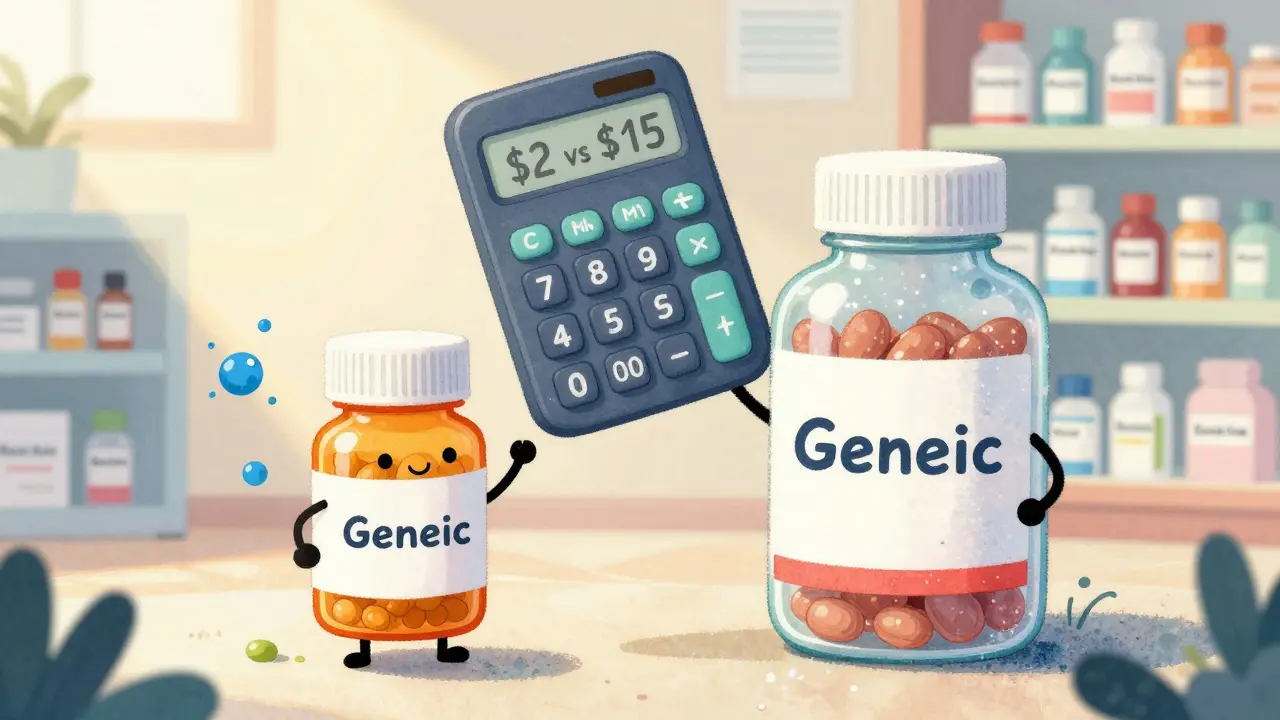
Why does a bottle of generic ibuprofen cost $2 while the brand-name version costs $15? It’s not magic. It’s math. And the numbers tell a clear story: generic drugs are cheaper because they skip the most expensive parts of drug development and rely on scale, efficiency, and regulation to cut costs without cutting safety.
They Don’t Have to Start From Scratch
Branded drugs take 10 to 15 years and $2.6 billion to develop. That’s not just for testing pills-it’s for discovering new molecules, running dozens of clinical trials, proving they work better than existing options, and fighting for patents. Generic manufacturers don’t do any of that. Instead, they wait until the patent expires, then prove their version is bioequivalent-meaning it works the same way in the body. The FDA doesn’t require new clinical trials. Just a few hundred volunteers to show the drug gets absorbed at the same rate and level. That cuts development costs from billions to just $2-5 million.Production Costs Are Built for Volume
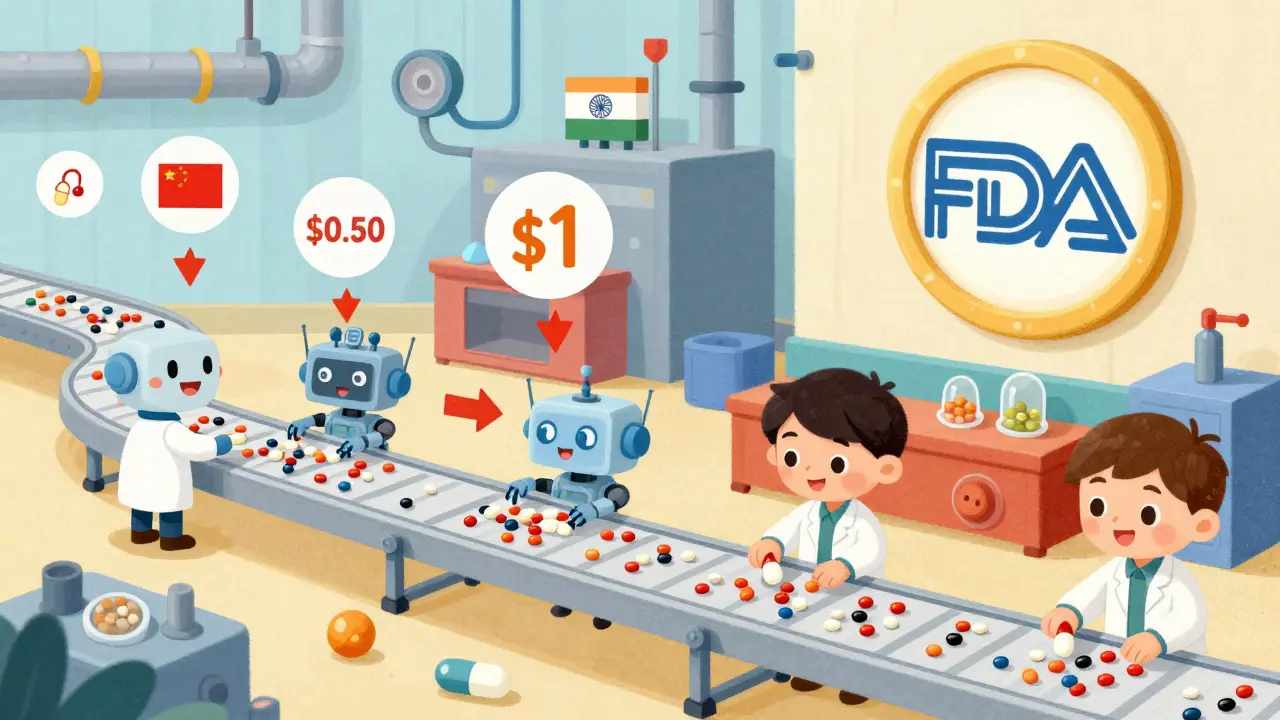
Once the formula is known, making generic drugs becomes a high-volume, low-margin game. Generic manufacturers produce billions of pills at once. Every time production volume doubles, the cost per unit drops by about 18%. For some products, when the number of units per pill type doubles, costs fall by 45%. That’s not theory-it’s what Boston Consulting Group found after analyzing 15 major generic producers. Take a common drug like fluoxetine (Prozac). When only one generic maker produced it, the price was 54% lower than the brand. When six companies started making it, the price dropped over 95%. That’s competition at work. More players = lower prices. No brand company can compete with that kind of scale.Where the Money Actually Goes
Let’s break down what $1 of generic drug revenue actually buys:- Active Pharmaceutical Ingredient (API): 40-60% of the cost. This is the actual medicine. Prices swing wildly based on where raw materials come from-China, India, or elsewhere. A 20-30% price jump in a single ingredient can shake the whole business.
- Excipients: 10-15%. These are the fillers, binders, and coatings that make the pill hold together and look right. Cheap, but necessary.
- Quality control and compliance: 15-20%. Every batch must be tested. Every factory must meet FDA standards. This isn’t optional-it’s the price of staying legal.
- Packaging and labeling: 5-10%. Simple, but adds up when you’re making millions of bottles.
- Marketing and sales: 0-5%. Unlike branded drugs, generics don’t run TV ads. They rely on pharmacies and insurers to choose them.
Why Branded Drugs Cost So Much More
Branded companies spend heavily on things generics avoid:- Patent litigation and extensions
- Marketing campaigns that cost billions
- High salaries for R&D scientists
- Expensive clinical trials with thousands of patients
- Building brand loyalty through advertising
Market Power and Competition
The generic market isn’t one big company. It’s split into three layers:- Global giants: Teva, Sandoz, and Mylan control about 25% of the market. They make thousands of generic drugs and have the scale to drive prices down.
- Regional specialists: 45% of the market. These companies focus on specific regions or drug types-like injectables or inhalers.
- Local manufacturers: 30%. Often smaller, cheaper, and sometimes less reliable. But they keep competition alive.
Why Generic Drugs Dominate Prescriptions-But Not Spending
Here’s the twist: generics make up 90% of all prescriptions filled in the U.S. That’s 8.9 billion pills a year. But they only account for 15.8% of total drug spending-$443 billion out of $2.8 trillion. Why? Because the other 10% of drugs-the branded ones-are way more expensive. A single cancer drug can cost $100,000 a year. A rare disease treatment? $1 million. Generics can’t compete there-they’re for common, older drugs. Statins, blood pressure pills, antibiotics. The workhorses of medicine. That’s why generics save the system so much money. From 2023 to 2027, they’re projected to save U.S. healthcare $1.7 trillion.The Hidden Risks
Cheaper doesn’t mean perfect. The pressure to cut costs has consequences:- Drug shortages. In 2022, there were 350 active shortages of generic drugs-mostly because manufacturers couldn’t make a profit at the prices they were forced to sell at.
- Supply chain fragility. Most APIs come from China and India. A single factory shutdown or trade disruption can cause shortages worldwide.
- Quality concerns. Not all generic manufacturers are equal. Some cut corners on testing or use cheaper ingredients. The FDA inspects factories, but with thousands of facilities globally, it’s a race to keep up.
What’s Changing Now?
The rules are shifting:- The FDA’s GDUFA III program is speeding up approvals-from 40 months to 24. That means more generics hit the market faster.
- The Inflation Reduction Act lets Medicare negotiate drug prices. That could push generic prices down another 10-15%.
- Automation is coming. Continuous manufacturing tech could cut production costs by 20-25% by 2027.
- Supply chains are being reshored. Companies are moving API production out of China, but that adds 5-8% to costs in the short term.
What This Means for You
If you take a daily pill-whether for blood pressure, cholesterol, or depression-chances are it’s a generic. And you’re saving money because of it. You’re not getting a second-rate drug. You’re getting the same medicine, made under the same rules, at a fraction of the cost. The system isn’t perfect. But the data doesn’t lie: generic drugs are the most effective cost-saver in modern medicine. They exist because regulation, competition, and scale made it possible. And as long as those forces stay strong, they’ll keep bringing prices down.Are generic drugs as safe as brand-name drugs?
Yes. The FDA requires generic drugs to have the same active ingredient, strength, dosage form, and route of administration as the brand-name version. They must also be bioequivalent-meaning they work the same way in your body. The only differences are in inactive ingredients like fillers or dyes, which don’t affect how the drug works.
Why do some generic pills look different from the brand?
By law, generic drugs can’t look identical to the brand-name version because of trademark rules. That’s why the shape, color, or size might be different. But the medicine inside is the same. The FDA checks every batch to make sure.
Do generic drugs take longer to work?
No. Bioequivalence means the drug enters your bloodstream at the same rate and to the same extent as the brand. If the brand works in 30 minutes, so does the generic. Any delay you notice is likely due to your body’s metabolism, not the drug itself.
Why are some generics more expensive than others?
It depends on competition. If only one company makes a generic, it can charge more. But if five companies are selling the same drug, prices drop fast. Also, some drugs are harder to make-like injectables or inhalers-so they cost more to produce.
Can I trust generics from other countries?
The FDA inspects all foreign factories that supply drugs to the U.S., whether they’re for brand or generic products. If a factory fails inspection, the FDA blocks imports. Many top generic makers are based in India and China, but they must meet the same standards as U.S. plants. Always buy from licensed pharmacies.
Will my insurance cover generics?
Yes-almost always. Most insurance plans require you to try the generic first. If your doctor insists on the brand, they may need to file an exception. But in most cases, generics are the default because they’re cheaper for the plan-and for you.

Comments (9)
Robert Cardoso
The math is clean but the real story is the regulatory capture. The FDA's bioequivalence standard is a joke-20% variance in absorption is legally acceptable. That’s not the same drug, that’s a gamble. And don’t get me started on the 350 drug shortages last year. This isn’t efficiency, it’s systemic fragility masked as savings.
James Dwyer
This is why I always pick generic. I’ve been on the same blood pressure med for 8 years-brand, then generic. Same results. No side effects. No drama. Just cheaper. Why pay more for a label when the pill does the same job?
Jeffrey Carroll
It is worth noting that the economic model underpinning generic pharmaceuticals is predicated upon economies of scale and minimal marketing expenditure. The absence of brand loyalty mechanisms allows for a more transparent pricing structure. One might argue that this represents a more ethically sound paradigm, as it decouples therapeutic efficacy from commercial persuasion.
Kevin Kennett
Look, I get it-big pharma makes billions off people who don’t know better. But here’s the thing: generics aren’t just cheaper, they’re the reason millions of people can actually afford to stay alive. My aunt takes her statin every day because it’s $3 a month, not $150. That’s not a loophole, that’s justice. Stop acting like the system’s broken when it’s actually working for the people who need it most.
Jess Bevis
Same pill. Different price. That’s capitalism.
Rose Palmer
The data presented here is both statistically robust and clinically significant. The cost differentials are not arbitrary but are functionally correlated with R&D amortization, regulatory burden, and market entry dynamics. It is imperative that public policy continues to incentivize generic manufacturing while enforcing stringent quality control protocols to mitigate supply chain vulnerabilities.
Howard Esakov
Of course generics are cheaper. They’re made in factories where the workers earn $2 an hour and the QA logs are written in Mandarin. The FDA inspects maybe 5% of these plants. You think your $2 ibuprofen is safe? It’s a lottery ticket with your health as the prize.
Mindee Coulter
My mom switched to generic thyroid med last year and her TSH dropped to normal. Same dose. Same results. I used to think the brand was better. Turns out I was just paying for the logo. Now I buy generic for everything. Save your money. Your body won’t notice the difference.
Rhiannon Bosse
So let me get this straight-Big Pharma spends billions to invent a drug, then sits on it for 20 years to milk it, then when the patent expires, suddenly it’s fine to let some Chinese factory make the exact same pill for 5 cents and sell it for $2? And we’re supposed to be grateful? This isn’t capitalism, this is a rigged game where the public pays twice: once for the R&D, then again for the shortage when the factory shuts down because no one can profit off $0.03 pills. Wake up.