
MAOI-Opioid Interaction Checker
Check for Dangerous Interactions
Enter your current MAOI medication and the opioid you're considering to determine if this combination is safe.
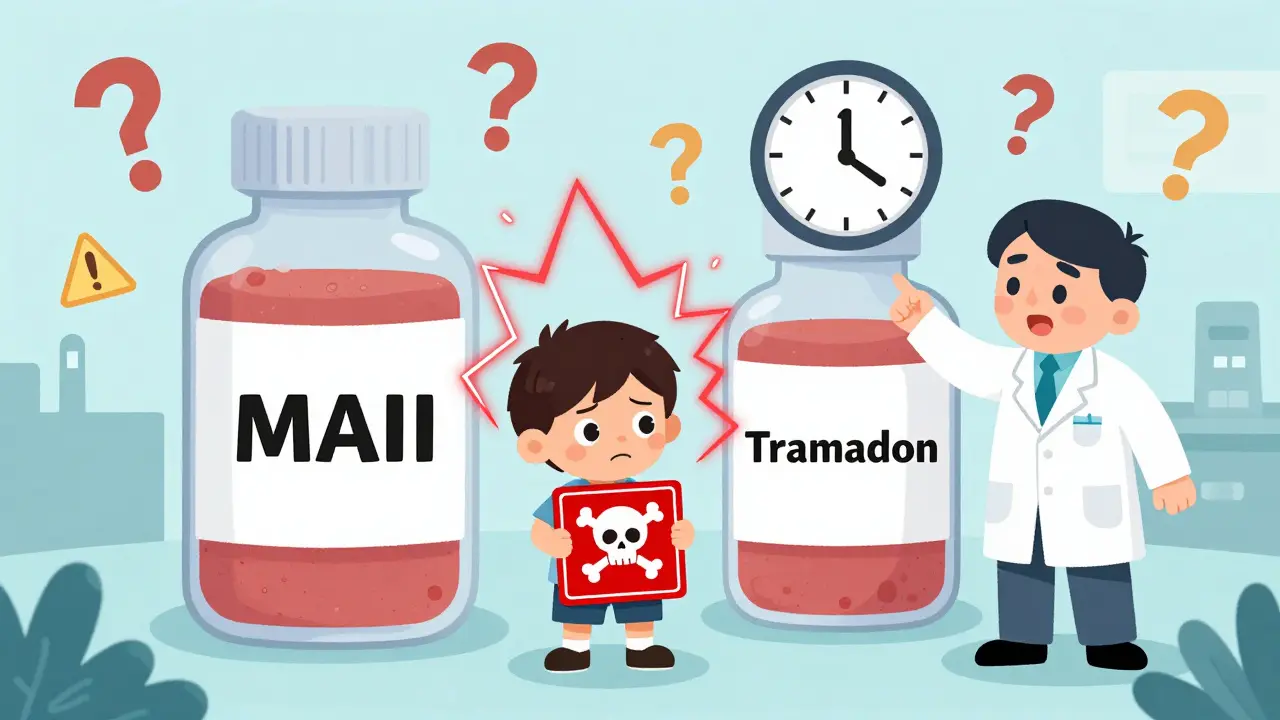
Combining opioids with MAOIs isn’t just risky-it’s deadly. This isn’t theoretical. People have died from this mix. Even if you’re on a low dose of an antidepressant like phenelzine or tranylcypromine, and your doctor prescribes tramadol for back pain, you could be walking into a medical emergency. The reaction doesn’t wait days. It can hit within an hour. Symptoms like a body temperature over 107°F, muscle rigidity, seizures, and high blood pressure don’t come with a warning label you can ignore.
Why This Combination Is a Medical Emergency
MAOIs-monoamine oxidase inhibitors-work by stopping your body from breaking down key brain chemicals like serotonin, norepinephrine, and dopamine. That’s how they help with depression. But when you add certain opioids, you’re flooding your system with even more of those same chemicals. The result? A runaway cascade that your body can’t handle.Meperidine (Demerol) is the most dangerous opioid in this mix. Between 1960 and 2010, there were 37 documented deaths from this combination. Tramadol isn’t much safer. It’s often mistaken as a "non-narcotic" painkiller, but it blocks serotonin reuptake just like SSRIs. When paired with an MAOI, serotonin levels can spike 300-500% above normal within an hour. That’s not a typo. That’s a recipe for serotonin syndrome.
Serotonin syndrome isn’t just feeling "a little off." It’s a full-body crisis: your muscles lock up, your temperature spikes, your heart races, and your brain can’t regulate basic functions. In severe cases, it leads to organ failure. A 2019 review found that 2-12% of people with severe serotonin syndrome die. And the FDA has a black box warning on every MAOI for this exact reason.
Which Opioids Are Safe? Which Are Not?
Not all opioids are equally dangerous. The risk isn’t the same across the board.- Never use: Meperidine (Demerol), tramadol, methadone, dextromethorphan, tapentadol (Nucynta). These are absolute no-gos. The FDA lists them as contraindicated. There’s no safe dose.
- Use with extreme caution: Morphine, oxycodone, hydromorphone. These carry lower risk, but they still affect serotonin and norepinephrine. Only use under close supervision.
- Best alternative: Buprenorphine. At low doses (0.2-0.4 mg sublingual), it’s been used safely in MAOI patients in clinical studies. No serotonin syndrome cases reported in over 140 administrations.
Even reversible MAOIs like moclobemide aren’t risk-free. There are documented cases of serotonin syndrome when moclobemide is mixed with tramadol-even at standard doses. The idea that "it’s just a mild MAOI" is dangerous.
The 14-Day Rule: Why Waiting Isn’t Optional
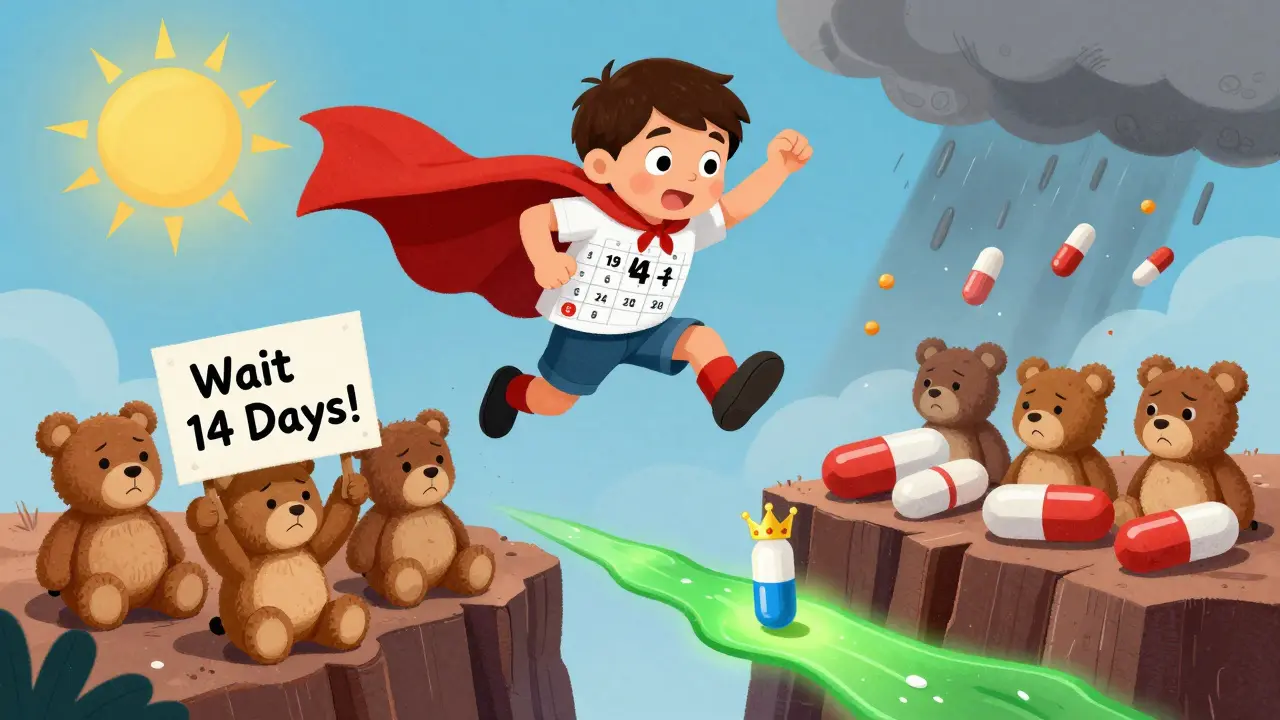
If you’re switching from an MAOI to an opioid-or vice versa-you can’t just stop one and start the other the next day.Irreversible MAOIs permanently disable the enzymes they target. Your body doesn’t just "get over it." It takes about 14 days for your liver to grow new enzymes and restore normal function. That’s why the FDA, Mayo Clinic, and American Society of Anesthesiologists all insist on a 14-day washout period before starting any serotonergic opioid.
Some people think, "I stopped my MAOI last week, so I’m fine." They’re wrong. That 14-day clock starts when you take your last pill. Not when you feel better. Not when your depression lifts. When the last dose leaves your system.
Reversible MAOIs like moclobemide are different. Their effect wears off faster-within 24 hours. But even then, you shouldn’t skip the waiting period unless your doctor confirms it’s safe. Most prescribers still recommend a 48-hour buffer for safety.
Real People, Real Consequences
Reddit user u/ChronicPainWarrior shared their story in March 2023. They were on phenelzine for treatment-resistant depression. When they got a toothache, their dentist prescribed tramadol. Within hours, their body temperature hit 107.1°F. Their muscles locked so tight they couldn’t breathe. They had seizures. They spent three days in intensive care.That’s not an outlier. The FDA’s adverse event database shows 427 reports of serotonin syndrome from MAOI-opioid combinations between 2015 and 2022. 89 of those were fatal. That’s a 20.8% death rate in reported cases-many more likely went unreported.
Emergency doctors have seen it too. One anesthesiologist described two near-fatal cases in 15 years: one patient on Parnate given Demerol after surgery spiked to 240/140 blood pressure and needed a continuous IV drip to control it. Another, on Nardil, developed serotonin syndrome after a dental procedure and required cooling blankets and cyproheptadine to survive.
Why Are These Errors Still Happening?
You’d think this would be common knowledge by now. But it’s not.A 2022 study in JAMA Internal Medicine found that 4.3% of people on MAOIs were still prescribed contraindicated opioids within 14 days of starting the antidepressant. That’s about 11,200 dangerous prescriptions every year in the U.S. alone.
Why? Because tramadol is still marketed as a "non-narcotic" painkiller. Many patients think it’s safe. Many doctors forget. A 2022 study in the Annals of Emergency Medicine found that 31% of ER physicians didn’t know tramadol was contraindicated with MAOIs.
Pharmacies still dispense these combinations. A 2022 study in the American Journal of Health-System Pharmacy found a 5.8% error rate in community pharmacies. Electronic health records have "hard stops" to block these prescriptions-but 14.3% of doctors override them anyway, often because they don’t realize how fast things can go wrong.
What to Do If You’re on an MAOI
If you’re taking an MAOI, here’s what you need to do right now:- Check your current medications. If you’re taking tramadol, methadone, or dextromethorphan (common in cough syrups), stop immediately and call your prescriber.
- Carry a wallet card listing your MAOI and all contraindicated drugs. The National Alliance on Mental Illness provides free ones. 78% of patients who use them say they’ve been saved by it.
- Before any surgery, dental work, or new prescription-tell every provider you’re on an MAOI. Say it clearly: "I’m on a monoamine oxidase inhibitor. No tramadol, no meperidine, no methadone."
- If you’re switching from an MAOI to another antidepressant, wait 14 days before starting any opioid. Don’t rush.
- For pain, ask for buprenorphine (low dose), acetaminophen, or NSAIDs like ibuprofen. These are your safest options.
What to Do in an Emergency
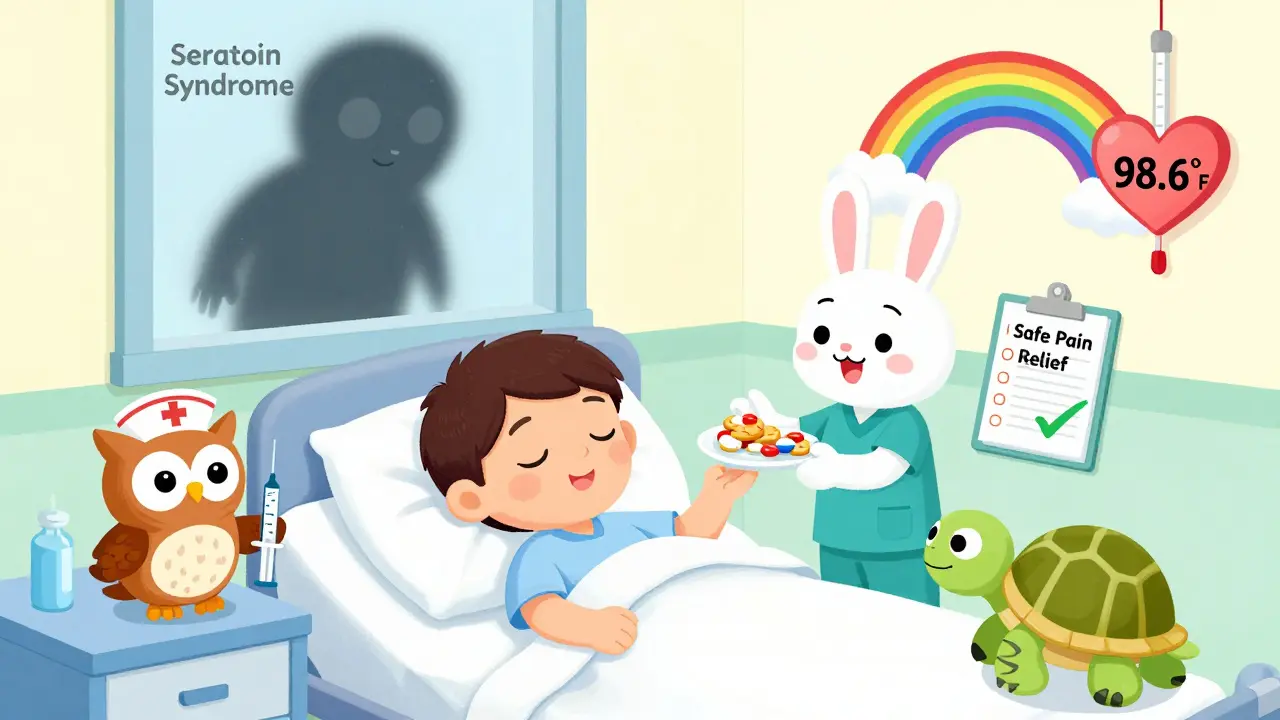
If you or someone you know is on an MAOI and takes a contraindicated opioid, watch for these signs:- Body temperature above 102°F
- Muscle stiffness or rigidity
- Confusion, agitation, or hallucinations
- Rapid heart rate, high blood pressure
- Seizures or loss of consciousness
If you see these, call 911. Don’t wait. Tell the paramedics: "Serotonin syndrome from MAOI and opioid interaction." They need to know immediately.
In the hospital, treatment includes:
- Cyproheptadine (12 mg loading dose) to block serotonin
- Benzodiazepines to control seizures and agitation
- Cooling measures for hyperthermia
- ICU monitoring for at least 24 hours
The Future: Better Safeguards, But the Risk Remains
There’s progress. The FDA now requires updated medication guides for all MAOIs that list 12 specific contraindicated opioids. The European Medicines Agency now mandates training for all prescribers. Digital tools like SerotoninSafe, a new FDA-approved app that integrates with electronic records, have cut prescribing errors by 76% in pilot programs.But the problem isn’t solved. MAOIs are still used-about 1.2 million Americans are on them, mostly for depression that didn’t respond to other treatments. And the risk doesn’t disappear just because the drugs are old. The biochemical danger is as real today as it was in 1964, when the first death was documented.
The takeaway? This isn’t about being careful. It’s about being absolute. If you’re on an MAOI, treat every opioid like a loaded gun. Know the list. Know the timeline. Know the signs. And never, ever assume a doctor or pharmacist knows the risk-unless they’ve proven they do.
Can I take tramadol if I’m on an MAOI?
No. Tramadol is absolutely contraindicated with MAOIs. Even at low doses, it can trigger serotonin syndrome within hours. There are over 60 documented cases of serotonin syndrome from this combination, including fatal ones. Never combine them.
How long do I have to wait after stopping an MAOI before taking an opioid?
Wait 14 days after your last dose of an irreversible MAOI like phenelzine or tranylcypromine. This is the time it takes for your body to regenerate the monoamine oxidase enzymes. For reversible MAOIs like moclobemide, a 24-hour wait is usually sufficient, but many doctors recommend 48 hours for safety. Never start an opioid sooner than this.
Is buprenorphine safe with MAOIs?
Yes, at low doses (0.2-0.4 mg sublingual), buprenorphine is considered the safest opioid option for people on MAOIs. Studies show no cases of serotonin syndrome in over 140 administrations. It’s the go-to choice for acute pain in these patients. Higher doses still carry respiratory risks, so use only under medical supervision.
What painkillers are safe with MAOIs?
Acetaminophen (Tylenol) and NSAIDs like ibuprofen or naproxen are safe and effective for most pain. Buprenorphine (low dose) is the only opioid considered safe. Avoid all other opioids, including codeine, oxycodone, hydrocodone, and morphine unless under strict monitoring. Never use dextromethorphan (in cough syrups) or tapentadol.
What should I do if I accidentally took an opioid while on an MAOI?
Call emergency services immediately. Do not wait for symptoms. If you feel your body getting hot, muscles tightening, or your heart racing, this could be serotonin syndrome. Tell responders you took an opioid while on an MAOI. Time is critical-early treatment with cyproheptadine and cooling can save your life.

Comments (9)
Emma Hooper
Okay but like… why is tramadol still sold like it’s just a ‘mild’ painkiller? I had a friend take it with her MAOI and ended up in ICU for three days. She’s fine now, but her mom still calls me crying every time she sees a cough syrup on the shelf. This isn’t theoretical-it’s a waiting room full of landmines.
Martin Viau
Canada’s got it right-pharmacies here flag every damn interaction. You can’t even get a script for tramadol without a pharmacist calling the prescriber. Meanwhile, in the States, it’s like everyone’s playing Russian roulette with their neurochemistry. And don’t even get me started on how many ER docs still think ‘serotonin syndrome’ is just ‘being too excited.’
Marilyn Ferrera
14 days. Not 10. Not 12. 14.
Robb Rice
I appreciate the depth of this post. It's clear, well-researched, and desperately needed. I work in primary care, and I've had to correct three prescriptions in the last month alone. The fact that 31% of ER docs don't know tramadol's contraindicated with MAOIs is… alarming. I hope this gets shared in every med school lecture.
Jenny Salmingo
My grandma’s on nardil. She reads this every Sunday with her coffee. She says it’s the only thing that made her feel safe again. Thank you.
Brandon Boyd
Look-I know you’re in pain. I get it. But if you’re on an MAOI, your body isn’t your enemy. The meds are. Buprenorphine at 0.2mg? That’s your new best friend. Acetaminophen? Your quiet hero. Don’t risk your life for a quick fix. You’ve already survived this long-you’ve got this.
Branden Temew
So let me get this straight-we’ve got a drug combo that kills people in an hour, and the solution is… to ask doctors nicely? Meanwhile, the FDA’s black box warning is basically a neon sign that says ‘DO NOT TOUCH’ and yet somehow, pharmacies still dispense it? This isn’t a medical issue-it’s a systemic failure wrapped in a white coat.
Frank SSS
Man, I read this and I just feel… sad. Not angry. Not mad. Sad. Because I know someone who died from this. They were 24. Took tramadol for a toothache. Thought it was ‘just a little extra help.’ Their mom still posts their birthday on Reddit every year. And the worst part? The doctor who prescribed it still works at the same clinic. No one ever called them out. No one ever asked why.
Paul Huppert
Thanks for writing this. I’m on moclobemide and just got prescribed ibuprofen for my back. I almost didn’t mention the MAOI because I didn’t think it mattered. Now I know better. I’ll be carrying that wallet card from now on.