
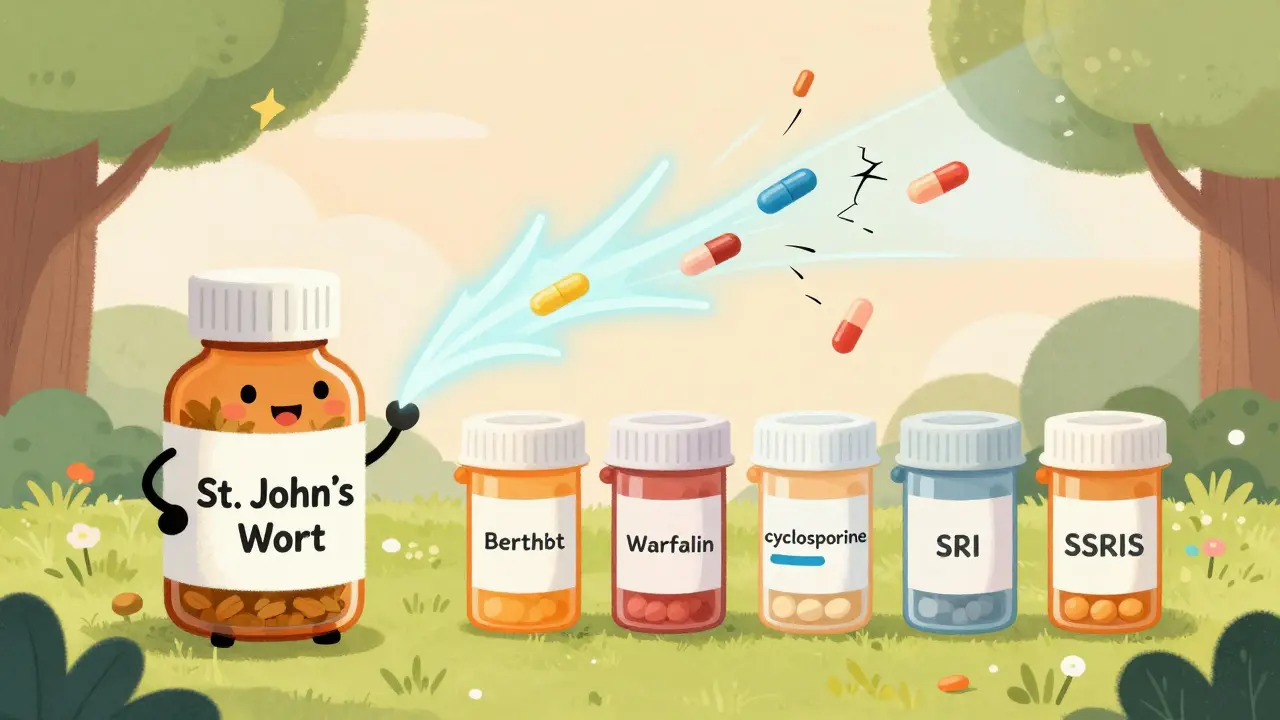
St. John’s Wort is one of the most popular herbal supplements for mild depression. You can buy it at any grocery store, pharmacy, or online without a prescription. But here’s the problem: St. John’s Wort doesn’t just sit quietly in your body. It actively changes how your prescription drugs work - sometimes dangerously so.
How St. John’s Wort Messes With Your Medications
St. John’s Wort doesn’t just interact with a few drugs. It interferes with dozens. The reason? Two main mechanisms. First, it turns on enzymes in your liver - especially CYP3A4 - that break down medications faster. Second, it affects brain chemicals like serotonin, which can cause serious side effects when mixed with antidepressants.
This isn’t theoretical. Over half of all prescription drugs are processed by the CYP3A4 enzyme. That means St. John’s Wort can reduce the effectiveness of medications you rely on - from birth control to blood thinners to cancer drugs. And because herbal supplements aren’t tightly regulated, the amount of active ingredients varies wildly between brands. One pill might be weak. Another might be strong enough to trigger a reaction.
Drugs That Become Less Effective
If you’re taking any of these, St. John’s Wort could make them useless - or worse.
- Birth control pills: St. John’s Wort speeds up how fast your body breaks down estrogen and progestin. Result? Unplanned pregnancy. Breakthrough bleeding. Even women on IUDs or patches shouldn’t assume they’re safe - there’s not enough data to say they’re protected.
- Warfarin (Coumadin): This blood thinner keeps clots from forming. St. John’s Wort lowers warfarin levels, increasing your risk of stroke or heart attack. One case study showed a patient’s INR (a clotting measure) dropped from 3.5 to 1.2 after starting St. John’s Wort - a dangerous drop.
- Phenytoin (Dilantin), carbamazepine (Tegretol), phenobarbital: These are seizure meds. If St. John’s Wort lowers their levels, you could have a breakthrough seizure - even if you’ve been seizure-free for years.
- Tacrolimus and cyclosporine: These are immunosuppressants used after organ transplants. Lower levels mean your body might reject the new organ. This isn’t rare. There are documented cases of kidney transplant rejection linked to St. John’s Wort.
- Methadone: Used for pain or opioid addiction treatment. St. John’s Wort can make methadone less effective, leading to withdrawal symptoms or relapse.
- Antiretroviral drugs for HIV: Protease inhibitors and non-nucleoside reverse transcriptase inhibitors (NNRTIs) can drop to ineffective levels. This raises the risk of drug-resistant HIV strains.
- Omeprazole (Prilosec): This acid reducer may become less effective, making heartburn worse.
- Fexofenadine (Allegra): Unlike most interactions, this one can cause the opposite problem - higher levels of the drug in your blood, leading to dizziness, headaches, or worse side effects.
The Serotonin Danger Zone
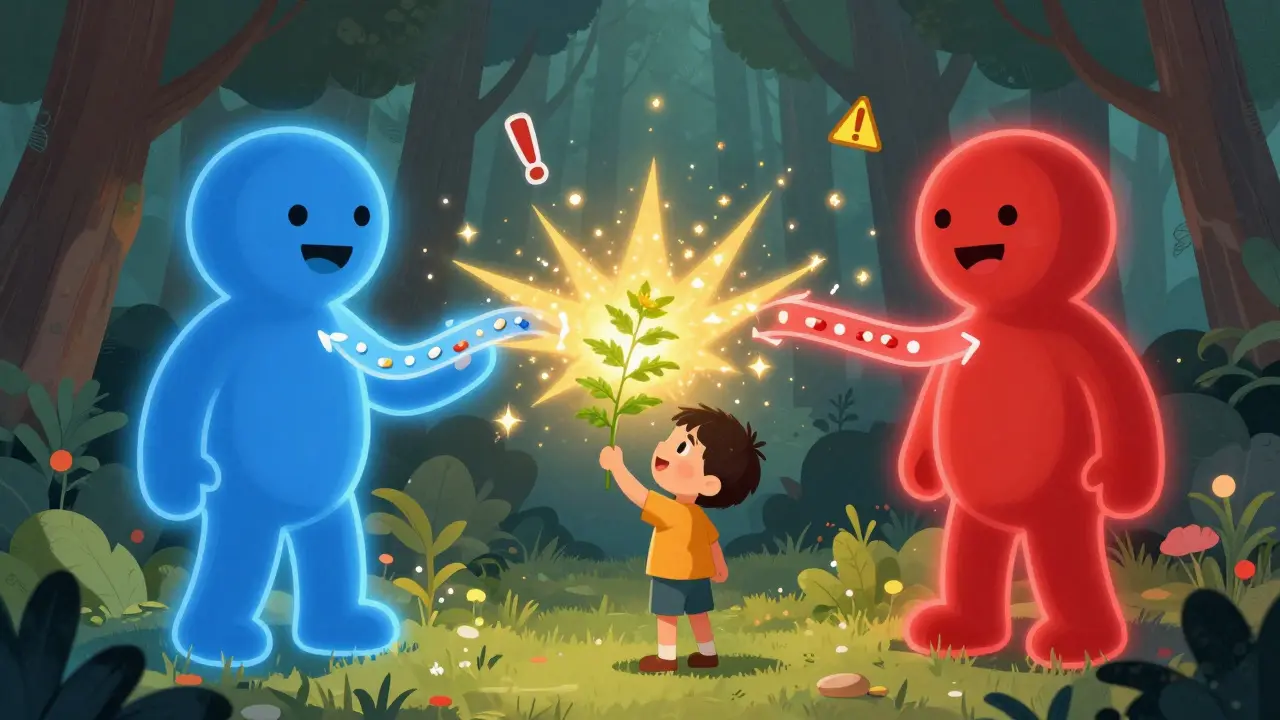
St. John’s Wort increases serotonin in the brain - the same way SSRIs like fluoxetine (Prozac) or sertraline (Zoloft) do. When you mix them, serotonin levels can spike dangerously high. This is called serotonin syndrome.
Symptoms include:
- Agitation or confusion
- Rapid heart rate
- High blood pressure
- Shivering or sweating
- Muscle twitching or stiffness
- Nausea, vomiting, diarrhea
- In severe cases: seizures, high fever, unconsciousness
It can happen within hours. One study found patients developed serotonin syndrome within 24 hours of combining St. John’s Wort with an SSRI. The American Academy of Family Physicians says combining them is not recommended. And it’s not just SSRIs - SNRIs, MAOIs, even some migraine meds like triptans can trigger this reaction.
What Happens When You Stop Taking It?
Many people think the danger ends when they quit St. John’s Wort. It doesn’t.
Once you stop, your liver enzymes slow down again. But your prescription drugs are still at the same dose. That means those drugs suddenly build up in your system - sometimes to toxic levels.
Case reports show:
- Cyclosporine levels spiked after stopping St. John’s Wort, leading to kidney damage.
- Patients on SSRIs had increased side effects like nausea and dizziness after quitting the herb.
- Warfarin levels rose, increasing bleeding risk.
This is why doctors need to know if you’ve taken St. John’s Wort - even if you stopped weeks ago.
Who’s at Highest Risk?
Not everyone who takes St. John’s Wort will have a problem. But some groups are much more vulnerable:
- People on multiple prescriptions - especially older adults.
- Transplant patients relying on immunosuppressants.
- Women using hormonal birth control.
- People with epilepsy or mood disorders.
- Those taking antidepressants or anxiety meds.
And here’s the kicker: most people don’t tell their doctors they’re taking it. They assume it’s “just a herb,” not medicine. But it acts like a drug. And it can be just as powerful - and dangerous.
What Should You Do?
If you’re taking St. John’s Wort:
- Don’t stop suddenly. Talk to your doctor first.
- List every supplement you take - including St. John’s Wort - on your medication list.
- Ask your pharmacist: “Could this interact with my prescriptions?”
- Watch for new symptoms: unexplained bleeding, seizures, mood swings, or nausea.
- If you’re planning surgery, tell your anesthesiologist. St. John’s Wort can interfere with anesthesia.
If you’re considering St. John’s Wort for depression:
- There are safer, FDA-approved options with known interactions and dosing.
- Depression is a medical condition. Treating it with unregulated herbs can delay real help.
- Even if you feel fine now, the risks build up over time.
Regulators Are Warning About This
It’s not just one doctor’s opinion. Regulatory agencies around the world have issued alerts:
- The Therapeutic Goods Administration (TGA) of Australia issued a safety alert in 2000 - and still updates it today.
- The UK and Sweden require warning labels on both St. John’s Wort products and the drugs it interacts with.
- The Mayo Clinic, Merck Manuals, and AAFP all list it as a high-risk herb.
- New Zealand’s Medsafe specifically warns against combining it with SSRIs.
These aren’t small warnings. They’re life-saving. And they’re based on real cases - not theories.
The Bottom Line
St. John’s Wort isn’t harmless because it’s natural. It’s a potent biochemical agent with documented, dangerous interactions. It doesn’t just “help” with depression - it changes how your body handles every drug you take.
If you’re on any prescription medication, don’t take St. John’s Wort without talking to your doctor. If you’re already taking it, don’t assume you’re safe. Talk to your pharmacist. Get your blood tested if you’re on warfarin, cyclosporine, or antiseizure meds. And never, ever stop or start it without medical guidance.
The myth that “natural equals safe” kills people. St. John’s Wort is a prime example. Know the risks. Protect yourself. Your life might depend on it.

Comments (13)
Manan Pandya
St. John’s Wort isn’t some harmless tea. I’ve seen patients on cyclosporine after transplants take it because they ‘read it helps mood,’ and then end up in the ER with organ rejection. It’s not anecdotal-it’s documented in every pharmacology textbook. If you’re on any prescription, especially immunosuppressants, anticoagulants, or antidepressants, this isn’t a gamble you can afford. The liver enzyme induction is real, and the half-life of the effect lingers long after you stop. Don’t assume ‘natural’ means safe. It just means unregulated-and that’s the danger.
David Chase
OMG I CAN’T BELIEVE PEOPLE STILL THINK HERBS ARE ‘SAFE’ 😤 I had a cousin take this stuff with her birth control and got pregnant-TWICE. And she swore it was ‘just a herb.’ Like bro, if it changes your liver enzymes, it’s a DRUG. Stop pretending herbal supplements are yoga and incense. They’re biochemical landmines. FDA doesn’t regulate them? Then they shouldn’t be on shelves next to Advil. Ban this crap. 🚫💊
Fabian Riewe
My grandma was on warfarin for years. She started taking St. John’s Wort after her friend said it ‘cleared her depression.’ Two weeks later, she had a minor stroke. They found her INR had dropped to 1.1. She’s fine now, but it scared the hell out of us. Doctors don’t always ask about supplements. You have to speak up. Even if you think it’s ‘nothing.’ This post is spot on. If you’re on meds, tell your pharmacist everything-even the ‘tiny’ stuff.
Sharleen Luciano
How is it still legal to sell this? In France, it’s classified as a prescription-only medicinal product. In the U.S., it’s sold like candy next to gummy vitamins. The regulatory failure here is staggering. The pharmacokinetic data is decades old, yet we let untrained retail clerks hand this out to people on SSRIs, transplant patients, and elderly polypharmacy cases. This isn’t a personal choice-it’s a public health crisis disguised as wellness culture.
Nicole K.
I don’t care what you say. I took this for three months and felt way better. My anxiety went away. No side effects. Why are you all so scared? It’s just a plant. People used to use herbs for centuries. You’re just scared of natural things because Big Pharma told you to be. I’m not taking your pills. I’m taking my rosemary and my St. John’s Wort. End of story.
Teresa Rodriguez leon
My therapist told me to stop taking it after I started having tremors and sweating. I didn’t realize I was on serotonin syndrome until my hands wouldn’t stop shaking. I was on sertraline. I thought the herb was ‘helping.’ Turns out, it was poisoning me. I’m lucky I didn’t have a seizure. Please, if you’re taking antidepressants, don’t touch this. Even if you think you’re ‘fine.’ It doesn’t care if you’re fine.
Jim Rice
Wow. Another fear-mongering post. You’re acting like St. John’s Wort is砒霜. Have you ever met someone who actually died from it? No? Then it’s not a threat. It’s just another thing big pharma wants to scare you out of using so they can sell you their overpriced SSRIs. I’ve taken it for 5 years with no issues. My doctor knows. I’m not a lab rat.
Jasmine Yule
I get why people are scared. I was one of them. But I also get why people use it. Depression is brutal. When your insurance won’t cover therapy and your paycheck barely covers rent, you look for help where you can find it. St. John’s Wort isn’t perfect-but it’s something. The real issue isn’t the herb. It’s that we don’t have accessible mental healthcare. Until we fix that, people will keep reaching for what’s available. We need education, not judgment.
Lisa Dore
I’m a nurse. I’ve seen the worst of this. A woman on tacrolimus stopped her transplant meds cold turkey after starting St. John’s Wort-thought she was ‘detoxing.’ She had a kidney rejection within 10 days. She’s on dialysis now. I’ve had patients cry because they didn’t know. No one told them. This isn’t about shaming. It’s about making sure people know. Please. If you’re reading this and take any meds-ask your pharmacist. Write it down. Show them your supplement bottle. It could save your life.
Amy Cannon
As someone who has studied ethnopharmacology for over two decades, I find it deeply troubling that Western medicine continues to dismiss traditional botanical remedies while simultaneously failing to provide adequate access to regulated alternatives. The pharmacological activity of Hypericum perforatum is well-characterized: hyperforin and hypericin are potent modulators of monoamine reuptake and cytochrome P450 isoforms. The issue is not the herb itself, but the absence of standardized dosing, labeling, and clinician education. To vilify the herb without addressing systemic healthcare gaps is intellectually dishonest.
Himanshu Singh
i took this for 2 years and no prob. i was on lisinopril and metformin. no issues. maybe its just for some peopel? i think the real problem is people dont read the label or talk to their doc. i did. and i was fine. so dont scare everyone. not everyone is the same.
Greg Quinn
It’s fascinating how we assign moral weight to substances based on their origin. A synthetic SSRI is ‘medicine.’ A plant extract is ‘dangerous.’ But chemically, they’re both just molecules interacting with receptors. The real problem isn’t St. John’s Wort-it’s our cultural blindness to the fact that all drugs, natural or synthetic, are tools with risks and benefits. We need better science, not fear. And we need to stop pretending that regulation equals safety. Opioids are regulated. They kill thousands every year.
Paige Shipe
Don't take it.