
The Real Meaning of SPF
Most of us view SPF is a numerical measure of a sunscreen's ability to protect against UVB radiation. First introduced by Franz Greiter in 1962, the Sun Protection Factor essentially tells you how much longer it would take for your skin to burn compared to if you wore nothing at all. However, the protection isn't linear. For example, SPF 15 blocks about 93.3% of UVB rays, while SPF 30 blocks 96.7%. If you jump from SPF 30 to SPF 50, you're only gaining about 1% more protection (reaching 98%).
The formula for this absorption is 100 - (100/SPF). This is why many experts, including those at the American Academy of Dermatology, suggest using higher ratings than you might think you need. Why? Because almost nobody applies enough. Research shows that 90% of people apply only 25-50% of the recommended amount. When you under-apply an SPF 30 cream, you're effectively getting the protection of an SPF 7.5 to 15 product. Using a higher number provides a safety net for that human error.
UVA vs. UVB: The Damage Duo
To protect your skin, you have to understand that not all sunlight is created equal. The UV spectrum is split into two main types that hit your skin: UVA and UVB. Think of them as "Aging" and "Burning."
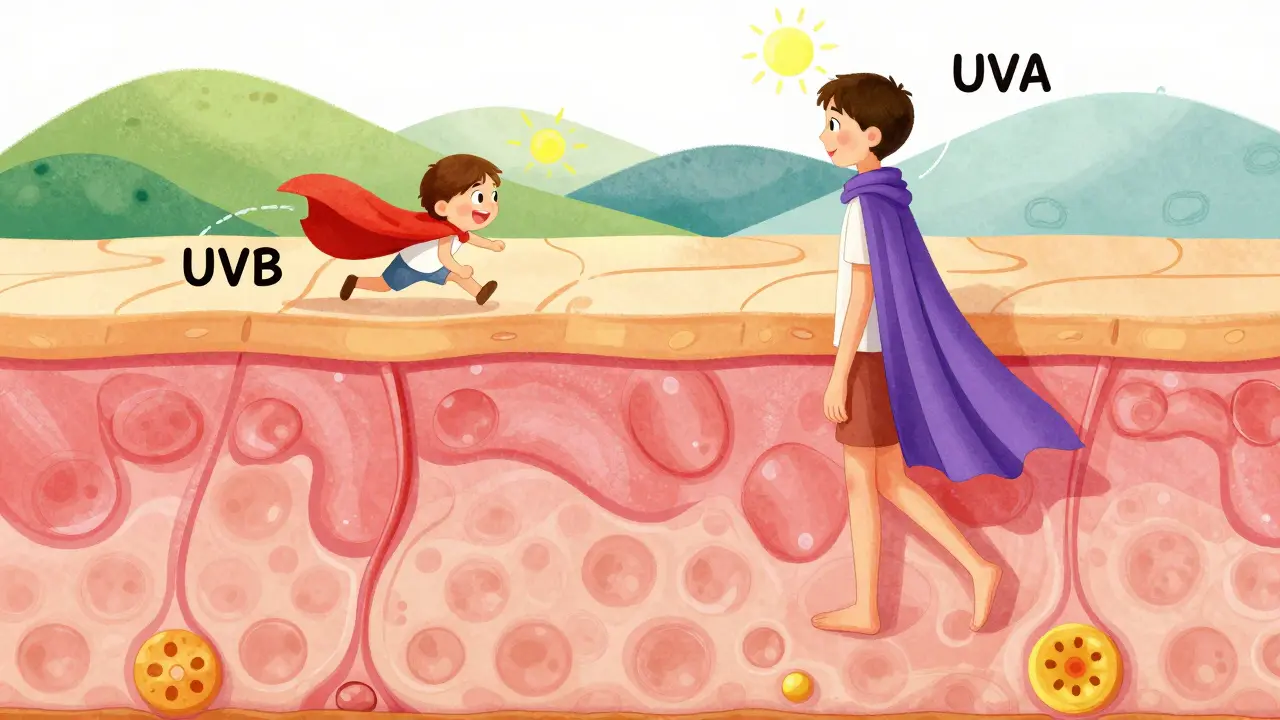
UVB Radiation is short-wavelength light (290-320 nm) that primarily affects the epidermis, causing sunburns and direct DNA mutations. This is the radiation that creates the red, peeling skin after a day at the beach. It's powerful, but it doesn't penetrate very deep.
On the other hand, UVA Radiation is longer-wavelength light (320-400 nm) that penetrates deep into the dermis layer. Unlike UVB, UVA is present with relatively equal intensity during all daylight hours and can even pass through glass. It causes oxidative stress that breaks down collagen and elastin, leading to wrinkles and leathery skin. Since UVA makes up about 95% of the UV radiation reaching Earth, ignoring it is a recipe for premature aging.
| Feature | UVA (Aging) | UVB (Burning) |
|---|---|---|
| Wavelength | 320-400 nm (Long) | 290-320 nm (Short) |
| Skin Penetration | Deep (Dermis) | Surface (Epidermis) |
| Primary Effect | Wrinkles, Age Spots | Sunburn, DNA Damage |
| Glass Penetration | Yes | No |
| Presence | Consistent all day | Peaks midday |
Mineral vs. Chemical Filters
When you pick up a bottle, you're choosing between two very different chemical processes. One reflects light; the other absorbs it.
Mineral Sunscreen (also called physical sunscreen) uses ingredients like Zinc Oxide and Titanium Dioxide. These sit on top of your skin and act like a mirror, reflecting UV rays away. They are generally better for sensitive skin or people prone to breakouts. The downside? They often leave a "white cast," especially on darker skin tones, and can feel heavier on the face.
Chemical Sunscreen uses organic compounds like Avobenzone or Octisalate. These absorb into the epidermis and convert UV rays into heat, which is then released from the skin. They are more "cosmetically elegant," meaning they rub in clear and feel lighter. However, some people find they cause stinging in the eyes or skin irritation, particularly those with eczema or highly reactive skin.
What "Broad Spectrum" Actually Means
If a bottle doesn't say "Broad Spectrum," it might only be protecting you from UVB (sunburns) while letting UVA (aging rays) slide right through. To be labeled as broad spectrum under FDA standards, a product must prove it protects against both. Specifically, it must achieve a critical wavelength of at least 370 nanometers.
The Skin Cancer Foundation recently tightened these rules. For a product to earn their "Daily Use Seal of Recommendation," it now requires at least SPF 30. This shift reflects the scientific understanding that consistent, moderate-to-high protection is better than the occasional application of a very high SPF. If you're active or outdoors all day, the "Active Seal" now requires SPF 50+.

The Art of Application: Avoiding Common Pitfalls
Most of the "science" of sunscreen fails at the application stage. If you're just putting a pea-sized amount on your face, you're not getting the SPF listed on the bottle. Dermatologists recommend roughly 1/4 teaspoon for the face alone. If you're applying it to your body, you're looking at about an ounce (a shot glass full) for the average adult.
Timing is also key. Chemical sunscreens need about 15 to 20 minutes to absorb into the skin before they become effective. If you apply it and immediately step into the sun, you're unprotected for those first few minutes. Mineral sunscreens work almost instantly because they are a physical barrier, but they are more prone to "pilling" (where the product balls up) if you apply too many serums underneath. To prevent this, apply your sunscreen as the final step of your skincare routine and let it set before applying makeup.
And then there's the reapplication rule. Sunscreen isn't a "once and done" deal. The filters break down under direct sunlight, and your skin absorbs some of the ingredients. Whether you're sweating, swimming, or just walking around, you need to reapply every two hours. If a product is labeled "water resistant," it only maintains its SPF for 40 or 80 minutes while immersed in water-not for the entire day.
Do I need sunscreen on a cloudy day?
Yes. Up to 80% of UV rays penetrate clouds. While you might not feel the heat of the sun, UVA rays are still hitting your skin, contributing to long-term DNA damage and aging. Daily protection is essential regardless of the weather.
Is SPF 100 actually better than SPF 50?
Marginally. SPF 50 blocks about 98% of UVB rays, while SPF 100 blocks about 99%. The difference is only 1%. The bigger risk with SPF 100 is a false sense of security, leading people to wait longer between reapplications or apply too little product.
Why does my mineral sunscreen leave a white cast?
Mineral filters like zinc oxide and titanium dioxide are white powders. Because they sit on top of the skin rather than absorbing into it, they reflect light, which appears as a white film. This is more noticeable on deeper skin tones, though many brands now use "micronized" or tinted versions to hide this effect.
Can I just rely on the SPF in my makeup?
Almost certainly not. To get the rated SPF from a foundation or tinted moisturizer, you would have to apply it much thicker than anyone normally does. Use a dedicated broad-spectrum sunscreen underneath your makeup for actual protection.
Are chemical sunscreens safe for the environment?
Some are not. Ingredients like oxybenzone and octinoxate have been linked to coral reef bleaching. If you're swimming in the ocean, look for "reef-safe" labels or stick to mineral sunscreens, which are generally less harmful to marine ecosystems.
Next Steps for Your Skin
If you've never used sunscreen daily, start by finding a formula that fits your skin type. If you have oily or acne-prone skin, a chemical "fluid" or "gel" might feel less greasy. If you have sensitive skin, a mineral-based cream is usually the safest bet. Patch test any new product on your inner arm for 24 hours to make sure you don't have a reaction.
For those who struggle with the feel of sunscreen, try the "two-finger rule": squeeze two strips of sunscreen along your index and middle fingers. This is roughly the amount needed for your face and neck. Once you master the application, make it a non-negotiable part of your morning, just like brushing your teeth.