
Vitamin E Warfarin Safety Calculator
Daily Vitamin E Calculator
Determine if your vitamin E intake is within the safe threshold for warfarin users
When you're on warfarin, even small changes in your diet or supplements can throw your blood clotting off balance. It's not just about avoiding kale or green tea-something as simple as a daily vitamin E pill might be putting you at risk for serious bleeding. This isn't theoretical. Real people have ended up in the hospital because they didn't know vitamin E could amplify warfarin's effects. And the scary part? It doesn't always show up right away.
How Vitamin E Interacts with Warfarin
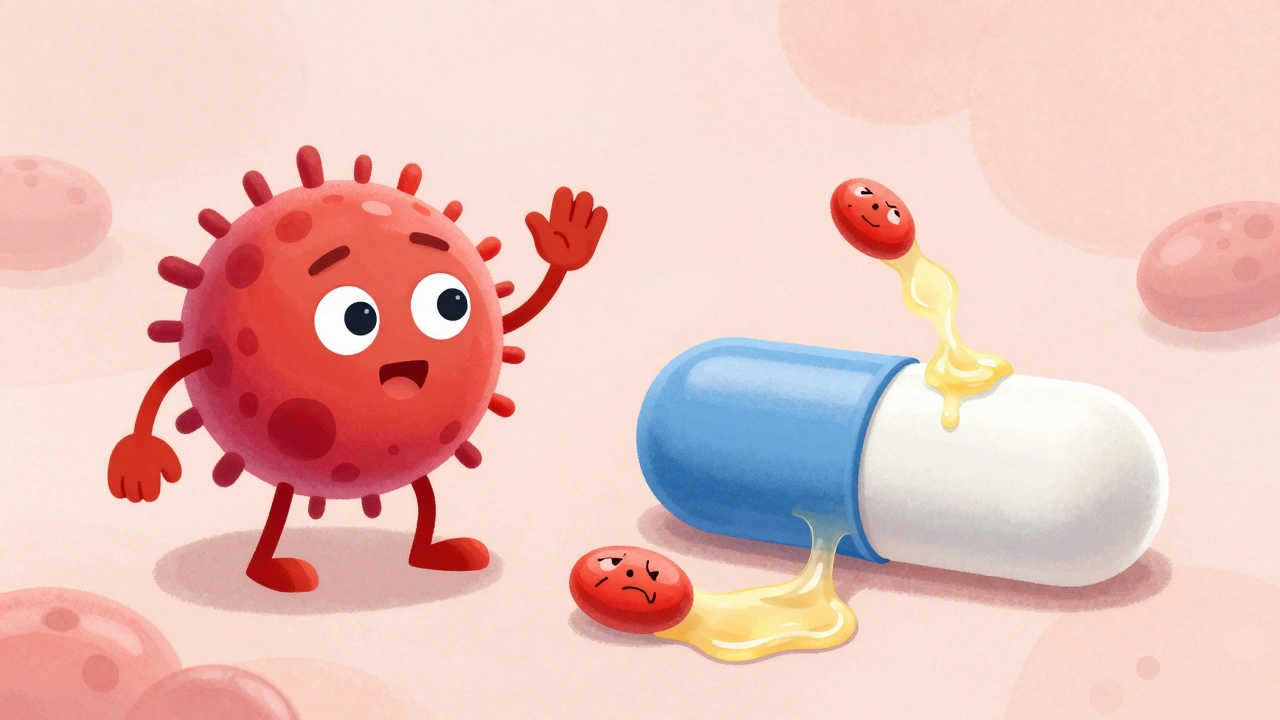
Warfarin works by blocking vitamin K, which your body needs to make clotting proteins. Vitamin E, on the other hand, doesn't directly interfere with vitamin K. Instead, it weakens platelets-the blood cells that help clots form. Think of it like this: warfarin slows down the glue that holds clots together, and vitamin E makes the glue less sticky. Together, they create a double hit on your body's ability to stop bleeding.
This isn't just theory. A 2013 study of over 1,000 patients with atrial fibrillation found that those with higher blood levels of vitamin E had significantly more bleeding events-including dangerous brain bleeds. The risk didn't jump overnight. It built up over time. One case report showed a patient taking 800 IU of vitamin E daily didn't bleed until the fourth week. By then, their INR had climbed dangerously high.
The 400 IU Threshold
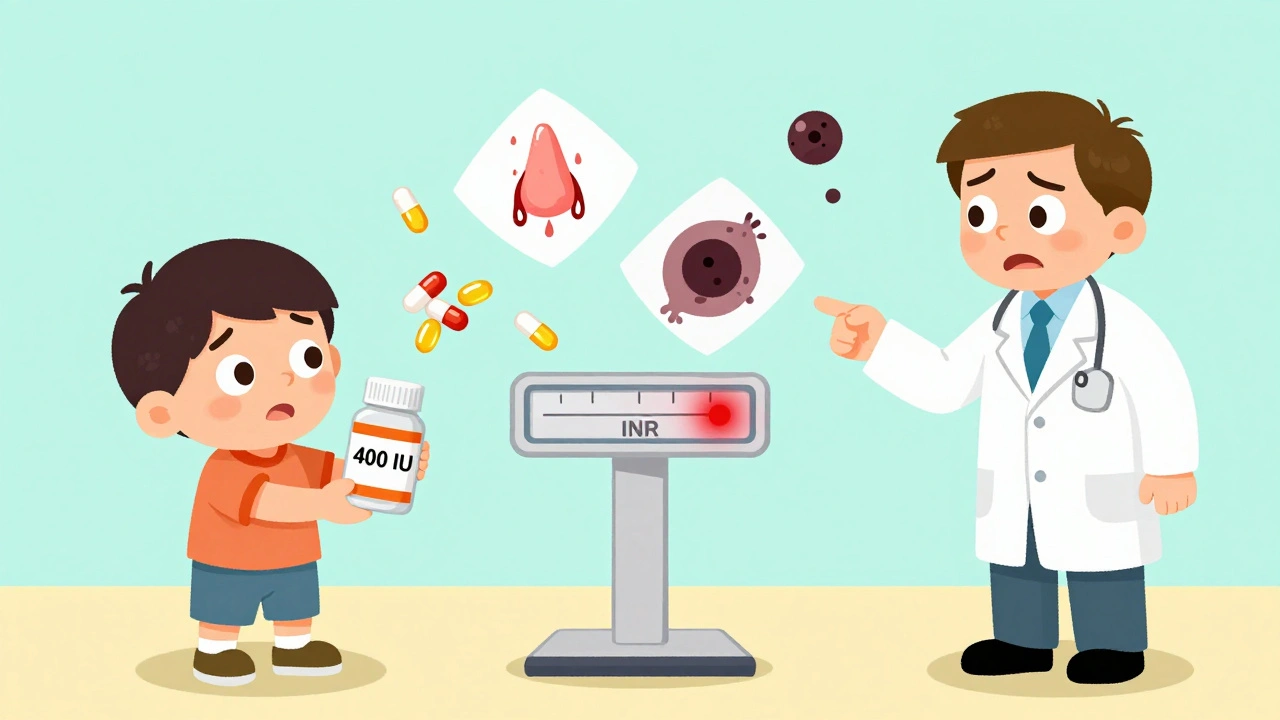
Not all vitamin E is risky. At low doses-under 400 IU per day-most studies show no major effect on INR. But above that, the danger rises sharply. The University of California San Diego Anticoagulation Guidelines, along with the American College of Chest Physicians, both warn against doses higher than 400 IU in patients on warfarin. That’s because beyond this point, vitamin E starts acting like a blood thinner itself.
Here’s the catch: most over-the-counter vitamin E supplements are 400 IU or more. A standard bottle might say “400 IU per capsule.” That’s not a suggestion-it’s a potential warning sign. Even if you’re only taking one a day, you’re crossing a line many clinicians consider unsafe.
Why Some Studies Say It’s Safe
You might have heard that vitamin E is fine with warfarin. That comes from a 1996 study by researchers at UC Davis, which found no INR changes in 21 patients taking up to 800 IU daily. But that study lasted only a few weeks. It didn’t measure long-term bleeding, and it didn’t check vitamin E blood levels. It only looked at INR.
That’s like checking your car’s fuel gauge but never looking at the engine. INR tells you how long it takes your blood to clot, but it doesn’t capture how platelets are behaving. Vitamin E’s main danger isn’t in changing INR-it’s in making platelets less effective. That’s why some patients bleed even when their INR is in range.
Who’s Most at Risk?
Not everyone reacts the same way. Genetics play a role. People with certain variants in the CYP2C9 or VKORC1 genes break down warfarin differently, making them more sensitive to interactions. Older adults, those with liver disease, or anyone already on multiple blood thinners (like aspirin or clopidogrel) are also more vulnerable.
And here’s something rarely discussed: vitamin E supplements aren’t regulated like drugs. Two bottles labeled “400 IU” might contain wildly different amounts. One might be pure alpha-tocopherol. Another might be a synthetic mix with other tocopherols that behave differently. There’s no guarantee of purity or potency.
What Happens If You’re Already Taking It?
If you’re on warfarin and already taking vitamin E, don’t stop cold turkey. Sudden changes can cause clotting problems. Talk to your anticoagulation clinic or doctor. They’ll likely want to:
- Check your current INR
- Measure your serum vitamin E level (if available)
- Review your supplement label for exact dosage and form
- Set up more frequent INR checks-for at least four weeks after stopping or adjusting the dose
Some clinics require weekly INR tests for the first month if you’re taking vitamin E, even at low doses. That’s not overkill-it’s insurance. Bleeding from warfarin and vitamin E together can be silent until it’s too late. A nosebleed that won’t stop, bruising without injury, dark stools, or headaches could be early signs.
What to Take Instead
If you’re on warfarin and taking vitamin E for antioxidant support, you’re not alone. Many people believe it helps with heart health or skin aging. But there’s no strong evidence that high-dose vitamin E improves outcomes in healthy people-and the risks on warfarin are real.
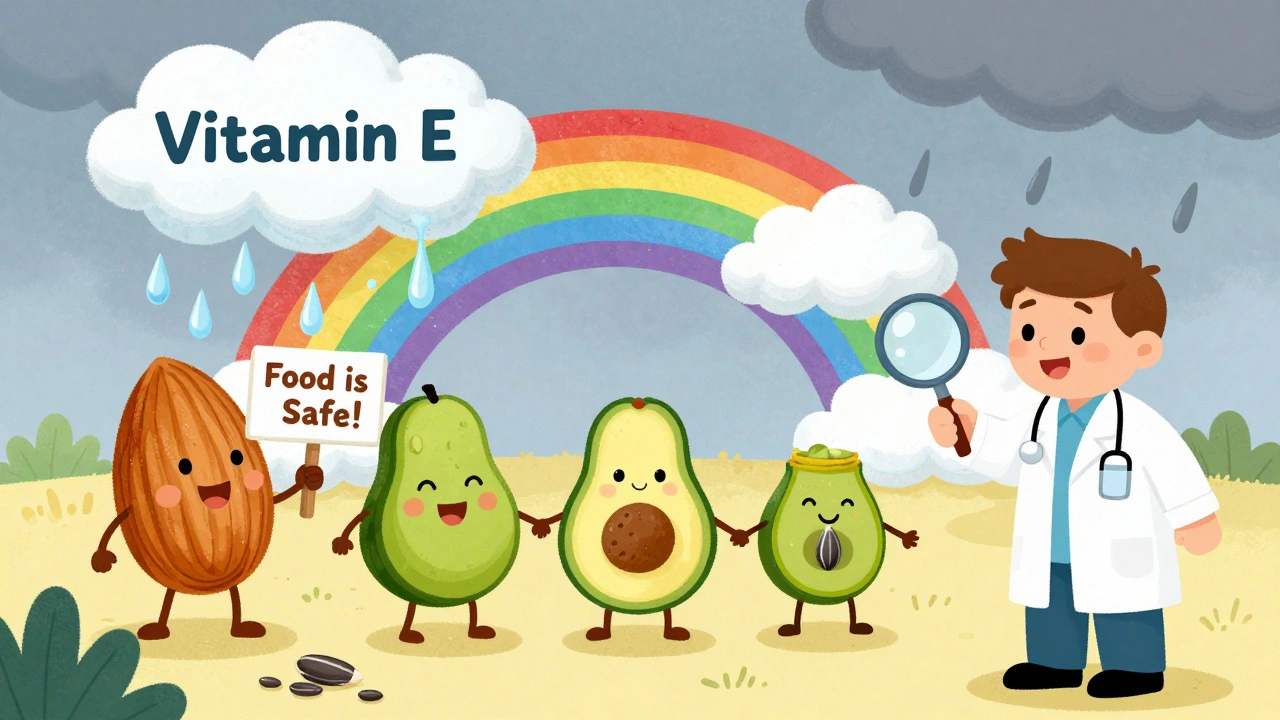
Instead of supplements, get vitamin E from food: almonds, sunflower seeds, spinach, and avocado. These provide safe, natural amounts-usually under 5 IU per serving. No platelet interference. No INR spikes. Just nutrients your body knows how to handle.
If you need antioxidant support, consider vitamin C or selenium. Neither has shown significant interaction with warfarin in clinical studies. Always check with your provider first, but these are safer alternatives.
What Clinicians Are Doing Now
By 2023, 78% of anticoagulation clinics in the U.S. routinely warn patients about vitamin E. Sixty-three percent specifically advise against doses over 400 IU. The European Society of Cardiology’s 2023 guidelines now recommend checking vitamin E levels in patients with unexplained bleeding on warfarin.
Some hospitals are starting to build vitamin E levels into their digital decision tools. If your INR is unstable and you’re on a supplement, your doctor might now run a vitamin E blood test-not just because it’s common, but because it’s becoming standard practice.
The Bottom Line
If you’re on warfarin, avoid vitamin E supplements above 400 IU daily. Period. Even if your INR looks fine, you could be quietly increasing your bleeding risk. Don’t rely on old studies that say it’s safe-they didn’t measure what matters most: actual bleeding.
Food sources of vitamin E? Fine. Supplements? Not worth the risk. Your blood doesn’t need extra help thinning. It needs stability. And that means knowing exactly what’s in your body-and what’s not.
When in doubt, talk to your anticoagulation clinic. Bring your supplement bottle. They’ve seen this before. They’ll help you adjust safely. Don’t wait for a nosebleed to be the wake-up call.
Comments (13)
john damon
Bro I took 800 IU of vitamin E for my skin and didn't think twice 😅 Then one morning I woke up with a black eye from a nosebleed that wouldn't stop... turns out it was the combo with my warfarin. Learned the hard way. Don't be like me.
matthew dendle
so u mean to tell me all them fancy supplement ads are just lying to us? lol i thought vitamin e was like the superhero of vitamins. now u tell me its basically liquid razor blades with warfarin? wow. thanks for the heads up i guess
Aman deep
Thank you for writing this with such care. I’ve been on warfarin for 7 years after a pulmonary embolism, and I never knew vitamin E could be this sneaky. I used to take 400 IU daily thinking I was being healthy. Now I’ve switched to almonds and sunflower seeds - small changes, big safety wins. To anyone reading: your body isn’t broken, it just needs gentle support. Food first, pills last. You’re not weak for listening to your doctor - you’re wise.
Sylvia Frenzel
This is why American healthcare is a mess. You can’t trust anything anymore. Supplements are unregulated, doctors don’t even know the science, and now we’re supposed to read 10-page essays just to take a vitamin? In my country, we just take what the pharmacist says. No drama. No overthinking.
Raj Rsvpraj
Let me be clear: this is not a debate. The 2013 study is definitive. The 1996 study? A fluke. A tiny sample. A flawed design. Anyone who cites it as proof is either misinformed or willfully ignorant. And let’s not forget - vitamin E supplements are not ‘natural’ - they’re synthetic isolates, chemically altered, stripped of co-factors. Real food contains tocopherols AND tocotrienols. This isn’t nutrition - it’s pharmaceutical-grade hubris.
Jack Appleby
Actually, the mechanism is more nuanced. Vitamin E’s platelet inhibition is dose-dependent and isoform-specific. Alpha-tocopherol is the main culprit; gamma-tocopherol may even have protective effects. Most commercial supplements are 90%+ alpha-tocopherol - which is why they’re dangerous. Whole-food sources contain balanced tocopherols. Also, INR is a poor proxy because it measures the extrinsic pathway, while vitamin E affects primary hemostasis. You need platelet function assays to see the real risk. Most clinicians don’t even know this.
Sarah Clifford
so like… if i eat almonds am i safe? what if i just eat one? is that still a betrayal? i feel so guilty now. like i’m a villain for wanting healthy skin. my life is over.
Stephanie Maillet
It’s fascinating how we’ve turned nutrition into a minefield. We’re so afraid of what we put in our bodies that we forget the body has been doing this for millions of years - balancing, adapting, healing. Maybe the real issue isn’t vitamin E or warfarin… it’s that we’ve outsourced our trust to pills and protocols instead of listening to our own rhythms. Food is not a variable to be controlled - it’s a conversation. And sometimes, the quietest voices - like those of almonds and spinach - are the wisest.
David Palmer
why is everyone so scared? i’ve been taking vitamin e with warfarin for 5 years. no bleeding. no problems. maybe it’s just me? or maybe this whole thing is just fearmongering by the medical industrial complex? i’m not stopping. i like my skin.
Paul Dixon
Hey, I just wanted to say thanks for sharing this. I’m on warfarin too, and I was taking a 400 IU capsule every day thinking it was harmless. I just tossed it out today and started snacking on sunflower seeds instead. Feels good to make a smart move. No drama, just better choices. You’re not alone in this.
Vivian Amadi
STOP. JUST STOP. You’re not a scientist. You’re not a doctor. You don’t get to ignore peer-reviewed studies because you ‘feel fine.’ Your nosebleed isn’t ‘fine.’ Your bruising isn’t ‘fine.’ And your ignorance isn’t bravery - it’s negligence. If you’re on warfarin and still taking vitamin E, you’re playing Russian roulette with your brain. Get help.
Jimmy Kärnfeldt
There’s a quiet kind of courage in choosing safety over convenience. I used to think supplements were my allies - now I see them as silent intruders. Switching to food-based vitamin E didn’t just lower my risk - it brought me back to something real. Eating almonds with my morning coffee feels like a small act of self-respect. You don’t need a pill to be healthy. You just need awareness. And maybe a little patience.
Ariel Nichole
Thanks for the clear info. I’ve been telling my mom to stop her 800 IU vitamin E for months, but she thought it was ‘just an antioxidant.’ Now I’m forwarding this to her. She’s gonna hate me, but I’d rather she hate me than end up in the ER. You did good.