
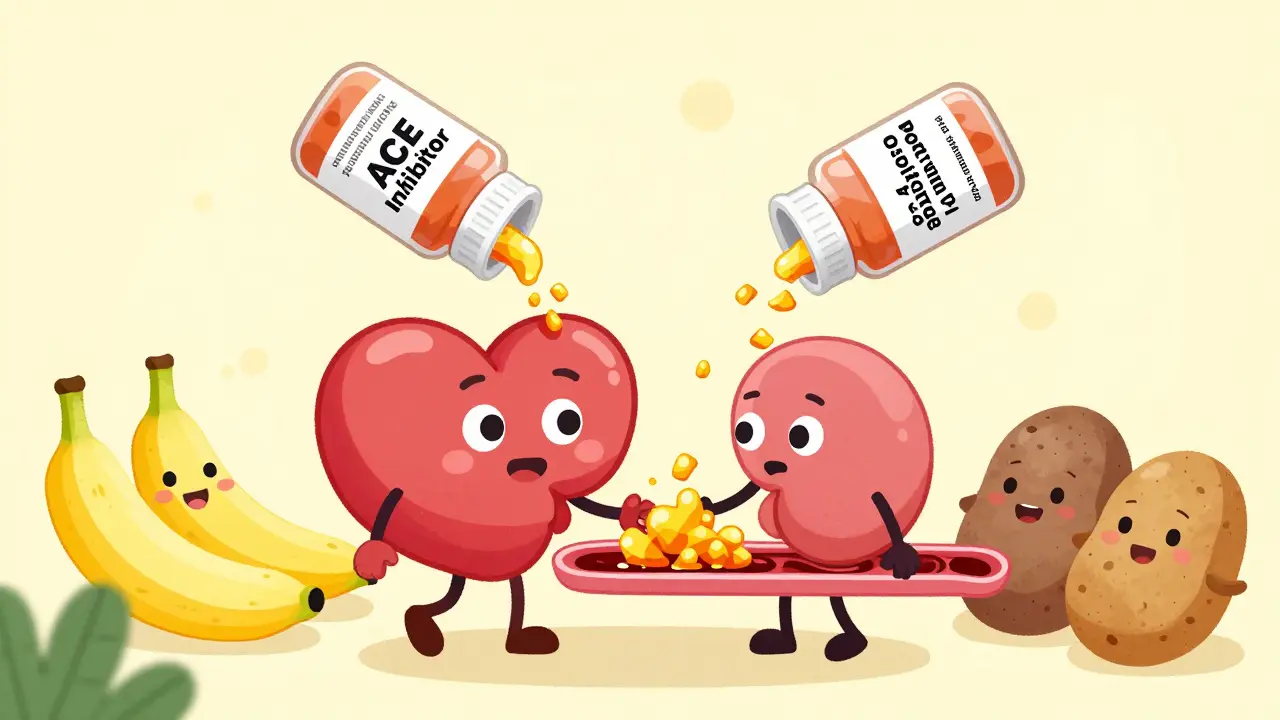
Hyperkalemia Risk Calculator
Calculate Your Hyperkalemia Risk
This calculator estimates your risk of developing high potassium levels when taking ACE inhibitors with potassium-sparing diuretics. It's based on clinical data and guidelines from the Cleveland Clinic.
When you take an ACE inhibitor for high blood pressure or heart failure, you’re doing something smart. These drugs protect your kidneys, lower your risk of heart attacks, and help you live longer. But if your doctor adds a potassium-sparing diuretic - like spironolactone or eplerenone - without checking your potassium levels, you could be walking into a silent danger zone. This isn’t theoretical. It’s real. And it kills people.
Hyperkalemia means your blood potassium is too high. Normal is under 5.0 mmol/L. Once it hits 6.0 or above, your heart can start misfiring. You might not feel a thing until your heart stops. That’s how quiet and deadly this interaction is.
How ACE Inhibitors and Potassium-Sparing Diuretics Work Together - and Why That’s Dangerous
ACE inhibitors block the enzyme that makes angiotensin II. Less angiotensin II means less aldosterone. Aldosterone is the hormone that tells your kidneys to flush out potassium. So when you take an ACE inhibitor, your body holds onto more potassium. Simple enough.
Now add a potassium-sparing diuretic. Spironolactone and eplerenone block aldosterone at the receptor level. Amiloride and triamterene block the sodium channels in your kidneys that normally push potassium out. These drugs don’t make you pee more - they just stop you from losing potassium. So now you’ve got two drugs, each independently reducing potassium excretion, working together to trap even more of it in your bloodstream.
This isn’t a minor bump in numbers. A 1998 study in JAMA Internal Medicine found that 11% of patients on ACE inhibitors alone developed high potassium. When you add a potassium-sparing diuretic? That risk jumps to 30% or higher. In patients with kidney disease, the combination pushed hyperkalemia rates from 4.2% to 18.7% - nearly a five-fold increase.
Who’s Most at Risk?
Not everyone is equally vulnerable. Your risk skyrockets if you have:
- eGFR below 60 - meaning your kidneys aren’t filtering well
- Diabetes - it damages kidney function over time
- Heart failure - your body holds onto fluid and potassium
- Baseline potassium above 4.5 mmol/L - you’re already close to the edge
- Older age - kidney function naturally declines
A scoring system used by the Cleveland Clinic gives you points for each of these. Score 4 or more? You’re in the high-risk zone. That means your doctor should be checking your potassium within a week of starting this combo - not waiting months.
And here’s the kicker: most people don’t know their eGFR. Many doctors don’t either. If you’re on one of these drugs, ask for your last eGFR number. If it’s below 60, you need tighter monitoring.
The Numbers Don’t Lie - But They’re Often Ignored
Here’s what happens in real-world practice:
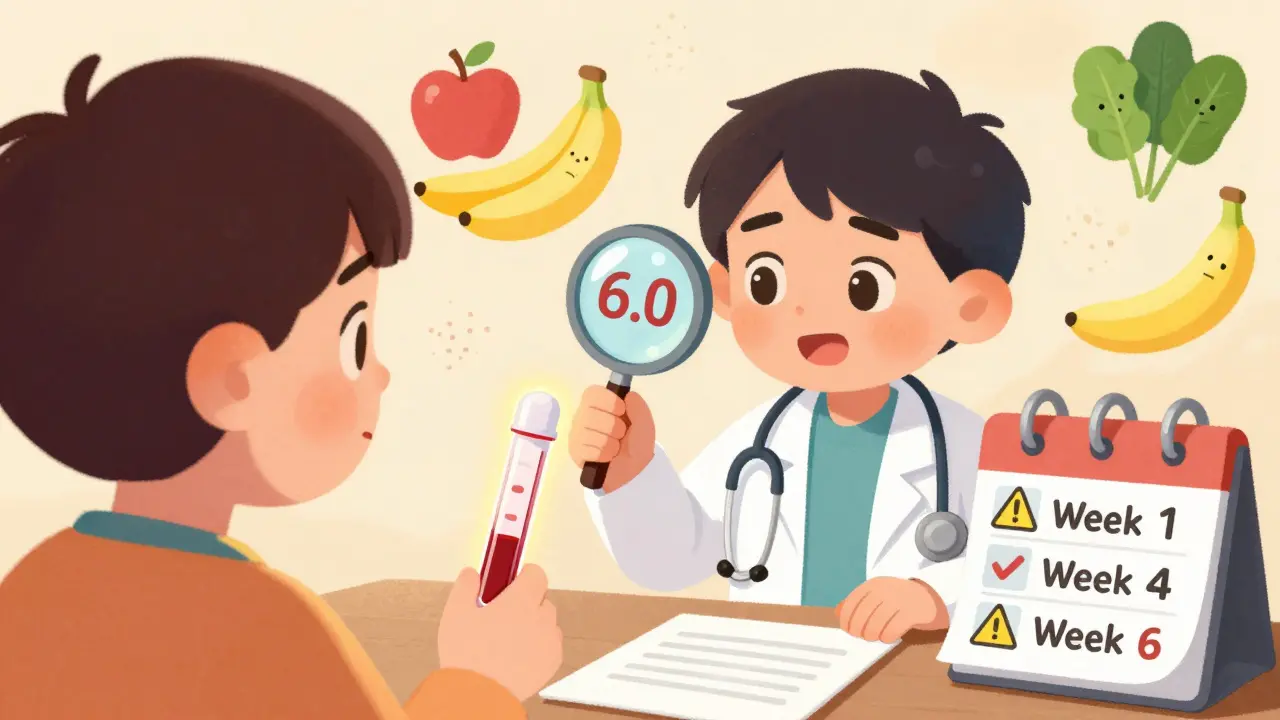
- 78% of hyperkalemia cases happen in the first three months after starting the combo.
- Peak risk? Weeks 4 to 6.
- Only 57% of patients with high potassium get retested within 30 days.
- One-third of patients with potassium over 6.0 mmol/L had no follow-up within a week.
That’s not just negligence - it’s negligence with lethal consequences. The American Heart Association says you should test potassium 1-2 weeks after starting these drugs together. Then again at 1 month, 3 months, and every 6 months after that. But in clinics, it’s often skipped unless someone gets sick.
And when hyperkalemia is found? Doctors stop the ACE inhibitor 43% of the time. That’s a mistake. These drugs cut death risk in heart failure by 23%. You don’t just stop them. You manage the potassium.
What to Do If Your Potassium Goes Up
Let’s say your blood test shows potassium at 5.3 mmol/L. What now?
- Check your diet. Bananas, oranges, potatoes, tomatoes, spinach, and salt substitutes can add 1,000-2,000 mg of potassium a day. That’s half your daily limit. Cut them out for a few weeks. Studies show this alone can drop potassium by 0.3-0.6 mmol/L.
- Switch to a thiazide or loop diuretic. Hydrochlorothiazide (12.5-25 mg daily) or furosemide can help your kidneys flush out extra potassium. This is safer than stopping your heart-protective drugs.
- Reduce the dose. Cut the ACE inhibitor or potassium-sparing diuretic in half. Retest in 1-2 weeks.
- Consider potassium binders. If you’ve tried everything and your potassium stays high, drugs like patiromer (Veltassa) or sodium zirconium cyclosilicate (Lokelma) bind potassium in your gut and pull it out in stool. They’re approved for this exact scenario.
And here’s something rarely discussed: sodium bicarbonate. If you have metabolic acidosis (common in kidney disease), 600-1,000 mg of baking soda daily can reduce hyperkalemia recurrence by 47%. Yet only 18% of eligible patients get it.
Alternatives and Smart Workarounds
You don’t have to give up on your treatment plan. There are better paths:
- Switch from ACE inhibitor to ARB. Angiotensin receptor blockers cause 18% less hyperkalemia. They’re just as effective for heart and kidney protection.
- Use a lower-potency potassium-sparing diuretic. Triamterene is less potent than spironolactone. Less risk. Same benefit.
- Add an SGLT2 inhibitor. Dapagliflozin (Farxiga) or empagliflozin (Jardiance) lower potassium by 32% in patients with kidney disease. They’re now recommended as part of a triple therapy: ACE inhibitor + SGLT2i + low-dose potassium-sparing diuretic.
- Use digital tools. Apps that track dietary potassium intake reduce hyperkalemia episodes by 27%. Simple, free, and effective.
Some doctors even use “drug holidays” - stopping the potassium-sparing diuretic for a few days every week. It’s not perfect, but it works for some.

What’s New in 2026?
There’s real hope on the horizon. Point-of-care potassium meters - devices you can use at home like a glucose monitor - are in late-stage trials. By 2026, you might check your potassium at home every week without ever going to a lab.
And genetic testing is coming. Some people have a variation in the WNK1 gene that makes them naturally prone to holding onto potassium. Once we can test for this, we’ll know who needs aggressive monitoring - and who doesn’t.
But right now, the best tool is awareness. If you’re on this combo, know your numbers. Know your risks. Don’t wait for a crisis.
What You Should Ask Your Doctor
- What’s my last eGFR? Is it below 60?
- What was my potassium level the last time I was tested?
- Are we monitoring potassium every 1-2 weeks after starting this combo?
- Have we considered switching to an ARB or adding an SGLT2 inhibitor?
- Have you checked my diet for hidden potassium sources?
If your doctor can’t answer these, get a second opinion. This isn’t about being difficult. It’s about staying alive.
Can ACE inhibitors and potassium-sparing diuretics be taken together safely?
Yes, but only with strict monitoring. The combination is effective for heart failure and kidney protection, but it increases hyperkalemia risk by 3-5 times. Potassium levels must be checked within 1-2 weeks of starting the combo, then regularly. Dose adjustments, dietary changes, or adding a thiazide diuretic can make it safe.
What are the symptoms of hyperkalemia?
Most people have no symptoms until potassium is dangerously high. When symptoms appear, they include muscle weakness, fatigue, irregular heartbeat, chest pain, or sudden palpitations. In severe cases, it can cause cardiac arrest. That’s why blood tests - not symptoms - are the only reliable way to detect it.
How often should potassium be checked when taking this drug combo?
For high-risk patients (eGFR <60, diabetes, heart failure), check potassium 1 week after starting, then at 2 and 4 weeks, and monthly for the first 3 months. After that, every 3-6 months. If eGFR is below 30, check weekly at first. Never wait longer than 3 months without testing.
Can I eat bananas or potatoes if I’m on these medications?
It’s risky. A single banana has 420 mg of potassium. Potatoes, oranges, tomatoes, spinach, and salt substitutes add up fast. The FDA recommends a daily limit of 4,700 mg, but for people on this combo, staying under 3,000 mg is safer. Avoid high-potassium foods unless your doctor confirms your levels are stable. Consider using apps to track your intake.
What if my potassium is high - should I stop my ACE inhibitor?
No, not automatically. Stopping ACE inhibitors increases death risk in heart failure patients by 23%. Instead, reduce the dose, add a thiazide diuretic, adjust your diet, or use a potassium binder like Lokelma. Only stop the drug if potassium stays above 6.0 mmol/L despite all other measures - and even then, consider alternatives like ARBs before discontinuing entirely.
Are there newer drugs that reduce this risk?
Yes. SGLT2 inhibitors like dapagliflozin reduce hyperkalemia risk by 32% in patients with kidney disease. Potassium binders like patiromer and sodium zirconium cyclosilicate lower potassium within 48 hours and allow patients to continue their heart-protective drugs. These are now standard options for patients who can’t tolerate the combo.
Hyperkalemia from this drug interaction isn’t a mystery. It’s predictable. Preventable. And too often, ignored. You don’t need to be afraid of your medications - but you do need to be informed. Ask questions. Demand tests. Know your numbers. Your heart depends on it.

Comments (9)
Wendy Lamb
Finally, someone laid this out without fluff. I work in cardiology, and this is exactly what we teach residents-but it’s not what happens in primary care. I’ve seen patients code because their potassium was 6.8 and no one checked for 10 weeks. This isn’t rocket science. It’s basic pharmacology. Why is it so hard to implement?
Prajwal Manjunath Shanthappa
Oh, for heaven’s sake-another ‘educational’ post that assumes everyone knows what eGFR means! Let me guess-you’re one of those people who thinks ‘renal function’ is a yoga pose? Let’s be clear: if you’re on spironolactone and don’t know your eGFR, you’re not managing your health-you’re playing Russian roulette with your myocardium. And don’t even get me started on ‘salt substitutes.’ They’re just potassium chloride in a fancy bag. Please, for the love of Hippocrates, read a textbook before you self-diagnose.
Antwonette Robinson
Wow. A 12-page essay on something that should’ve been a 3-sentence warning in the drug insert. Honestly, if your doctor can’t explain this combo’s risk in under 60 seconds, maybe they shouldn’t be prescribing it. Also-‘sodium bicarbonate’? That’s like recommending baking soda for a broken leg. Cute.
Ed Mackey
Thanks for this. I’ve been on lisinopril + spironolactone for 2 years. My last potassium was 5.2. My doc said ‘it’s fine.’ I just looked up my eGFR-it’s 54. I’m gonna call them tomorrow. I didn’t even know I could ask for that. Really helpful.
Alex LaVey
Hey-first off, thank you for writing this with such clarity. I’m from a rural town where most patients don’t even have access to regular labs. But I’ve started sharing this with my community health group. We’re printing it out, laminating it, and putting it in the waiting room. Knowledge is power, and you just gave us a weapon. Keep going. People like you make medicine human.
Joseph Cooksey
You know what’s really tragic? Not that this combo is dangerous-it’s that we’ve known it for decades. The 1998 JAMA study? I read that in med school. We’ve had potassium binders since 2018. We’ve had SGLT2 inhibitors showing cardiorenal benefits since 2015. Yet here we are, in 2026, still having the same conversations. It’s not ignorance. It’s inertia. The system is designed to prioritize volume over vigilance. Doctors are overworked, labs are underfunded, and patients are treated like data points. We need systemic change-not just better handouts. And yes, I’m still mad about it.
Justin Fauth
USA, baby. We got the best drugs, the best science, the best docs-and yet somehow we still let people die because no one checked a lab? That’s not a medical issue. That’s a cultural failure. We got the tech to monitor this at home, but we’re still stuck in 1995. Fix the system, not the patient. This isn’t about being careful-it’s about being responsible.
Daz Leonheart
I’m a nurse in a dialysis unit. We see this every week. One guy came in with a potassium of 7.1. No symptoms. No follow-up. Just a ‘I thought I was fine.’ He’s okay now. But we lost two others last year. This isn’t theory. It’s our daily reality. Please, if you’re on this combo-get tested. Don’t wait.
Mandy Vodak-Marotta
I’m a 68-year-old with heart failure and type 2 diabetes. I’ve been on lisinopril and spironolactone for 3 years. My potassium was 5.6 last month. My doctor said, ‘We’ll watch it.’ I didn’t know what to do-until I read this. I cut out bananas, switched to low-sodium salt, and started taking hydrochlorothiazide as suggested. My next labs are in two weeks. I’m scared, but I feel like I have a plan now. Thank you. Seriously. This saved me from just… hoping it’d be okay.