

Why Waiting for Memory Loss Is Too Late
Most people think cognitive decline means forgetting names or where you left your keys. But by the time those moments become frequent enough to worry about, the brain has already been changing for years-sometimes decades. The real breakthrough isn’t in treating advanced dementia. It’s in catching the earliest signs, before daily life is affected. That’s where modern screening comes in.
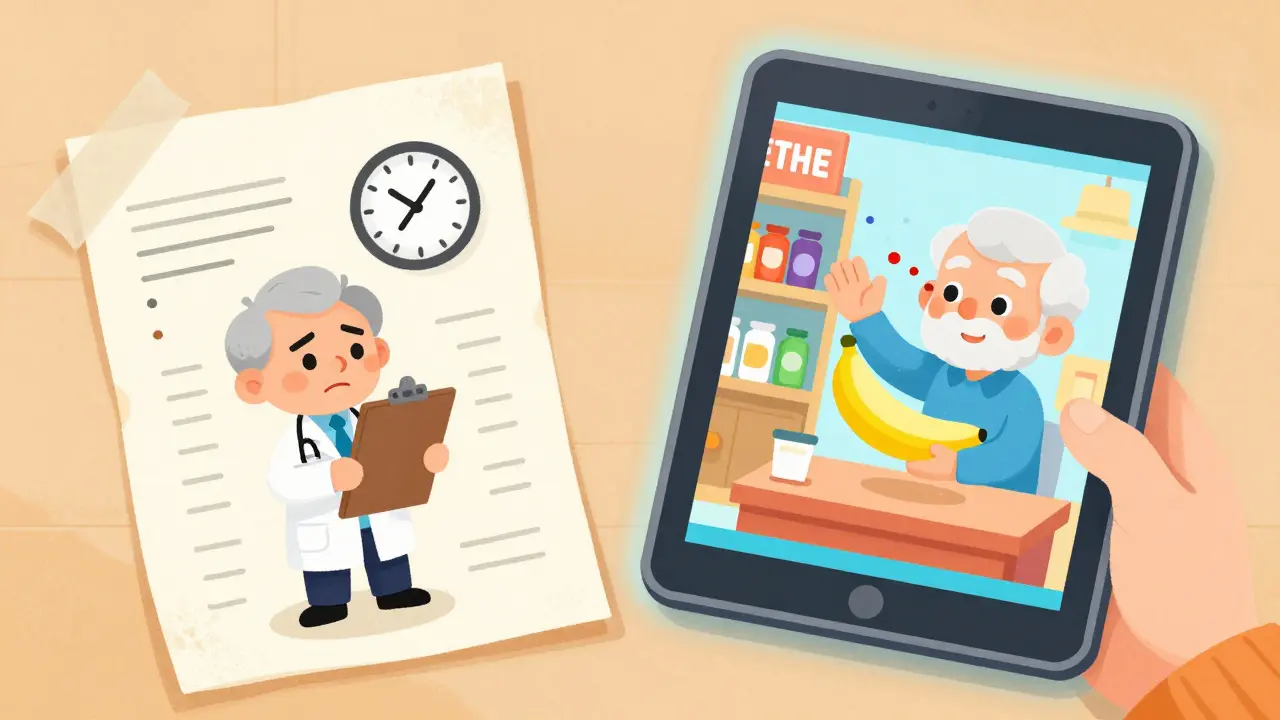
In 2025, we’re no longer relying on pencil-and-paper tests that miss subtle changes. A 78-year-old woman in Melbourne might complete a cognitive check during her annual Medicare visit using a tablet, answering questions through a simple app while her eye movements are tracked. She doesn’t feel stressed. She doesn’t feel like she’s being tested. She just thinks she’s watching a short video. Meanwhile, the system is measuring how long she pauses before answering, how her hand shakes when tracing a path, and whether she remembers a word from three minutes ago. All of this happens in seven minutes.
The Old Way Didn’t Catch Enough
For years, doctors used the Montreal Cognitive Assessment (MoCA), the Mini-Cog, or the MMSE. These tests asked people to draw a clock, remember three words, or name as many animals as they could in a minute. They were easy to use and didn’t need special equipment. But they weren’t sensitive enough.
A 2023 meta-analysis showed these tools missed up to 40% of people with mild cognitive impairment (MCI). Why? Because they only measured outcomes-not how the brain got there. A person might draw a clock with the right numbers but take twice as long as normal. Or they might remember the words but only after being prompted. These are early warning signs the old tests couldn’t detect.
Even worse, these tests didn’t track changes over time. One year, someone scores 26 out of 30. The next year, they score 25. Is that normal aging? Or the start of decline? With paper tests, you can’t tell. That’s why so many people are diagnosed too late-when treatments have limited effect.
What’s Replacing the Old Tests
Today, the best tools don’t just ask questions-they watch how you answer. The Virtual Reality-Based Cognitive Function Examination (VR-E) immerses users in a 3D environment where they navigate a virtual store, find items, and recall details. It tracks eye movements, reaction times, and even how long someone stares at a misplaced object. This tool has a 94% accuracy rate in spotting early MCI.
Then there’s Linus Health’s Digital Assessment of Cognition (DAC). It combines two simple tasks: drawing a clock digitally and recalling a list of words. But instead of just scoring the final result, it analyzes 12 hidden metrics-like how fast the pen moves, how many times the user lifts it off the screen, or how close their drawing comes to a perfect circle. Machine learning compares these patterns to thousands of previous cases and flags even tiny deviations.
Cleveland Clinic’s Cognitive Battery (C3B) is now used in Medicare annual wellness visits. It’s designed for primary care settings. It takes 10 minutes. It’s built into the clinic’s electronic system. If a patient’s score drops by more than 1.5 points from last year, the doctor gets an alert. No extra paperwork. No waiting for a specialist.
And then there’s RoCA-the Rapid Online Cognitive Assessment. It works on any smartphone or tablet. It’s free for patients. It’s been validated across age groups, including those with little tech experience. One study found 95% of users felt it added real value to their care.
Why Digital Tools Work Better
Traditional tests measure what you know. Digital tools measure how you think.
Take the Trail Making Test. On paper, you connect dots in order. The score is how long it takes. But digital versions like dTMT-B record every millisecond of movement. If someone hesitates between numbers 3 and 4, that’s different than if they rush through the whole thing. The system can tell if the delay is due to memory loss, motor issues, or just poor eyesight.
These tools also remove human bias. A doctor might unconsciously give hints during a MoCA test. A tablet won’t. A person might feel embarrassed forgetting a word in front of someone. They won’t feel that way answering a screen.
Most importantly, digital tools create a baseline. One test today. Another in six months. Another in a year. The system doesn’t just say “you’re fine” or “you’re not.” It says, “Your memory recall speed dropped 12% since last year. Your spatial navigation time increased by 18%. This is outside normal aging.” That’s actionable.
Who’s Using These Tools-and Who Isn’t
As of early 2025, 450 U.S. healthcare systems have adopted Linus Health’s platform. Cleveland Clinic rolled out C3B to all its primary care clinics. Medicare now reimburses up to $45 per digital cognitive test. The FDA has cleared 12 digital tools for clinical use.
But adoption isn’t universal. In Australia, uptake is slower. Many GPs still use MoCA because it’s familiar. Some patients resist screens. One Reddit user wrote, “My dad failed the online test because he couldn’t figure out how to click the buttons-not because he forgot his granddaughter’s name.”
That’s a real problem. Not everyone can use a tablet. Not everyone trusts technology. Older adults from low-income or non-English-speaking backgrounds are underrepresented in digital tool studies. That means the algorithms might not work as well for them.
Health equity isn’t an afterthought-it’s a design challenge. The best tools now include voice-guided instructions, larger buttons, slower pacing, and options for family members to assist without taking over.
What Happens After a Positive Screen
A positive result doesn’t mean dementia. It means: “Your brain is showing early signs of change. Let’s find out why.”
Next steps include blood tests for amyloid and tau proteins-new biomarkers that can now detect Alzheimer’s pathology with over 90% accuracy, without a brain scan. If those come back positive, doctors may recommend lifestyle changes: more aerobic exercise, Mediterranean diet, better sleep hygiene, cognitive training.
For some, disease-modifying drugs like lecanemab may be an option. But these drugs work best when started early-before memory loss is obvious. That’s why screening matters. If you wait until someone can’t find their way home, it’s too late for these drugs to make a real difference.
Studies show people who start interventions in the MCI stage slow decline by 30-50% over two years. That’s not a cure. But it’s enough to keep someone independent, driving, managing their finances, and living at home for years longer.
The Future Is Multimodal
The next big leap isn’t just better screens. It’s combining them.
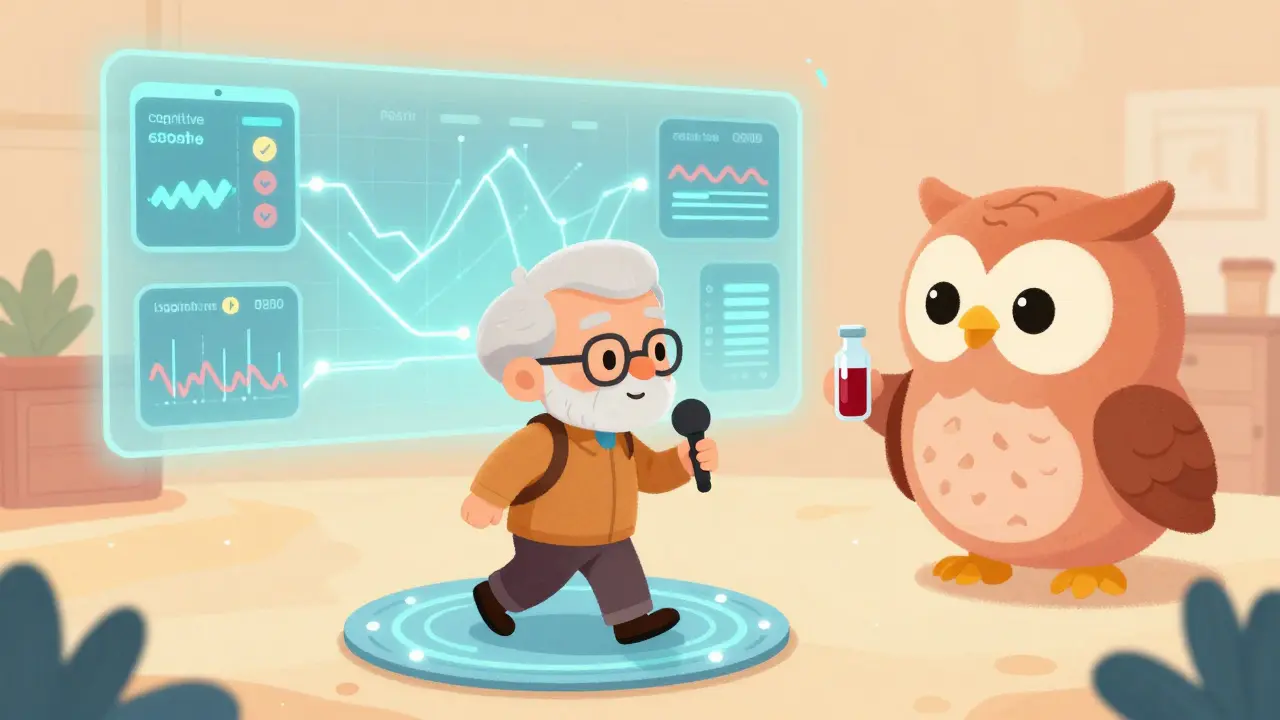
Linus Health already combines digital cognitive testing with APOE gene status and blood biomarkers. Their model predicts amyloid buildup in the brain almost as accurately as a PET scan-but at 1/10th the cost. In 2025, clinical trials are testing whether combining these tools can predict who will progress from MCI to Alzheimer’s within 18 months.
Other researchers are adding voice analysis-listening for changes in speech rhythm or word-finding pauses. Some are using wearable sensors to track walking speed and balance, which often decline before memory does.
By 2030, your annual health check might include: a blood draw, a 7-minute digital cognitive test, a 30-second walk test, and a voice recording. All analyzed together. All uploaded to your medical record. All tracked over time.
What You Can Do Today
If you’re over 65, ask your doctor if they offer digital cognitive screening during your annual wellness visit. If they say no, ask why. If they say they use MoCA, ask if they’ve considered newer tools. Bring up the topic. It’s your right.
If you’re caring for someone older, don’t wait for them to forget your name. Watch for small changes: Are they taking longer to complete familiar tasks? Are they avoiding social events because they feel overwhelmed? Are they repeating questions they just asked?
And if you’re under 65? Start now. Cognitive health isn’t just about aging. It’s about brain resilience. Exercise. Sleep. Manage blood pressure. Limit alcohol. Stay socially connected. These aren’t just “good habits.” They’re proven ways to delay or even prevent decline.
What’s Next
The U.S. Preventive Services Task Force is reviewing whether to recommend routine cognitive screening for all adults over 65. Australia’s National Health and Medical Research Council is watching closely. If they follow suit, screening could become as standard as cholesterol checks.
But the real win won’t be the test. It’ll be what happens after. Earlier detection means more time. More control. More years living well-not just living.

Comments (8)
Bob Cohen
I’ve seen this in my own family. My uncle thought he was fine until he started forgetting to turn off the stove. The digital test caught it before he nearly burned down his house. Honestly, if this stuff is free and built into Medicare visits, why aren’t more doctors pushing it? We’re not talking sci-fi here-we’re talking preventing disasters before they happen.
Aditya Gupta
in india we still use paper tests. my grandpa did moca and the doc said 'you're fine' even though he kept asking the same question every 5 mins. digital tools? we need them bad. but also need phones that dont crash when u tap too hard lol
Angel Fitzpatrick
Let’s be real. This isn’t medicine-it’s Big Pharma’s new surveillance play. They’re not trying to save your brain. They’re collecting behavioral biometrics to feed AI models that will later be sold to insurers who’ll deny you coverage if your 'cognitive decline trajectory' looks 'unfavorable.' And don’t tell me about 'early detection.' The FDA cleared 12 tools? That’s not science-that’s regulatory capture. They want you scared, dependent, and on a subscription.
Donna Macaranas
I work in geriatric care and honestly, the digital tools have been a game changer. One patient who used to get frustrated and shut down during MoCA tests now sits there calmly doing the tablet thing like it’s a game. She even smiled once. That’s huge. And the data? It’s so much more useful than a 25/30 score with no context.
Lisa Rodriguez
I’ve been pushing my dad’s doctor to use C3B since last year. They said they don’t have the bandwidth. I showed them the Medicare reimbursement info and they blinked. Now they’re testing it on 5 patients. It’s slow but it’s happening. Also-side note-my mom used the RoCA app on her phone and said it felt like playing a puzzle game. She didn’t even realize she was being tested until it was over. That’s genius.
Lilliana Lowe
The notion that digital tools eliminate human bias is fundamentally flawed. The algorithms are trained on datasets that are overwhelmingly white, affluent, and technologically literate. To claim they're 'objective' is not only inaccurate-it’s dangerously negligent. Furthermore, the term 'normal aging' is a vague, culturally constructed construct that pathologizes natural neurocognitive variation. These tools don’t detect decline-they enforce a narrow standard of cognitive performance that excludes vast swaths of the population.
vivian papadatu
My grandma is 82, doesn’t speak English well, and uses a flip phone. We got her the RoCA app with voice guidance and a big red button. She did it in 8 minutes while eating oatmeal. She said, 'That was fun, like a little quiz.' And the doctor got an alert that her recall speed dropped 14%. We got her into a study for brain health supplements. No panic. No stigma. Just care. This is what equity looks like when you actually design for people, not just data points.
Melissa Melville
My dad failed the online test because he couldn’t figure out how to click the buttons-not because he forgot his granddaughter’s name. 😒