

Living with ADHD as an adult isn’t just about forgetting keys or being late. It’s about staring at a pile of unpaid bills, missing deadlines at work, or canceling plans because you’re too overwhelmed to even start. The noise in your head doesn’t turn off. And no, you’re not lazy. You’re neurodivergent - and there’s a better way forward.
ADHD Isn’t Just a Childhood Thing
For decades, ADHD was seen as a kid’s problem. But here’s the truth: about 4.4% of U.S. adults - that’s over 8 million people - have it. And most of them were never diagnosed as kids. They just learned to cope with constant chaos: missed appointments, unfinished projects, emotional burnout. The brain doesn’t outgrow ADHD. It learns to mask it. Until the pressure becomes unbearable.
Modern diagnosis isn’t guesswork. Doctors use tools like the Adult ADHD Self-Report Scale (ASRS) and clinical interviews based on DSM-5 criteria. Symptoms aren’t just about being hyperactive. In adults, it’s more about disorganization, emotional dysregulation, and chronic procrastination. You might be the person who can work 14-hour days on a passion project but can’t pay a utility bill on time. That’s ADHD.
Medication: The Foundation, Not the Fix
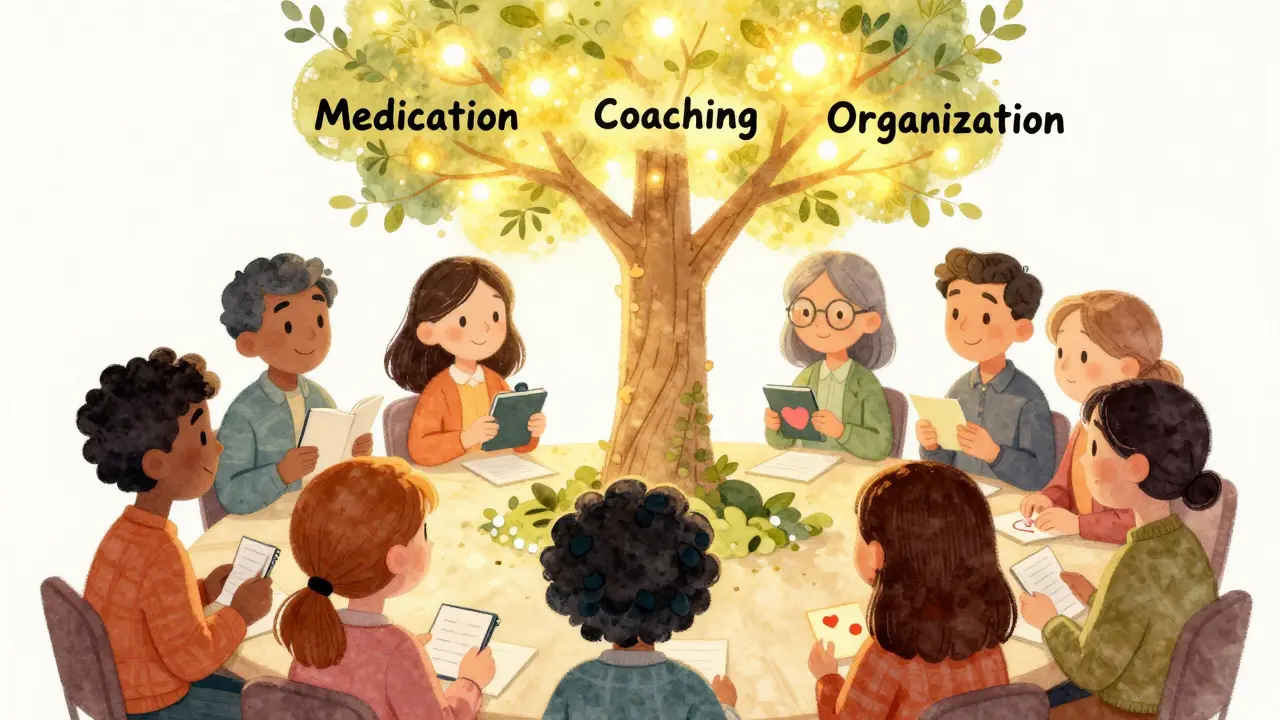
Medication is the most researched part of adult ADHD treatment. And yes, it works - for most people. Stimulants like methylphenidate (Concerta, Ritalin) and amphetamine-based drugs (Adderall, Vyvanse) are first-line options. They don’t make you “calm.” They quiet the static. They help you focus long enough to actually start tasks - and finish them.
Here’s what you need to know:
- Stimulants kick in within 30-60 minutes and last 8-16 hours, depending on the formulation.
- Non-stimulants like atomoxetine (Strattera) take weeks to work but are safer for people with heart concerns.
- Generic methylphenidate can cost as little as $10/month with insurance. Vyvanse? Up to $450 without it.
- Response rates? Around 70-80% of adults see major improvement in focus and task completion.
But medication isn’t magic. It doesn’t teach you how to organize your life. It just gives you the mental clarity to learn.
Medication Safety: What No One Tells You
There’s fear around ADHD meds. And for good reason. Stimulants can raise blood pressure and heart rate. A 2023 study in JAMA Psychiatry found each year of use slightly increases cardiovascular risk - especially after five years. But here’s the twist: the same study showed people on meds had 39% lower risk of death overall. Why? Because they were less likely to have accidents, overdoses, or job loss.
Here’s the real safety checklist:
- Get a baseline ECG and blood pressure check before starting - especially if you’re over 40.
- Monitor your heart rate weekly. If it’s consistently above 90 bpm at rest, talk to your doctor.
- Never mix stimulants with MAO inhibitors. That’s dangerous.
- Annual blood pressure checks aren’t optional. Many primary care docs skip them. Don’t let that happen to you.
And yes, Vyvanse is harder to abuse than Adderall because it’s a prodrug - it only converts to active amphetamine in your gut. That’s why it’s the #1 prescribed stimulant in 2023.
Coaching: The Missing Piece
Medication helps you think. Coaching helps you act.
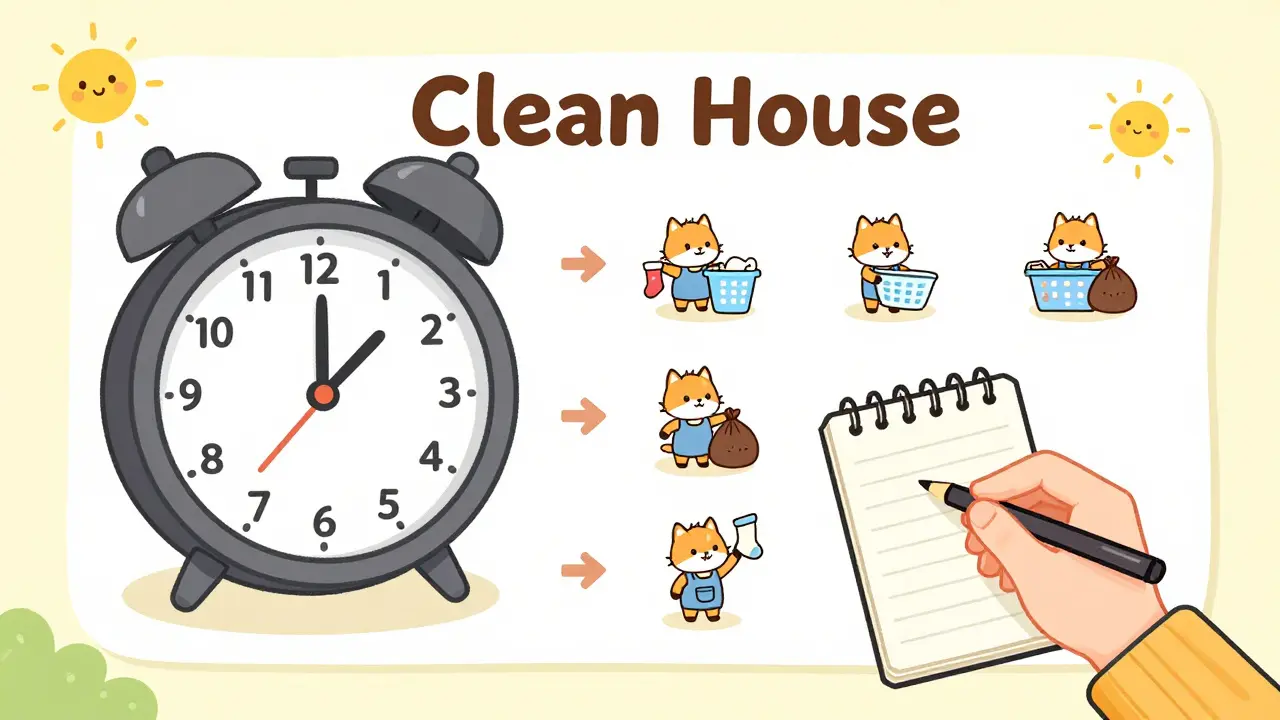
ADHD coaches aren’t therapists. They don’t dig into your childhood. They’re like personal trainers for your executive function. They help you build systems that work with your brain - not against it.
Here’s what real ADHD coaching looks like:
- Breaking down “clean the house” into: 1) Grab one trash bag. 2) Put socks in it. 3) Walk to the laundry room. 4) Stop. Breathe. Reward yourself.
- Using the Eisenhower Matrix to sort tasks by urgency and importance - not by how you feel.
- Setting alarms that actually work - not just phone alerts, but physical timers you can’t ignore.
- Creating “launch rituals”: a 5-minute routine to start work, like making tea, putting on headphones, and saying out loud, “I’m starting now.”
Studies show that when people combine medication with coaching, 81% report major improvements in time management. With medication alone? Only 58%. Coaching fills the gap between knowing what to do and actually doing it.
Organization: Building Systems That Stick
Forget fancy apps. If your system requires more energy than it saves, it’s useless.
People with ADHD don’t need more to-dos. They need fewer decisions.
Try this:
- One notebook, one pen. No digital clutter. Write down everything - tasks, ideas, worries. At the end of the day, review it. Toss what doesn’t matter. Move the rest to a calendar.
- Time blocking isn’t about perfection. It’s about protection. Block 90 minutes for your most important task. No email. No phone. Just you and the task.
- Visual cues work better than reminders. Put your keys next to your wallet. Put your gym clothes on your bed. Your brain needs to see it.
- Accountability partners beat willpower. Tell someone: “I’m sending you my weekly plan by Sunday night.” Then do it. Even if it’s messy.
One client I know went from missing 3 out of 4 deadlines to hitting 90% after just 6 weeks of using a paper planner and a weekly check-in with her sister. No apps. No fancy tech. Just structure.
What Doesn’t Work
Here’s what fails most people:
- Trying to “just be more disciplined.” ADHD isn’t a willpower issue.
- Using apps that require 10 steps to log a task. If it’s harder than doing the task, you won’t use it.
- Waiting until you “feel like it.” Motivation doesn’t come before action for ADHD brains. Action comes before motivation.
- Skipping doctor visits because “I feel fine.” Medication needs monitoring. Blood pressure doesn’t lie.
And please - don’t try to self-medicate with caffeine, nootropics, or CBD. They don’t fix the core issue. And they can make anxiety or sleep problems worse.
Where to Start Today
You don’t need to fix everything at once.
Here’s your 7-day starter plan:
- Day 1: Write down your top 3 ADHD struggles. Be specific. “I forget to pay bills” not “I’m disorganized.”
- Day 2: Call your doctor. Ask: “Can we check my blood pressure and heart rate before starting meds?”
- Day 3: Buy a $5 spiral notebook. Use it for everything.
- Day 4: Set one alarm for the same time every day - morning or evening. When it rings, do one tiny task: wash one dish, put one item away.
- Day 5: Find a free ADHD coaching workshop. CHADD.org has them nationwide.
- Day 6: Tell one person: “I’m working on my ADHD. Can you check in with me next week?”
- Day 7: Celebrate. You didn’t fix everything. But you started. That’s the win.
It Gets Better - But Only If You Act
Adult ADHD isn’t a life sentence. It’s a condition you manage - like diabetes or high blood pressure. With the right tools, people with ADHD thrive. They start businesses. They write books. They raise kids. They build careers.
But it takes more than a pill. It takes a system. A coach. A plan. And the courage to ask for help.
You’re not broken. You’re wired differently. And that’s not a flaw. It’s a challenge - one that’s totally solvable.
Can ADHD meds cause heart problems?
Stimulant medications can raise blood pressure and heart rate, especially in adults over 40. Studies show a small increased risk of cardiovascular disease with long-term use - but the overall risk remains low for healthy individuals under proper medical supervision. Baseline heart checks and annual monitoring are essential. Non-stimulants like atomoxetine are safer for those with heart concerns.
Is ADHD coaching worth it if I’m on medication?
Yes - and research shows it’s more effective than medication alone. Medication helps you focus. Coaching teaches you how to use that focus. One study found 81% of adults who used both improved their time management, compared to just 58% on meds only. Coaching fills the gap between knowing what to do and actually doing it.
What’s the best organization system for ADHD adults?
There’s no single “best” system - only what works for you. Most successful adults use simple, visual, low-effort tools: a paper planner, physical timers, and habit stacking (linking new habits to existing ones). Apps often fail because they’re too complex. Start with one notebook and one daily task. Build from there.
Can adults be diagnosed with ADHD for the first time?
Absolutely. Most adults with ADHD weren’t diagnosed as children. Diagnosis now relies on self-reports, clinical interviews, and evidence of symptoms dating back to childhood - even if they weren’t recognized at the time. You don’t need childhood records. You need a qualified clinician who understands adult ADHD.
How long does it take for ADHD meds to work?
Stimulants work within 30-60 minutes. But finding the right dose and type takes weeks - often 6-8 weeks of adjustments. Non-stimulants like Strattera take 2-4 weeks to show effects. Patience and tracking symptoms (using the ASRS scale) are key. Don’t quit too early.
Are there free resources for adult ADHD support?
Yes. CHADD (Children and Adults with Attention-Deficit/Hyperactivity Disorder) offers free coaching workshops, webinars, and local support groups across the U.S. Their website has toolkits for work, relationships, and daily organization. ADHD Coaches Organization also lists certified coaches who offer sliding-scale fees.
What’s Next?
If you’re reading this and thinking, “This sounds like me,” don’t wait. Start small. Talk to your doctor. Try one organizational hack. Reach out to a coach. You don’t need to be fixed. You just need the right support.
The world is starting to catch up. Companies now offer ADHD workplace accommodations. Insurance plans cover coaching. New medications are being designed with safety in mind. You’re not behind. You’re just early.
And that’s okay.

Comments (16)
Satyakki Bhattacharjee
Everyone just takes meds like they’re candy. No one talks about how the system is designed to keep you dependent. Big Pharma doesn’t want you to heal, they want you to keep buying.
ADHD isn’t a brain disorder-it’s a response to a broken world. You’re not broken. The world is.
Kishor Raibole
It is my solemn duty to inform you that the foundational premise of this discourse is fundamentally flawed. The notion that pharmacological intervention constitutes a legitimate therapeutic modality for neurocognitive variance is an artifact of biomedical hegemony.
One must question the epistemological validity of DSM-5 criteria when applied to adult phenomenology. The very concept of ‘executive function’ is a construct of industrial capitalism, designed to enforce compliance.
John Barron
As a board-certified psychiatrist with 22 years in private practice, I must say-this article is dangerously oversimplified. 🤨
Stimulants do NOT ‘quiet the static.’ That’s pop neuroscience. They modulate dopamine reuptake in the prefrontal cortex via D1 and D2 receptor agonism. And Vyvanse isn’t ‘harder to abuse’-it’s just slower to hydrolyze. Also, if you’re not doing therapeutic drug monitoring, you’re doing it wrong. 🩺
Liz MENDOZA
I just want to say-thank you for writing this. I’ve been struggling for years and never felt seen until now.
My therapist said I had ‘high-functioning anxiety’ for seven years. Turns out, it was ADHD. The first time I took methylphenidate, I cried because I could finally finish a sentence without my brain jumping to five other things.
You’re not alone. I’m here if you need to talk.
Jane Lucas
so i tried the notebook thing and it worked kinda
but then i lost it and now i have 3 notebooks and no idea what’s in any of them 😅
Elizabeth Alvarez
They’re hiding the truth. ADHD meds are just a gateway. The real agenda? The government wants us distracted so we don’t notice the surveillance state.
Did you know the ASRS scale was originally developed by DARPA? And Vyvanse? It’s made by a company linked to the CIA’s MKUltra program. They don’t want you to think clearly-they want you to be productive enough to work but too zoned out to ask questions.
Check the patent dates. Look at the funding. It’s all connected.
And why are the studies always funded by pharma? Coincidence? I think not.
They’re selling control disguised as help.
They want you dependent. They want you docile.
And they’re using your children’s diagnoses to normalize it.
Wake up.
It’s not ADHD. It’s programming.
Miriam Piro
They call it ‘ADHD’ so you don’t realize you’re being drugged into compliance. 🧠💉
Ever notice how every ‘successful’ ADHD person on TikTok is wearing a blazer and holding a coffee? That’s not recovery-that’s assimilation.
Medication doesn’t fix your brain-it makes you a better corporate drone.
Coaching? That’s just emotional labor disguised as productivity.
And that ‘paper planner’? It’s a 1950s office tool repackaged as a ‘solution’ for people they want to control.
You’re not broken. You’re awake. And they’re terrified of you.
Stop buying the lie. The system doesn’t want you to thrive-it wants you to be manageable.
dean du plessis
Man this hits different
Been living with this since school and no one ever said it’s not laziness
Just got my diagnosis last year
Now I use a whiteboard and one alarm
Life’s still messy but at least I’m not yelling at myself anymore
Peace out
Kylie Robson
While the article provides a clinically oriented overview, it fails to address the neurochemical asymmetry inherent in dopaminergic dysregulation within the mesocortical pathway. The reliance on stimulants as a first-line intervention is predicated on an outdated monoamine hypothesis that neglects glutamatergic modulation and the role of the salience network.
Furthermore, the efficacy of coaching is confounded by the absence of standardized outcome metrics in the cited 81% statistic-likely derived from non-blinded, self-selected cohorts.
One must interrogate the epistemic authority of the ASRS scale, which exhibits poor construct validity in non-Western populations.
And the ‘paper planner’ recommendation? Aesthetic minimalism masking a lack of neurocognitive scalability.
This is not treatment. It’s symptom management with a side of performative productivity.
Caitlin Foster
OMG YES. I literally did the 7-day plan and I cried at day 3 because I FINALLY washed ONE dish and didn’t feel like a failure 😭
My partner thought I was having a breakdown. I was having a breakthrough.
Coaching saved me. Not meds. Not apps. Just someone saying ‘it’s okay if it’s messy.’
And yes-I still forget my keys. But now I have a hook by the door. And I don’t hate myself for it.
You’re doing better than you think.
Andrew Gurung
How can you even recommend this? 🤦♂️
Anyone who takes stimulants without a full neuropsych eval is playing Russian roulette with their brain.
And coaching? Please. That’s just a fancy way of paying someone to nag you like your mom.
Real change comes from discipline, not dopamine hacks.
And that ‘$5 notebook’? That’s not a solution-it’s a bandaid on a hemorrhage.
You’re not ‘wired differently.’ You’re undisciplined.
Stop looking for shortcuts. The world rewards grit. Not gadgets.
Paula Alencar
Let me begin by extending my profound gratitude to the author for articulating with such clarity the silent, invisible battle that so many of us endure in silence.
For years, I was told I was ‘unmotivated,’ ‘unreliable,’ ‘chaotic’-as if my neurology were a moral failing rather than a biological reality.
When I first began taking atomoxetine, I wept-not because I was suddenly ‘fixed,’ but because I was finally seen.
Coaching did not teach me to be productive. It taught me to be compassionate with myself.
And yes-the paper planner? It was the first time I felt like I had a voice that wasn’t screaming.
This is not a guide to productivity. This is a lifeline.
Thank you. From the bottom of my heart.
You have given me back my dignity.
Chris Garcia
In my village in Nigeria, we don’t have names for this. We say: ‘He thinks too fast.’ Or ‘His mind is a drum that never stops.’
My uncle, a carpenter, could build a whole house from memory-but he couldn’t pay his taxes on time.
They called him lazy. He was just wired to build, not to wait.
Medication? We don’t have it. But we have community.
Someone reminds him. Someone sits with him while he writes.
Maybe the answer isn’t more tech. Maybe it’s more humanity.
ADHD isn’t American. It’s human.
Todd Scott
For those wondering about long-term stimulant safety: the JAMA Psychiatry study you referenced actually had a 10-year follow-up with over 200,000 patients. The absolute increase in cardiovascular events was 0.3% over baseline. That’s less than the risk from daily coffee consumption.
Meanwhile, untreated ADHD carries a 5x higher risk of traffic accidents and a 3x higher risk of unemployment.
Also-Vyvanse’s prodrug mechanism isn’t just about abuse resistance. It’s about consistent plasma levels. Less peaks and crashes = fewer emotional spirals.
And yes, coaching works because it reduces cognitive load. Your brain isn’t lazy-it’s overloaded. Systems aren’t ‘extra work.’ They’re cognitive offloading.
Stop treating ADHD like a character flaw. It’s a neurodevelopmental condition. Treat it like one.
James Bowers
It is deeply concerning that this article promotes the normalization of psychostimulant use without sufficient emphasis on the potential for dependency and the erosion of intrinsic motivation.
One cannot help but observe that the rise in adult ADHD diagnoses coincides precisely with the proliferation of performance-driven, algorithmic work environments.
It is not the individual who is disordered. It is the system that demands impossible levels of sustained attention from neurodivergent minds.
Medication is not a solution-it is an accommodation to a pathological culture.
True healing lies in dismantling the structures that pathologize natural variation.
Until then, we are merely drugging the symptoms of a broken world.
Liz MENDOZA
I just want to say-thank you for writing this. I’ve been struggling for years and never felt seen until now.
My therapist said I had ‘high-functioning anxiety’ for seven years. Turns out, it was ADHD. The first time I took methylphenidate, I cried because I could finally finish a sentence without my brain jumping to five other things.
You’re not alone. I’m here if you need to talk.