
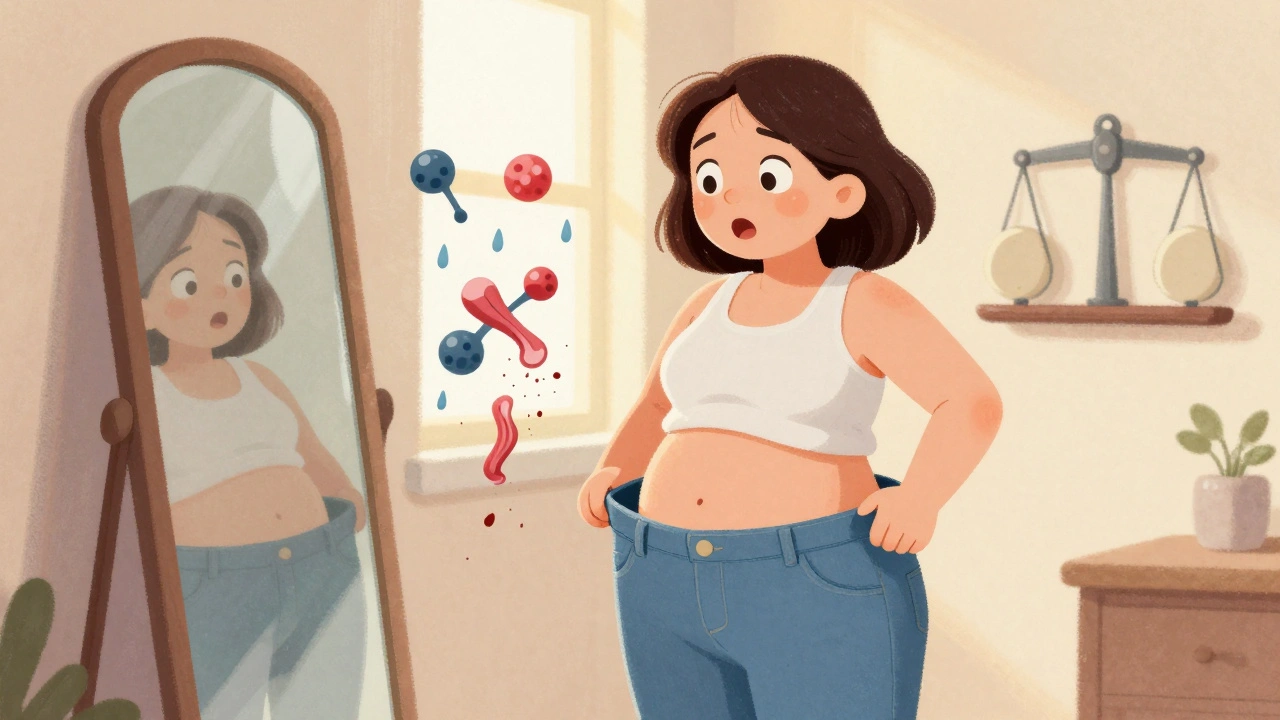
For many women, the first sign that something has changed isn’t a missed period-it’s the jeans that no longer zip. You haven’t changed your diet. You’re still walking every day. But suddenly, the scale creeps up, and your waistline expands-even though your arms and legs look the same. This isn’t laziness. It’s biology. And it’s happening to millions of women right now, especially as they enter their late 40s and early 50s.
Why Your Body Changes During Menopause
The drop in estrogen during menopause isn’t just about hot flashes or night sweats. It’s a full-system reset. Estrogen, particularly estradiol, plummets from around 70-150 pg/mL to just 10-20 pg/mL. That’s a 60-70% drop. And when estrogen falls, your body doesn’t just adjust-it reprograms.One major shift? Fat storage. Before menopause, estrogen directs fat to your hips, thighs, and buttocks. After menopause, that changes. Fat moves inward-to your belly. Visceral fat. The kind that wraps around your liver, pancreas, and intestines. This isn’t just cosmetic. Visceral fat is metabolically active. It pumps out inflammatory chemicals and makes your body more resistant to insulin. That’s why postmenopausal women are nearly five times more likely to develop abdominal obesity than women before menopause.
And here’s the kicker: you can eat the same amount, do the same workouts, and still gain weight. Why? Because your resting metabolism slows down. As you lose muscle-about 3-8% per decade after 30, and an extra 1-2% annually during menopause-your body burns fewer calories at rest. Studies show a 2-3% drop in metabolic rate per decade. That means if you were burning 1,800 calories a day at 40, you might now be burning 1,650 at 50-even if you haven’t changed a thing.
The Hormone Puzzle: Estrogen, Testosterone, and Appetite
It’s not just estrogen. When estrogen drops, testosterone becomes relatively higher. That might sound good-until you realize testosterone, in this context, pushes fat toward your abdomen. It’s not about becoming more muscular. It’s about fat redistribution.Then there’s appetite. Estrogen helps regulate leptin, the hormone that tells your brain you’re full. When estrogen falls, leptin drops by 20-30%. At the same time, ghrelin-the hunger hormone-rises. Why? Because sleep is disrupted. Hot flashes and night sweats mean you’re not getting deep, restorative sleep. And poor sleep spikes ghrelin by 15-25%. So now you’re hungrier, less satisfied after meals, and more likely to crave carbs and sugar.
One woman on Reddit put it simply: “I’ve eaten the same for 20 years. I’ve walked 5K every day. Then menopause hit. In three years, I gained 25 pounds. My jeans won’t zip. No matter what I do.” She’s not alone. In a Mayo Clinic survey of over 1,200 menopausal women, 78% reported unexpected weight gain despite unchanged habits. This isn’t failure. It’s physiology.
Muscle Loss: The Silent Accelerator
Most women think weight gain after menopause is about eating too much. But the real villain? Muscle loss. Also called sarcopenia. It’s not just about getting weaker. It’s about losing your body’s main calorie-burning engine.Think of muscle like a furnace. The more you have, the more you burn-even when you’re sitting. After menopause, muscle loss accelerates. And without intervention, you lose 1-2% of lean mass every year. That’s not a small thing. Losing just 2 kg of muscle can drop your daily calorie burn by 100-150 calories. That’s the equivalent of one extra muffin every day. No wonder the scale moves.
And here’s what most people miss: you can’t out-exercise muscle loss with cardio alone. Running, cycling, swimming-they’re great for heart health. But they don’t rebuild muscle. In fact, if you’re only doing cardio and not lifting, you might even lose more muscle over time. That’s why women who rely on walking or yoga alone often see little change in their waistline, even after years of effort.

What Actually Works: The Strategy
The good news? You can fight back. Not with restrictive diets or miracle pills-but with three proven strategies: strength training, protein, and sleep.Strength training is non-negotiable. Two to three sessions a week of resistance training-using weights, resistance bands, or bodyweight-can reverse muscle loss. A 2022 clinical trial showed women who lifted weights three times a week for six months gained 1.8-2.3 kg of muscle and lost 8-12% of abdominal fat. You don’t need to lift heavy. Start with dumbbells, kettlebells, or even resistance bands. Squats, lunges, push-ups, rows, and planks are enough. Focus on form. Consistency beats intensity.
Protein intake needs to increase. Your body becomes resistant to protein as you age. That means you need more to trigger muscle repair. Aim for 25-30 grams of protein per meal. That’s about 1.2-1.6 grams per kilogram of body weight daily. For a 70 kg woman, that’s 85-110 grams of protein a day. Spread it out. Eggs for breakfast. Chicken or tofu at lunch. Greek yogurt or a protein shake after your workout. Don’t wait until dinner. Your muscles need fuel throughout the day.
Sleep isn’t optional-it’s medicine. If you’re not sleeping 7-8 hours, you’re sabotaging your hormones. Poor sleep raises ghrelin, lowers leptin, and increases cravings. If hot flashes are keeping you up, try cooling bedding, avoiding caffeine after noon, and keeping your bedroom at 18-20°C. Some women benefit from low-dose hormone therapy for sleep, but talk to your doctor first.
Why Diets Fail-And What to Do Instead
If you’ve tried keto, intermittent fasting, or calorie counting and it didn’t work, you’re not broken. You’re just using a strategy designed for someone else’s body.Menopause weight gain isn’t caused by eating too many carbs. It’s caused by hormonal shifts, muscle loss, and metabolic slowdown. Diets that worked in your 20s and 30s often fail because they don’t address these biological changes. Cutting calories too low can make muscle loss worse. And without enough protein and strength training, you’ll lose muscle instead of fat.
Instead of counting calories, track protein. Instead of running longer, lift heavier. Instead of blaming yourself, understand your body is changing-and you can adapt.
The Bigger Picture: Health Beyond the Scale
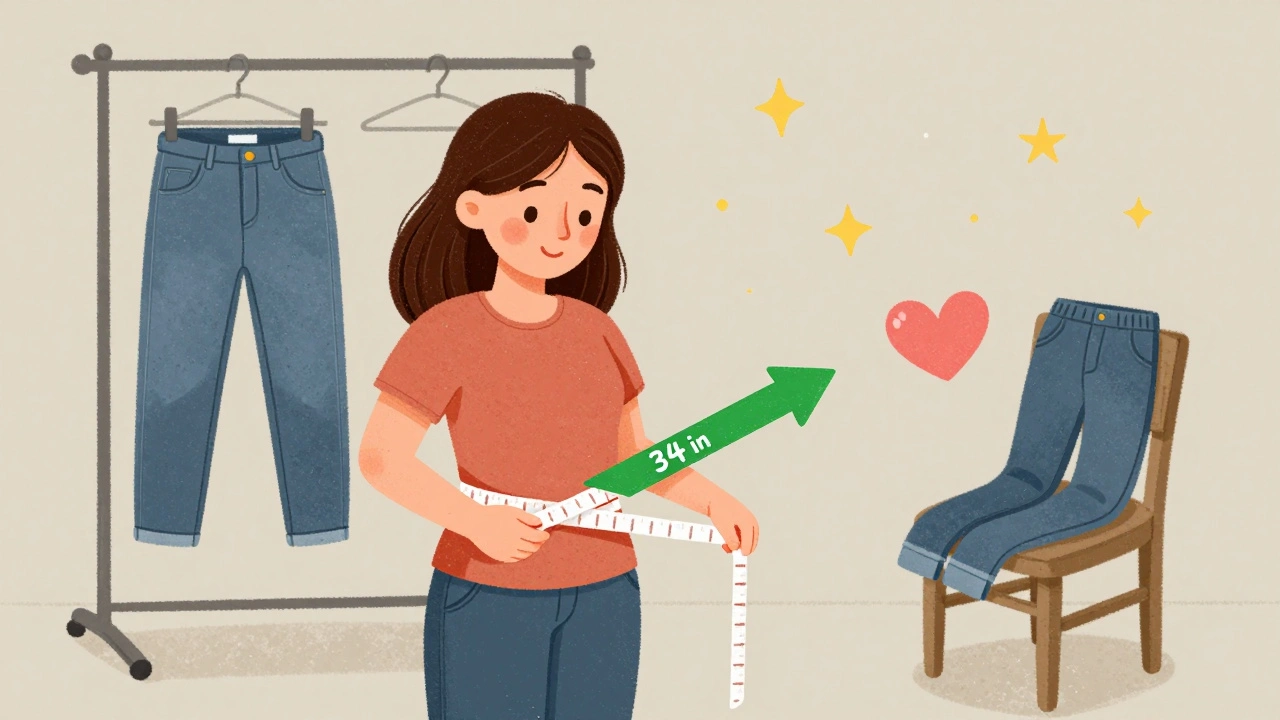
The goal isn’t just to lose weight. It’s to reduce your risk of heart disease, diabetes, and metabolic syndrome. Postmenopausal women have 3.2 times higher risk of metabolic syndrome than premenopausal women-even at the same BMI. That’s why waist circumference matters more than the number on the scale.Health guidelines now recommend measuring your waist. If it’s over 88 cm (35 inches), your risk for metabolic issues increases significantly. That’s a better marker than BMI. And it’s something you can track at home with a tape measure.
There’s also new hope on the horizon. In September 2023, the FDA approved bimagrumab for Phase 3 trials-a drug that increases muscle mass by 5-7% and reduces fat by 8-10% in just 24 weeks. The NIH is also funding a five-year study to see if early hormone therapy can prevent fat redistribution. But these are still in research. For now, the best tools are still strength training, protein, and sleep.
What to Do Today
You don’t need to overhaul your life. Start small:- Do two bodyweight squats and ten push-ups (against a wall if needed) every morning.
- Add one extra serving of protein to your breakfast-two eggs, a scoop of protein powder, or a cup of Greek yogurt.
- Set a bedtime alarm for 9:30 PM to ensure seven hours of sleep.
- Measure your waist once a month. Don’t weigh yourself daily.
Progress takes time. Women typically see changes in 3-6 months. And it’s slower than before. You might lose weight at 20-30% slower rates than you did in your 30s. That’s normal. Be patient. Your body isn’t broken. It’s adapting. And with the right strategy, you can rebuild strength, reduce belly fat, and protect your long-term health.
Why am I gaining weight even though I eat the same as before?
Your metabolism slows down because you’re losing muscle mass and estrogen levels drop, which changes how your body stores fat. Even if your calorie intake hasn’t changed, your body now burns fewer calories at rest. This is why many women gain weight during menopause without eating more.
Is belly fat after menopause dangerous?
Yes. Belly fat during menopause is often visceral fat, which surrounds internal organs and releases inflammatory chemicals. This increases your risk of insulin resistance, heart disease, and type 2 diabetes. Visceral fat is more dangerous than fat stored in the hips or thighs.
Can I lose menopause weight with just cardio?
Cardio helps your heart and burns calories, but it won’t stop muscle loss. Without strength training, you may lose muscle along with fat, which slows your metabolism further. To reverse menopause weight gain, you need resistance training to rebuild muscle and boost your resting calorie burn.
How much protein do I need after menopause?
Aim for 1.2-1.6 grams of protein per kilogram of body weight daily. For a 70 kg woman, that’s about 85-110 grams per day. Spread it across meals: 25-30 grams per meal. This helps overcome age-related anabolic resistance and supports muscle maintenance.
Should I take hormone therapy to lose weight?
Hormone therapy isn’t approved as a weight-loss treatment. But for some women, it can help manage symptoms like hot flashes and sleep disruption, which indirectly support better eating and exercise habits. It may also reduce fat redistribution. Talk to your doctor to see if it’s right for your health profile.
Menopause isn’t the end of your fitness journey-it’s a new chapter. Your body is changing, but you still have control. Focus on strength, protein, and sleep. Measure progress by how your clothes fit and how strong you feel-not just by the scale. You’re not fighting against your body. You’re working with it.
Comments (12)
dan koz
Bro I was laughing at my wife trying to squeeze into her jeans last week and then I read this and was like ohhhh so it’s not her fault? I thought she was just eating more snacks while watching Netflix. Turns out biology’s just being a jerk. Thanks for the clarity.
Mindy Bilotta
As a nurse who’s seen this play out with hundreds of patients, this is spot on. Muscle loss is the silent killer here-not the carbs, not the sugar, not ‘laziness.’ It’s the lack of resistance training. And protein? Most women are eating like it’s 1995. Time to upgrade. I tell my clients: if you’re not lifting, you’re losing. Period. 💪
Brian Perry
Okay but wait-what if this is all just a big pharma scam? I mean, who profits from women buying dumbbells and protein powder? Big Fitness. Big Supplements. Big Doctors. They want you to think you need to ‘fix’ your body when really, menopause is just nature saying ‘you’re not a 25-year-old anymore.’ Why not just embrace the belly? I’m not fighting my body, I’m surrendering to it. 🙏
Chris Jahmil Ignacio
Let me guess-you’re one of those women who thinks this is just about estrogen and muscle. Wake up. The real reason you’re gaining weight is because the government replaced all the natural fats in your food with seed oils and now your mitochondria are dead. Add to that 5G radiation disrupting your hormone receptors and glyphosate poisoning your liver. No amount of squats will fix that. You need to go full paleo, detox with activated charcoal, and sleep in a Faraday cage. I’ve seen it. I’ve studied it. You’re being poisoned by the system.
Pamela Mae Ibabao
Okay but can we talk about how everyone says ‘just lift weights’ like it’s that easy? I work two jobs, have three kids, and my knees hurt. I tried a dumbbell routine once and cried because I couldn’t even pick them up. So yeah, the advice is right-but the delivery is tone-deaf. Not everyone has time, money, or access to a gym. What about the rest of us?
Palanivelu Sivanathan
Ah yes, the great menopausal paradox-your body becomes a temple of metabolic betrayal. Estrogen, that divine feminine force, retreats like a queen abandoning her throne… and in her absence, the patriarchal fat gods rise-visceral, greedy, insidious. We are not failing. We are evolving. But evolution demands sacrifice. The modern woman is caught between the altar of youth and the temple of wisdom. Can we reclaim our bodies without becoming slaves to the gym? Perhaps… but only if we surrender to the chaos. 🌌
Erik van Hees
Y’all are overcomplicating this. It’s simple: you’re eating too much. You think you’re not, but you are. I tracked my macros for 90 days after 45 and lost 18 pounds. No magic. No lifting. Just calories in vs calories out. The science is clear. If you’re not losing, you’re not in a deficit. Stop blaming hormones and start counting. You want to fix your body? Start with your fork. Not your dumbbells.
Cristy Magdalena
I’ve been trying to lose this weight for 5 years. I did everything. Keto. Intermittent fasting. Yoga every day. I even cried in the mirror. And now I’m told it’s because I didn’t lift enough? Like I’m not trying hard enough? I’m exhausted. Not just from the hot flashes-from the guilt. Why does every article feel like a personal attack? I just want to feel okay in my skin. Is that too much to ask?
May .
So… just lift weights and eat protein? That’s it? No other hacks? No pills? No secret app? Okay. I’ll try it. But I’m not holding my breath.
Sara Larson
YOU GOT THIS!! 💪❤️ I was right where you were-jeans not zipping, tired all the time, crying over a muffin. Then I started doing 10 squats every morning with my coffee. Then I added 2 eggs. Then I slept 7 hours. Three months later? My pants fit. Not perfect, but better. You don’t need to be a superhero. Just show up. Tiny steps. I’m rooting for you!! 🌸✨
Josh Bilskemper
Strength training? Protein? Sleep? Groundbreaking. I’m sure the author got paid by the National Strength and Conditioning Association to write this. Real innovation would be a drug that makes you burn fat while you sleep. Until then, this is just fitness gospel dressed up as science. I’ve seen 100 of these articles. Same message. Same tone. Same boring advice. I’m bored.
Storz Vonderheide
I’m a 52-year-old man from Canada who’s watched my wife go through this. I thought it was just ‘getting older.’ But reading this? It hit me. We don’t talk about this enough. Not just for women-but for partners too. We need to stop saying ‘just eat less’ and start saying ‘how can I help?’ I started cooking more protein-rich meals. I got her a resistance band. I stopped making jokes about her waist. It’s not about losing weight. It’s about dignity. Thank you for writing this.