
BPH Decongestant Risk Calculator
Your Risk Assessment
Enter your age and BPH symptom score to calculate your risk of urinary retention when taking decongestants.
Risk Assessment Result
Enter your details to see your risk level
Understanding Your Risk
Under 20% risk - Continue with caution and consult your doctor before taking decongestants
20-40% risk - Consider alternatives to decongestants; consult your urologist
Over 40% risk - Avoid decongestants; discuss safer alternatives with your healthcare provider
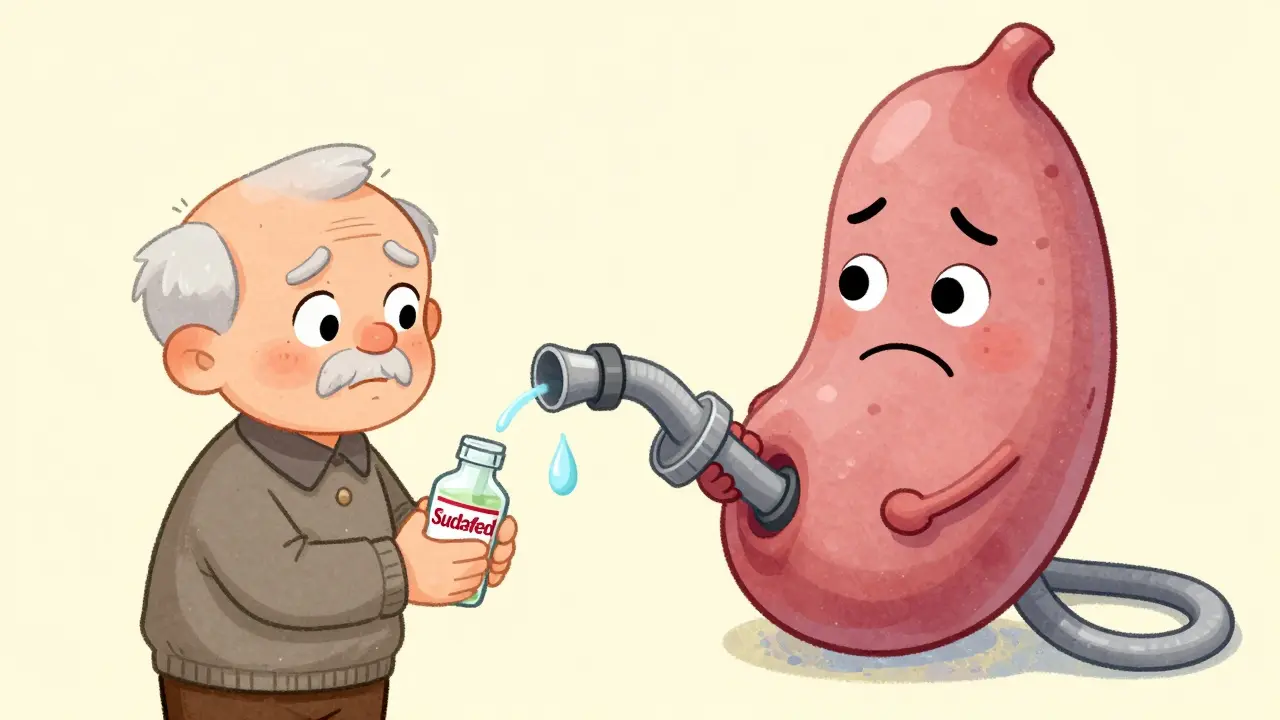
Men over 50 with an enlarged prostate - a condition called benign prostatic hyperplasia (BPH) - face a hidden danger when they reach for common cold and allergy medicines. Many don’t realize that a simple decongestant like pseudoephedrine, found in Sudafed and dozens of over-the-counter products, can trigger sudden, painful urinary retention. This isn’t just a minor inconvenience. It can mean a trip to the emergency room, a catheter, and days of discomfort. And the risk isn’t theoretical - it’s backed by decades of research and real-world cases.
What Exactly Is BPH?
Benign prostatic hyperplasia means the prostate gland grows larger as men age. It’s not cancer, and it’s not rare. By age 60, about half of all men have some degree of prostate enlargement. By 85, that number jumps to 90%. The prostate sits right below the bladder and wraps around the urethra - the tube that carries urine out of the body. As it grows, it squeezes the urethra like a kinked hose. That’s why men with BPH often feel the need to urinate often, struggle to start peeing, or feel like their bladder never fully empties.
These symptoms are measured using the International Prostate Symptom Score (IPSS). A score above 12 is considered moderate to severe. But here’s the catch: even men with mild symptoms can be at serious risk when they take certain medications. The prostate doesn’t just swell - it’s packed with smooth muscle that reacts strongly to certain chemicals. And that’s where decongestants come in.
How Decongestants Trigger Urinary Retention
Decongestants like pseudoephedrine and phenylephrine work by narrowing blood vessels in the nose to reduce swelling. But they don’t stop there. These drugs are alpha-adrenergic agonists, meaning they activate receptors in smooth muscle throughout the body - including in the prostate and the bladder neck. When these receptors fire, the muscles tighten. For a man with an already enlarged prostate, this extra squeeze can completely block urine flow.
Studies show pseudoephedrine increases urethral resistance by 35-40%. That’s not a small change. In a 2022 double-blind trial at Massachusetts General Hospital, men over 50 with BPH who took a single 30mg dose of pseudoephedrine saw their maximum urinary flow rate drop by 27%. That’s the difference between a steady stream and a trickle - or worse, no stream at all.
The effects last a long time. Pseudoephedrine has a half-life of 12 to 16 hours. That means even after one pill, the risk of urinary retention can linger for up to 24 hours. And unlike nasal sprays, which mostly stay local, oral decongestants flood the bloodstream. That’s why pseudoephedrine is far more dangerous than oxymetazoline nasal spray, which has minimal systemic absorption and a much lower risk.
The Real Numbers: How Big Is the Risk?
The data doesn’t mince words. A 2021 study in the Journal of Urology found that men with BPH who take pseudoephedrine are 2.8 times more likely to develop acute urinary retention - a medical emergency where the bladder fills but urine can’t exit. The risk climbs sharply with age. Men over 70 using pseudoephedrine have a 51.8% chance of developing subclinical voiding dysfunction, compared to just 17.3% in men under 50.
Here’s another sobering stat: 85% of acute urinary retention cases in men over 65 with BPH are linked to decongestant use, according to the National Institutes of Health. And it’s not rare. In one study, 70% of men who developed urinary retention after taking pseudoephedrine needed a catheter for 48 to 72 hours. That’s not just uncomfortable - it’s disruptive, embarrassing, and sometimes dangerous.
Meta-analyses confirm the pattern. Pseudoephedrine has an odds ratio of 3.45 for urinary retention in BPH patients - meaning it’s over three times more likely to cause trouble than not taking it. Phenylephrine is a bit safer, but still carries a 2.15 odds ratio. Even the “safer” nasal sprays aren’t risk-free for everyone.

What the Experts Say
Leading urologists are united on this. Dr. Claus Roehrborn, lead author of the American Urological Association (AUA) guidelines, says pseudoephedrine should be considered contraindicated for men over 50 with moderate to severe BPH (IPSS >12). The AUA’s 2022 guidelines list decongestants as high-risk medications - and they’re not alone. The European Association of Urology recommends avoiding all systemic alpha-agonists in men with BPH. The American Geriatrics Society’s 2023 Beers Criteria lists pseudoephedrine as a “potentially inappropriate medication” for men over 65 with BPH.
But there’s nuance. Dr. Roger Dmochowski of Vanderbilt says occasional, low-dose use might be acceptable for men with very mild symptoms (IPSS <8) - if they’re under a doctor’s watch. That’s not a green light. It’s a caution sign. And even then, the risk isn’t zero.
The FDA mandated warning labels on all pseudoephedrine products in January 2022. Before that, only 28% of men knew about the risk. Now, 63% do. That’s progress - but it’s still not enough.
Real Stories, Real Consequences
Online forums are full of men who didn’t realize the danger until it happened to them. On Reddit, user u/BPH_Warrior described how a single 30mg dose of pseudoephedrine led to complete urinary retention. “I could feel my bladder filling but couldn’t push anything out,” he wrote. “It lasted 12 hours until the medication wore off.” He ended up in the ER.
On the Prostate Cancer Foundation forum, 76% of 187 users reported urinary problems after taking pseudoephedrine. One in three needed emergency catheterization. On Healthline’s BPH community, 68% of 1,245 men said their symptoms worsened after using decongestants - with an average IPSS increase of 4.7 points. That’s the difference between mild discomfort and moderate, disruptive symptoms.
Not everyone reacts the same. Some men, like one user on Drugs.com, say they’ve used Sudafed for years with no issues. But that’s not the norm. Individual sensitivity varies, but the data shows the risk is real for most men with BPH.

Safe Alternatives for Congestion
You don’t need to suffer through congestion to stay safe. There are better options.
- Saline nasal irrigation - using a neti pot or squeeze bottle with saltwater - works for 68% of people, according to a 2022 Cochrane Review. It’s cheap, safe, and has zero urinary side effects.
- Intranasal corticosteroids like fluticasone (Flonase) are effective in 72% of cases and don’t affect the prostate at all.
- Non-sedating antihistamines like loratadine (Claritin) carry a low risk (odds ratio 1.35). Avoid first-generation antihistamines like diphenhydramine (Benadryl), which have an odds ratio of 2.85 and can also worsen urinary retention.
- Steam inhalation and humidifiers can help loosen mucus without any drugs.
One of the most trusted alternatives? NeilMed Sinus Rinse. On Amazon, 82% of 457 reviewers rated it “very effective” for congestion without urinary side effects.
What to Do If You Have BPH
If you’re over 50 and have prostate symptoms, here’s your action plan:
- Check every medication. Look at the active ingredients. If it says pseudoephedrine, phenylephrine, or any “decongestant,” pause. Ask your pharmacist or doctor.
- Try non-drug options first. Use saline rinses, steam, or a humidifier for 48-72 hours before reaching for pills.
- If you must use a decongestant, only use the lowest dose possible - 30mg of pseudoephedrine max - and never for more than two days in a row. The American Pharmacists Association calls this the “48-hour rule.”
- If you’re on an alpha-blocker like tamsulosin (Flomax), you’re already reducing prostate muscle tone. Combining it with a low-dose decongestant under medical supervision can reduce retention risk by 85%, according to a 2022 Cleveland Clinic study. But never start this combo without talking to your urologist.
- Know the warning signs. If your urine stream weakens, you feel straining, or you can’t urinate despite a full bladder - stop the decongestant and seek help immediately.
The Bigger Picture
This isn’t just about individual choices. It’s a systemic problem. In 2023, 73% of pseudoephedrine sales happened without any pharmacist counseling about BPH risks. That’s a gap in patient safety. Urology practices are now required to include decongestant avoidance in routine BPH management - 78% already do. But many men still don’t know.
The good news? Research is moving forward. The NIH is funding a $2.3 million trial testing a new drug that blocks only the bladder-specific alpha receptors - potentially letting men take decongestants without risk. Purdue Pharma’s experimental drug PF-06943303 showed 92% success in preventing urinary retention in Phase II trials and is now under FDA Priority Review.
Until then, the safest approach is simple: avoid systemic decongestants if you have BPH. Your bladder will thank you.
Can pseudoephedrine cause urinary retention in men with BPH?
Yes. Pseudoephedrine is a strong alpha-1 adrenergic agonist that tightens smooth muscle in the prostate and bladder neck. In men with benign prostatic hyperplasia (BPH), this can block urine flow entirely, leading to acute urinary retention - a medical emergency. Studies show it increases the risk of retention by 2.8-fold, with odds ratios as high as 3.45 in men over 70.
Is phenylephrine safer than pseudoephedrine for men with BPH?
Phenylephrine is slightly less potent than pseudoephedrine but still carries a significant risk. It increases urethral resistance by 15-20% and has an odds ratio of 2.15 for urinary retention in BPH patients. While it’s not as dangerous as pseudoephedrine, it’s not safe. Both should be avoided unless under strict medical supervision.
What’s the safest decongestant for someone with BPH?
There is no completely safe oral decongestant for men with BPH. The safest options are non-systemic: saline nasal irrigation, intranasal corticosteroids like fluticasone, or steam inhalation. If you need an antihistamine, choose loratadine (Claritin) over diphenhydramine (Benadryl), as it has a much lower risk of worsening urinary symptoms.
How long does it take for pseudoephedrine to affect urination?
Effects can begin within 30 to 60 minutes after taking pseudoephedrine. Peak levels occur around 2-4 hours, and the drug remains active for 12-16 hours. Urinary symptoms may persist for up to 24 hours after a single dose. This prolonged effect makes it especially risky for men with BPH.
Should I stop taking my BPH medication if I need a decongestant?
Never stop your prescribed BPH medication without talking to your doctor. If you need a decongestant, your urologist may recommend starting or adjusting your alpha-blocker (like tamsulosin) 72 hours before use. Combining an alpha-blocker with a low-dose decongestant can reduce retention risk by 85%. But this should only be done under medical guidance.
Are nasal sprays like oxymetazoline safe for men with BPH?
Nasal sprays like oxymetazoline (Afrin) have minimal systemic absorption, so they pose a much lower risk than oral decongestants. Their odds ratio for urinary retention is only 1.25 - close to baseline. But they’re still not risk-free. Use them for no more than three days in a row to avoid rebound congestion. Saline rinses remain the safest long-term option.

Comments (15)
Harbans Singh
I had no idea decongestants could do this. My dad took Sudafed last winter for a cold and ended up in the ER. He thought it was just a UTI. Turns out, his prostate was already acting up. I’m going to print this out and leave it on the kitchen counter. Everyone needs to know this.
Justin James
This is all part of the pharmaceutical industry’s grand plan to keep men dependent on catheters and urologists. They don’t want you to know that natural remedies like saw palmetto and pumpkin seed oil can shrink the prostate without side effects. The FDA? They’re in bed with Big Pharma. Pseudoephedrine was banned in some countries for a reason. And now they’ve rebranded it as ‘safe’ while quietly pushing men toward surgery. Wake up. The system is rigged.
Zabihullah Saleh
It’s funny how we treat the body like a machine you can tweak with pills. We get angry when a car engine seizes from the wrong fuel, but we’re shocked when our own biology rebels after a decongestant? The prostate isn’t broken-it’s just aging. Maybe we need to stop treating it like a problem to fix and start treating it like a signal to slow down. Eat better. Drink water. Stop pretending we’re invincible because we’re still lifting weights at 60.
Rick Kimberly
Based on the evidence presented in the original post, it is unequivocally clear that systemic alpha-adrenergic agonists pose a statistically significant and clinically relevant risk for acute urinary retention in men with benign prostatic hyperplasia. The odds ratios cited, particularly for pseudoephedrine (OR 3.45), are well above the threshold for clinical concern as defined by the Cochrane Collaboration. It is therefore imperative that clinicians and patients alike recognize this as a Class I contraindication in the context of moderate to severe BPH.
Sophie Stallkind
This is heartbreaking. My husband didn’t know any of this. He took a cold medicine thinking he was being responsible. I had to hold his hand while they put in the catheter. He cried. Not from pain-from shame. Men are taught to suffer in silence. Please, if you’re reading this, talk to your partner. Ask about bathroom habits. This isn’t just a medical issue. It’s a human one.
Katherine Blumhardt
so like… i just took a cold pill last week and now my pee is like a drip?? is that it?? i thought i was just dehydrated?? oh my god i need to tell my dad he’s been taking this for years and he’s always mad he can’t pee at night??
sagar patel
Decongestants are not the issue. The issue is that men over 50 don’t get regular prostate checks. If they did, they’d know their IPSS score and avoid these meds themselves. Blaming the drug is lazy. Take responsibility.
Oluwatosin Ayodele
You think this is bad? In Nigeria, men over 50 with BPH don’t even have access to urologists. They use herbal teas and pray. Some die from sepsis because they can’t get a catheter. You’re complaining about a pill? At least you have a healthcare system. Be grateful. This is a first-world problem dressed up as a crisis.
Winni Victor
Oh great. So now I’m supposed to feel guilty for taking NyQuil because my prostate is ‘acting up’? Newsflash: I’ve been peeing like a fountain since I was 45. I’m not going to trade my cold relief for a catheter. Maybe the real problem is that medicine keeps making men feel like their bodies are broken just because they’re old. I’m not a patient. I’m a man. And I’ll take my Sudafed like a boss.
Terry Free
Wow. A 3.45 odds ratio. That’s like saying if you eat a banana, you’re 3.5x more likely to become a professional basketball player. Also, phenylephrine is 2.15? So it’s basically just a slightly less dangerous version of the same thing? And yet somehow we’re still selling this stuff next to gum and batteries. Someone’s making a killing. And we’re the cash register.
Lindsay Hensel
This is one of those quiet tragedies no one talks about. A man loses his dignity not from illness, but from a pill he bought without a second thought. Thank you for writing this with such clarity and care. It’s not just medical advice-it’s a lifeline.
Christopher King
THEY KNOW. THEY ALL KNOW. Pseudoephedrine was pulled from shelves in Canada because they realized it was turning men into bladder prisoners. But here? We’re sold it like candy. Why? Because the pharmaceutical lobby pays off lawmakers. And the FDA? They’re just a revolving door for ex-pharma execs. This isn’t medicine. It’s a profit-driven trap. Wake up. The system is designed to make you dependent. Don’t be the next statistic.
Mussin Machhour
My uncle got a catheter after a cold. He’s 72. He’s fine now, but he won’t touch anything with pseudoephedrine again. I told him to check labels like it’s a bomb squad. Now he reads every OTC bottle like it’s the Constitution. Good advice. Spread it.
Carlos Narvaez
As a man who’s read the AUA guidelines, I can confirm this is Class A evidence. That said, your post lacks nuance. The risk is real-but it’s not binary. Men with IPSS <8? Probably fine. IPSS >12? Don’t even think about it. You’re oversimplifying a complex urological dynamic. But still, important.
Bailey Adkison
So you’re saying a man should suffer through a cold because his prostate got big? That’s the logic here? What’s next? Ban aspirin because some people have ulcers? This isn’t science. It’s fearmongering wrapped in jargon. If you’re that worried, don’t take it. But don’t guilt-trip the rest of us.