
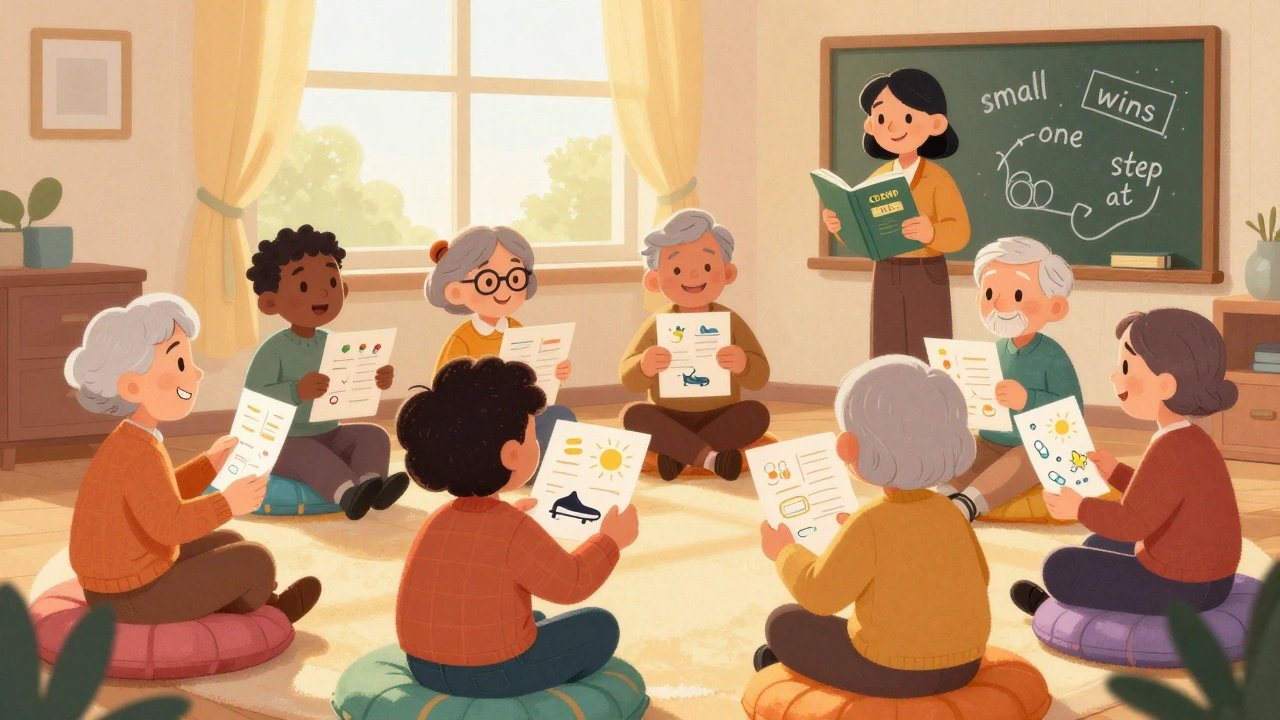
Living with a chronic disease doesn’t mean giving up on living well. Millions of people manage conditions like diabetes, arthritis, heart disease, and COPD every day-not by fixing their illness, but by learning how to live with it. The key isn’t just medicine. It’s self-management. And it’s not about doing everything perfectly. It’s about making small, steady changes that add up to real improvements in how you feel, move, and function each day.
What Self-Management Really Means
Self-management isn’t a magic fix. It’s not about becoming a health expert overnight. It’s about learning how to handle the daily grind of living with a long-term condition. That means knowing when your symptoms are normal versus when they need attention. It means figuring out how to take your meds without forgetting. It means finding ways to stay active even when pain or fatigue hits. And yes-it means dealing with the emotional weight that comes with never being fully "cured." The Chronic Disease Self-Management Program (CDSMP), developed at Stanford in the 1990s, was one of the first evidence-based models to prove this approach works. It doesn’t focus on one disease. It teaches skills that apply to almost any chronic condition. Six core tasks form the foundation: solving problems as they come up, making smart decisions about your care, using available resources, working with your doctor as a team, setting realistic goals, and adjusting your plan as your needs change.What makes it different from just reading a brochure? It’s structured. It’s group-based. And it’s led by people who’ve been there-not just doctors or nurses, but peer leaders who live with chronic illness themselves. These aren’t lectures. They’re conversations. You learn by doing: writing action plans, role-playing doctor visits, sharing what worked (and what didn’t) with others who get it.
The Tools That Actually Work
There are dozens of apps, websites, and programs out there claiming to help. But not all of them deliver. Here’s what actually moves the needle, based on real-world results:- CDSMP Workshops (In-Person or Virtual): These six-week courses meet once a week for 2.5 hours. Participants get a workbook, videos, and guided activities. Completion rates are high-72% finish the full program. People report better sleep, less pain, and more confidence talking to their doctors. One user in Oregon tracked their steps before and after: from 1,200 a day to over 5,800 in just eight weeks.
- Better Choices, Better Health® (Online): If you can’t make it to a class, this digital version offers the same content online. You log in 2-3 times a week for short lessons and discussion boards. It’s flexible, but harder to stick with-only 58% complete it. Still, it reaches people in rural areas where transportation is a barrier.
- ProACT Platform: This isn’t just an app. It’s a full system that connects patients with clinicians through mobile tools and wearable sensors. It’s designed for people juggling multiple conditions, like diabetes and heart failure. In trials, users improved their self-management behaviors by 28% over a year.
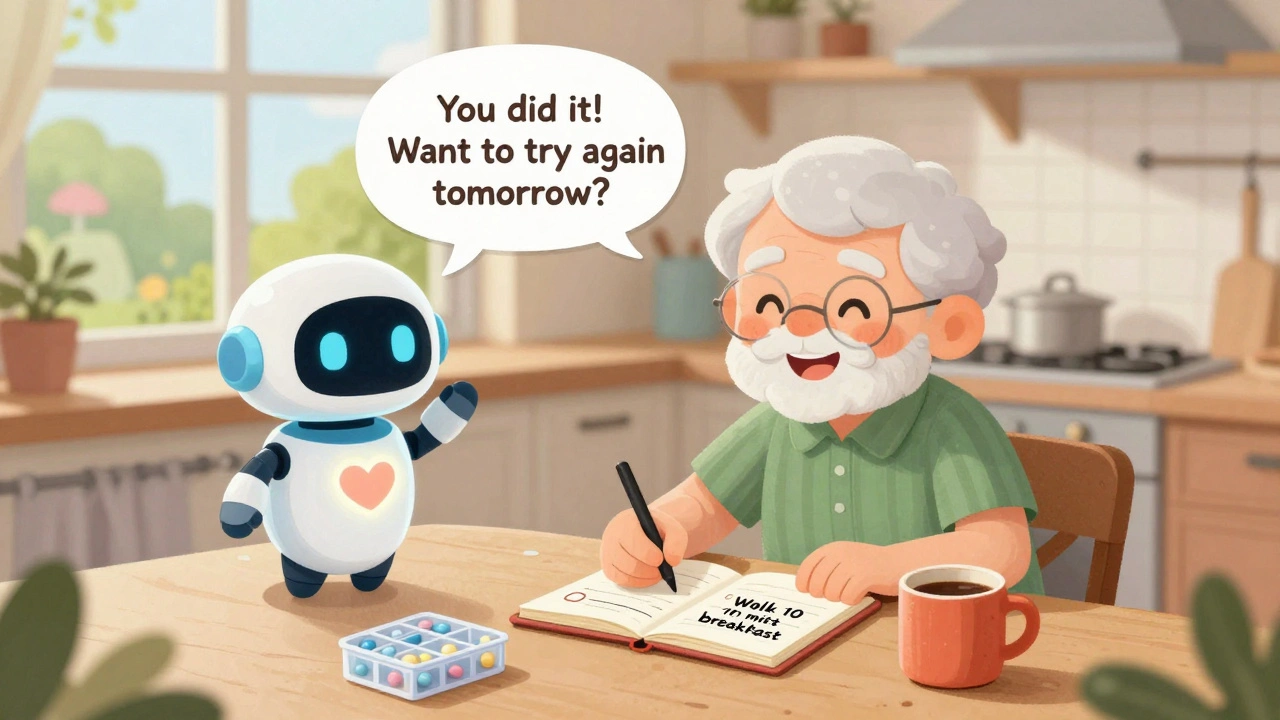
- Mun Health AI Companion: A newer tool that uses artificial intelligence to offer emotional support. It checks in with you daily, asks how you’re feeling, and adapts its tone based on your responses. Early pilots showed 85% user satisfaction, especially among those who felt isolated or overwhelmed.
Here’s what these tools have in common: they all help you build habits, not just give information. They don’t tell you what to do-they show you how to figure it out for yourself.
What You’ll Learn (And What You Won’t)
A good self-management program won’t teach you how to cure your disease. But it will teach you how to stop letting it run your life.- You’ll learn to spot early warning signs-like swelling, unusual fatigue, or changes in mood-and know when to call your doctor instead of waiting for a crisis.
- You’ll build simple action plans: "This week, I’ll walk for 10 minutes after breakfast, three days in a row. If I miss one day, I’ll do it the next morning." Small wins build momentum.
- You’ll practice communicating with your healthcare team. Instead of saying, "I’m fine," you’ll say, "My knee hurts more on rainy days, and I’m having trouble climbing stairs. Can we adjust my plan?"
- You’ll learn to manage stress and frustration. Chronic illness isn’t just physical. It’s emotional. Programs include techniques for calming your mind, not just your body.
What they don’t do: replace your doctor. You still need medical care. Self-management is the missing piece between doctor visits. It’s what happens when you’re at home, alone, trying to make sense of your symptoms.
Digital vs. In-Person: Which Is Right for You?
Choosing between an online program and a live workshop comes down to your lifestyle and needs.| Feature | In-Person CDSMP | Online CDSMP | Digital Platforms (e.g., ProACT) |
|---|---|---|---|
| Completion Rate | 72% | 58% | Varies (60-70% in trials) |
| Time Commitment | 2.5 hours/week for 6 weeks | 2 hours/week, flexible timing | 5-10 mins/day, ongoing |
| Social Support | High (group interaction) | Moderate (discussion boards) | Low (AI or automated) |
| Best For | People who thrive on human connection | Busy schedules, rural areas, mobility issues | People with multiple conditions, tech-savvy users |
| Medication Adherence | Higher (peer accountability) | Lower (22% drop vs. in-person) | High (reminders + tracking) |
If you’re someone who feels lonely or disconnected, the group setting of an in-person workshop can be life-changing. One participant in North Dakota said, "I didn’t realize how much I needed to hear someone else say, ‘I feel the same way.’"
If you’re juggling work, kids, or transportation problems, the online version gives you freedom. But if you struggle with motivation or complex meds, the lack of human contact can make it harder to stick with it.
Getting Started: Your First Steps
You don’t need to overhaul your life on day one. Start small.- Take a quick self-check: What’s the one thing that’s hardest for you right now? Is it remembering meds? Getting out of bed? Feeling heard by your doctor? Pick one area to focus on.
- Find a program: Search for "Chronic Disease Self-Management Program" plus your state or region. Many are free or low-cost. Medicare covers Diabetes Self-Management Training (DSMT)-check if you qualify.
- Start your first action plan: Write it down. "I will take my blood pressure every morning after brushing my teeth for the next 7 days." No fancy app needed. A notebook works.
- Track progress, not perfection: Did you do it 5 out of 7 days? That’s a win. Celebrate it. Then adjust the next plan.
Most people feel overwhelmed at first. One participant in Tennessee said, "Checking my blood sugar, adjusting meds, and caring for my feet all at once felt impossible." But the program broke it down. Week one: just track your sugar. Week two: add one walking session. Week three: talk to your doctor about your notes. Step by step, it becomes doable.
Common Pitfalls and How to Avoid Them
Even the best tools fail if you hit these traps:- Trying to do everything at once: Focus on one habit. Master it. Then add another. Trying to track sleep, diet, meds, and exercise all at once leads to burnout.
- Ignoring emotional health: Anxiety and depression are common with chronic illness. If you’re feeling hopeless, talk to someone. Programs like Mun Health include emotional support. If yours doesn’t, seek counseling.
- Skipping the doctor check-ins: Self-management isn’t about going it alone. It’s about being an active partner. Bring your action plan to your next appointment. Ask: "Does this make sense?"
- Assuming tech is better: Apps are great-but if you’re not comfortable with them, don’t force it. A printed logbook and a phone alarm work just as well.
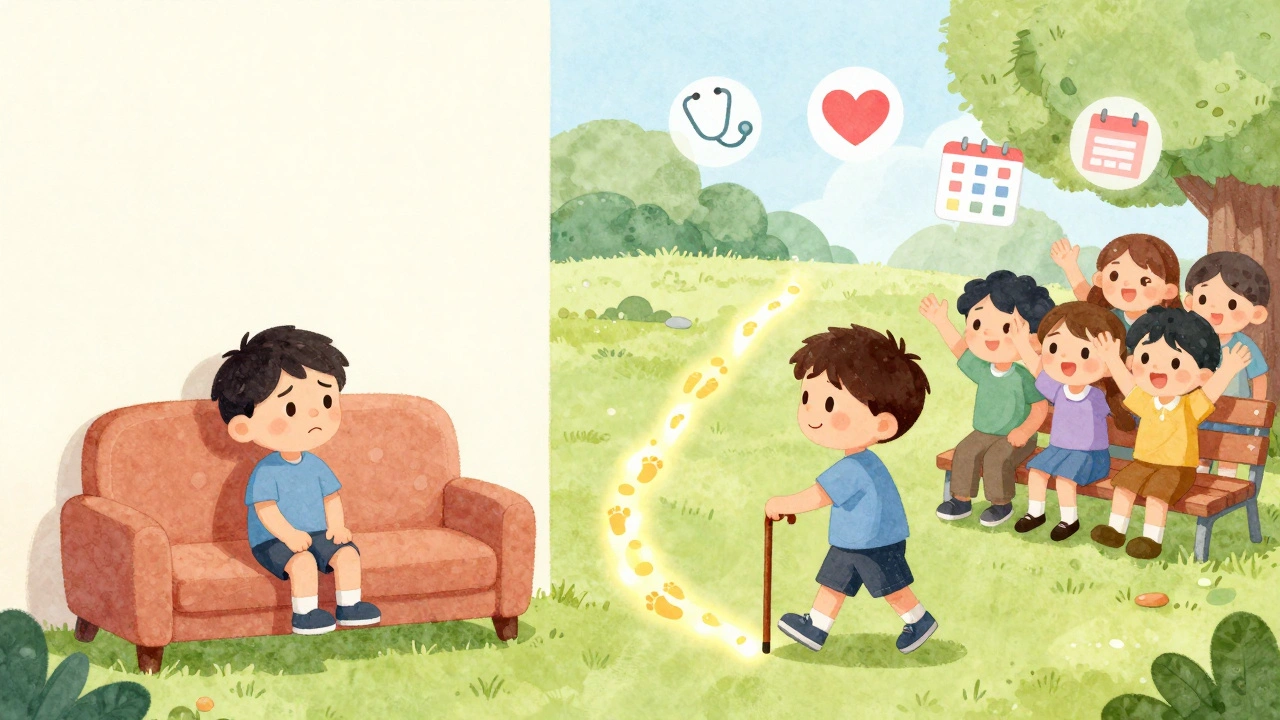
And remember: setbacks are normal. You miss a week of walking? You forget your pill? It happens. The goal isn’t flawless execution. It’s getting back on track without guilt.
Why This Matters Now More Than Ever
Six in ten U.S. adults have at least one chronic condition. By 2030, that number will rise to 171 million people managing multiple diseases. Our healthcare system can’t keep up with the demand. That’s why self-management isn’t optional anymore-it’s essential.Medicare and private insurers are starting to pay for these programs because they work. Studies show participants reduce hospital visits by up to 28%. They feel more in control. They sleep better. They talk to their doctors more effectively.
It’s not about becoming a health guru. It’s about reclaiming your days. It’s about being able to play with your grandkids, walk to the mailbox, or sit through a movie without pain stealing the joy. That’s what self-management gives you-not a cure, but a better life, one small step at a time.
Can I do self-management on my own without a program?
Yes, but structured programs significantly increase your chances of success. Programs like CDSMP are designed using research-tested methods to build habits, reduce overwhelm, and provide peer support. Trying alone often leads to burnout or giving up. If you’re motivated and organized, you can use free resources like the CDSMP workbook (available online) and create your own action plans-but the group setting and guided structure make a big difference.
Are these programs free?
Many are. The Chronic Disease Self-Management Program (CDSMP) and Better Choices, Better Health® are often offered at no cost through local health departments, hospitals, or senior centers. Medicare covers Diabetes Self-Management Training (DSMT), and some Medicaid plans cover similar programs. Digital tools like ProACT may require a subscription, but many health systems offer them at no cost to patients. Always ask your doctor or local clinic-they often have brochures or referrals.
I have trouble reading or understanding medical info. Can I still join?
Absolutely. High-quality self-management programs design materials for a 6th-8th grade reading level. Workbooks use simple language, visuals, and spoken instructions. Facilitators are trained to explain things clearly and check for understanding. If you’re unsure, ask ahead of time if they offer audio versions or in-person help. Programs that include peer leaders often have participants who help each other understand the material.
What if I don’t have transportation to a class?
You’re not alone. Many rural and mobility-limited individuals face this challenge. The online version of CDSMP (Better Choices, Better Health®) is designed for this exact situation. It works on phones, tablets, or computers. You don’t need to travel. Some local organizations even offer free ride services or Zoom group sessions. Ask your local Area Agency on Aging or health department-they often coordinate transportation for health programs.
How long until I see results?
Most people notice small changes within 2-4 weeks-like feeling more confident talking to their doctor or remembering to take meds. Physical improvements, like walking farther or sleeping better, often show up after 6-8 weeks. The biggest gains come after 3-6 months of consistent practice. It’s not a quick fix. But the changes stick. Studies show benefits last at least a year after finishing the program.
Do I need to be tech-savvy to use digital tools?
Not at all. Apps like Mun Health or ProACT are designed for people who aren’t tech experts. They use simple icons, voice prompts, and step-by-step guidance. If you can use a smartphone to send a text or watch a video, you can use these tools. Many programs offer free one-on-one tech help when you sign up. If you’re nervous, start with the online CDSMP course-it’s web-based but doesn’t require apps or wearables.
Comments (15)
Declan Flynn Fitness
Been doing CDSMP for 6 months now. My knee pain hasn’t vanished, but I walk 30 mins daily without needing a nap afterward. The real win? I stopped feeling like a burden to my family. Small steps, yeah-but they stack up. No magic, just consistency.
Also, the workbook is free on Stanford’s site. Don’t overcomplicate it. Pen and paper still works.
Also, if you’re on Medicare, DSMT is covered. Just ask your doc. They’ll send you the form.
And yes, the group thing? It’s weird at first. But hearing someone say ‘I forgot my meds too’? That’s the glue.
Kshitij Shah
Bro, in India we call this ‘jugaad’ health. No fancy app needed-just your auntie’s advice, a cheap pedometer, and a stubborn will. My uncle with diabetes? Walks 5 km every morning before chai. No app. No group. Just routine. Turns out, human discipline beats AI nudges every time.
Also, why are we so obsessed with tech? My grandma manages her BP with a notebook and a prayer. Still alive at 89. Just saying.
Patrick Smyth
I’ve been living with COPD for 12 years. I’ve tried every app, every webinar, every ‘structured program.’ None of them fixed the loneliness. I cried during my first CDSMP session because someone said, ‘I don’t want to be a burden either.’ That’s when I realized I wasn’t broken-I was just tired. This isn’t about steps or meds. It’s about being seen.
And yes, I still forget my inhaler. But now I leave it on my toothbrush. Small wins.
Shannon Gabrielle
Wow. Another American health cult. Next they’ll sell us ‘Mindful Breathing™’ NFTs. We pay $1200 a month for insulin but get free ‘peer-led workshops’? Real innovation. The system’s broken and you’re selling bandaids as breakthroughs. I’m just here for the irony.
Also, ‘Mun Health AI Companion’? Sounds like a Silicon Valley scam wrapped in a TED Talk. Next thing you know, your Fitbit will judge your tears.
ANN JACOBS
As someone who has navigated the labyrinth of chronic illness for over two decades, I find it both heartening and profoundly necessary that structured, evidence-based self-management programs are finally gaining recognition. The psychological toll of living with an unrelenting condition is often underestimated, and the fact that peer-led models foster not only behavioral change but emotional resilience is nothing short of transformative. I have personally witnessed participants transition from passive recipients of care to empowered agents of their own well-being-this is not merely a program, it is a paradigm shift.
Moreover, the integration of digital platforms with clinical oversight represents the future of sustainable healthcare delivery. Let us not underestimate the dignity inherent in self-efficacy.
Lydia Zhang
Why is everyone acting like this is new? I’ve been doing this since 2010. Notebook. Alarm. Walk when I can. Call doc when I’m scared. No program needed. Just don’t give up.
Also, the AI thing? Nah.
Michelle Smyth
Let’s deconstruct this neoliberal health-industrial complex masquerading as empowerment. The CDSMP framework, while empirically validated, functions as a performative act of patient compliance-a mechanism to offload systemic healthcare failures onto the already burdened individual. The real issue isn’t poor self-management; it’s the commodification of survival under late-stage capitalism.
Why are we celebrating a 72% completion rate for a program that merely teaches people to optimize their suffering within a broken system? The real intervention would be universal healthcare, not a workbook. The peer leaders are noble, yes-but they’re also symptoms of a system that outsources care to the vulnerable.
And let’s not pretend the Mun Health AI is therapeutic. It’s a digital placebo, a soothing algorithm designed to pacify while structural inequities fester. The real ‘tool’ is collective action. Not a notification.
Irving Steinberg
Same. I tried the online thing. Got bored after 2 weeks. Then I just started walking after dinner. Now I do 15 mins. That’s it. No app. No group. No guilt. My doctor didn’t even know I was doing it until I showed up with my BP log.
Also, why are we calling this ‘self-management’ like it’s a yoga retreat? It’s just… living with shit. No need to overthink it.
Also, the AI companion? Bro. I talk to my cat. She listens better.
Also, I still forget my meds. But now I keep them next to my coffee. Small things. Real wins.
Also, why do we need 6 weeks? Just start. That’s it.
Kay Lam
I want to say thank you to everyone who shared their stories here because I’ve been sitting in silence for too long. I have lupus and fibromyalgia and for years I felt like I was failing because I couldn’t do everything the ‘right way.’ I thought if I didn’t track every meal, every step, every mood swing, I was lazy or broken. But what I’ve learned is that healing isn’t a checklist. It’s a rhythm. Some days I walk. Some days I cry. Some days I nap. All of it counts. The programs help because they remind you you’re not alone, not because they make you perfect. And if you’re reading this and you’re tired? You’re allowed to rest. You’re allowed to miss a day. You’re allowed to be human. You’re not failing. You’re still here. And that’s enough.
Priyam Tomar
Let’s be real-this whole self-management thing is just a distraction from the fact that healthcare is a profit-driven nightmare. You think someone with $300 insulin bills gives a damn about ‘action plans’? The only ‘tool’ that works is a functioning public health system. Everything else is just corporate PR dressed up as empowerment. And don’t get me started on ‘peer leaders’-they’re unpaid labor. The real solution? Nationalize healthcare. Then we can talk about walking more.
Nnaemeka Kingsley
My cousin in Lagos uses a phone alarm and a piece of paper. No app. No group. Just writes down when he takes his pills. He walks when he can. He talks to his neighbor who also has diabetes. They laugh. They cry. They share food. That’s the real program. Not the fancy website. Just real people.
Also, why do we need 6 weeks? He started last Tuesday. Now he’s walking to market. Simple. Real.
Matt Dean
Wow. This post is basically a 2000-word ad for Stanford. Where’s the funding coming from? Who’s paying for these ‘peer leaders’? Are they even paid? Or are they just patients doing free labor because the system won’t? Also, why is the AI companion the only thing that sounds like it might actually help? Because it doesn’t ask you to do more. It just listens.
Also, I’m not buying the ‘small wins’ crap. If your ‘win’ is walking 500 steps, you’re not empowered-you’re trapped.
Walker Alvey
Let me guess-the people who wrote this have never had to choose between insulin and rent. You talk about ‘small steps’ like it’s a motivational poster. Try doing a 10-minute walk when your legs are swollen and your insurance denied your physical therapy. This isn’t empowerment. It’s gaslighting wrapped in a workbook.
Also, ‘Mun Health AI’? Cute. My dog barks louder than that bot.
Jack Arscott
Just started the online CDSMP. Day 3. I cried during the ‘emotional health’ module. Not because I’m weak. Because no one ever asked me how I felt. Just ‘take your meds.’
Also, I made a list: ‘What I can do today.’
1. Drink water
2. Sit outside for 5 min
3. Text my sister
That’s it. And I did it.
❤️
Adrian Barnes
It is imperative to recognize that the current paradigm of chronic disease self-management, while superficially benevolent, fundamentally reinforces a biomedical hegemony that pathologizes bodily difference and absolves structural determinants of health. The invocation of ‘empowerment’ serves as a discursive mechanism to shift responsibility from institutional failure to individual inadequacy. The CDSMP, despite its empirical efficacy, operates within a neoliberal framework that commodifies resilience. One must interrogate the ontological assumptions underlying the notion of ‘self-management’-is the self a sovereign agent, or a site of biopolitical governance? The AI companion, though algorithmically sophisticated, remains a prosthetic of control, not liberation. True liberation lies not in better action plans, but in the dismantling of the healthcare-industrial complex itself.