
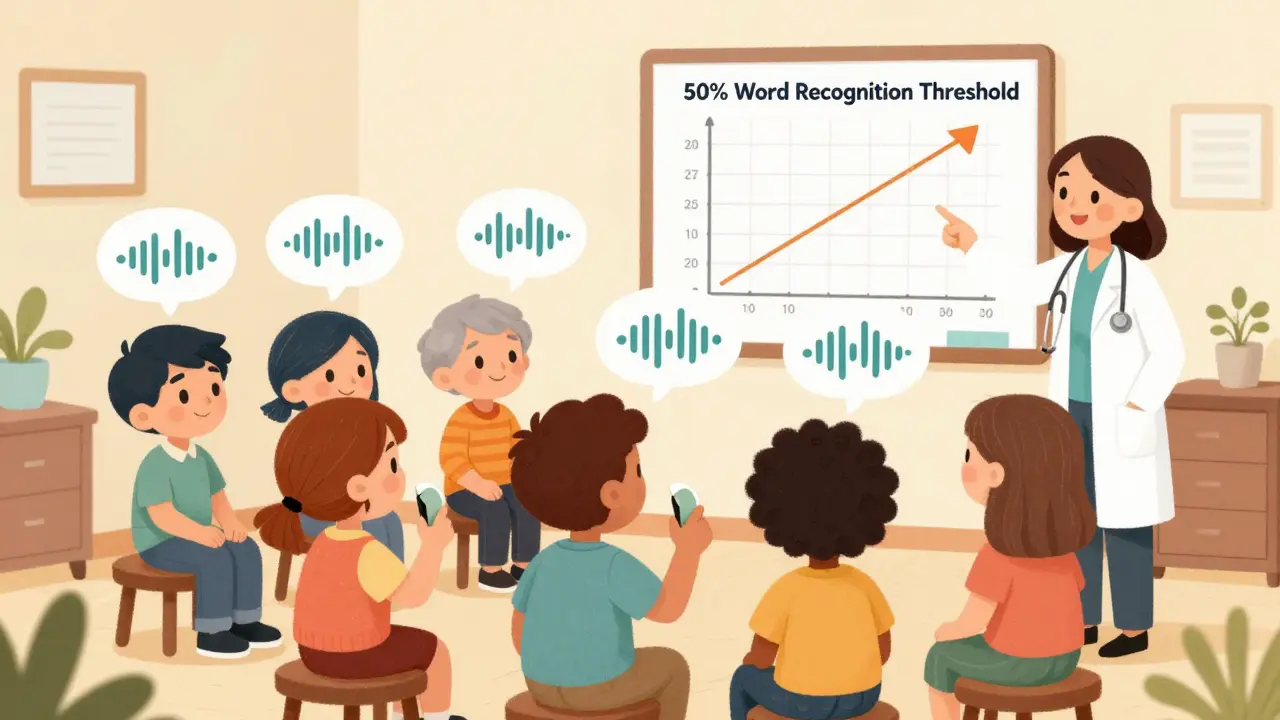
Many people assume cochlear implants are only for those who are completely deaf. That’s not true anymore. If you’re struggling to understand speech even with hearing aids - especially in noisy places or on the phone - you might be a candidate. The rules changed in 2023, and thousands of people who were previously told they weren’t eligible now qualify. This isn’t about waiting until you hear nothing. It’s about acting before your brain forgets how to process sound.
What Has Changed in Cochlear Implant Guidelines?
For decades, the standard was simple: if your hearing loss was profound and hearing aids didn’t help, you got referred. But that left out a lot of people. The American Cochlear Implant Alliance (ACIA) released new guidelines in November 2023 that flipped the script. Now, if you understand fewer than 50% of words in quiet while wearing properly fitted hearing aids, you should be evaluated. That’s a big shift from the old 40% threshold. And it’s not just about how loud things are - it’s about how clearly you understand them.The new guidelines also say you should be evaluated for each ear separately. That means if one ear has decent hearing but the other is severely impaired, you might still benefit from an implant in the weaker ear. This matters because about 8.3% of people with hearing loss have single-sided deafness, and many of them struggle more than you’d think - especially in crowded rooms or when someone speaks from their bad side.
Even if you still hear some sounds, that doesn’t disqualify you. Hybrid implants exist for people who keep low-frequency hearing but lose high-frequency clarity. These devices combine amplification with electrical stimulation. The goal isn’t to replace hearing aids - it’s to upgrade them when they’re no longer enough.
How Do You Know If You’re a Candidate?
The evaluation isn’t a single test. It’s a full picture. First, your hearing aids must be checked. A lot of people are turned away because their aids aren’t working right. Real-ear measurements - which check if the hearing aid is actually delivering the right volume in your ear canal - are required. If that step is skipped, you might be told you don’t qualify when you just need better-fitted aids.Then comes speech testing. The gold standard is the AzBio sentence test. You listen to sentences like “The boy kicked the ball” in quiet and then in background noise. If you get less than 50% right with your best-aided ear, you meet the new referral threshold. Some clinics still use older tests like CNC words, but AzBio is more realistic - it mimics real conversations.
Functional assessment matters too. The Speech, Spatial and Qualities of Hearing Scale (SSQ) asks questions like: “Can you follow a conversation in a restaurant?” or “Do you feel tired after listening all day?” Some people score well in quiet rooms but crash in real life. That’s a red flag. Their brain is working overtime just to catch fragments of speech. That’s exhaustion. And that’s a sign an implant could help.
Imaging is next. A high-res CT scan checks if your cochlea is shaped right for the implant. An MRI looks for nerve damage or tumors. These aren’t routine for everyone, but they’re essential if your hearing loss came on suddenly or if you have dizziness or ringing in your ears.
What Happens After You Get an Implant?
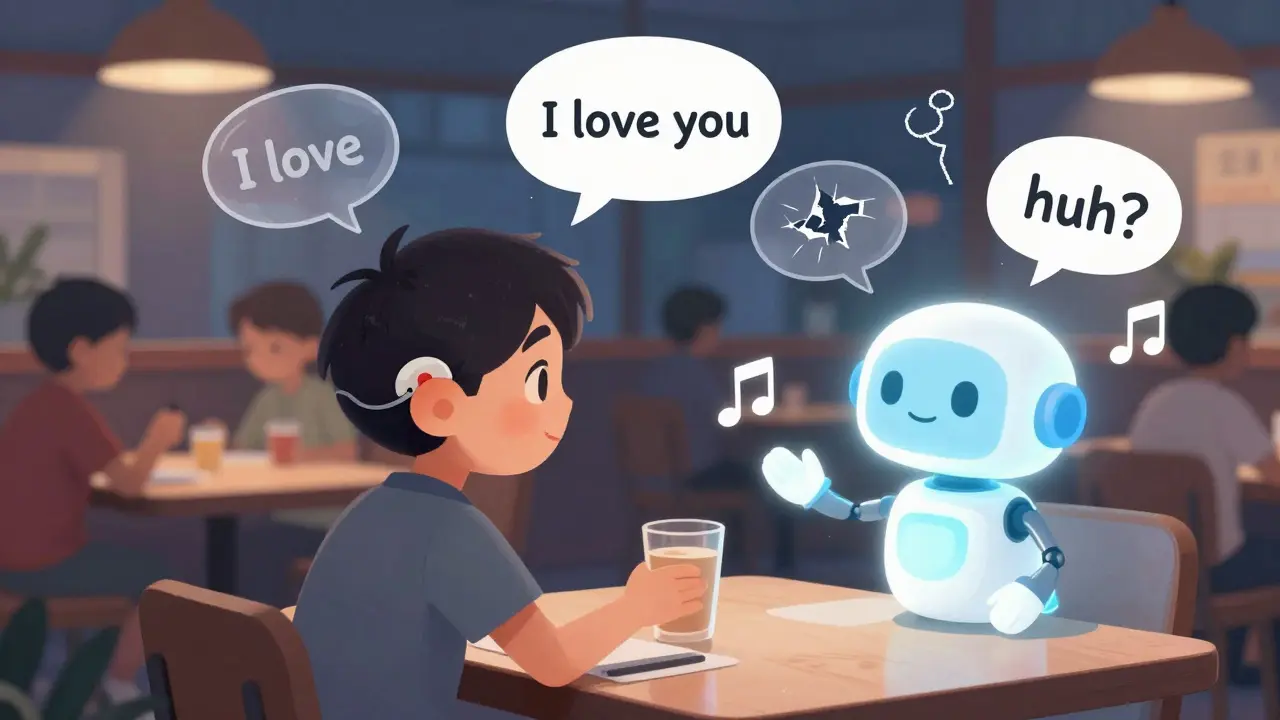
The surgery itself is outpatient and takes about two hours. Most people go home the same day. The device isn’t turned on right away - you wait 2-4 weeks for healing. Then comes activation. The audiologist programs the device to match your hearing profile. It’s not magic. At first, sounds might be strange - robotic, metallic, like a cartoon. That’s normal. Your brain needs time to relearn what sound means.Rehabilitation is where the real work happens. You’ll need weekly or biweekly sessions for at least 3-6 months. These aren’t optional. Studies show people who stick with therapy improve 3-5 times faster than those who don’t. You’ll practice listening to voices, identifying environmental sounds, and using the phone. Many clinics now use apps that let you train at home with guided exercises.
Outcomes are strong. A 2022 study of 1,247 adults found that, on average, sentence understanding improved by 47 percentage points after implantation. Eighty-nine percent said they could talk to family again without constant repetition. Ninety-two percent reported better phone use. And 87% said they felt less mentally drained after conversations.
But it’s not perfect. About 63% of users say music still sounds off. That’s because cochlear implants don’t reproduce pitch the way natural hearing does. And noisy places? They’re still tough - though most users say they’re better than before. The key is managing expectations. This isn’t about hearing like you did at 20. It’s about reconnecting with the people you love.
Who Gets Left Out - And Why?
Despite clear evidence, only about 1% of adults with severe hearing loss get implants in the U.S. Why? Three big reasons: awareness, access, and bias.Primary care doctors still don’t know the updated criteria. A 2021 JAMA survey found only 32% could correctly identify who qualifies. Many still think you need to be totally deaf. So they don’t refer.
Access is another issue. Cochlear implant centers are concentrated in big cities. Rural patients often travel hundreds of miles for evaluation. And even if you get referred, insurance can be a hurdle. Medicare covers implants for people over 65 who meet the new 50% word recognition threshold - but private insurers sometimes still use outdated rules.
Then there’s the hidden barrier: age. People assume older adults won’t benefit. But research shows that even those with 15+ years of deafness do just as well as younger patients - if they’re motivated and get rehab. The real predictor of success isn’t age. It’s willingness to show up for therapy.
Disparities are stark. In 2022, only 18% of U.S. CI recipients were from minority groups, even though they make up 40% of people with hearing loss. Language barriers, lack of culturally competent providers, and mistrust in the medical system all play a role. This isn’t just a medical gap - it’s a justice issue.
What’s Next for Cochlear Implants?
The FDA is reviewing new labeling that would officially adopt the 50% word recognition threshold. That means by 2026, every manufacturer will be required to follow the same rules. That’s huge. Right now, some clinics are ahead of others. Standardization will make it easier for patients to get care no matter where they live.Research is moving fast. Scientists at Johns Hopkins are testing brainwave responses to sound - using EEG to see how well your auditory cortex responds before surgery. If your brain is still “listening,” even with poor hearing, you’re a strong candidate. This could replace guesswork with data.
Long-term, the World Health Organization predicts cochlear implants will become standard care for anyone with hearing loss over 55 dB HL and speech understanding under 60%. That could open the door for 7.8 million Americans - up from 1.2 million today.
The economic case is strong too. Untreated hearing loss costs the U.S. $56 billion a year in lost work, emergency visits, and dementia care. Cochlear implants pay for themselves in three years through improved employment and reduced healthcare use. That’s a 3:1 return on investment.
What Should You Do If You Think You’re a Candidate?
Start here: ask your audiologist for an AzBio sentence test in quiet and in noise. If your score is below 50%, ask for a referral to a cochlear implant center. Don’t wait for your doctor to bring it up. Most won’t.Bring your hearing aids to the appointment. Make sure they’re cleaned and tested. If your clinic doesn’t do real-ear measurements, find one that does. A poorly fitted aid can mask your true potential.
Write down your biggest frustrations. Can you hear your spouse? Do you avoid family dinners? Do you feel embarrassed asking people to repeat themselves? These aren’t just complaints - they’re evidence. Use them in your evaluation.
And don’t be afraid to get a second opinion. Not all centers are the same. Look for one with board-certified audiologists and neurotologists. Ask how many implants they do a year. Centers that do 50+ annually have better outcomes.
This isn’t about giving up on hearing aids. It’s about upgrading when they’re no longer enough. The best time to get an implant isn’t when you hear nothing. It’s when you’re still trying - and still struggling.
Can I still get a cochlear implant if I have some natural hearing left?
Yes. The 2023 guidelines specifically say residual hearing doesn’t disqualify you. In fact, people with partial hearing may be ideal candidates for hybrid implants, which preserve low-frequency hearing while using electrical stimulation for high frequencies. This allows for more natural sound quality than traditional implants.
Is there an age limit for cochlear implants?
No. There’s no upper age limit. People in their 80s and 90s have received implants with excellent results. The key factors are overall health, cognitive function, and willingness to participate in rehabilitation - not age. Medicare covers implants for seniors who meet the criteria.
How long does it take to hear well after the implant is activated?
Most people notice improvements within weeks, but full adaptation takes 3-6 months. Your brain needs time to interpret the new signals. Consistent listening practice - even just 30 minutes a day - speeds up progress. Speech therapy is critical during this phase.
Will a cochlear implant help me understand music?
Music perception remains challenging. Most users report that melodies and instruments sound unnatural or distorted. This is because implants transmit timing and loudness better than pitch. Some people enjoy music after training, but few regain the full emotional experience. It’s not a primary goal of the device - communication is.
What if I’ve had hearing loss for over 10 years? Is it too late?
No. Studies show that people implanted after 10+ years of deafness can achieve outcomes just as good as those implanted sooner - as long as they’re cognitively healthy and committed to rehab. The myth that “longer deafness = worse results” has been debunked by multiple peer-reviewed studies.
Are cochlear implants covered by insurance?
Yes. Medicare covers cochlear implants for eligible adults. Most private insurers do too, especially under the updated 2023 guidelines. Coverage includes the device, surgery, and follow-up care. However, some insurers still use outdated criteria - so always verify your benefits and ask for a pre-authorization.
Comments (14)
Dan Alatepe
Okay but imagine hearing your grandkid say 'I love you' and it sounds like a robot reciting a grocery list… 😔 I cried the first time my mom heard my voice again after her implant. Not perfect? Nah. But it’s *there*. And that’s everything.
They say music sounds weird? Yeah, but now I can hear my wife laugh. That’s the upgrade.
Also-why do doctors still think you need to be DEAF to qualify? My aunt had 30% word recognition and was told 'come back when you can’t hear the microwave beep.' Like… that’s not a waiting game. That’s a tragedy.
Angela Spagnolo
i just… wow. i didn’t realize how much i didn’t know. i’ve been ignoring my tinnitus for years, but now i’m scared. what if i’m already losing more than i think? i’m gonna ask my audiologist for the azbio test. please, someone tell me it’s not too late…
Sarah Holmes
This article is dangerously misleading. You're telling people to rush into a neurosurgical procedure based on a 50% threshold? That's not medicine-that's corporate-driven audiological capitalism. The brain doesn't 'forget' how to process sound; it adapts. And you're pathologizing normal human variation under the guise of 'progress.'
Let me guess-next you'll be pushing cochlear implants for people who just don't like loud parties.
And don't even get me started on the 'economic case.' You're reducing human dignity to a cost-benefit spreadsheet. Disgusting.
Jay Ara
my dad got one last year at 72. he was stubborn as hell. thought he was fine. then one day he said 'i didn’t realize how much i missed the sound of rain on the roof.'
he’s still not great with music. but he hears my mom call him from the other room now. that’s enough.
if you’re thinking about it-just go. no regrets.
Michael Bond
50% is the new 40%. That’s it.
Kuldipsinh Rathod
my cousin got one after 15 years of silence. she said the first thing she heard clearly was her dog barking. she started crying in the middle of the grocery store.
don’t wait for silence. wait for the moment you realize you’re tired of pretending you heard everything.
SHAKTI BHARDWAJ
oh please. another tech-solution-for-everything narrative. you think a metal chip in your skull fixes loneliness? or the fact that your kids don’t talk to you because you keep saying 'what?'
the real problem? society doesn’t accommodate deaf people. we fix the person instead of fixing the world. hypocrites.
also-why is everyone suddenly obsessed with 'rehabilitation'? sounds like a cult. 'show up for therapy or you’re not worthy of sound.'
Matthew Ingersoll
I’ve worked with cochlear implant recipients across six countries. The cultural stigma around them is real-especially in places where deafness is seen as a moral failing or divine punishment.
In rural India, a man I met told me his family hid his hearing aids because they 'made him look broken.' He got an implant last year. Now he teaches other men in his village how to advocate for themselves.
This isn’t just medical. It’s human.
And yes-music still sounds like a dial-up modem. But the sound of your daughter’s voice? That’s worth every glitch.
Jody Kennedy
YOU ARE NOT TOO OLD. YOU ARE NOT TOO LATE. YOU ARE NOT TOO FAR GONE.
I’m 78. Got my implant 18 months ago. My grandkids now sit on my lap and whisper secrets because I can finally hear them.
Yes, it’s work. Yes, it’s weird at first. But if you’re still reading this? You’re still trying. And that’s the sign you’re ready.
Go. Get tested. Don’t let fear write your next chapter.
christian ebongue
my audiologist skipped the real-ear measurment. told me i 'didn't qualify.' went to another clinic. they found my aids were delivering 15db less than they should've. i was a candidate all along.
don't trust the first no. check your aids. ask for azbio. be annoying. it's worth it.
Shreyash Gupta
so you’re saying if I can’t understand my boss during Zoom calls, I should get a brain implant? cool. next you’ll be selling implants for people who can’t remember their passwords.
also-why is everyone so obsessed with 'rehabilitation'? sounds like a cult. 'show up for therapy or you’re not worthy of sound.'
and what about people who just… don’t want to hear? is that not a valid choice? you act like silence is a disease.
Ellie Stretshberry
i didn’t know any of this. i thought cochlear implants were for people who heard nothing.
i’ve been saying 'what?' at dinner for years. my husband thinks i’m just zoning out. turns out i’m exhausted from trying to catch every word.
i’m scheduling a test this week. i don’t want to keep pretending.
Zina Constantin
Let me be clear: the 2023 guidelines represent a paradigm shift grounded in neuroplasticity, functional outcomes, and patient-centered care. The previous threshold of 40% word recognition was arbitrary and outdated, failing to account for real-world communication challenges. The AzBio test, validated across multiple cohorts, demonstrates superior ecological validity compared to CNC word lists. Furthermore, the inclusion of single-sided deafness under candidacy criteria is not merely progressive-it is ethically imperative. The economic data is not incidental; it is foundational. Untreated hearing loss correlates with a 50% increased risk of dementia. This is not a luxury. It is preventative neurology.
Dismissing this as 'techno-optimism' ignores decades of peer-reviewed evidence. The goal is not to 'fix' deafness-it is to restore communicative autonomy. And autonomy is a human right.
carissa projo
I used to think hearing loss was just… quiet. Then I watched my mother sit alone at family gatherings, smiling through conversations she couldn’t follow. She said she felt invisible.
She got her implant last year. Now she laughs at jokes before anyone else. She calls me just to hear me say ‘hi.’
This isn’t about technology. It’s about belonging.
If you’re hesitating? You’re not afraid of the surgery. You’re afraid of being seen. But the truth? You’ve already been seen. You’ve just been waiting for someone to say: ‘It’s okay to ask for help.’
You’re not broken. You’re just out of sync. And that’s fixable.