
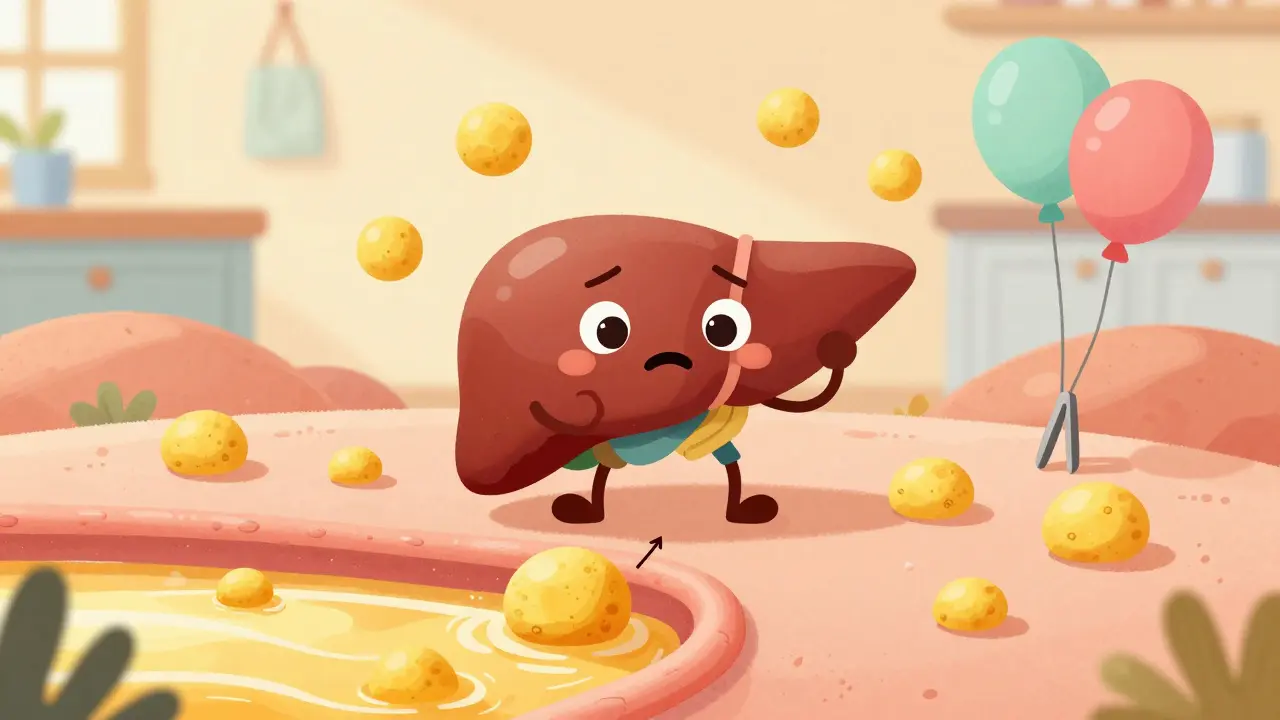
When your gallbladder stops working right, the pain doesn’t just come and go-it hits like a freight train. You might feel it deep under your right ribs, radiating to your back or shoulder, lasting hours after a fatty meal. For many, it’s not just discomfort-it’s a warning sign of gallstones, infected bile ducts, or a blocked passage that needs urgent attention. Gallbladder and biliary diseases are more common than most people realize, affecting 10-15% of adults in developed countries. In the U.S. alone, over 20 million people live with gallstones, and nearly half a million end up in the hospital each year because of complications.
What Are Gallstones, and Why Do They Form?
Gallstones are hard deposits that form inside the gallbladder, a small organ tucked under the liver. They’re not like kidney stones-they’re made mostly of cholesterol (about 80% of cases) or bilirubin (the rest). When bile, the fluid your liver makes to digest fat, becomes too concentrated, crystals start forming. Over time, these crystals grow into stones as small as grains of salt or as big as golf balls.Why does this happen? Risk factors pile up: being overweight, losing weight too fast (more than 1.5 kg per week), having diabetes, or being female. Women are more than twice as likely to develop gallstones as men. Native American populations, especially Pima Indians, have the highest rates globally-up to 64%. Age matters too: while only 1% of people in their 20s have gallstones, that number jumps to 25% by age 60.
Here’s the thing: most gallstones never cause trouble. About 80% of people with them feel nothing at all. The American College of Gastroenterology says you don’t need surgery just because you have stones-you need it when they start causing pain, inflammation, or blockage. That’s where things get serious.
When Gallstones Turn Dangerous: Cholangitis and Pancreatitis
A gallstone stuck in the cystic duct causes cholecystitis-swelling of the gallbladder. But if it moves into the common bile duct, things get life-threatening. That’s when cholangitis kicks in: a bacterial infection of the bile ducts. It doesn’t sneak up. It announces itself with Charcot’s triad: severe pain in the upper right abdomen, fever, and yellowing skin or eyes (jaundice). In worse cases, you’ll see Reynolds’ pentad-low blood pressure, confusion, and signs of septic shock. This isn’t something you can wait out. It needs emergency treatment.Another dangerous complication is gallstone pancreatitis. When a stone blocks the ampulla of Vater-the shared opening where bile and pancreatic juice enter the small intestine-it can trigger inflammation of the pancreas. About 40% of acute pancreatitis cases in the U.S. are caused by gallstones. Both cholangitis and pancreatitis land people in the ICU.
These aren’t rare. Together, they account for over half a million hospital visits every year. And they’re not just about the stones-they’re about timing. If you have gallstones and your bile duct gets blocked, the clock starts ticking. Delayed treatment increases infection risk, organ damage, and even death.
ERCP: The Procedure That Saves Lives (and How It Works)
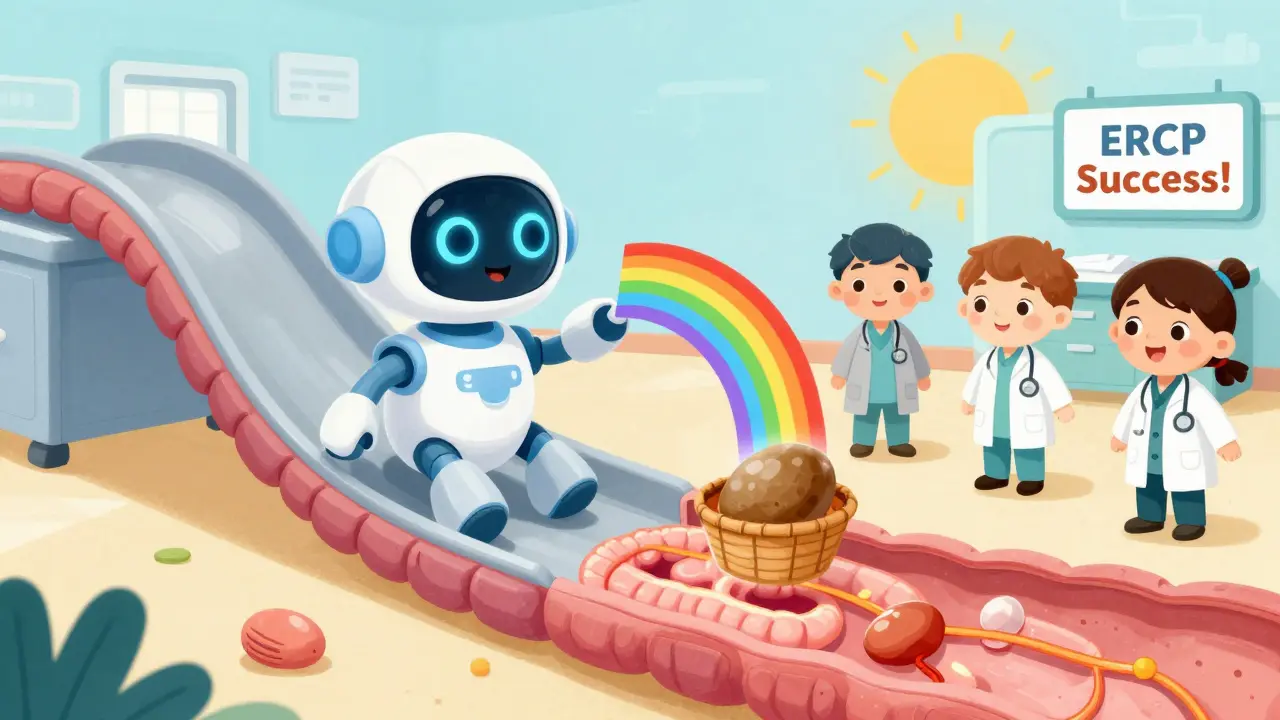
Endoscopic Retrograde Cholangiopancreatography, or ERCP, is the go-to procedure when a bile duct is blocked by a stone. It’s not a surgery-you don’t get cut open. Instead, a thin, flexible tube with a camera (an endoscope) is threaded through your mouth, down your esophagus, past your stomach, and into the first part of your small intestine. From there, the doctor finds the opening of the bile duct and injects dye to see the blockage on X-ray.If a stone is found, they can use tiny tools to cut the muscle around the duct (sphincterotomy), then grab the stone with a basket or balloon and pull it out. Success rates? Over 90% in experienced hands. And unlike open surgery, most people go home the same day or the next.
But ERCP isn’t perfect. About 3-10% of patients develop post-ERCP pancreatitis-the most common complication. It’s more likely if you have Sphincter of Oddi dysfunction, a history of pancreatitis, or if the procedure is done by someone with low volume (fewer than 100 ERCPs a year). High-volume centers cut complication rates by 20%. That’s why it’s critical to go to a center that does this often.
And here’s a key point: ERCP should never be used just to diagnose. That’s what MRCP (Magnetic Resonance Cholangiopancreatography) is for. MRCP gives a crystal-clear 3D image of your bile ducts without any needles or radiation. It’s 95% accurate at finding stones. If MRCP shows a stone, then-and only then-do you go for ERCP to remove it. Too many patients still get ERCPs as a first step, which increases risk and cost unnecessarily.
What Happens After Gallbladder Removal?
For symptomatic gallstones, the standard treatment is laparoscopic cholecystectomy-removing the gallbladder through tiny keyhole incisions. It’s been the gold standard since the 1990s. Compared to open surgery, recovery is faster: 7-10 days instead of 4-6 weeks. Hospital stays drop from nearly 5 days to just over 1 day.Most people feel dramatically better after. Studies show 87% report major symptom relief within 30 days. But not everyone. About 12% develop post-cholecystectomy syndrome-ongoing pain, bloating, or diarrhea. Why? Because the gallbladder isn’t just a storage bag. It fine-tunes bile flow. Without it, bile drips constantly into the intestine, which can irritate the gut. Some people need to stick to a low-fat diet for weeks, and a few need medication like loperamide to control diarrhea.
And here’s a gap in care: only 30-40% of patients with bile duct stones get their stones removed during the same procedure as their gallbladder removal. That means they come back for a second surgery, another ERCP, more time off work, and higher costs. Guidelines say if you have both gallbladder and bile duct stones, remove them together. Too often, that doesn’t happen.
What About Non-Surgical Options?
You might have heard about pills that dissolve gallstones. Ursodeoxycholic acid (UDCA) can work-but only for small cholesterol stones under 15mm, and only in about 30-40% of cases. It takes 6-12 months. And it doesn’t touch pigment stones at all. Plus, once you stop the pills, stones often come back. So it’s only useful for a small group of people who can’t have surgery.Shock wave therapy? Used to be popular, but it’s largely abandoned. It breaks up stones, but the fragments often get stuck in the ducts, and recurrence rates hit 50% within five years. It’s not worth the risk.
There’s no magic pill. For most people with symptoms, removing the gallbladder is still the most reliable fix. For bile duct stones, ERCP is the most effective way to clear them.
What’s New in Treatment?
Technology is improving. In 2023, the FDA approved a new duodenoscope with a fully disposable elevator mechanism. Why? Because old designs were linked to over 100 outbreaks of drug-resistant infections between 2013 and 2018. Now, the part that touches the bile duct is thrown away after each use-no more cross-contamination.Another advance: intraductal ultrasonography (IDUS). This tiny ultrasound probe goes inside the bile duct during ERCP and can spot stones smaller than 5mm-ones that standard X-rays miss. Sensitivity jumps from 75% to 92%. That means fewer missed diagnoses and fewer repeat procedures.
Researchers are also working on new drugs to dissolve pigment stones, which currently have no good medical treatment. That’s a big deal, especially in Asian populations where pigment stones make up nearly half of all cases.
And telehealth is helping. Post-ERCP check-ins via video calls have cut 30-day hospital readmissions by 18% in pilot programs. Patients get faster feedback, fewer unnecessary trips to the ER, and better guidance on diet and symptoms.
What Should You Do If You Think You Have a Problem?
If you have recurring pain under your right ribs-especially after eating fatty food-see your doctor. Start with an ultrasound. It’s cheap, safe, and detects gallstones with 96% accuracy. If the ultrasound is normal but symptoms persist, ask about MRCP before jumping to ERCP.If you’re diagnosed with gallstones but have no symptoms, don’t rush into surgery. The risk of complications is only 1-2% per year. Surgery carries its own risks. Wait until you have pain, fever, jaundice, or pancreatitis.
If you’re scheduled for ERCP, ask: How many of these do you do each year? What’s your complication rate? Do you use prophylactic stents for high-risk patients? And make sure you get clear instructions on what to eat after-no heavy meals for at least two weeks.
And if you’ve had your gallbladder removed and still have digestive issues, you’re not alone. Talk to your doctor about bile acid binders or dietary adjustments. It’s not failure-it’s adaptation.
Gallbladder and biliary disease isn’t glamorous. But it’s common, treatable, and often preventable. Understanding the difference between silent stones and dangerous blockages can save you from unnecessary surgery-or worse, a trip to the ICU.

Comments (13)
jeremy carroll
man i had gallstones back in 2018 and thought it was just indigestion till i couldnt breathe right. worst pain of my life. glad they got it out fast.
Rulich Pretorius
It's fascinating how medicine has evolved from open surgeries to endoscopic interventions. The shift from reactive to preventive care in biliary disease reflects a broader paradigm in healthcare-prioritizing patient outcomes over procedural volume. ERCP isn't just a tool; it's a signal of diagnostic maturity when paired with MRCP. Still, access disparities remain. In many parts of the world, even ultrasound is a luxury.
What’s often overlooked is the psychological toll of chronic abdominal pain. Patients are dismissed as hypochondriacs until they collapse. We need better triage protocols and education-not just for patients, but for primary care providers who see these cases first.
The statistic about 80% of gallstones being asymptomatic is critical. It challenges the medical instinct to intervene. Overtreatment is a silent epidemic. We must resist the urge to ‘fix’ what isn’t broken, even when the technology exists to do so.
And yet, when it does break, the system must be ready. That’s where high-volume centers matter. Quality isn’t just about skill-it’s about repetition, institutional protocols, and team coordination. A single ERCP is a team sport.
The new disposable duodenoscopes? Long overdue. Infection control isn’t optional. The fact that it took over a decade and hundreds of outbreaks to fix a design flaw says more about healthcare economics than medical ethics.
Also, let’s talk about bile acid diarrhea post-cholecystectomy. It’s underdiagnosed and undertreated. Patients are told to ‘eat less fat’ and left to suffer. Loperamide isn’t a bandaid-it’s a physiological necessity for some. We need guidelines that acknowledge this isn’t a failure of surgery, but a consequence of anatomy.
And yes, the 30-40% rate of missed bile duct stones during cholecystectomy? That’s unacceptable. It’s not negligence-it’s fragmentation. Surgeons, gastroenterologists, and radiologists need to be on the same page from day one.
Non-surgical options are tempting, but the data doesn’t lie. UDCA works for a sliver of patients. Shockwave therapy? A relic. Medicine isn’t about hope-it’s about evidence. We owe patients better than placebo solutions.
What’s promising is the rise of IDUS. Detecting sub-5mm stones changes everything. It’s the difference between a repeat procedure and a clean resolution. Technology like this should be standard, not experimental.
Telehealth follow-ups reducing readmissions by 18%? That’s the future. We’re moving from hospital-centric to patient-centric care. That’s not just innovation-it’s compassion.
Finally, stop calling it ‘gallbladder disease.’ It’s biliary tract disease. The gallbladder is just one part. Language shapes perception. And perception shapes care.
Sinéad Griffin
AMERICA STILL HAS THE BEST HOSPITALS IN THE WORLD NOBODY CAN TOUCH US 🇺🇸💪 #GallbladderPride
Natalie Koeber
They never tell you the truth about ERCP. Did you know the dye used contains mercury? And the endoscope? Manufactured by companies tied to the pharmaceutical cartel. They want you dependent on procedures because pills don’t make enough profit. They’re keeping you sick to sell you more scans. Ask yourself-why is this procedure so expensive if it’s just a tube and a camera? 🤔
And why are they pushing cholecystectomy so hard? The gallbladder is a vital organ. Remove it and your liver goes haywire. I’ve seen people turn into walking zombies after surgery-mood swings, brain fog, chronic fatigue. It’s not coincidence. Big Pharma wants you on bile acid binders forever. Wake up.
Also, why do they say 80% of stones are silent? Because they don’t want you to panic. But what if those ‘silent’ stones are slowly poisoning your system? What if they’re the root of your autoimmune issues? Nobody talks about that. They just cut it out and call it a day.
And the ‘disposable’ scopes? Please. They’re still reused 3-4 times before being tossed. I’ve got friends in the OR. They’re lying. You think they’re throwing away $10,000 scopes? That’s not capitalism-that’s insanity.
MRCP is just a distraction. It’s cheaper, sure, but it misses micro-stones. They’re using it to cut costs, not because it’s better. The real solution? Fasting. Cold water. Turmeric. I healed my stones with a 7-day water fast. No surgery. No drugs. Just discipline. But you won’t hear that on Medscape, will you?
Thomas Anderson
if you got pain after greasy food and it lasts hours, get an ultrasound. no joke. mine was a 12mm stone. got it out in 2 days. no big deal. don't wait till you're yellow.
Wade Mercer
People who ignore their gallbladder pain are just being lazy. You think your diet doesn’t matter? You eat fast food every day and then wonder why your body shuts down? This isn’t bad luck-it’s consequences. Take responsibility. Or keep ending up in the ER like a statistic.
Dwayne hiers
It’s worth noting that the incidence of pigment stones in non-Asian populations remains low, but rising in patients with hemolytic disorders, cirrhosis, or chronic biliary infection. The pathophysiology differs fundamentally from cholesterol stones-bile supersaturation with unconjugated bilirubin, bacterial deconjugation, and calcium precipitation. This has direct implications for therapeutic strategy. UDCA is ineffective here; chelation or litholysis agents under investigation may hold promise. Furthermore, the role of gut microbiota in bile acid metabolism is increasingly implicated in stone formation-particularly in recurrent cases. Future management may require microbiome profiling alongside imaging.
Jonny Moran
Just wanted to say-this is the kind of clear, detailed info we need more of. Too many people think ‘stomach pain’ means ‘just eat less’ or ‘it’s stress.’ This post breaks down what’s actually going on inside the body. And it doesn’t scare you-it empowers you. If you’re reading this and have unexplained pain, don’t brush it off. Talk to a doctor. Ask for an ultrasound. You’ve got this.
Sarthak Jain
bro in india we got so many pigment stones cause of liver flukes and poor sanitation. urdoc acid? useless here. we need cheap ultrasound access and trained endoscopists in rural areas. also, why no one talks about how many women get misdiagnosed as gyn issues? i had pain for 8 months before anyone checked my gallbladder. pls spread awareness.
Tim Bartik
Let me tell you something-this whole system is rigged. They want you scared of your own body. Gallstones? Nah, it’s the glyphosate in your food. The EMFs from your phone. The fluoride in the water. They don’t want you to know you can dissolve stones with apple cider vinegar and lemon juice. But they’ll sell you a $20k ERCP. Wake up. The system profits from your ignorance.
And why do you think they removed the gallbladder so fast? Because they don’t want you to learn how to heal yourself. They want you hooked on meds and procedures. I’ve seen it. My cousin got his gallbladder out, then got diarrhea, then got prescribed 3 different drugs. Now he’s on a cocktail. That’s not medicine. That’s slavery.
Edward Stevens
So let me get this straight-we spend billions on disposable scopes because of contamination, but we still can’t get people to stop eating fried chicken? 🤦♂️
Daniel Thompson
While the clinical data presented is largely accurate, one must consider the broader socioeconomic context. In under-resourced settings, even basic ultrasound access remains limited. The emphasis on high-volume ERCP centers assumes a level of healthcare infrastructure that is absent in over 60% of the world’s population. This narrative, while medically sound, risks reinforcing a Western-centric model of care that dismisses alternative pathways-traditional herbal therapies, dietary adaptations, and community-based monitoring-which have demonstrated efficacy in longitudinal studies from Southeast Asia and Sub-Saharan Africa. The absence of these perspectives in mainstream discourse is not neutral-it is exclusionary.
Alexis Wright
You call this ‘understanding’? This is a textbook case of medical reductionism. You treat the gallbladder like a faulty plumbing part you can just yank out. But the body is a network, not a machine. That stone didn’t just appear-it was the symptom of a systemic collapse: chronic inflammation, bile acid dysregulation, microbial imbalance, and metabolic toxicity. You fix the stone, but what about the liver? The gut? The immune system? You’re not healing-you’re suppressing. And then you wonder why patients come back with ‘post-cholecystectomy syndrome.’ Of course they do. You removed the warning light, not the engine fire.
And ERCP? A dangerous, invasive gamble. You cut the sphincter, you create a permanent leak point. Now bile flows backward. Now you’ve got bile reflux gastritis, duodenitis, maybe even Barrett’s. You think that’s ‘success’? That’s iatrogenic disaster dressed in white coats.
And the ‘disposable’ scope? A PR stunt. The real issue? The entire endoscopy industry is built on profit-driven obsolescence. They design devices to fail. They train doctors to overuse. They bury the truth: most gallstones never need intervention. But if you don’t operate, you don’t get paid. So you operate. And you call it ‘standard of care.’
Meanwhile, the real solution-fasting, bile acid modulation, gut repair-is buried under layers of pharmaceutical lobbying. They don’t want you to know you can reverse this with diet and time. They want you on lifelong meds. This isn’t medicine. It’s a multi-billion-dollar industry built on fear, ignorance, and the commodification of pain.
And you wonder why people are sick?