
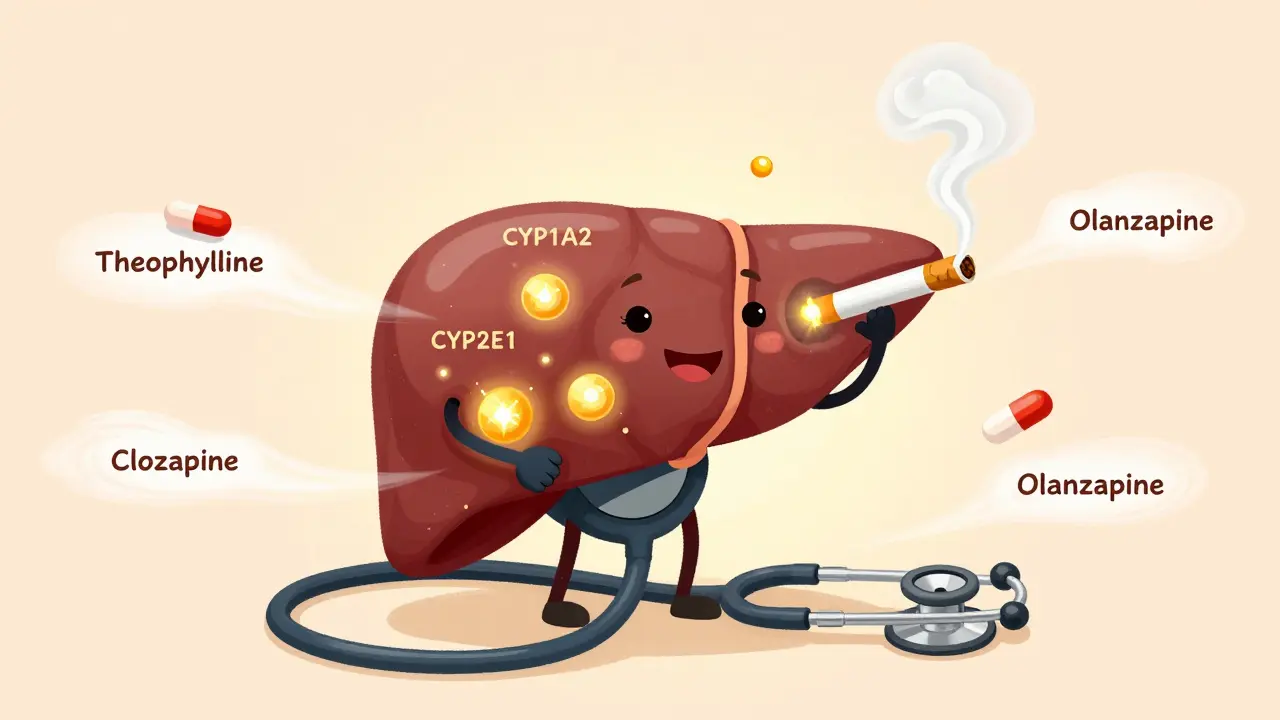
When you smoke, your body isn’t just dealing with nicotine. It’s also activating enzymes that can dramatically change how your medications work - sometimes to dangerous effect. This isn’t theoretical. It’s happening right now in millions of people who take pills for mental health, heart conditions, diabetes, or pain - and don’t realize their smoking is making those drugs less effective or suddenly too strong.
What’s Really Going On Inside Your Liver?
Tobacco smoke doesn’t just harm your lungs. It sends chemicals like polycyclic aromatic hydrocarbons (PAHs) straight to your liver. There, they trigger a chain reaction that turns up the volume on certain drug-processing enzymes. The biggest player is CYP1A2 a liver enzyme responsible for breaking down more than a dozen common medications. When activated by smoking, CYP1A2 can work 2 to 4 times faster than normal. That means drugs it handles get cleared out of your bloodstream much quicker - often before they’ve had time to do their job.
Other enzymes get a boost too: CYP2E1 breaks down acetaminophen and some painkillers, and UGTs which process morphine and ezetimibe. The more you smoke, the stronger this effect becomes. People who smoke more than 10 cigarettes a day show the highest enzyme activity. And it doesn’t happen overnight - it takes about two weeks of regular smoking for this effect to fully kick in.
Which Medications Are Most Affected?
Not all drugs are impacted the same way. Some are barely touched. Others? Their levels can drop by half. Here are the big ones:
- Theophylline a lung medication used for asthma and COPD - Smokers clear it 63% faster. That means the drug’s half-life drops from 8 hours to just 3 hours. Many smokers need double the dose just to stay in the therapeutic range.
- Clozapine an antipsychotic for treatment-resistant schizophrenia - Smokers require 50% higher doses. Studies show that without dose adjustments, patients can experience worsening psychosis.
- Olanzapine another antipsychotic - Clearance increases by 98%. Smokers often have blood levels 12% lower than non-smokers on the same dose.
- Duloxetine an antidepressant and pain medication - Smokers break it down 30% faster. This can lead to loss of symptom control.
- Pioglitazone a diabetes drug - Smokers may need 20-30% higher doses to maintain blood sugar control.
On the flip side, drugs like SSRIs metabolized by CYP2D6 such as fluoxetine or sertraline show almost no change. That’s because CYP2D6 isn’t affected by smoke. But if a drug is primarily handled by CYP1A2? You’re in high-risk territory.
The Real Danger: What Happens When You Quit?
Most people think the problem is only when you smoke. But the bigger clinical risk? When you stop.
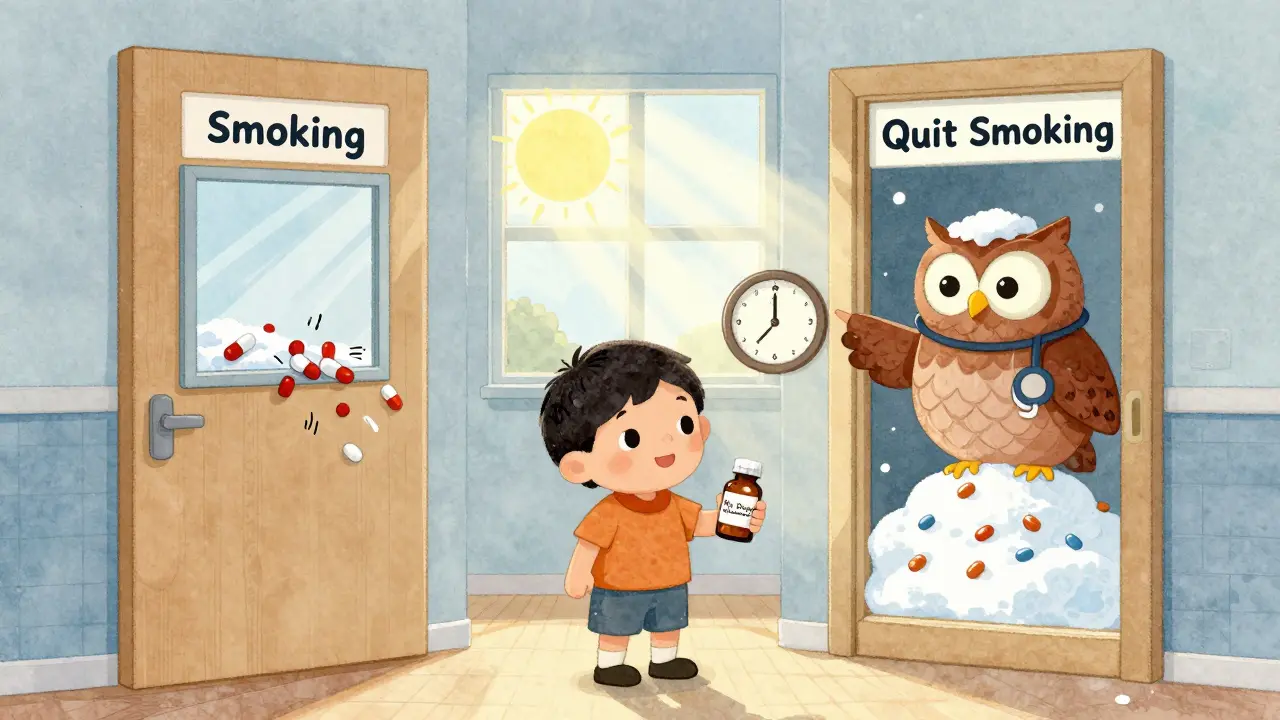
Once you quit, your enzyme levels don’t stay high. They start dropping - fast. Within 72 hours, CYP1A2 activity begins to normalize. By day 14, it’s usually back to pre-smoking levels. But here’s the trap: your medication dose hasn’t changed. So now, the same amount of drug is being broken down much more slowly. Blood levels rise. And that can push you into toxicity.
There are dozens of documented cases of this. One pharmacist on Reddit shared: “Patient hospitalized for theophylline toxicity 10 days after quitting smoking. Dose hadn’t been adjusted. Levels went from subtherapeutic to toxic.” Another patient wrote on a diabetes forum: “My A1C dropped from 7.8% to 5.9% two weeks after quitting. My doctor didn’t warn me. I almost went into hypoglycemia.”
The FDA’s adverse event database recorded 147 cases of clozapine toxicity linked to smoking cessation between 2020 and 2022. Nearly 90% happened within two weeks of quitting. That’s not coincidence. It’s predictable.
Why Doctors Often Miss This
A 2022 survey found that only 37% of primary care doctors routinely check smoking status before prescribing theophylline - even though the data is clear. Many still assume patients will mention it. Or they forget. Or they think it’s too complicated.
But it’s not. The NHS and UCSF have clear protocols:
- Document smoking status at every visit - not just “yes” or “no.” Record how many cigarettes per day.
- If a patient starts smoking, monitor drug levels weekly for 2-3 weeks. Increase dose if needed.
- If a patient quits smoking, reduce the dose of affected drugs by 25-50% within 3-7 days. Especially for clozapine, theophylline, and olanzapine.
Health systems that added mandatory smoking status prompts into their electronic records saw a 42% drop in related adverse events. It’s not rocket science. It’s basic safety.
New Tools Are Making It Easier
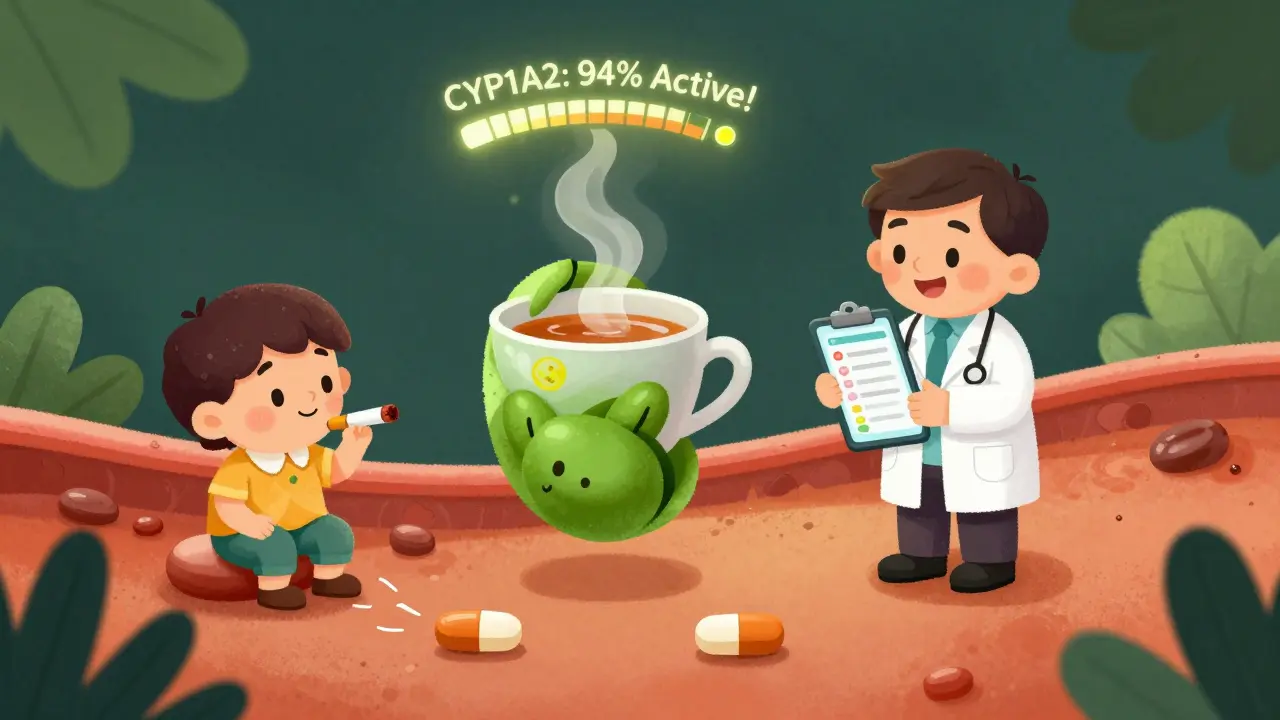
Now there’s a test called SmokeMetrix® a diagnostic tool that measures CYP1A2 activity using a simple caffeine challenge. It was approved by the FDA in early 2023. You drink a set amount of caffeine, then your blood is tested 4 hours later. The rate at which your body clears it tells you exactly how active your CYP1A2 enzyme is. It’s 94% accurate compared to lab tests.
And it’s not just for research. A smartphone app under beta testing at UCSF uses a breath carbon monoxide sensor to estimate enzyme activity in real time. It’s not perfect - but it gives patients and clinicians a live update: “Your enzyme level is at 80% of normal. Your clozapine dose might be too high.”
What Should You Do?
If you smoke and take any of these medications:
- Ask your doctor: “Is this drug affected by smoking?”
- If you’re planning to quit - tell your doctor before you stop. Ask if your dose needs to change.
- If you’ve already quit and your symptoms changed (worse depression, more side effects, dizziness, nausea) - get your drug levels checked.
- Don’t assume your pharmacist knows. Bring up smoking status yourself.
For doctors and pharmacists: Always ask about smoking. Document it. Update doses proactively. Use the NHS or UCSF guidelines. You don’t need a fancy test - just awareness.
The Bottom Line
Smoking isn’t just a bad habit. It’s a drug interaction waiting to happen. It can make your medication useless - or turn it into a poison. And quitting? That can be just as risky if your dose doesn’t change.
This isn’t about judging people who smoke. It’s about making sure everyone gets the right dose of medicine. Whether you’re the patient or the provider, ignoring this connection isn’t negligence - it’s preventable harm.
The science is clear. The tools are here. What’s missing? Consistent action.
Can smoking really make my medication stop working?
Yes - especially for drugs like theophylline, clozapine, and olanzapine. Smoking increases enzyme activity in your liver, causing these drugs to be cleared from your body much faster. This can lead to therapeutic failure - meaning your condition worsens because the drug isn’t staying in your system long enough.
What happens to my drug levels when I quit smoking?
When you quit, your enzyme levels start dropping within 72 hours. Within two weeks, they return to normal. But if your medication dose hasn’t been lowered, your blood levels can rise sharply - sometimes into the toxic range. This is why many people end up in the hospital after quitting smoking, even if they were stable before.
Which medications are most affected by smoking?
The top ones are: theophylline (asthma), clozapine and olanzapine (antipsychotics), duloxetine (antidepressant/pain), pioglitazone (diabetes), and methadone. These are all primarily broken down by CYP1A2 or CYP2E1 - enzymes strongly induced by tobacco smoke.
Do all smokers experience the same effect?
No. The effect depends on how much you smoke and your genetics. People who smoke more than 10 cigarettes a day show the strongest enzyme induction. Also, those with the CYP1A2*1F gene variant are 30% more sensitive to the effects of smoking. So two people smoking the same amount may need very different doses.
Is there a test to check if my enzymes are affected?
Yes. The FDA-approved SmokeMetrix® test measures CYP1A2 activity using a caffeine challenge. You drink a fixed amount of caffeine, and your blood is tested 4 hours later. The rate your body clears caffeine directly reflects how active your CYP1A2 enzyme is. This helps doctors personalize your dose.
Should I stop smoking if I’m on medication?
Quitting smoking is always the best long-term choice for your health. But don’t quit without talking to your doctor first. If you’re on a medication affected by CYP1A2 or CYP2E1, your dose may need to be reduced within days of quitting to avoid toxicity. The benefits of quitting far outweigh the risks - as long as your medication is adjusted properly.

Comments (12)
Stephen Rudd
This is why medicine is a joke. You think doctors know what they're doing? They don't even check if you smoke. I've been on clozapine for 8 years. Quit cold turkey in 2021. Went from stable to hallucinating in 4 days. ER visit. They acted like I was the problem. Not the system. Not the doctors who never asked. This isn't science. It's negligence dressed up as practice.
Erica Santos
Oh wow. Another article that treats smokers like lab rats. Let me guess - next you'll tell us to stop breathing because CO2 interferes with mitochondrial respiration. The real issue? Doctors don't give a damn until someone overdoses. Then it's 'oops, we forgot to ask.' Meanwhile, the people who actually need these meds are getting screwed because their provider thinks 'smoker' means 'irresponsible.' The system doesn't care. It just wants to avoid liability.
George Vou
i heard this is all just a big pharma scam to sell more drugs. like if you quit smoking theyll make you pay for more tests and adjust your dose so they can charge you more. also why is caffeine involved? is this like a coffee conspiracy? i dont trust any of this. my cousin quit smoking and his meds were fine. they just said he was lucky.
Samantha Fierro
This is one of the most important public health insights I’ve read in years. The fact that we don’t routinely screen for smoking status before prescribing these medications is a systemic failure - not an oversight. Patients deserve to be informed, not left to guess. I’m a nurse, and I’ve seen this happen twice in my unit. One man nearly died from theophylline toxicity after quitting. He didn’t know. His doctor didn’t know. We need mandatory alerts in EHRs. Not optional. Mandatory. And we need to train every provider - from interns to attendings - to treat smoking as a pharmacokinetic variable, not a moral judgment.
Robert Bliss
I never thought about this before. I smoke and take duloxetine. My anxiety got worse last year and I blamed stress. Turns out I was just getting less of the drug in my system. I told my doc and we upped my dose. Now I feel way better. Also, I’m trying to quit. I’m telling my doc before I do. This stuff matters. Thanks for laying it out clear.
Peter Kovac
The data presented here is methodologically sound but contextually incomplete. CYP1A2 induction is only one component of a broader pharmacodynamic landscape. Genetic polymorphisms, concomitant alcohol use, and dietary flavonoid intake significantly modulate enzyme activity. The reliance on SmokeMetrix® as a standalone diagnostic tool is premature. Without concurrent genotyping and metabolic profiling, dose adjustments remain probabilistic rather than precision-based. This article reduces a complex biochemical phenomenon to a binary smoker/non-smoker dichotomy - a reductionist fallacy.
APRIL HARRINGTON
I JUST QUIT SMOKING LAST WEEK AND MY DOCTOR DIDNT SAY A WORD ABOUT MY MEDS AND NOW IM DIZZY AND NAUSEOUS ALL THE TIME I FEEL LIKE IM GOING TO PASS OUT AND NO ONE CARES I JUST WANT TO BE NORMAL AGAIN
Leon Hallal
You people act like smoking is the enemy. I’ve been on clozapine for 12 years. I smoke 20 a day. I’m stable. I’m alive. You want me to quit? Fine. But then you better be ready to fix what you break. Don’t come crying to me when I’m hospitalized because your system didn’t plan for me. I’m not a statistic. I’m a person who’s been surviving on your broken system for over a decade.
Judith Manzano
I’m so glad someone finally wrote this. My mom took pioglitazone for diabetes and quit smoking last year. Her blood sugar dropped so fast she passed out at the grocery store. No one warned her. She thought quitting smoking would help her health - and it did, but not without almost killing her. Please, if you’re on any of these meds and thinking of quitting - talk to your doctor. It’s not about quitting smoking being bad. It’s about doing it safely.
rafeq khlo
This is merely a symptom of the Western medical industrial complex's obsession with quantification. In India, we have been managing such cases for generations without tests or algorithms. We observe. We adjust. We rely on clinical intuition, not caffeine challenges. The notion that one must rely on a smartphone app or FDA-approved kit to manage a physiological response is a profound failure of medical education. The patient is not a machine. The body is not a lab.
Morgan Dodgen
Smoking = CYP1A2 induction = corporate profit. Let me guess - SmokeMetrix® is owned by LabCorp? And the caffeine test? Patent pending. This whole thing is a monetized panic. They want you to get tested so they can bill you. They want you to quit so they can adjust your dose and bill you again. And meanwhile, the real cause? The stress of poverty, trauma, and lack of access to mental healthcare. Smoking is a coping mechanism. Don’t punish the symptom. Fix the disease.
Philip Mattawashish
I’ve been saying this for years. People think quitting smoking is a moral victory. It’s not. It’s a medical emergency. You think your therapist cares? Your psychiatrist? Your pharmacist? No. They’re too busy checking boxes. I had a friend on olanzapine. Quit. Three days later, he was in a psych ward, convinced his teeth were melting. They didn’t reduce his dose. They didn’t even ask. Now he’s on disability. They call it mental illness. I call it medical malpractice.