
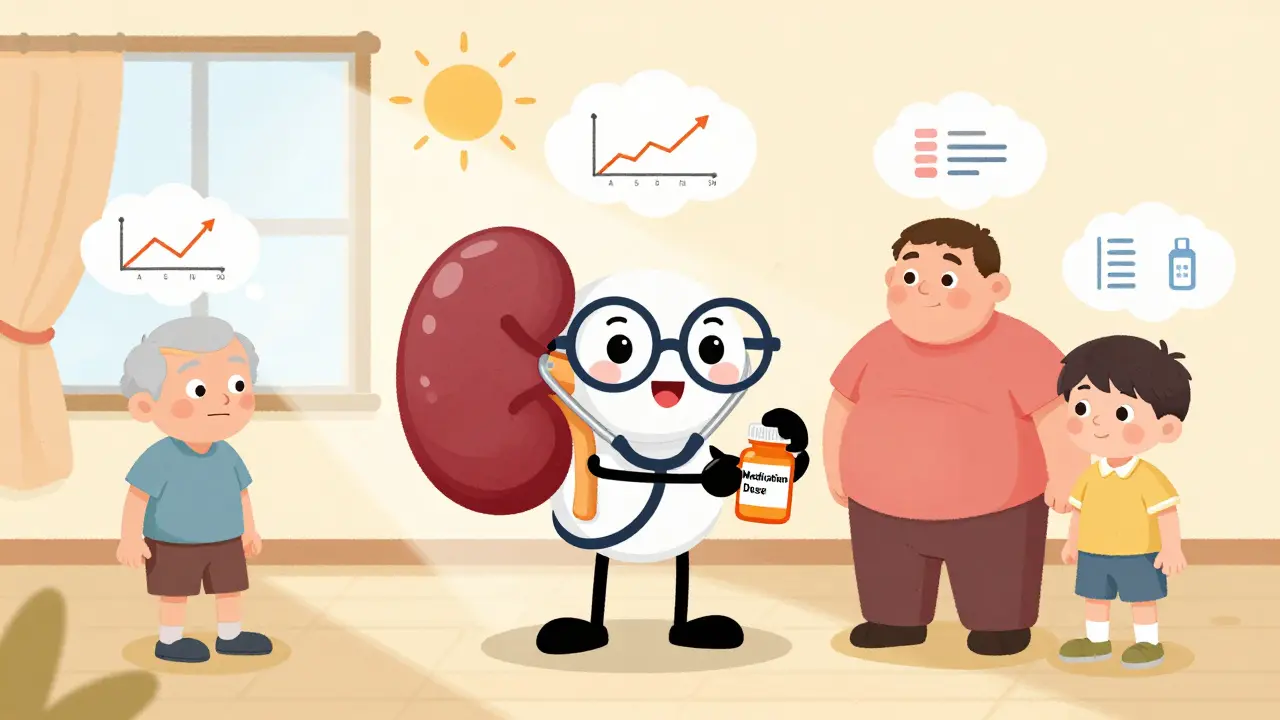
Getting the right dose of medication isn’t just about following the label. For many people, the dose on the bottle might be too much-or too little. That’s because your body’s ability to handle medicine changes with your age, your weight, and how well your kidneys are working. A dose that’s perfect for a healthy 35-year-old might cause serious harm to someone over 70, underweight, or with kidney disease. And yet, these adjustments aren’t always made-leading to dangerous side effects, hospitalizations, or even death.
Why One Size Doesn’t Fit All
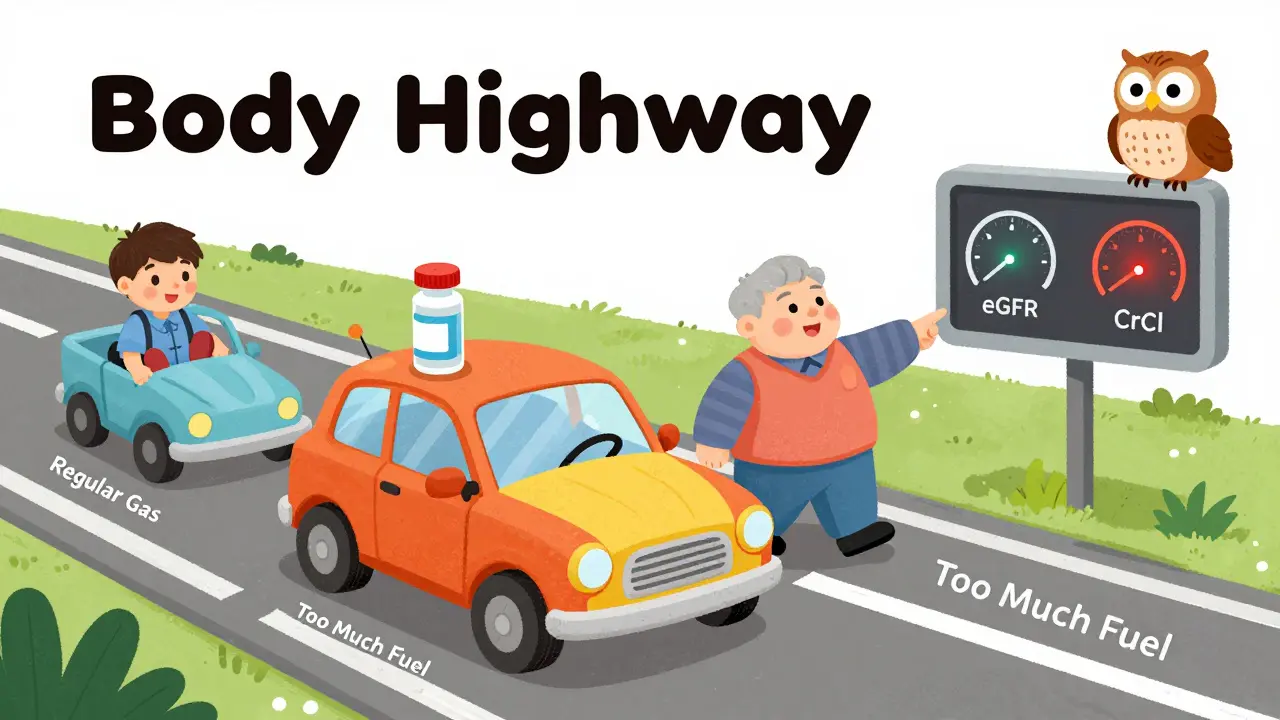
Think of your body like a car. The same engine can run fine on regular gas, but if you put diesel in a gasoline engine, it breaks down. Medications work the same way. Your body’s chemistry changes over time, and those changes affect how drugs are absorbed, distributed, and cleared out. If your kidneys aren’t filtering well, a drug can build up to toxic levels. If you’re very thin or very heavy, the drug might not reach the right concentration in your blood. And as you age, your liver and kidneys slow down, so drugs stick around longer than they should.Here’s the hard truth: about 40% to 60% of commonly prescribed medications need some kind of adjustment if you have reduced kidney function. And with 37 million Americans living with chronic kidney disease, that’s millions of people at risk every day.
How Kidney Function Changes Dosing
Your kidneys are the main way your body gets rid of many drugs. When they’re working well, they clear the medicine out quickly. When they’re not, the drug lingers. That’s why doctors need to know how well your kidneys are functioning.Two numbers are used to measure this: eGFR and CrCl. eGFR stands for estimated glomerular filtration rate. It’s used to stage kidney disease. CrCl is creatinine clearance, and it’s used to adjust drug doses. They’re related, but not the same. Many doctors mix them up.
The eGFR is calculated using your age, sex, race, and serum creatinine. It’s the standard for diagnosing kidney disease. But when it comes to dosing pills, it’s not always the best tool. Why? Because it doesn’t account for muscle mass or body size the way drug manufacturers originally designed their dosing guidelines.
That’s where CrCl comes in. The Cockcroft-Gault equation is still used in 85% of FDA drug labels. It looks like this:
(140 - age) × weight × 0.85 (if female) ÷ (serum creatinine × 72)
This formula gives you a number in mL/min-the rate your kidneys are clearing creatinine. That number tells the doctor how much to lower your dose. For example, if your CrCl is half of what’s normal, you might get half the usual dose.
But here’s the catch: if you’re obese, the standard Cockcroft-Gault equation overestimates your kidney function. That’s because it uses your total body weight. So if you’re 300 pounds, the formula thinks your kidneys are working better than they are. That’s dangerous. The fix? Use adjusted body weight instead.
Adjusted body weight = Ideal body weight + 0.4 × (actual weight - ideal weight)
Ideal body weight? For men: 50 kg + 2.3 kg for every inch over 5 feet. For women: 45.5 kg + 2.3 kg for every inch over 5 feet.
Use this adjusted number in the Cockcroft-Gault formula. It’s more accurate for people with obesity.
Age Makes a Big Difference
As you get older, your kidneys naturally lose function-even if you’re healthy. A 70-year-old with no diabetes or high blood pressure might have an eGFR of 60, which is considered normal. But for a 30-year-old, that same number would mean early kidney damage. So age alone can change how a drug is processed.Studies show that older adults are three times more likely to have a serious drug reaction because of improper dosing. The most common culprits? Antibiotics, blood thinners, diabetes drugs, and painkillers like NSAIDs.
Take metformin, a common diabetes drug. The FDA says if your eGFR drops below 30, you shouldn’t take it. But many doctors still prescribe it at 45, thinking it’s safe. A 2023 study found that 1 in 5 elderly patients on metformin had eGFR levels below the safe threshold-without anyone noticing.
Another issue? Older people often take five or more medications. Each one can interact with another. A drug that’s fine alone might become toxic when combined with a blood pressure pill or an antacid.
Weight Matters More Than You Think
You might assume that heavier people need bigger doses. But that’s not always true. Some drugs are stored in fat. Others are cleared by the liver. And some are filtered by the kidneys-regardless of weight.For drugs that are cleared by the kidneys (like vancomycin or many antibiotics), total body weight can be misleading. In very overweight people, the Cockcroft-Gault equation using actual weight overestimates kidney function by 15% to 20%. That means doctors might give a dose that’s too high. The result? Toxic levels build up, leading to hearing loss, kidney damage, or even death.
On the flip side, very thin people (BMI under 18.5) often have their kidney function overestimated too. The Cockcroft-Gault formula thinks their kidneys are working better than they are. That can lead to under-dosing. A patient with low muscle mass might need a lower dose than expected.
Doctors now use lean body weight or adjusted body weight depending on the drug. For example, antibiotics like cefazolin are dosed using adjusted weight. But insulin? That’s dosed by total weight. It varies by drug. That’s why you can’t rely on guesswork.
Real-World Mistakes Are Common
A pharmacist in Chicago told a story about a 78-year-old woman on vancomycin. Her eGFR was 32, so the system flagged her for a reduced dose. But the hospital’s automated system used eGFR, not CrCl. The vancomycin dose was cut too much. She developed a severe infection that didn’t respond. It took days to realize the dose was too low.Another case: a 62-year-old man with Stage 3B kidney disease was prescribed 1,000 mg of metformin twice a day. His eGFR was 28. The label says max 500 mg daily. He’d been on this dose for six months. No one caught it.
A 2022 survey of pharmacists found that 68% see wrong dosing at least once a week. Antibiotics are the most common mistake. Then cardiovascular drugs. Then diabetes meds.
Why? Because guidelines conflict. One hospital says to reduce cefazolin by 50% at eGFR 20-29. Another says 75%. A third says don’t adjust at all. That confusion leads to errors.

How Technology Is Helping
Hospitals are starting to fix this. Many now have built-in alerts in their electronic health records. When a doctor tries to prescribe a drug to someone with low CrCl, the system pops up a warning. Some even auto-calculate the dose.One hospital in Boston cut dosing errors by 53% in 18 months by integrating real-time CrCl calculations into their system. Another study found that automated alerts reduced serious medication errors by 47%.
But technology isn’t perfect. A Cleveland Clinic doctor warned that over-relying on alerts can lead to under-dosing. If the system says “reduce dose,” and the patient has sepsis, reducing antibiotics could be deadly. Clinical judgment still matters.
Companies are also developing AI tools that combine kidney function, genetics, age, and weight to predict the best dose. The NIH is funding a $50 million project to test these tools starting in late 2024. The goal? Personalized dosing, not population-based guesses.
What You Can Do
If you’re on any regular medication and have kidney disease, are over 65, or have a very high or very low body weight, here’s what to ask:- Is my dose adjusted for my kidney function?
- Are you using CrCl or eGFR to calculate this?
- Is my weight being factored in correctly?
- Can you check if this drug is cleared mostly by the kidneys?
Keep a list of all your meds-including over-the-counter ones. Bring it to every appointment. Ask your pharmacist to review it. They’re trained to catch these errors.
And if you’re a caregiver for an older adult or someone with chronic illness, don’t assume the doctor got it right. Double-check. Ask questions. You might save a life.
The Bottom Line
Medication dosing isn’t magic. It’s math. It’s biology. It’s science. But it’s not one-size-fits-all. Your kidney function, your age, and your weight aren’t just background details-they’re critical parts of your prescription. Ignoring them isn’t negligence. It’s a mistake waiting to happen.The good news? We have the tools to fix this. We just need to use them right.
How do I know if my medication dose needs to be adjusted?
If you’re over 65, have kidney disease, are very overweight or underweight, or take multiple medications, your dose likely needs adjustment. Ask your doctor or pharmacist: "Is my kidney function being used to calculate this dose?" They can check your creatinine level and calculate your CrCl. If your CrCl is below 60 mL/min, most drugs need some change in dose or timing.
What’s the difference between eGFR and CrCl?
eGFR estimates how well your kidneys filter waste overall and is used to diagnose kidney disease. CrCl estimates how fast your kidneys clear creatinine from your blood and is used to adjust drug doses. eGFR is better for staging disease; CrCl is better for dosing. Many drug labels still use CrCl, even though labs report eGFR. Always ask which one is being used for your medication.
Why do some drugs need dose changes for obesity?
Many drugs are cleared by the kidneys. In obese people, the standard CrCl formula using total body weight overestimates kidney function by 15-20%. That means doctors might give too much of the drug, leading to toxicity. Using adjusted body weight (ideal weight + 40% of excess weight) gives a more accurate estimate. This is especially important for antibiotics, seizure meds, and heart drugs.
Can I trust my pharmacy’s dosing recommendation?
Most pharmacies use reliable databases like Lexicomp or Micromedex, which are updated regularly. But they don’t always agree with each other. One might say reduce a dose by 50%, another by 75%. Always ask your pharmacist: "Which guideline are you using?" If you’re unsure, ask your doctor to clarify. Never assume the dose is correct just because it came from the pharmacy.
What should I do if I’m told my dose needs to be lowered?
Don’t panic. Lowering a dose doesn’t mean the drug won’t work-it means it’s safer. For example, lowering a blood thinner reduces bleeding risk. Lowering an antibiotic might prevent kidney damage. Ask: "What’s the risk if I don’t change it?" and "What signs should I watch for?" If you feel worse after the change, contact your doctor. Some adjustments take time to balance.
Are there drugs that don’t need adjustment?
Yes. Some drugs are broken down by the liver instead of the kidneys, so kidney function doesn’t affect them much. Examples include many statins, some antidepressants, and certain antivirals. But you can’t assume-always check. A drug like metformin is almost entirely cleared by the kidneys. A drug like atorvastatin is mostly processed by the liver. Your pharmacist can tell you which category your medicine falls into.

Comments (9)
matthew runcie
Honestly, this is the kind of info every patient should have. I didn't realize how much kidney function affects meds until my dad got hospitalized over a simple antibiotic. Simple fix: ask your doc if they're using CrCl or eGFR. Most don't even know the difference.
Just say it plainly. No jargon. Just ask.
shannon kozee
Pharmacists are the real heroes here. I’ve had mine catch three wrong doses in the last year. Always ask them. They see the math before the doctor even writes the script.
Shaun Wakashige
lol so basically we’re all just guinea pigs for drug companies 🤡
Solomon Kindie
its funny how we think medicine is science but its really just guesswork with a fancy algorithm and a prayer
we got people dying because some computer says reduce dose but the doc just clicks through cause its faster
no one wants to think about the math
Johny Prayogi
I’ve been pushing my mom to ask for her CrCl since she hit 70. She’s on metformin and blood pressure meds. Pharmacist caught the over-dose last month. She’s been fine since. Don’t wait for a crisis. Ask now.
And yes, use adjusted body weight if you’re over 200 lbs. It’s not about judgment-it’s about survival.
Desiree LaPointe
Oh wow, a post that doesn’t just say ‘ask your doctor’ like a broken record. How novel. I suppose next you’ll tell us the sky is blue and water is wet. But hey, at least you mentioned Cockcroft-Gault. Most ‘experts’ still think eGFR is the golden ticket. Pathetic.
Still, I’m surprised anyone in healthcare hasn’t figured this out by now. Did they teach this in med school or just in PowerPoint decks?
Jackie Tucker
The fact that we’re still using a 1970s formula with a 1980s patch for obesity is a national disgrace. We have AI that can predict stock trends and cat memes. But when it comes to saving lives by adjusting a single number? We’re still arguing over whether to use total weight or ideal weight.
And don’t even get me started on the hospital systems that auto-flag eGFR but ignore CrCl. It’s like using a map from 1995 to drive a Tesla.
trudale hampton
I work in a clinic and this is 100% true. We had a guy on vancomycin with CrCl at 22. They gave him the full dose because his eGFR was 45. He ended up with hearing loss. Took us three days to catch it. Now we auto-calculate CrCl with adjusted weight. Saved three people in six months.
It’s not rocket science. Just do the math.
Timothy Olcott
why do we let computers do this? we got real doctors for a reason. i dont trust no algorithm to tell me how much medicine to take. its like letting a phone tell you how to breathe. dumb. also usa is too soft. in russia they just give the dose and shut up