
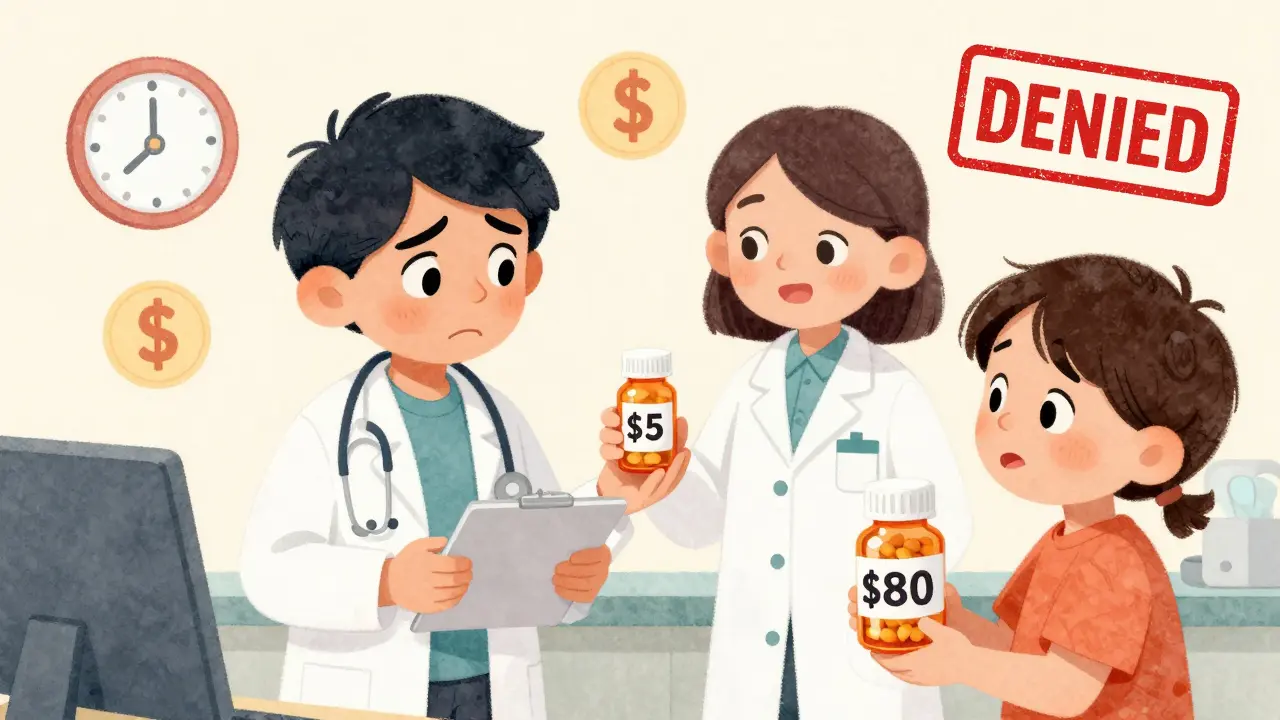
When your doctor writes a prescription for a brand-name medication, and the pharmacy tells you it’s not covered unless you switch to the generic version, you’re not just dealing with a pharmacy policy-you’re caught in the middle of a system designed by insurers to cut costs. This isn’t rare. In the U.S., 90% of all prescriptions are filled with generics today, up from just 48% in 2000. But behind that number is a growing tension between insurers pushing for savings and providers trying to keep patients safe and treated effectively.
How Insurers Enforce Generic Substitution
Insurers don’t just ask providers to use generics-they make it mandatory through layered rules. The most common tool is the tiered formulary. Generic drugs sit in Tier 1, with copays as low as $5. Brand-name drugs without a generic alternative? Tier 3 or 4, with copays of $40 to $100 or more. For many patients, that price gap is enough to force a switch-even if they’ve been stable on the brand for years. But it doesn’t stop there. Many plans require step therapy: you must try and fail on the generic before you can get the brand. Others use formulary exclusions, removing certain brand drugs entirely from coverage. And then there’s prior authorization. If a provider wants to prescribe a brand-name drug, they must submit documentation proving medical necessity. This isn’t a quick call-it’s a digital form, often requiring lab results, previous treatment history, and sometimes even letters from specialists. Electronic prior authorization (ePA) systems are now standard. They’re supposed to speed things up, but in practice, they’re inconsistent. One insurer might accept a simple checkbox. Another demands a 500-word clinical narrative. And if you get it wrong? The claim gets denied. No second chance. No warning. Just a message: “Insufficient documentation.”What Providers Are Doing to Cope
Doctors aren’t sitting idle. They’ve adapted-often at the cost of their own time and sanity. A 2023 MGMA survey found physicians spend an average of 16.9 minutes per prior authorization request. That’s nearly 17 hours a week for a solo practitioner seeing 20 patients daily. Many clinics now hire dedicated staff just to handle these requests. Medium-sized practices report spending over $112,000 a year on a single full-time prior authorization coordinator. To save time, 68% of providers use standardized template letters for common exceptions. Instead of writing from scratch each time, they plug in patient data: “Patient has documented GI intolerance to generic levothyroxine. Switch resulted in TSH increase from 2.1 to 8.7. Symptoms returned: fatigue, weight gain, bradycardia.” Objective data. Lab values. Clear cause-and-effect. These appeals have a 37% higher approval rate than vague statements like “This patient does better on the brand.” Some providers now preemptively include clinical notes on every brand-name prescription-just in case. One cardiologist on Reddit shared that since 2023, he adds a 3-line justification to every non-generic script. It’s increased his prescription processing time by 40%, but he’s cut down on denials by 70%.
When Substitutions Go Wrong
The FDA says generics must be bioequivalent to brand drugs within an 80-125% range. That sounds precise-until you realize that for drugs like levothyroxine, warfarin, or phenytoin, even small differences in absorption can trigger serious side effects. The AMA reports that 28% of physicians have seen adverse outcomes after insurer-mandated switches to generics. One case from Minnesota, shared in an AMA forum, involved a patient switched from a brand anticoagulant to a generic. Within weeks, they had two emergency room visits for internal bleeding. The insurer denied coverage for the original drug for 22 days. Only after three appeals-and a hospitalization-was the brand restored. Patients aren’t always aware of the risks. They assume “generic” means “same.” When they feel worse after a switch, they blame themselves. “Maybe I’m just not taking it right.” Or worse-they stop taking it altogether. A 2023 survey found that 78% of providers have seen patients abandon treatment because of prior authorization delays or out-of-pocket costs.State Laws Are Changing the Game
Some states are pushing back. California’s AB 347, effective January 2024, forces insurers to respond to step therapy exceptions within 72 hours for urgent cases and 5 business days otherwise. Approval rates jumped to 92% on first submission. Arizona took it further with HB 2175, signed in May 2025. It bans insurers from using AI alone to deny care based on medical necessity. A human medical director must review every denial. Implementation starts June 30, 2026. Other states are watching closely. Meanwhile, federal law now requires Medicare Advantage plans to respond to urgent prior authorization requests within 72 hours. The CMS Interoperability and Prior Authorization Final Rule, released in 2024, mandates standardized ePA systems for all Medicaid and Medicare Advantage plans by January 2027. Analysts predict this will cut processing time by 40-60%.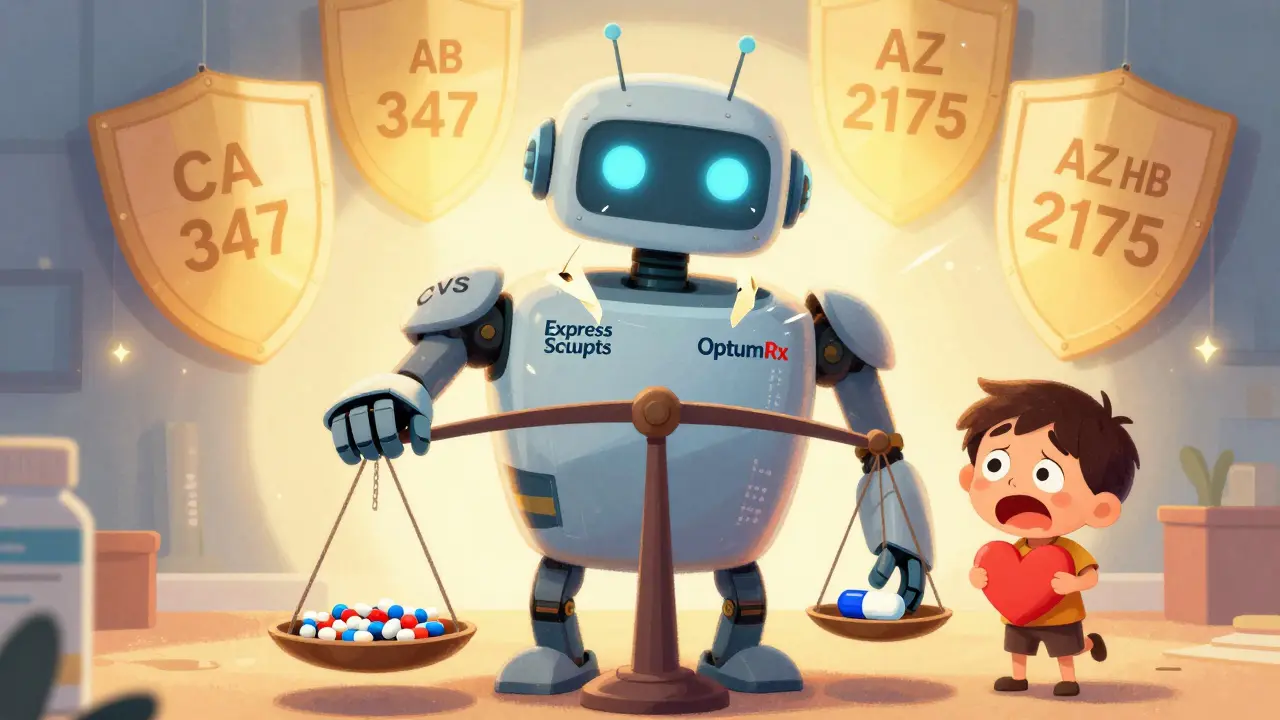
The Bigger Picture: PBMs, Costs, and Control
Behind every insurer is a Pharmacy Benefit Manager (PBM)-CVS Caremark, Express Scripts, OptumRx. These companies control formularies for 85% of insured Americans. And they’re often owned by the same parent companies as the insurers. That means the same entity decides what drugs are covered, how much patients pay, and who gets approved. The result? A vertically integrated system designed to maximize generic use. In 2023, generics made up 90% of prescriptions but only 18% of total drug spending. That’s billions saved. But the savings don’t always reach patients. PBMs keep a cut. Insurers keep a cut. Providers bear the administrative cost. Even brand-name drugmakers are fighting back. After Lipitor lost patent protection in 2010, its manufacturer offered $5 copay coupons. Sun Life Financial reported a 138% spike in “no substitution” claims in the following year. Patients used the coupons to stay on the brand-undermining the insurer’s cost-saving strategy.What’s Next?
Insurers aren’t backing down. UnitedHealthcare aims for 95% generic utilization by 2030. But providers are pushing back harder. The AMA’s 2024 survey found 68% of physicians believe current prior authorization rules harm patient outcomes. And as more states pass laws requiring human review, faster responses, and clearer criteria, the system is being forced to change. The real question isn’t whether generics are cost-effective-they are. The question is: at what cost to care? Providers are caught between two truths: insurers need to control spending, and patients need consistent, effective treatment. The answer won’t come from more automation or stricter rules. It’ll come from collaboration-clear clinical standards, transparent criteria, and systems that trust doctors to know what their patients need.Why do insurers push so hard for generic drugs?
Insurers push for generics because they cost 80-85% less than brand-name drugs, according to FDA data. This saves billions annually across the healthcare system. For insurers, it’s a direct way to reduce drug spending without cutting coverage. But they also use tiered formularies and prior authorization to steer patients toward generics, even when the clinical need isn’t clear.
Can patients refuse a generic drug substitution?
Yes, but it’s not simple. Patients can ask their doctor to write “Dispense as Written” or “Do Not Substitute” on the prescription. But if the insurer doesn’t approve it, the patient may have to pay the full brand-name price out of pocket. Some insurers allow exceptions if the provider submits clinical documentation proving a medical necessity-like a prior adverse reaction or therapeutic failure with the generic.
Do generic drugs really work the same as brand-name drugs?
For most drugs, yes. The FDA requires generics to be bioequivalent, meaning they deliver the same active ingredient at the same rate and amount as the brand. But for drugs with a narrow therapeutic index-like levothyroxine, warfarin, or epilepsy medications-even small differences in absorption can affect outcomes. Studies show 28% of physicians have seen adverse effects after switching patients to generics in these categories.
How long does prior authorization take?
It varies. Under federal rules, Medicare Advantage plans must respond to urgent requests within 72 hours and non-urgent ones within 7 days. But for private insurers, timelines aren’t always enforced. Some take 5-10 business days. In states like California, AB 347 mandates 72-hour responses for urgent cases. Delays can mean patients go without medication for weeks.
Are there any states that protect patients from forced generic switches?
Yes. California’s AB 347 requires insurers to approve step therapy exceptions quickly when clinical documentation is provided. Arizona’s HB 2175 (effective 2026) bans AI-only denials and requires human medical director review. Other states, including New York, Illinois, and Washington, have passed similar laws in 2024-2025. These laws are changing how insurers operate, forcing them to be more transparent and responsive.
What can providers do to improve approval rates?
Use objective clinical data: lab results, previous treatment failures, documented side effects. Avoid vague statements like “patient prefers the brand.” Submit through electronic prior authorization (ePA) systems integrated with your EHR-this cuts approval time by 55%. Build relationships with insurer case managers. And consider hiring a dedicated prior authorization specialist. Practices that do this see approval rates rise by 30-50%.

Comments (9)
Henry Jenkins
Man, I’ve been on levothyroxine for 12 years and switched to generic last year. Felt like I was dragging through molasses for six months-brain fog, weight gain, heart palpitations. My doctor had to fight the insurer for three months just to get me back on brand. They said ‘bioequivalent,’ but my body didn’t get the memo. This isn’t about savings anymore-it’s about playing Russian roulette with people’s health.
Rakesh Kakkad
The systemic inefficiencies described herein are emblematic of a commodified healthcare paradigm wherein clinical autonomy is subordinated to actuarial calculus. The administrative burden imposed upon providers constitutes a form of structural violence, disproportionately impacting primary care physicians who serve as de facto gatekeepers of therapeutic continuity.
Nicholas Miter
My clinic hired a PA coordinator last year. Cost us $110k, but we went from 60% denial rate to 85% approval. Honestly? Worth it. The templates we use now-lab numbers, symptoms, dates-are straight outta the AMA guide. No fluff. Just facts. Insurers can’t argue with that.
Suresh Kumar Govindan
PBMs are the real villains. They’re not even healthcare entities-they’re Wall Street profit machines disguised as pharmacy managers. The entire system is rigged. You think this is about cost savings? It’s about control. And the FDA’s 80-125% bioequivalence window? That’s not science-it’s a loophole.
TONY ADAMS
generic = same thing. why is this so hard??
Uche Okoro
The administrative overhead associated with prior authorization protocols represents a significant opportunity cost in clinical workflow optimization. The non-linear escalation of documentation requirements-particularly in the absence of standardized interoperability-exacerbates provider burnout and introduces systemic delays in therapeutic intervention.
Peter Sharplin
I’ve been doing this for 20 years. I’ve seen generics work wonders-and I’ve seen them wreck lives. The key isn’t banning them. It’s trusting doctors to know when not to use them. If a patient’s been stable on brand for five years, and switching causes symptoms? That’s not a cost issue-it’s a safety issue. Let the docs decide. We didn’t go to med school to fill out forms.
shivam utkresth
Bro, in India we don’t even have this problem-brand names are the default because generics are often sketchy. One guy I knew switched to a generic antiepileptic and had a seizure in front of his kid. That’s not bioequivalence-that’s roulette with a loaded chamber. The FDA’s standards are fine for aspirin, but for drugs that tweak your brain chemistry? Nah. We need to stop pretending all generics are equal.
John Wippler
Here’s the truth nobody wants to say: we’re not fighting over generics. We’re fighting over who gets to control the patient’s body. Insurers think they’re saving money. Providers think they’re saving lives. But the real losers? The people caught in the middle, too tired to fight, too scared to stop taking their meds. The answer isn’t more automation. It’s more humanity. Let the doctor be the doctor. Let the patient be the patient. And let the algorithm stay in its lane.