

When governments require one system to replace another, it’s not just a policy change-it’s a legal earthquake. Mandatory substitution isn’t a single rule. It’s a concept that shows up in banking, mental health care, and environmental safety, but each time, it works differently. What’s legal in Brussels might be illegal in Washington. What’s a human rights win in Ontario might be a violation in London. And none of it is simple.
Finance: The Tri-Party Repo Swap
In banking, mandatory substitution means a financial institution must replace the exposure to a collateral issuer with the exposure to the tri-party agent in repurchase agreements. This rule comes from Article 403(1) of the EU’s Capital Requirements Regulation (CRR), which became binding in June 2021. It’s not about reducing risk-it’s about making risk visible. If a bank lends money backed by corporate bonds, but the deal goes through a third-party agent, the regulator wants the bank to report the agent as the real counterparty, not the bond issuer.
The European Banking Authority (EBA) laid out strict guidelines by the end of 2019. Banks had to change their systems to track these substitutions, and they had to report compliance within two months of the rules being translated into all EU languages. The cost? Mid-sized banks spent an average of €1.2 million on IT upgrades. J.P. Morgan’s internal review in 2020 found a 15-20% spike in operational costs just to meet the reporting demands.
But the U.S. didn’t follow. The Federal Reserve, FDIC, and OCC all rejected mandatory substitution in their 2018 large exposure proposal. They argued that internal risk models were more accurate than a one-size-fits-all swap. The Basel Committee’s 2014 framework allowed substitution as optional. The EU made it mandatory. The result? A regulatory gap that created arbitrage. Twenty-two percent of EU-based financial firms moved some tri-party repo operations to London after Brexit to avoid the rule. That’s not innovation-it’s regulatory escape.
Mental Health: Who Decides for You?
In mental health law, mandatory substitution means someone else-often a family member, guardian, or court-appointed official-makes decisions for a person who’s deemed unable to do so themselves. This isn’t about helping someone. It’s about overriding them. And that’s where the conflict begins.
Canada, Australia, England, Wales, and Northern Ireland all have laws that allow this. Ontario uses the Substitute Decisions Act (1992). Victoria, Australia, uses the Guardianship and Administration Act (2019). England and Wales rely on the Mental Capacity Act (2005). Each has different thresholds for when substitution kicks in. Some require a formal capacity assessment. Others rely on clinician judgment.
But the United Nations’ Convention on the Rights of Persons with Disabilities (CRPD), ratified by 182 countries as of 2023, says this is a human rights violation. Article 12 insists that people with disabilities must have equal recognition before the law. The CRPD Committee’s 2014 General Comment No. 1 argued that substitute decision-making violates this. It doesn’t matter if the decision is "in your best interest." If you didn’t choose it, it’s still coercion.
Canada signed the CRPD in 2007 and ratified it in 2010-with a reservation. It said it understood Article 12 to allow both supported and substitute decision-making. Australia did the same. But legal scholars like Professor Michael Ashley Stein say that’s a misreading. He argues the CRPD bans all substitute decision-making. The tension is real. In Ontario, since 2015, the shift toward supported decision-making (where the person still chooses, but gets help) has cut coercive interventions by 12%. But frontline workers say it’s nearly impossible to apply in cases of severe psychosis or dementia.

Environment: The Chemical Swap
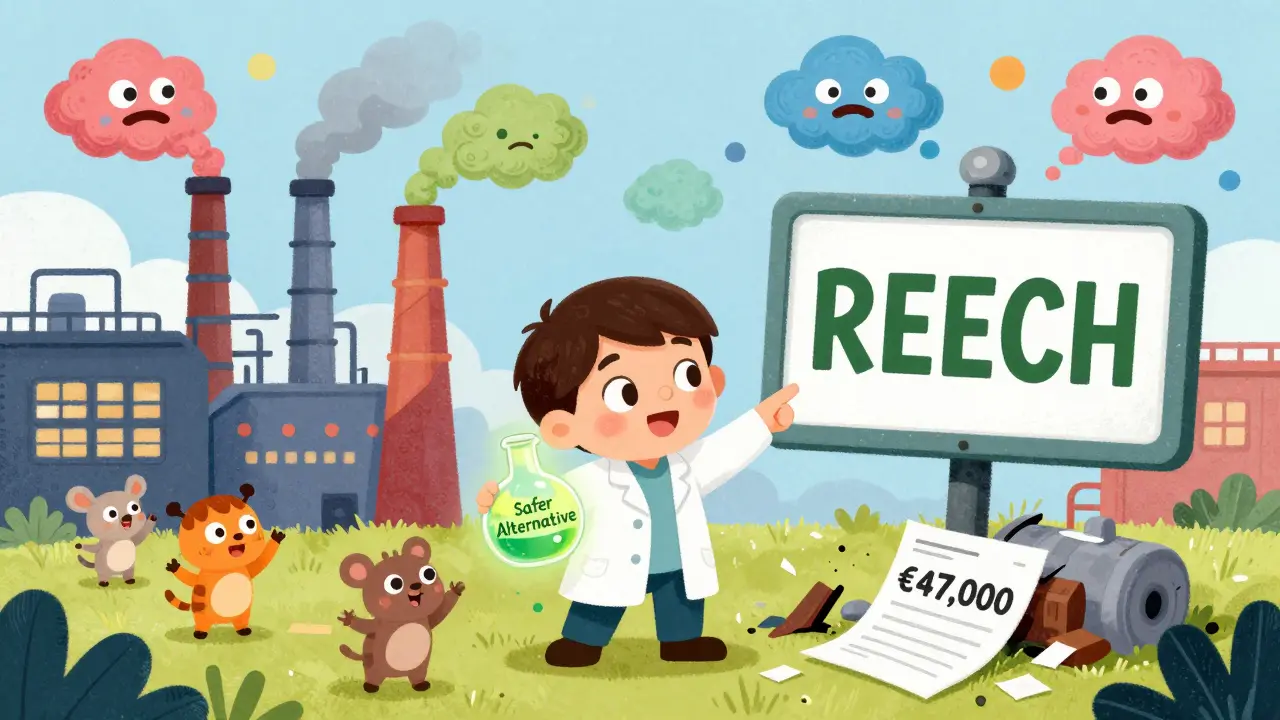
In environmental regulation, mandatory substitution is about forcing companies to replace dangerous chemicals with safer ones. The EU’s REACH framework is the global benchmark. It doesn’t ban substances outright. Instead, it requires manufacturers to prove they’ve tried-and failed-to find a safer alternative before they can keep using a substance classified as "of very high concern."
ChemSec’s SIN List, a voluntary database of hazardous chemicals, has pushed companies to act before they’re forced to. BASF, one of the world’s largest chemical producers, reported a 23% reduction in these substances in its products since 2016. But small businesses? They’re drowning. ECHA data shows the average cost of a single authorization application under REACH is €47,000 per year. Sixty-two percent of applications were initially rejected because the alternatives assessment wasn’t good enough. Processing time jumped to 18 months.
And now, the EU’s 2022 Chemicals Strategy for Sustainability is tightening the screws. By 2025, substitution planning will be mandatory for every restriction-not just authorization. Twenty-seven new substances were added to the candidate list in 2023 alone. Sweden’s PRIO list and the U.S. EPA’s Safer Choice program are alternatives, but they’re voluntary. REACH is the only one with teeth.
Why Do These Frameworks Clash?
It’s not just about rules. It’s about philosophy.
In finance, the EU prioritizes transparency. The U.S. prioritizes precision. In mental health, the UN prioritizes autonomy. Many nations prioritize safety. In environment, the EU prioritizes prevention. The U.S. prioritizes cost-benefit analysis.
The same word-substitution-means different things depending on who’s using it. In banking, it’s a technical swap of counterparty risk. In mental health, it’s a legal takeover of autonomy. In environmental law, it’s a forced innovation trigger.
And the outcomes? Mixed. IMF research found jurisdictions with mandatory risk substitution had 18% lower systemic financial risk. But the Bank for International Settlements found those same places had 12% higher operational risk. In mental health, supported decision-making reduced coercion-but didn’t eliminate it. In environmental regulation, substitution drove innovation-but buried small companies in paperwork.
The Future: Harmonization or Fragmentation?
The trend is clear: global regulation is pulling in opposite directions. In finance, 78% of experts predict more harmonization by 2030. In mental health, 63% expect ongoing conflict between CRPD ideals and national laws through 2035. In environmental policy, the EU is moving toward stricter substitution. The U.S. is doing the opposite-rolling back chemical restrictions under the Toxic Substances Control Act.
There’s no global authority to force alignment. No world court to settle disputes. Just a patchwork of laws, each shaped by history, culture, and power. The EU pushes because it can. The U.S. resists because it won’t. Canada and Australia walk the middle path-ratifying the CRPD but keeping substitute decision-making alive.
What’s clear is this: mandatory substitution isn’t a technical fix. It’s a moral choice. And every country is making it differently.
What does mandatory substitution mean in finance?
In finance, mandatory substitution requires banks to replace the exposure to a collateral issuer in tri-party repurchase agreements with the exposure to the tri-party agent. This rule, under Article 403(1) of the EU’s Capital Requirements Regulation (CRR), aims to improve transparency in risk reporting. The European Banking Authority (EBA) set guidelines in 2019, requiring banks to track and report this substitution, which led to significant IT and compliance costs-up to €1.2 million per firm for mid-sized banks.
Is mandatory substitution allowed in mental health care?
Yes, but it’s controversial. Countries like Canada, Australia, England, and Wales allow substitute decision-makers to make medical and legal decisions for people deemed unable to do so themselves. However, the UN’s Convention on the Rights of Persons with Disabilities (CRPD) argues this violates Article 12, which guarantees equal legal recognition. While some nations like Ontario have moved toward supported decision-making, others still rely on court-appointed guardians, creating tension between human rights standards and traditional legal practices.
How does REACH enforce mandatory substitution in chemicals?
Under the EU’s REACH regulation, manufacturers must prove they’ve explored and failed to find safer alternatives before using a substance classified as "of very high concern." This is called substitution planning. If they can’t, they must apply for authorization. ECHA rejected 62% of initial applications due to weak alternatives assessment. The 2022 Chemicals Strategy for Sustainability now requires substitution planning for all restrictions, not just authorizations, pushing companies to innovate-or stop using the chemical entirely.
Why do the U.S. and EU differ on mandatory substitution?
The U.S. favors risk-based, flexible approaches. In finance, it kept internal models over mandatory swaps. In chemicals, it relies on cost-benefit analysis and voluntary programs like Safer Choice. The EU favors preventive, standardized rules. It mandates substitution in finance and chemicals to reduce systemic risk and environmental harm. The difference comes down to regulatory philosophy: precision vs. precaution.
What’s the impact of mandatory substitution on small businesses?
Small businesses bear the heaviest burden. In finance, mid-sized banks spent millions on system upgrades. In environmental regulation, SMEs face €47,000 annual costs per REACH authorization, with 18-month approval delays. In mental health, small providers struggle to train staff in supported decision-making models. While large firms absorb these costs or shift operations, small players often exit markets or simplify offerings to avoid compliance.

Comments (11)
Nishan Basnet
Man, this post really laid bare how the same word can mean five different things depending on who’s writing the law. In finance, substitution is about transparency. In mental health, it’s about control. In environment, it’s about forcing innovation. And yet we act like these are just technical tweaks. They’re not. They’re moral stances dressed up as policy. The EU doesn’t just regulate-they declare what kind of society they want. The US doesn’t regulate-they negotiate risk. Neither is wrong. But both are deaf to the other’s philosophy. I’m from India, and we’re watching this play out with our own mental health reforms and chemical bans. We’re not picking sides-we’re trying to stitch together what works without losing our soul in the process.
Allison Priole
ok but like… why is everyone so dramatic about substitution?? 🤔 like i get it’s a big deal but also… maybe we’re overthinking it? like in finance, sure, it’s a mess, but banks are already juggling 47 different systems anyway. and mental health? if someone’s in a psychotic episode and their mom says ‘no, you’re not drinking bleach today’-should we really be having a UN debate about autonomy? i mean… i’m all for rights, but also… sometimes you just need someone to say ‘no’ for you. 🤷♀️ also i love how the EU just says ‘nope, you’re switching’ and the US says ‘nah we’ll do it when we feel like it’-like why can’t we all just chill and do what works for us? 🌈✨
Casey Tenney
The EU is a regulatory cult. They don’t solve problems-they replace them with paperwork. And now they want to export their bureaucratic religion worldwide? You think a small business in rural Kansas can afford €47,000 to prove they didn’t use a banned chemical? No. They shut down. And that’s the point. The EU doesn’t want competition. They want control. This isn’t safety. It’s economic warfare dressed as environmentalism.
Sandy Wells
The whole point of mandatory substitution is to force change without consent. That’s not policy. That’s authoritarianism. In finance, mental health, environment-it’s the same pattern. Someone decides what’s better for you and enforces it. No consultation. No compromise. Just compliance. And we wonder why trust in institutions is collapsing. It’s because we’re being treated like children who can’t be trusted to make their own mistakes.
Bryan Woody
LMAO the EU thinks they’re the world’s policy police but they’re just the most overregulated country on earth. Let’s break this down: in finance, they made banks track a third party instead of the actual borrower-so now 12% of IT budgets go to reporting a number that doesn’t even reflect real risk. In mental health, they’re pretending ‘supported decision-making’ is a magic wand when 80% of clinicians say it’s useless in acute psychosis. And in chemicals? They banned 27 new substances last year. That’s not science-that’s panic. Meanwhile, the U.S. says ‘prove it’s dangerous before you ban it.’ That’s called evidence-based policy. The EU says ‘prove it’s safe before you use it.’ That’s called tyranny with a spreadsheet. Also-€1.2 million per bank? That’s a startup. You’re not saving the system-you’re bankrupting it.
Chris Dwyer
Hey everyone-just wanted to say this is one of the most thoughtful threads I’ve seen in a while. Seriously. We’re talking about human dignity, economic survival, and planetary health-all in one post. And yeah, the EU’s rules are heavy. But let’s not forget: they’re the only ones pushing real change. The U.S. waits for a crisis. The EU tries to prevent it. In mental health, Ontario’s shift to supported decision-making cut coercion by 12%? That’s not a fluke. That’s progress. Small businesses? Yeah, they’re crushed. But that’s why we need policy that helps them adapt-not just punish them. Grants. Subsidies. Technical aid. We can fix this. We just have to stop treating regulation like a war and start treating it like a partnership. We’re not enemies. We’re just on different sides of the same table.
Timothy Olcott
EU = socialism with a spreadsheet 🇪🇺💀
USA = freedom with a checklist 🇺🇸🔥
Why are we even debating this? The answer is obvious. Stop copying Europe. Start thinking for ourselves. Also-REACH? More like REACH-OUT-AND-SLAP-AN-AMERICAN-BUSINESS. 😡
Desiree LaPointe
How is it possible that anyone still thinks the U.S. approach is ‘pragmatic’? Let’s be honest: it’s not. It’s lazy. It’s the difference between a surgeon who says ‘I’ll just monitor the tumor’ and one who says ‘I’ll remove it before it metastasizes.’ The EU doesn’t wait for bodies to drop before acting. The U.S. waits for a congressional hearing. And then a lawsuit. And then a 3-year review. Meanwhile, children are breathing carcinogens. Small businesses are going bankrupt. People are being forced into guardianship because ‘it’s too hard’ to support them. This isn’t freedom. It’s negligence with a flag.
Jackie Tucker
How quaint. We’re all so proud of our regulatory philosophies as if they’re personal taste-like coffee or socks. But here’s the uncomfortable truth: the EU’s model isn’t ‘heavy-handed.’ It’s the only one that recognizes systemic risk as a moral failure. The U.S. model isn’t ‘pragmatic.’ It’s a slow-motion collapse disguised as innovation. And the fact that Canada and Australia are trying to straddle both worlds? That’s not compromise. That’s intellectual cowardice. You can’t have your human rights and your laissez-faire capitalism too. One of them will always bleed out. The question is: which one will you let die?
Shaun Wakashige
meh. too much text. someone summarize pls?
Paul Cuccurullo
While I respect the depth of this analysis, I believe we must remember that regulation, at its core, is not about control-it’s about care. Whether it’s a bank, a person in crisis, or a river in danger-each system we’re discussing is a reflection of how we value life. The EU may be rigid, but it is consistent. The U.S. may be flexible, but it is often reactive. Perhaps the path forward isn’t choosing one over the other, but asking: who are we trying to protect? And are we willing to pay the cost-not in dollars, but in dignity?