
Every time you pick up a prescription, there’s a hidden safety net printed right on the bottle. It’s not just the name of the drug or how many pills to take. It’s the special instructions-the small print that could mean the difference between healing and harm. These aren’t suggestions. They’re life-saving directions. And yet, nearly half of all patients misunderstand them.
What Are Special Instructions on Prescription Labels?
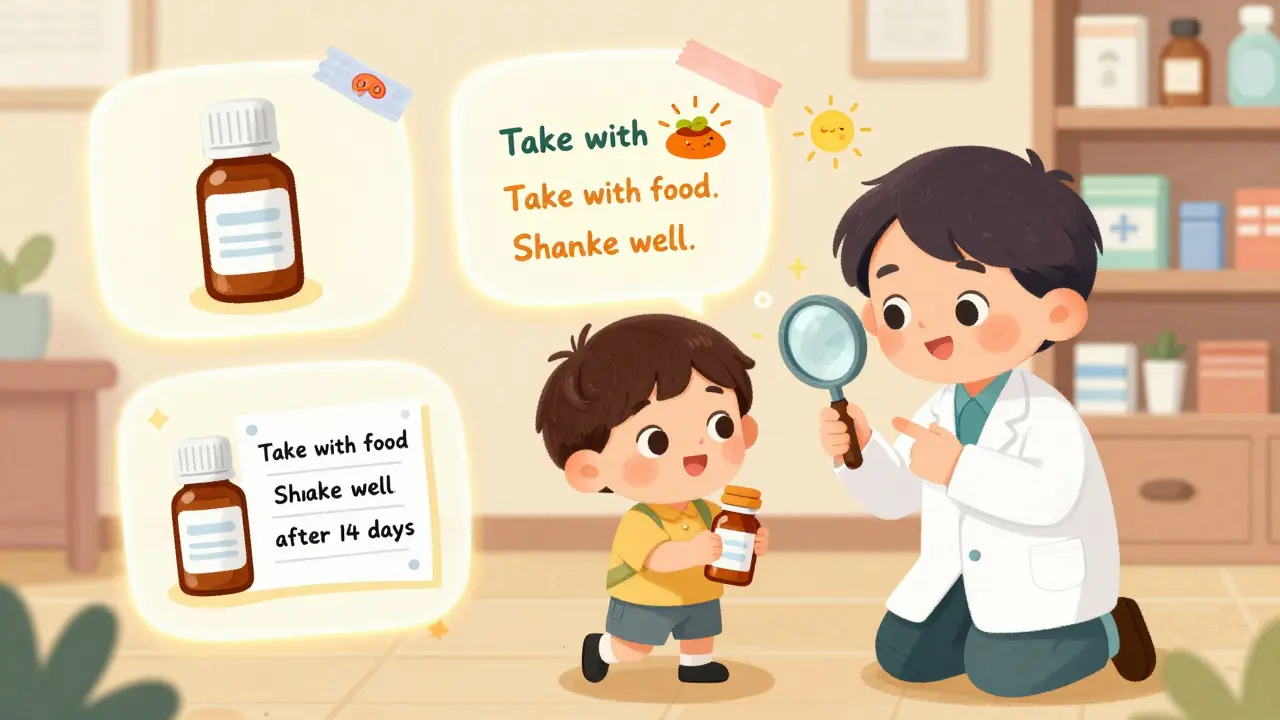
Special instructions are the specific, non-negotiable rules that tell you how to take your medicine correctly. They go beyond "take one tablet daily." They say things like: "Take with food," "Shake well before use," "Do not crush," "Refrigerate," "Take on an empty stomach," or "Discard after 14 days." These aren’t random notes. They’re based on how your body absorbs the drug, how it reacts with food or sunlight, and how long it stays stable.According to the FDA, these instructions are legally required for prescription medications. They’re not optional. And they’re different from over-the-counter (OTC) labels, which average just 1.2 special instructions per bottle. Prescription labels? On average, they carry 3.7. That’s more than triple the detail.
Where Do You Find These Instructions?
You won’t always find them in one place. That’s the problem.Thirty-two percent of special instructions appear directly on the main label. Forty-seven percent are printed on a small sticker stuck to the bottle. And 21%? They’re tucked into a separate paper insert. If you only glance at the front of the bottle, you’re missing nearly half the rules.
One patient in Melbourne took her blood thinner every morning with coffee. The label said "take on an empty stomach." She thought that meant "before breakfast." But her pharmacist later explained it meant no food, no coffee, no juice for two hours before and after. She’d been reducing the drug’s effectiveness for months. That’s the kind of gap that leads to hospital visits.
Why Do These Instructions Matter So Much?
Misreading a single instruction can cost lives-and billions of dollars.A 2021 report from the Agency for Healthcare Research and Quality found medication errors cost the U.S. healthcare system $42 billion a year. Nearly half of those errors come from patients misunderstanding label instructions. For example:
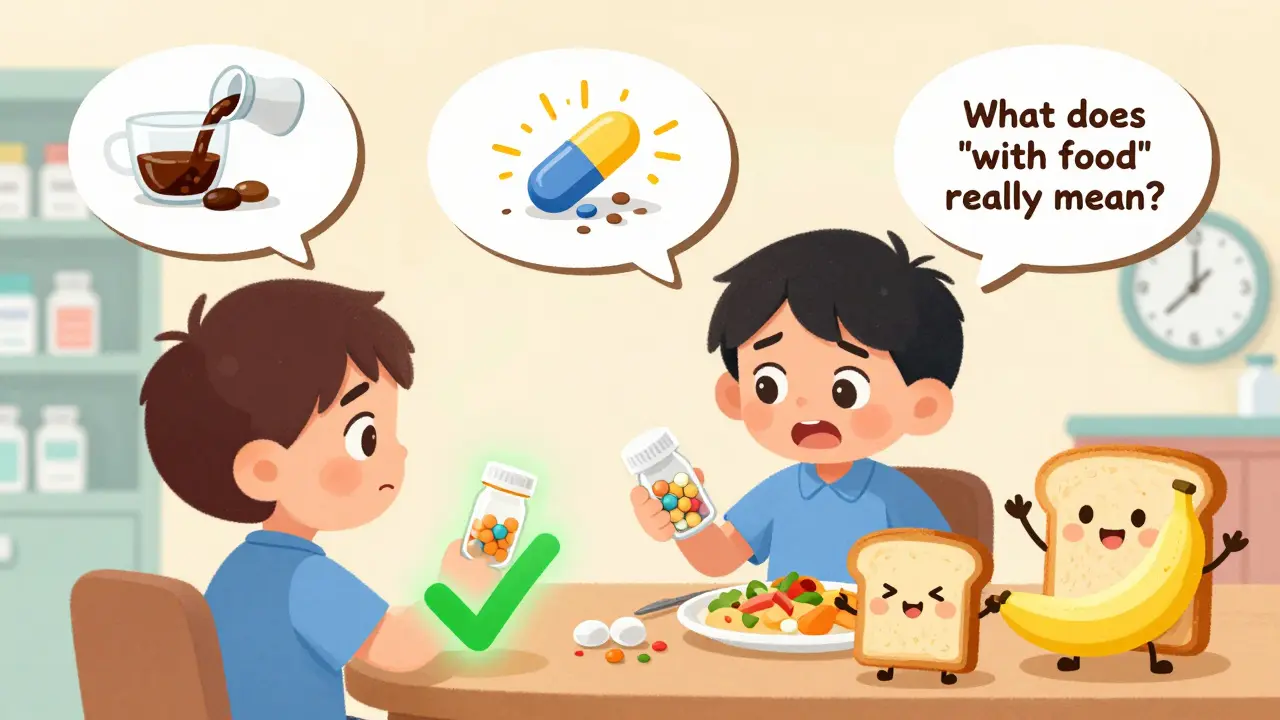
- 41% of patients think "take with food" means "with the first bite."
- 33% think it means "during the meal."
- 26% believe it’s okay as long as they eat within 30 minutes.
But some drugs need a full meal. Others need no food at all. Take antibiotics like doxycycline: if you take them with dairy, calcium blocks absorption. The pill becomes useless. And if you skip the "avoid sunlight" warning on certain antibiotics, you could end up with a severe burn.
Timing matters too. "Take every 12 hours" sounds simple. But 53% of patients take doses too close together-like 8 p.m. and 2 a.m.-thinking "every 12 hours" means "twice a day, morning and night." That can lead to overdose. Or worse, it can make the drug ineffective if spaced too far apart.
Who Struggles the Most?
It’s not just about being careless. It’s about access.One in three U.S. adults has below-basic health literacy. That means they struggle to read, understand, or act on medical information. For these patients, misinterpreting instructions happens 62% of the time. For those with strong health literacy? Just 28%.
Language barriers make it worse. Spanish-speaking patients misinterpret "take with food" instructions 3.2 times more often than English speakers. Older adults, people with vision problems, or those with cognitive decline face the same challenges.
And here’s the cruel twist: pharmacies often don’t notice. A 2023 University of Michigan study found that the average pharmacist spends just 2.1 minutes explaining a prescription. But the Agency for Healthcare Research and Quality says it takes 7.3 minutes of real education for patients to fully understand their instructions.
What’s Being Done to Fix This?
The system is changing-but slowly.The FDA has been pushing for clearer language since 2006. In 2014, they updated labeling rules to require a minimum 10-point font and 70% contrast between text and background. That’s so the labels are readable, even for older eyes.
They also require Medication Guides for 250 high-risk drugs-about 12% of all prescriptions. These are separate booklets that explain side effects, interactions, and special instructions in plain language. And in August 2023, the FDA proposed a new rule to standardize 12 key phrases across all labels by 2026. "Take with food" will become "Take with a full meal." "Take on an empty stomach" will mean "no food for 2 hours before and after." No more guessing.
Some pharmacies are testing new tech. Augmented reality labels are being piloted: scan the bottle with your phone, and a video plays showing how to take the medicine. AI is being used to customize labels based on your literacy level. And in 2023, the American Medical Association created a new billing code-99444-for doctors and pharmacists to get paid for spending extra time explaining instructions.

What Can You Do Right Now?
You don’t have to wait for the system to fix itself. Here’s how to protect yourself:- Check all three places: Look at the bottle, the sticker, and the paper insert. Don’t assume it’s all on the front.
- Ask for clarification: If it says "take with food," ask: "What counts as food? Can I have a banana? A handful of nuts?" If it says "every 12 hours," ask: "Should I take it at 8 a.m. and 8 p.m., or can I take it at 7 a.m. and 7 p.m.?"
- Use tools: Get a pill organizer with time compartments. Use a medication reminder app. Ask for a large-print label-94% of U.S. pharmacies offer this for free.
- Bring your list: Every time you refill a prescription, bring a list of all your meds-including supplements. Pharmacists can spot dangerous interactions you might miss.
- Don’t guess: If you’re unsure, call your pharmacy. Don’t risk it. A 30-second call could prevent a trip to the ER.
One patient told Reddit’s r/Pharmacy community: "I thought "take with food" meant I could take it while eating my cereal. Turns out, the drug needs fat to work. I was taking it with toast and jam. My cholesterol didn’t drop. My doctor finally asked me how I was taking it-and we fixed it in five minutes. I wish I’d asked sooner."
When to Call Your Pharmacist
Don’t wait until you feel sick. Call if:- You’re unsure what "with food" really means.
- You’re confused about timing-"every 8 hours" vs. "three times a day."
- You can’t read the label. Even if you think you can, ask for a larger font.
- The instructions changed from your last refill.
- You’re taking more than five medications.
Pharmacists are trained for this. And they’re the ones who see the most mistakes. In fact, 89% of positive pharmacy reviews on Yelp mention "helpful clarification of special instructions" as the top reason they trust their pharmacist.
Final Thought: Your Safety Is in Your Hands
Prescription labels aren’t designed to be easy. They’re designed to be legal. But you don’t have to accept confusion as normal. You have the right to understand your medicine. And you have the power to ask.Next time you pick up a prescription, pause. Don’t just grab it and go. Read every word. Ask one question. Write down the answer. Your body will thank you.
What does "take with food" really mean on a prescription label?
"Take with food" means you should take the medication during or right after eating a meal-not just a snack. For most drugs, this means a full meal with protein and fat, because these help your body absorb the medicine properly. But it varies: some drugs need any food at all, while others require a specific type. Always ask your pharmacist: "What counts as food for this pill?"
Why do some pills say "do not crush"?
Some medications are designed to release slowly over time. Crushing them destroys that design, causing the full dose to hit your system at once. This can lead to overdose. Other pills have coatings that protect your stomach or prevent them from being absorbed too early. Crushing can make them ineffective or cause serious side effects.
What should I do if I miss a dose because I didn’t understand the instructions?
Don’t double up. Call your pharmacist or doctor immediately. For most medications, if you miss a dose by less than 2 hours, you can take it right away. If it’s been longer, skip it and go back to your regular schedule. Never take two doses at once unless told to. The wrong action can be dangerous.
Can I trust the instructions on the sticker if they’re different from the bottle?
Yes, but only if you confirm both with your pharmacist. Stickers often update instructions when your dosage changes or when new safety info comes out. But sometimes, the sticker is added by mistake. Always compare the sticker to the original label and ask: "Is this the latest instruction?"
Why do some prescriptions come with a separate Medication Guide?
The FDA requires Medication Guides for drugs with serious risks-like blood thinners, cancer treatments, or psychiatric meds. These guides explain side effects, what to avoid, and how to spot warning signs. They’re not optional. Read them. Keep them. They’re your best defense against hidden dangers.
Are there free tools to help me remember my medication instructions?
Yes. Most pharmacies offer free pill organizers with time slots. Many apps like Medisafe, MyTherapy, or even Apple Health can send reminders. You can also ask your pharmacist for a large-print label-available at 94% of U.S. pharmacies. And if you’re on Medicare, you can request a personalized medication review at no cost.
What if I don’t speak English well? How do I understand my prescription?
Pharmacies are legally required to provide translation services. Ask for a Spanish, Mandarin, Arabic, or other language interpreter when you pick up your prescription. Many pharmacies have bilingual staff or phone interpretation services. Don’t rely on family members to translate medical terms-misunderstandings are common. Always ask for the official translation.
Why do some labels say "discard after 14 days"?
Some liquid medications, eye drops, or insulin pens lose effectiveness after a certain time-even if they look fine. Bacteria can grow. Chemicals can break down. Taking expired medication can be dangerous or useless. Never keep these past the date, even if there’s medicine left. Ask your pharmacist how to safely dispose of them.

Comments (8)
vishnu priyanka
Man, I just picked up my dad’s blood pressure med and noticed the sticker said 'take with food'-but the bottle said 'on empty stomach.' I thought I was going crazy. Called the pharmacy, turns out the sticker was updated after a new warning came out. They were super chill about it. Just asked me to bring the bottle next time I come in. Small thing, huge difference.
Avneet Singh
The entire paradigm of pharmaceutical labeling is a neoliberal farce predicated on the epistemological collapse of patient autonomy. The FDA’s ‘plain language’ initiative is merely performative semiotics-a linguistic veneer over structural neglect. We’re not dealing with comprehension gaps; we’re confronting the ontological alienation of the pharmacological subject under late-stage capitalism.
Adam Vella
Actually, the FDA’s 2023 proposal isn’t new-it’s been brewing since the 2006 MedWatch reforms. And ‘take with food’ becoming ‘take with a full meal’? Long overdue. I’ve seen patients take statins with a single cracker and wonder why their LDL didn’t budge. Fat-soluble drugs need lipids to trigger chylomicron transport. No food? No absorption. It’s basic pharmacokinetics. If you’re still confused, you’re not dumb-you’re just uneducated by a system that outsources responsibility to the patient.
Damario Brown
bro i took my doxycycline with yogurt for 3 months and thought i was being healthy. turns out calcium = drug suicide. my skin broke out like i was in a horror movie. then my pharmacist looked at me like i just admitted i licked a toad. i still dont know if i’m dumb or just unlucky. also i think the sticker on my bottle was written by a drunk squirrel. i think it said ‘take with food’ but it looked like ‘take with f00d’
Clay .Haeber
Oh wow, so we’re now treating adults like toddlers who can’t read? ‘Take with a full meal’? Next they’ll put a cartoon of a smiling apple next to it. And don’t get me started on ‘discard after 14 days’-like, I’m supposed to throw away $200 of insulin because some bureaucrat decided 14 is the magic number? What if I’m poor? What if I’m in rural Kansas? Do I get a wellness consultant to come over and check my fridge? This isn’t safety. This is condescension wrapped in a 10-point font.
sam abas
Let’s be real here-pharmacists are overworked, underpaid, and expected to be part-time doctors, psychologists, and translators all while juggling 20 other patients. The 2.1-minute average explanation? That’s a miracle. The real issue isn’t the label-it’s the entire healthcare infrastructure collapsing under the weight of profit-driven inefficiency. And don’t even get me started on how Medicare Part D forces patients to choose between insulin and rent. You can’t fix medication errors by changing font size when people are skipping doses to afford groceries. This whole thread is like polishing the deck chairs on the Titanic while the water’s up to our necks.
Milla Masliy
I’m from Nigeria and my sister moved to the US last year. She was terrified of her meds because the labels felt like a foreign language-even though she speaks English. Then she found a local pharmacy with a Nigerian pharmacist who spoke Yoruba and had a printed guide in her language. She cried. That’s the kind of care that saves lives. We need more of this-not just translation, but cultural connection. Medicine isn’t just chemistry. It’s trust.
Alan Lin
Thank you for this. This isn’t just about labels-it’s about dignity. I’ve worked in rural clinics for 18 years. I’ve watched people swallow pills they don’t understand because they’re too ashamed to ask. I’ve seen grandparents give their insulin to their grandkids because they thought ‘discard after 14 days’ meant ‘don’t waste.’ You don’t need a PhD to fix this. You need a moment. A pause. A question. A pharmacist who listens. And if your pharmacy doesn’t offer that, find one that does. Your life isn’t a data point. It’s a person. Ask. Always ask.