
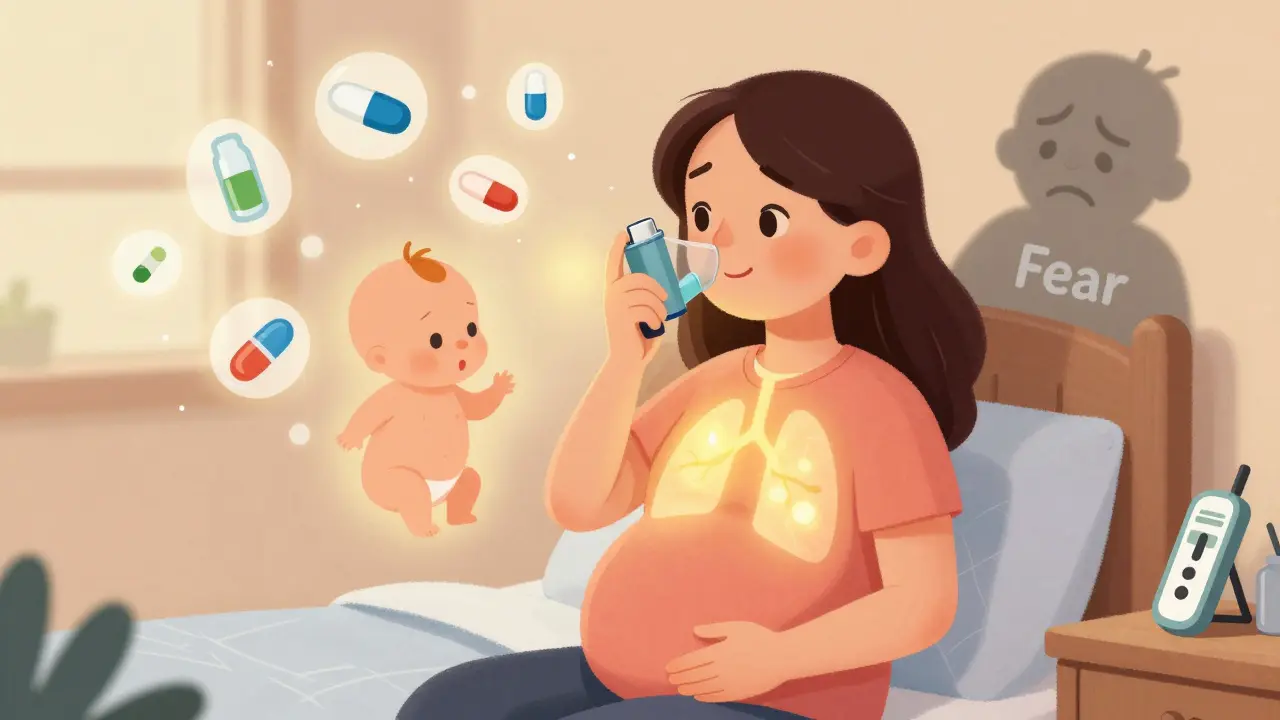
When you're pregnant and have asthma, every decision feels heavier. Should you keep using your inhaler? Is it safer to stop? What if something goes wrong with the baby? These aren’t just questions-they’re real fears that 8 out of 10 pregnant women with asthma report feeling. The truth is, uncontrolled asthma is far more dangerous to your baby than the medications you need to manage it.
Why Asthma Gets Worse During Pregnancy
Asthma doesn’t treat itself just because you’re expecting. In fact, about one-third of pregnant women with asthma see their symptoms get worse, especially between weeks 24 and 36. Hormones shift, your lungs have less room to expand, and your body’s immune response changes. All of this can trigger more frequent wheezing, coughing, or shortness of breath.And here’s the catch: when asthma flares up, your oxygen levels drop. That means less oxygen reaches your baby. That’s not just uncomfortable-it can lead to preterm birth, low birth weight, or even preeclampsia. Studies show that women with poorly controlled asthma are up to 7 times more likely to have complications than those who keep their asthma in check.
What Medications Are Actually Safe?
The good news? Most asthma medications are safe during pregnancy. The key is using the right ones, the right way, and not stopping them without a plan.The gold standard for long-term control is inhaled corticosteroids (ICS). These go straight to your airways, with almost no amount reaching your bloodstream-or your baby. Among them, budesonide has the most solid safety record. Over 1,000 documented pregnancies show no increased risk of birth defects. Beclomethasone and fluticasone propionate are also well-studied and recommended.
For quick relief during an attack, albuterol (salbutamol) is your go-to. It’s been used safely in over 1.2 million pregnancies. There’s no link to birth defects. Levalbuterol works the same way and is equally safe. You don’t need to avoid these inhalers-you need to use them.
Long-acting inhalers like formoterol or salmeterol are okay too, but only if you’re already using them before pregnancy and your asthma isn’t under control with ICS alone. They’re always paired with an inhaled steroid. No need to panic if you’re on them-just keep going, under your doctor’s watch.
What to Avoid
Not all asthma meds are created equal when you’re pregnant. Oral steroids like prednisone or methylprednisolone carry real risks. A 2023 study of 1.8 million pregnancies found that using them in the first trimester increases the chance of cleft lip or palate by 56%. They also raise the odds of preterm birth and low birth weight.Don’t assume that because something is "natural" or "over-the-counter," it’s safe. Some herbal remedies, decongestants, or antihistamines can interfere with asthma control or even trigger contractions. Always check with your doctor before trying anything new.
And while newer biologics like omalizumab show promise, they’re still not recommended for routine use during pregnancy. There’s not enough data yet. If you’re on one and get pregnant, talk to your specialist-don’t stop abruptly.

What About Theophylline or LAMAs?
Theophylline used to be common, but it’s rarely used now. It works, but it needs blood tests to make sure the dose is right. Too much can be toxic, especially with common antibiotics like erythromycin. It’s not dangerous, but it’s harder to manage than an inhaler.As for tiotropium (a LAMA), there’s simply not enough data. Only about 300 pregnancies have been tracked. Until more studies come out, experts advise avoiding it as a first choice.
How to Track Your Asthma During Pregnancy
You can’t manage what you don’t measure. Use a peak flow meter every day. Your goal? Stay above 80% of your personal best. Keep a symptom diary. Use the Asthma Control Test (ACT)-if your score drops below 20, it’s time to talk to your doctor.Most women with asthma need to see both their OB and their asthma specialist at least four times during pregnancy-at 8, 16, 24, and 32 weeks. This isn’t overkill. It’s prevention. Joint care reduces hospital visits by nearly half.
And don’t forget the basics: use allergen-proof mattress covers, keep indoor humidity between 30% and 50%, and remove carpets. These steps cut allergen exposure by up to 80%. Fewer triggers mean fewer attacks.
What Happens If You Stop Your Inhaler?
A lot of women panic and stop their meds. A Canadian registry found that 41% of women who stopped their inhaled steroids had at least one severe asthma attack requiring emergency care. Only 17% of those who kept using them had the same issue.One woman in Melbourne told her doctor she was afraid of her inhaler. She stopped it at 18 weeks. By 28 weeks, she was in the hospital with pneumonia and a preterm labor scare. Her baby weighed 4.2 pounds. She didn’t need to go through that. Her asthma was manageable. She just didn’t know it.

What About Breastfeeding?
Yes, you can still use your inhalers while breastfeeding. The amount of medication that passes into breast milk is tiny-far less than what your baby would get from breathing the same air. In fact, keeping your asthma under control helps you care for your newborn better. No need to switch or stop.Telehealth and New Tools Are Making It Easier
Before the pandemic, only 5% of pregnant women with asthma used telehealth. By 2023, that jumped to 47%. Now, you can check your peak flow with a smartphone app, send readings to your doctor, and get advice without leaving your couch. This isn’t just convenient-it’s life-saving.Researchers are also looking into how your genes might affect your response to asthma meds. One study found that 28% of women have a gene variant that makes them respond better to certain inhaled steroids. In the next few years, we might be able to personalize treatment based on your DNA.
Bottom Line: Keep Taking Your Meds
The fear of medication is real. But the fear of uncontrolled asthma is worse. Every time you use your inhaler, you’re not just breathing easier-you’re giving your baby the oxygen they need to grow strong.Don’t let myths or uncertainty make you stop. Budesonide, albuterol, and other inhaled medications have been studied in thousands of pregnancies. They’re safe. They work. And they protect your baby more than any fear ever could.
Work with your team-your OB, your allergist, your pharmacist. Stick to your plan. Track your symptoms. And remember: the best thing you can do for your baby right now is to take care of yourself.
Is it safe to use my asthma inhaler while pregnant?
Yes, most asthma inhalers are safe during pregnancy. Inhaled corticosteroids like budesonide and short-acting bronchodilators like albuterol have been studied in over a million pregnancies and show no increased risk of birth defects. These medications work locally in your lungs, with very little entering your bloodstream or reaching your baby. Stopping them puts both you and your baby at greater risk.
Can asthma medications cause birth defects?
The overwhelming evidence shows that inhaled asthma medications do not cause birth defects. Budesonide, the most studied ICS, has been used in over 1,000 pregnancies with no increase in major malformations. In contrast, uncontrolled asthma increases the risk of complications like preterm birth and low birth weight. Oral steroids, however, can raise the risk of cleft lip or palate if used in the first trimester-so they’re avoided unless absolutely necessary.
Should I stop my asthma meds if I’m trying to get pregnant?
No. If you’re planning pregnancy and have asthma, now is the time to optimize your treatment-not stop it. Work with your doctor to ensure your asthma is well-controlled before conception. This reduces the chance of flare-ups during early pregnancy, when organ development is most sensitive. Most inhalers are safe from day one of pregnancy.
What if my doctor tells me to stop my inhaler?
If your doctor suggests stopping your asthma medication, ask for the evidence behind that advice. Many healthcare providers still operate on outdated fears. The latest guidelines from GINA, NAEPP, and AAAAI all say to continue inhaled steroids and SABAs. If your doctor isn’t familiar with current standards, consider seeking a second opinion from a pulmonologist or maternal-fetal medicine specialist.
Can I use a nebulizer instead of an inhaler during pregnancy?
Yes, nebulizers are safe and effective during pregnancy. They deliver the same medications as inhalers-just in a mist form. Some women find them easier to use, especially during severe attacks or if coordination with an inhaler is difficult. Just make sure the medication inside is approved for pregnancy, and clean the device regularly to prevent infection.
Does asthma affect my baby’s long-term health?
If your asthma is well-controlled, your baby’s long-term health isn’t affected by your medications. However, uncontrolled asthma increases the risk of preterm birth and low birth weight, which can lead to developmental delays or respiratory problems later in childhood. Ongoing research, like the NIH’s $15.2 million study launched in 2024, is tracking whether asthma meds impact neurodevelopment-but so far, no negative effects have been found in children born to mothers who used standard asthma treatments.
Are there natural ways to manage asthma during pregnancy?
Lifestyle changes help-but they don’t replace medication. Avoiding smoke, dust mites, and mold reduces triggers. Using allergen-proof covers and keeping humidity at 30-50% can cut flare-ups by half. But if you still need your inhaler after making these changes, that doesn’t mean you’re failing-it means your asthma needs medical support. Natural doesn’t always mean safe or effective.
What should I do if I have an asthma attack while pregnant?
Use your rescue inhaler (albuterol) right away-4 to 8 puffs with a spacer. If your symptoms don’t improve within 15 minutes, or if your peak flow drops below 70% of your personal best, go to the hospital. Don’t wait. Low oxygen levels during an attack can stress your baby. Oxygen saturation should stay above 95%. If you’re having trouble breathing, call your doctor or head to the ER immediately.

Comments (8)
michelle Brownsea
I can't believe people still question this-like, really? You're risking your baby's life because you're scared of a tiny puff of medicine? Inhaled corticosteroids have been studied in over a thousand pregnancies-and yet, here we are, still having this conversation in 2025? It's not just irresponsible-it's narcissistic. Your fear isn't a moral compass; it's a biological ignorance masquerading as caution. Budesonide doesn't cross the placenta in meaningful amounts. Albuterol? Safe. Period. If you're not using your inhaler, you're not protecting your child-you're just indulging in a dangerous myth.
Philip Williams
Thank you for this comprehensive and meticulously referenced overview. The data presented here aligns precisely with current guidelines from GINA and NAEPP, and it is imperative that healthcare providers disseminate this information with the same rigor. The distinction between inhaled and oral corticosteroids is critical, and the 56% increased risk of cleft palate associated with first-trimester oral steroid use must be emphasized in prenatal education materials. Furthermore, the integration of telehealth and peak flow monitoring via smartphone applications represents a significant advancement in maternal-fetal care. This is precisely the kind of evidence-based guidance that should be standard, not exceptional.
Rod Wheatley
Hey-I just wanted to say this post saved my life. I was terrified to use my inhaler when I got pregnant. Thought I’d be ‘hurting’ the baby by breathing in meds. I stopped for two weeks. Two weeks. I ended up in the ER with oxygen levels at 89%. My OB looked me dead in the eye and said, ‘You’re not saving your baby by being scared-you’re hurting them.’ I started budesonide again. My peak flow went from 65% to 92% in three days. My son is now 8 months old, healthy, laughing, and breathing like a champ. If you’re reading this and hesitating-just breathe. Your medicine is your baby’s oxygen. Don’t let fear steal that from you. You’re not alone.
Jarrod Flesch
Man, this is solid. I'm an Aussie dad whose wife had asthma through both pregnancies-budesonide and albuterol the whole way. We used a nebulizer when she was too wiped to coordinate the inhaler. Zero issues. Baby one: 8lbs 3oz. Baby two: 7lbs 11oz. Both thriving. Honestly? The biggest risk wasn't the meds-it was the well-meaning aunties who told her to ‘go herbal’ or ‘breathe in eucalyptus steam.’ Like, no. Just… no. The science’s clear. Use your inhaler. Keep your humidity at 40%. Skip the ‘natural’ junk. And if your doctor says to stop? Ask them to show you the study. They probably haven't read it.
Barbara Mahone
My mother had asthma in the 70s. She was told to stop everything. I was born premature. She spent weeks in the NICU. I never knew that until I got pregnant and had my own asthma flare. I looked up the data. Found this exact article. Started budesonide at 8 weeks. No complications. My daughter is 2 now, asthmatic only because of genetics-not because of medication. I wish someone had told my mom this. Don’t let silence be your enemy. Knowledge is oxygen.
Kelly McRainey Moore
Just wanted to say thank you for writing this. I was so scared, but now I feel like I can breathe again-literally and figuratively. I started using my inhaler again last week and already feel like a new person. My husband even said I’ve stopped sighing so much. 😊
Stephen Rock
Wow. Another ‘trust science’ post. So dramatic. So performative. You think people are stupid for being scared? Newsflash: medicine is a business. And ‘safe’ is a marketing term. You’re not brave-you’re brainwashed. But sure, keep puffing. I’ll be over here watching the data get buried under another wave of corporate-approved ‘health advice.’
Amber Lane
Used my inhaler. Baby’s fine. Don’t stop.