
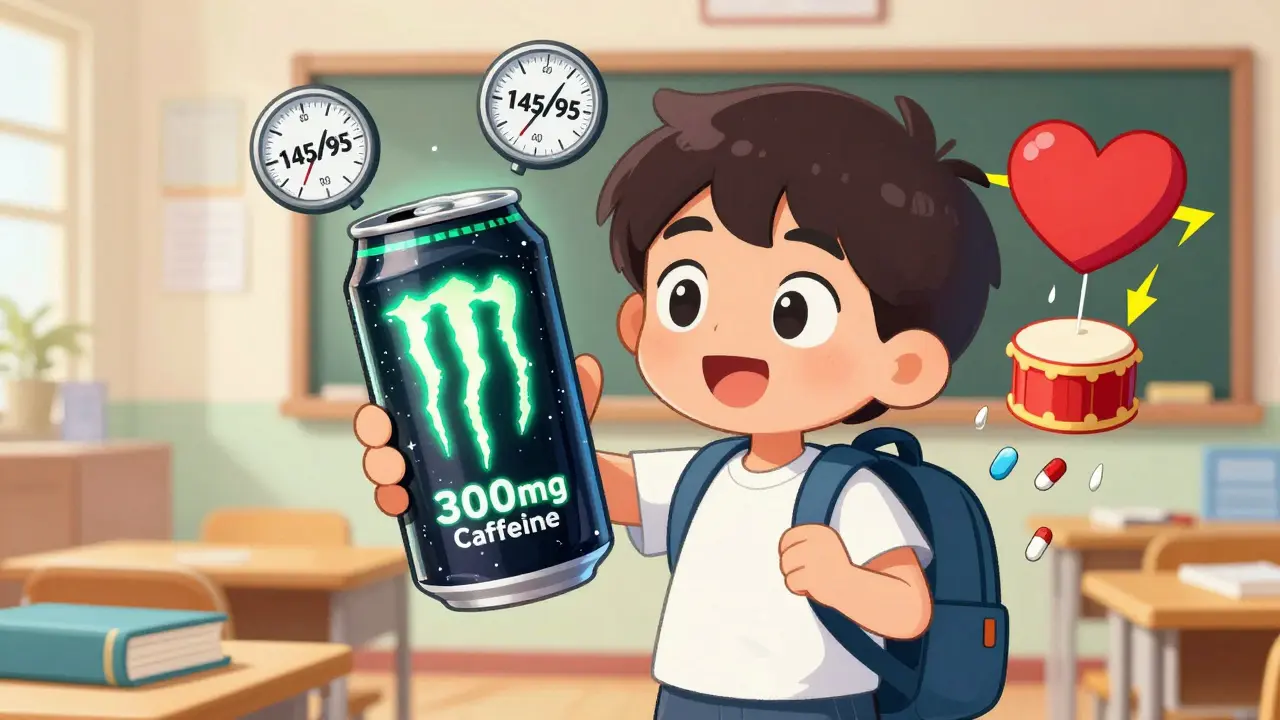
Energy Drink and Medication Risk Calculator
According to medical studies, combining energy drinks with stimulant medications can dangerously increase blood pressure and heart rate. This calculator estimates your potential risk based on the information provided in the article.
When you down a can of energy drink before a big exam or mix it with your ADHD medication, you might think you’re just boosting focus. But what you’re really doing is putting your heart under strain-sometimes dangerously so. Energy drinks and stimulant medications like Adderall or Ritalin don’t just give you a quick spike in alertness. Together, they can push your blood pressure and heart rate into risky territory, even if you’re young and feel fine.
What’s in These Drinks?
Energy drinks aren’t just sugary soda with caffeine. A single can of Monster Energy has 160 mg of caffeine. Bang Energy? That’s 300 mg-more than three cups of coffee. Red Bull packs 80 mg per can. But caffeine isn’t the only player. Most also contain guarana (which adds more caffeine), taurine, and bitter orange extract (synephrine). These aren’t harmless additives. Synephrine, for example, acts like a mild stimulant on its own, tightening blood vessels and raising heart rate. Taurine doesn’t directly raise blood pressure, but it can amplify the effects of caffeine.
When you combine these ingredients, you’re not just getting a caffeine boost. You’re triggering a full-body stress response. Your adrenal glands dump adrenaline. Your heart beats harder. Blood vessels constrict. Blood pressure shoots up. Studies show that within 30 minutes of drinking one energy drink, systolic blood pressure can jump by 6 to 10 points. For someone already on the higher end of normal, that’s enough to cross into dangerous territory.
How Stimulant Medications Add to the Danger
If you’re taking prescription stimulants for ADHD-like Adderall (amphetamine salts) or Ritalin (methylphenidate)-you’re already putting extra pressure on your cardiovascular system. These drugs are designed to stimulate the central nervous system. They increase heart rate by 3 to 13 beats per minute and raise systolic blood pressure by 2 to 7 mmHg. That’s not a lot on its own. But add a 300 mg energy drink on top of that, and you’re doubling down on the stress.
There’s no official guideline saying “don’t mix,” but medical experts agree: it’s a bad idea. A 2024 study tracking 5,000 people found that those who combined energy drinks with stimulant meds had a 3 to 5 times higher risk of heart rhythm problems, chest pain, or sudden spikes in blood pressure compared to those who used either one alone. One case report in the Journal of the American Heart Association described a 22-year-old student on Adderall who collapsed after drinking two energy drinks during finals week. He had no prior heart issues. His heart stopped for 45 seconds.
Who’s at Highest Risk?
You might think only older people with heart disease are at risk. That’s not true. While older adults are more vulnerable, younger people aren’t immune. In fact, the most alarming data comes from teens and young adults.
The CDC reports that 30% to 50% of adolescents consume energy drinks regularly. Between 2017 and 2023, emergency room visits for caffeine overdose in middle schoolers more than doubled. In 2011, nearly 1,500 teens aged 12 to 17 ended up in ERs after energy drink-related incidents. Symptoms? Heart palpitations, anxiety, chest pain, seizures.
Even healthy-looking young people can have hidden risks. Undiagnosed heart conditions-like long QT syndrome or hypertrophic cardiomyopathy-can be triggered by caffeine and stimulants. These conditions often show no symptoms until something like an energy drink pushes the heart past its limit.
And it’s not just about one drink. People who drink multiple cans a day, or who mix energy drinks with alcohol or exercise, are at even higher risk. Alcohol dehydrates you, making your blood thicker and harder to pump. Exercise raises your heart rate further. Combine all three? You’re asking your heart to do way more than it’s built for.
Real Stories, Real Consequences
Online forums are full of people sharing their experiences. One Reddit user, u/BloodPressureWatcher, recorded his BP rising from 120/80 to 145/95 after a single 300 mg energy drink. Another, u/HeartPalpitations, described heart palpitations lasting three hours after two Monster cans. These aren’t rare outliers.
Doctors on medical forums report seeing the same patterns. A student doctor in Texas wrote in March 2024 about a 19-year-old patient with no family history of heart disease who developed new-onset high blood pressure and constant tachycardia after drinking three energy drinks daily for months. His BP only normalized after he quit.
And then there are the lawsuits. In 2022, a 19-year-old in California suffered a heart attack after drinking three Monster Energy drinks in two hours. His family sued Monster Beverage Corp., arguing the company failed to warn about cardiac risks. The case is still ongoing, but it’s part of a growing trend: over 140 lawsuits have been filed against energy drink makers since 2018.
What’s Considered Safe?
The FDA says up to 400 mg of caffeine per day is safe for most healthy adults. That’s about four cups of coffee or one can of Bang. But this number doesn’t account for stimulant medications. If you’re on Adderall or Ritalin, even 200 mg of caffeine could be too much.
Teens should cap caffeine at 100 mg per day, according to the American Academy of Pediatrics. That’s less than one can of Red Bull. And yet, most teens have no idea how much caffeine they’re consuming. Labels don’t always list total caffeine accurately. Some drinks contain up to 20% more than stated on the can.
Canada requires warning labels on energy drinks with more than 180 mg of caffeine. The EU says no more than 200 mg per serving. The U.S. has no such rules. The FDA still classifies caffeine as “Generally Recognized As Safe,” but that label hasn’t kept pace with how these drinks are actually used today.
Warning Signs You Can’t Ignore
If you’re drinking energy drinks or taking stimulant meds, watch for these symptoms:
- Chest pain or pressure
- Heart palpitations lasting more than a few minutes
- Severe headache or dizziness
- Difficulty breathing
- Blurred vision or confusion
- Nausea or vomiting after consumption
These aren’t “just anxiety.” They’re signs your heart is struggling. If you experience any of these, stop consuming stimulants immediately and seek medical help. Delaying care can lead to heart attack, stroke, or sudden cardiac arrest.
What Should You Do?
If you’re on stimulant medication: talk to your doctor before drinking any energy drink-even “sugar-free” or “natural” ones. Ask if caffeine is safe for you. Many doctors will tell you to avoid it entirely.
If you’re a regular energy drink consumer: track how much you’re drinking. Write it down. Notice how you feel after each one. Are you jittery? Is your heart racing? Are you having trouble sleeping? These are clues your body is overloaded.
Try cutting back slowly. Quitting cold turkey can cause headaches, fatigue, and irritability for up to a week. Replace energy drinks with water, herbal tea, or a small cup of black coffee. Get more sleep. Move your body. Natural energy comes from rest and movement-not chemical blasts.
And if you’re a parent: check what your teen is drinking. Energy drinks are marketed like soda, but they’re not. They’re potent stimulants. Keep them out of the house. Talk to your kids about the risks. They’re not immune just because they’re young.
The Bigger Picture
Energy drink sales hit $77.6 billion globally in 2023. The industry is growing, not shrinking. New products are being launched with “vitamin boosts,” “no sugar,” or “clean energy” claims. These labels make people feel better about drinking them. But they don’t change the science.
Research now shows that regular energy drink use may damage the lining of blood vessels over time-a condition called endothelial dysfunction. That’s the first step toward plaque buildup and heart disease. This isn’t just about a one-time spike in blood pressure. It’s about long-term damage.
The American Heart Association now recommends that people with known heart disease avoid energy drinks entirely. That advice should extend to anyone on stimulant meds. The risks aren’t theoretical. They’re documented. They’re measurable. And they’re getting worse.
There’s no magic pill for focus. There’s no shortcut to energy that doesn’t cost your heart something. If you need to stay alert, try sleep, hydration, and movement. Your heart will thank you.

Comments (12)
vishnu priyanka
Man, I saw this post and thought of my cousin in Delhi who drinks 3 Monster a day while studying for med school entrance exams. He swears it’s his ‘focus fuel’-but last month he ended up in the ER with palpitations. No prior history. Just energy drinks + caffeine pills. The doctor told him his heart looked like it had been running a marathon for a year. We’re all just trying to survive modern life, but damn, we’re poisoning ourselves with marketing.
Angel Tiestos lopez
bro why are we still acting like this is news?? 🤡 caffeine is just legal meth for adults who don’t wanna admit they’re tired. adderall + monster = my college weekends. i’m alive, right? 🫡💥
Alan Lin
While I appreciate the clinical tone of this article, I must emphasize that the risks are not merely statistical-they are physiological, systemic, and profoundly underreported. The cardiovascular system does not distinguish between ‘prescribed’ and ‘recreational’ stimulants; it responds to catecholamine surges with identical biochemical pathways. When you combine pharmacologically active compounds with unregulated, high-dose caffeine formulations, you are not enhancing performance-you are inducing iatrogenic stress. The FDA’s outdated thresholds ignore the cumulative, synergistic, and chronically toxic effects observed in longitudinal studies. This is not a lifestyle choice. It is a public health emergency masked as productivity.
Pankaj Singh
Stop being soft. If your heart can’t handle 300mg of caffeine, you shouldn’t be in college. Everyone’s got a weak heart these days. Just go to the gym, stop whining, and drink your Monster like a man. You think your grandpa survived the war by sipping chamomile tea?
Randall Little
So let me get this straight: the same people who scream about Big Tobacco are now fine with Big Energy Drinks because ‘it’s legal’? And we’re supposed to be shocked when a 19-year-old’s heart stops after three cans? The industry doesn’t even have to put warning labels in the U.S. because caffeine is ‘GRAS’-Generally Recognized As Safe. Funny how ‘safe’ is defined by lobbyists, not cardiologists.
Adam Rivera
My roommate drinks these like water before coding marathons. Last week he passed out during a Zoom call. We called 911. He woke up confused, said ‘I’m fine, just tired.’ I made him throw out his stash. He still says I’m overreacting. But I’ve seen his resting heart rate go from 62 to 112 after one can. That’s not focus. That’s a panic attack with a label.
Rosalee Vanness
I used to be one of those people who thought energy drinks were just ‘strong coffee.’ I’d down two before finals, then wonder why I couldn’t sleep for three days, why my hands shook like I had Parkinson’s, why I’d get these stabbing pains in my chest. I didn’t realize it was the taurine + synephrine combo until I read a paper from Johns Hopkins. I quit cold turkey. It took two weeks to stop feeling like a ghost. Now I drink green tea. I nap. I walk. My heart feels like it’s mine again-not some battery being overcharged by a corporation that doesn’t care if I live or die. If you’re reading this and you’re still drinking these… I’m not judging. I’m just saying: you deserve better than a chemical crutch.
lucy cooke
Ah, the modern Faustian bargain: sell your cardiovascular integrity for a fleeting illusion of cognitive transcendence. We are the generation that outsourced focus to corporate chemists, mistaking pharmacological fireworks for enlightenment. The energy drink is not a beverage-it is a sacrament of late-stage capitalism’s war against rest. And we, the obedient acolytes, sip our synephrine-laced nectar as if it were holy water. The heart, that ancient engine of being, is reduced to a mere pump in the machine of productivity. How tragic. How beautifully, horrifyingly human.
sam abas
Okay but what about the people who drink coffee and adderall? That’s literally the same thing. Why are energy drinks the bad guys? Oh right, because they’re cheaper and sold in gas stations. The real issue is that doctors prescribe adderall like candy and then act shocked when people pair it with soda. Hypocrites. Also, the FDA says 400mg is safe, so if you’re having issues, you’re just weak. Also, I saw a guy on TikTok drink 5 cans and then lift weights. He’s fine. So maybe you’re just scared of your own body?
John Pope
Let’s talk about the neurochemical cascade: dopaminergic upregulation, adrenergic receptor sensitization, endothelial nitric oxide suppression, and mitochondrial oxidative stress-all triggered by synergistic stimulant exposure. The long QT phenomenon isn’t anecdotal; it’s quantifiable via ECG telemetry. The real tragedy isn’t the ER visits-it’s the silent, subclinical remodeling of cardiac tissue over time. We’re not just talking about acute arrhythmias. We’re talking about accelerated atherosclerosis in adolescents. This isn’t ‘bad parenting.’ It’s systemic negligence wrapped in neon branding.
Priyanka Kumari
As someone who’s been on ADHD meds for 12 years, I get it. You need to stay awake. But I switched to green tea + 10-minute walks every hour. My focus is better, my anxiety is lower, and my heart doesn’t feel like it’s trying to escape my chest. You don’t need a chemical explosion to be productive. You just need to listen to your body. And if you’re a parent? Talk to your kid. Not with fear. With care. They’re not being lazy-they’re just trying to survive a world that never taught them how to rest.
Avneet Singh
It’s amusing how this article pathologizes normal human behavior under the guise of medical authority. Caffeine is a mild stimulant. Adderall is a controlled substance. Both are used by millions. The fact that some individuals have adverse reactions doesn’t invalidate the utility of the substances-it merely highlights the need for individualized assessment. Blaming corporations for consumer behavior is the intellectual equivalent of blaming knives for stabbings. If you can’t regulate your intake, that’s not a systemic failure-it’s a personal one.