
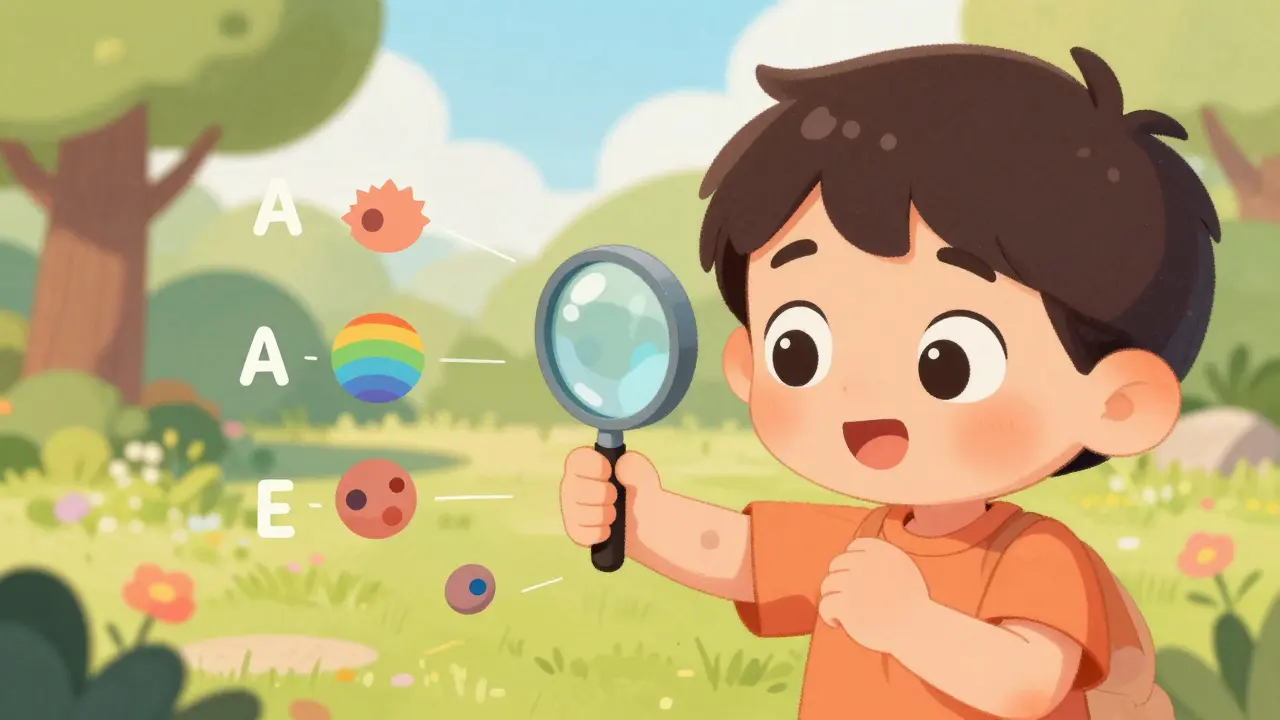
Most people have moles. Some have a few. Others have dozens. But not all moles are harmless. A tiny change in color, shape, or texture could signal melanoma - the deadliest form of skin cancer. The good news? When caught early, melanoma is almost always curable. The bad news? Many people wait too long to get a suspicious mole checked, because they’re relying on outdated or incomplete clues.
What the ABCDE Rule Really Means
The ABCDE rule isn’t magic. It’s a simple checklist doctors and patients use to spot warning signs in moles. It was developed in the 1980s to help non-experts recognize melanoma before it spreads. Here’s what each letter stands for:
- A for Asymmetry: One half of the mole doesn’t match the other. If you drew a line through the middle, the two sides wouldn’t look the same.
- B for Border irregularity: The edges are ragged, notched, or blurred - not smooth and round like a typical mole.
- C for Color variation: A mole with multiple shades - black, brown, tan, red, white, or even blue - is a red flag. Normal moles are usually one even color.
- D for Diameter: Most melanomas are larger than 6 millimeters (about the size of a pencil eraser). But here’s the catch: 30% of melanomas are smaller than this. Some experts now say to think of "D" as both "Diameter" and "Dark" - if a mole is noticeably darker than your others, it needs attention.
- E for Evolving: This is the most important sign. Has the mole changed in size, shape, color, or texture over weeks or months? Has it started itching, bleeding, or crusting? Any change matters.
These signs work together. A mole with three or more ABCDE features has a much higher chance of being melanoma. But here’s what most people don’t know: the ABCDE rule misses early melanomas.
Why the ABCDE Rule Falls Short
A 2022 study of 144 melanoma cases found that 36% were in situ - the earliest, most treatable stage. Yet in these early cases, the "E" sign (evolving) was present in only 33% of lesions. That means nearly two out of every five early melanomas showed no obvious change.
Even worse, some melanomas look nothing like the classic ABCDE pattern. Desmoplastic melanoma, for example, often appears as a flesh-colored or scar-like bump with no color or border irregularity. Childhood melanoma can look like a red, pimple-like spot. In both cases, the ABCDE rule fails to flag them.
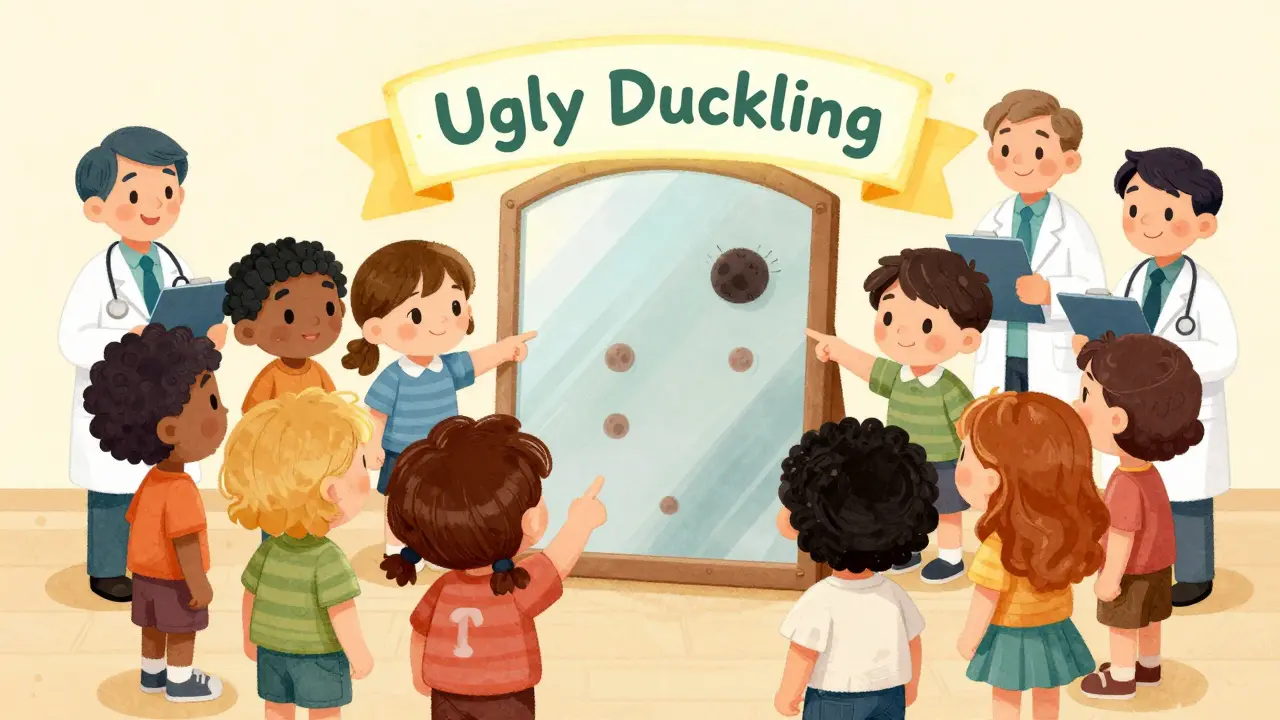
And then there’s the "ugly duckling" sign - the idea that one mole looks completely different from all the others on your body. A 2019 study found this single clue caught 73% of melanomas that ABCDE missed. If you have 20 moles and one stands out like a sore thumb, that’s the one to check - even if it’s small, round, and perfectly colored.
When to Get a Biopsy
Not every weird-looking mole needs surgery. But dermatologists don’t wait for all five ABCDE signs to appear. They look for patterns:
- Three or more ABCDE features - this is the most common trigger for a biopsy.
- Documented change over 3-6 months - even if it doesn’t fit ABCDE, if you’ve noticed growth or darkening, it’s worth removing.
- The ugly duckling - if a mole looks alien compared to your others, it’s a strong reason for biopsy.
Here’s the hard truth: for every one melanoma found, nearly five benign moles are removed. That’s not because doctors are overcautious - it’s because the stakes are too high. Melanoma that spreads to lymph nodes or organs drops the five-year survival rate from 99% to under 33%.
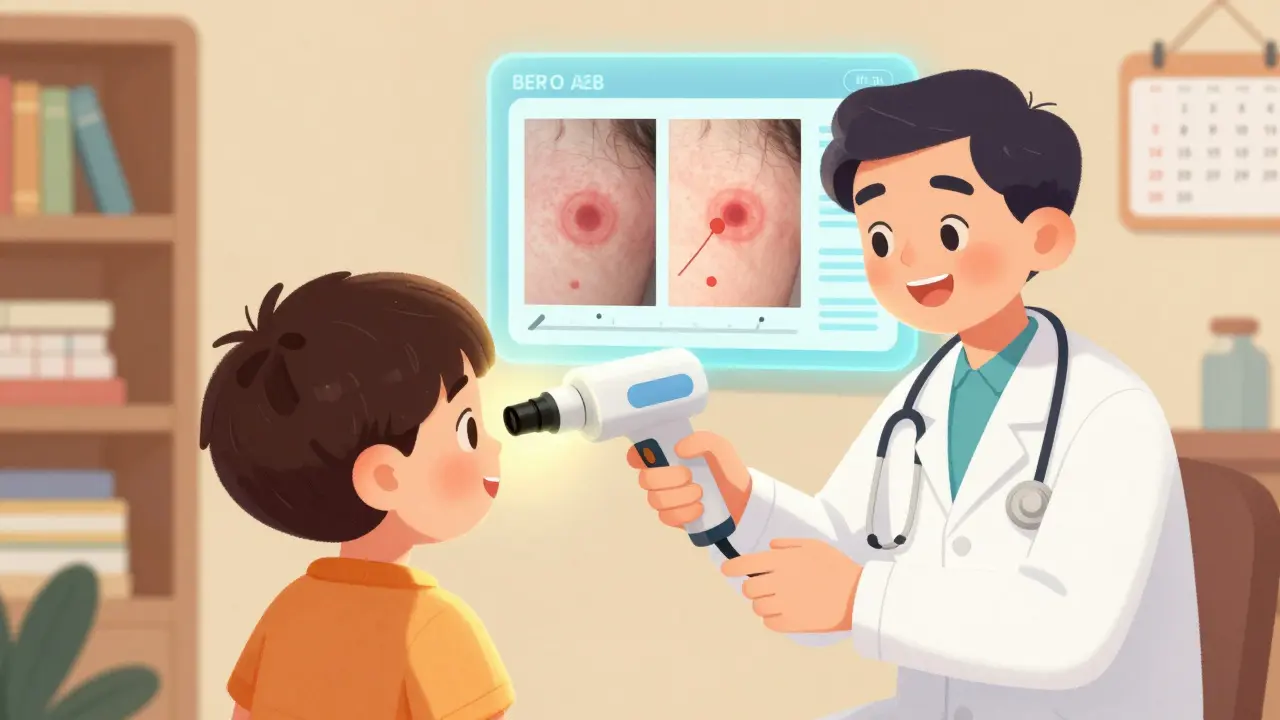
Biopsy decisions aren’t just about looks. Dermatologists use tools like dermoscopy - a handheld magnifier with polarized light - to see beneath the surface. Studies show this increases accuracy from 75% to 92%. Many clinics now use digital dermoscopy, storing images over time to track subtle changes you can’t see with the naked eye.
What Patients Get Wrong
People often delay seeing a doctor because they think their mole "doesn’t fit" the ABCDE rule. A 2022 survey of 1,200 patients found that 42% waited an average of 7.3 months because their mole was "too small," "too symmetrical," or "too uniform in color."
One Reddit user, u/SkinCancerSurvivor, shared their story: their melanoma was only 3mm, perfectly round, and one color - none of the ABCDE signs applied. It was stage IIB - already deep in the skin. Another user, u/MoleWatcher99, caught theirs early because it was asymmetrical and multi-colored. Both cases happened. Both are real.
What’s more, most people don’t have baseline photos of their moles. Only 19% of patients bring in pictures from a year ago. Without those, it’s hard to prove something is "evolving." That’s why dermatologists recommend taking monthly selfies - front, back, sides - with good lighting. Save them on your phone. Compare them every month.
New Tools Are Changing the Game
Technology is catching up to the limitations of ABCDE. In March 2022, the FDA approved the first AI-powered app for melanoma detection - SkinVision. It analyzes photos of moles against a database of 12 million images and gives a risk score. In trials, it caught 95% of melanomas.
Now, 43% of U.S. dermatology practices use AI-assisted tools. Some labs offer genetic tests like DecisionDx-Melanoma, which analyzes a mole’s gene expression to predict cancer risk - helping doctors decide whether to remove a borderline lesion without surgery.
But these tools aren’t for home use yet. You still need a dermatologist to interpret them. The ABCDE rule remains the first line of defense - not because it’s perfect, but because it’s free, simple, and widely understood.
What You Should Do Right Now
You don’t need to be a doctor to save your life. Here’s what works:
- Check your skin monthly - use a mirror, or ask a partner to help with hard-to-see spots like your back or scalp.
- Use ABCDE as a starting point - but don’t stop there. If something looks "off," even if it doesn’t check all the boxes, get it checked.
- Look for the ugly duckling - the one mole that doesn’t belong with the others.
- Take monthly photos - use your phone. Compare them side by side.
- See a dermatologist if anything changes - don’t wait for all five ABCDE signs. Evolution is the biggest red flag.
Every year, over 100,000 new melanoma cases are diagnosed in the U.S. And the number keeps rising. But deaths are falling - because more people are catching it early. You don’t need fancy tools. You just need to pay attention.
Can a mole be cancerous even if it’s small?
Yes. While melanomas are often larger than 6mm, 30% are diagnosed when smaller than that. Size alone isn’t a reliable indicator. A tiny mole that’s changing color, bleeding, or looks different from your others should be evaluated.
Do I need a biopsy if my mole only has one ABCDE sign?
Not necessarily - but it depends. A single sign like "evolving" is more important than multiple signs that haven’t changed. If a mole is growing, itching, or bleeding, even without other ABCDE features, a biopsy may still be recommended. Dermatologists look at the whole picture, not just a checklist.
Is the ABCDE rule still useful today?
Yes, but not as a final answer. It’s a screening tool, not a diagnostic one. It helps raise awareness and spot obvious warning signs. But it misses early melanomas and rare types. Always combine it with the "ugly duckling" sign and any personal changes you notice.
Can I rely on apps or AI to check my moles?
AI apps like SkinVision can help you track changes and flag risks, but they’re not replacements for a dermatologist. They can miss subtle patterns or misclassify benign lesions. Use them as a reminder to get checked - not as a green light to ignore a suspicious mole.
How often should I get a professional skin check?
If you have no personal or family history of skin cancer and no unusual moles, once a year is enough. But if you’ve had melanoma before, have many moles (over 50), have a history of sunburns, or have a first-degree relative with melanoma, you should see a dermatologist every 6 months. High-risk individuals may need more frequent checks.
Comments (12)
Tim Goodfellow
Man I never realized how much I’ve been ignoring my moles. I’ve got like 15 and I never took a single photo of them. Just assumed if it didn’t look like the textbook examples it was fine. This post flipped my whole perspective. Time to start monthly selfies before I regret it.
Emily P
I’ve been checking my skin since my dad had melanoma. I don’t trust the ABCDE rule anymore. I look for the one that feels wrong. The one that makes me pause. That’s the one I show my derm.
Meenakshi Jaiswal
As a nurse who’s seen too many late-stage cases, I can’t stress this enough: don’t wait for all five signs. If a mole feels different, looks alien, or makes you go ‘huh’ - get it checked. Early = curable. Delayed = life-altering. No exceptions.
Alex Curran
My derm showed me the ugly duckling sign last year. I had 40 moles and one tiny brown dot on my shoulder that looked like it belonged to someone else. Turned out it was melanoma in situ. ABCDE didn’t flag it. Ugly duckling did. This is real life stuff.
Dev Sawner
It is an empirical fact that the ABCDE heuristic, while rudimentary, remains statistically significant in population-level screening protocols. However, the reliance on anecdotal evidence such as the 'ugly duckling' phenomenon introduces unquantifiable bias into diagnostic decision-making. One must not conflate heuristic utility with clinical validity.
Kelly Mulder
People think they’re being smart by ignoring the ABCDE rule because they read a study. Newsflash: if your mole looks like it crawled out of a horror movie, it probably is. You don’t need a PhD to know when something’s wrong. Stop overthinking and go see a doctor.
Lynsey Tyson
my mom used to say ‘if it itches, it’s not just dry skin’ and she was right. i’ve got a mole on my back that’s been there forever but lately it’s been kinda flaky. i’m going to make an appointment this week. no excuses.
holly Sinclair
What fascinates me is how our biological intuition - the ‘ugly duckling’ sensation - predates medical taxonomy. We evolved to notice anomalies, to distrust sameness in patterns. The ABCDE rule is a human-made filter, but our nervous system has been screaming ‘something’s off’ for millennia. Why do we trust a checklist over our own perception? Is it fear? Or is it the illusion of control that formal systems provide? Maybe the real diagnosis isn’t in the mole - it’s in our willingness to listen to the quiet voice that says, ‘this doesn’t belong.’
Jedidiah Massey
AI dermoscopy is the future. SkinVision’s sensitivity is 95% and specificity is 89%. You’re not just using a tool - you’re leveraging a trained convolutional neural net trained on 12M labeled histopathological images. If you’re not using tech to augment your clinical vigilance, you’re operating in the stone age.
Monte Pareek
Look I’ve been in 3 countries and seen this same pattern. People wait because they think it’s not serious enough. But cancer doesn’t care if your mole is small or symmetrical. It just grows. I got mine caught early because I took a photo every month. No apps. No fancy tools. Just my phone. Do that. Now.
Takeysha Turnquest
It’s not about moles. It’s about how we ignore the whispers until they become screams. We numb ourselves with rules because the truth is terrifying - that our bodies are fragile and time is running out. That one little change could be the last one we ever notice. So we pretend it’s fine. We pretend we’re safe. But the skin doesn’t lie. And neither does death.
benchidelle rivera
Stop reading articles. Start taking photos. Right now. Open your phone. Take a picture of your back. Your scalp. Your feet. Don’t wait. Don’t overthink. Just do it. Your future self will thank you.