

Deductible Tracker Calculator
What this means:
Your copay card covers $ per month, but these payments do not count toward your deductible. When the card expires, you'll owe the full remaining deductible of $.
When you're on a life-changing medication that costs thousands a month, a copay card can feel like a lifeline. For many people with chronic conditions like multiple sclerosis, rheumatoid arthritis, or Crohn’s disease, these cards from drug manufacturers drop monthly costs from $7,000 to $10. But here’s the catch: that $10 might not last. And when it disappears, you could be left facing the full price-without ever having made progress on your deductible. This isn’t a glitch. It’s a system many patients don’t even know exists until it’s too late.
What Copay Cards Actually Do
Copay cards are financial tools offered by pharmaceutical companies to help commercially insured patients afford high-cost specialty drugs. They’re not discounts you apply at checkout like a coupon. Instead, they’re direct payments from the drug maker to your pharmacy, covering part (or all) of your copayment. If your insurance says you owe $800 for a prescription, and your card covers $790, you pay $10. Sounds simple, right?
But here’s what’s hidden: these cards only work if you have private insurance. They don’t work for Medicare, Medicaid, or anyone on government plans. That’s federal law. And even if you’re covered, the card might not help you in the way you think.
The Hidden Trap: Copay Accumulator Programs
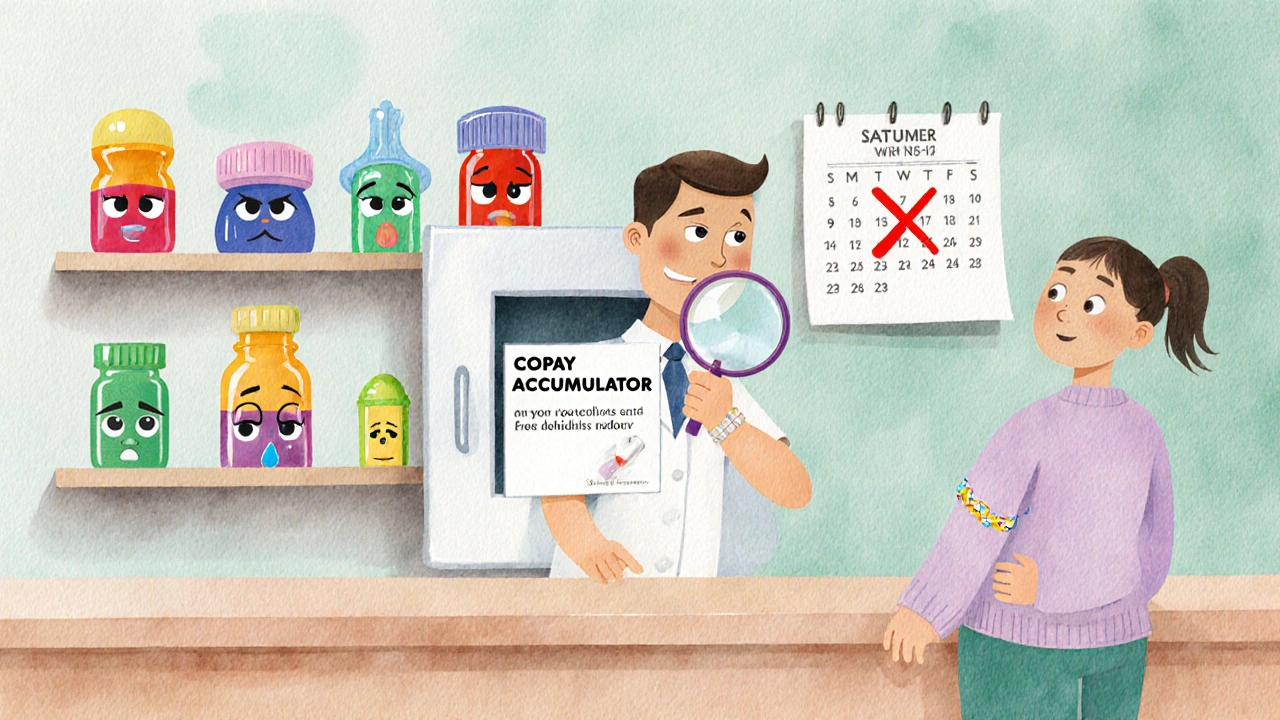
In 2016, UnitedHealthcare started a new policy that spread fast. Now, 56% of commercial health plans use what’s called a copay accumulator program. Here’s how it works: when you use your copay card, the manufacturer’s payment doesn’t count toward your deductible or out-of-pocket maximum. It just disappears.
Let’s say your plan has a $7,000 deductible. You’ve paid nothing toward it all year because your copay card covered everything. Then, one day, your card runs out. Suddenly, you’re expected to pay the full $7,000-on top of your regular premiums-just to get your insurance to start covering your meds. That’s not a surprise. It’s a trap.
A 2023 NIH study found that 68% of patients using copay cards reported better adherence. But the same study showed that 82% of patients on forums like Reddit had no idea their card payments weren’t counting toward their deductible. One patient wrote: “I used my card for two years. When it expired, I still owed $7,000. I had to stop treatment for three months.”
Even Worse: Copay Maximizer Programs
Some insurers don’t just ignore the card-they use it to your disadvantage. In a copay maximizer program, the insurer calculates the maximum amount the card can cover and sets your copay to exactly that amount. So if your card can pay up to $1,000 per month, your copay is set to $1,000-even if your drug only costs $800. You pay $0. Sounds great. But here’s the catch: you still haven’t paid anything toward your deductible. You’re stuck at zero progress, even though you’re technically paying nothing.
These programs are used by 42% of large insurers. Why? Because they make the drug look cheaper to the plan, even though the total cost to the system goes up. The drug maker pays more. You pay nothing. But your insurance doesn’t help you any faster.
Who’s Affected-and Who’s Not
These programs hit hardest those on long-term, high-cost therapies. If you’re on a biologic for lupus, psoriasis, or rheumatoid arthritis, you’re likely on the drug for life. That means your copay card won’t just last a few months. It’ll last years. And when it ends? You’re left with a deductible you never touched.
People on short-term treatments-like a six-month course of a new cancer drug-might be fine. If your card covers you for the full duration, you never hit the wall. But if your treatment lasts longer than your card? You’re at risk.
And here’s the brutal truth: patients with lower incomes are the most vulnerable. They can’t afford to pay $7,000 out of pocket. They don’t have savings to fall back on. For them, this isn’t an inconvenience. It’s a health crisis.
How to Use Copay Cards Safely
You don’t have to be blindsided. Here’s how to protect yourself:
- Ask your pharmacist: “Does my plan have an accumulator or maximizer program?” Don’t assume. Ask. Write it down.
- Call your insurer. Ask: “How much of my deductible have I met?” Don’t trust your portal. Call. Get the number in writing.
- Ask: “What happens when my copay card runs out?” Find out if you’ll be responsible for the full cost. Get the answer in writing.
Specialty pharmacies now have systems to flag patients at risk. If you’re on a long-term therapy, ask if they offer “accumulator alerts.” These notify you when 80% of your card is used-giving you 60 days to plan. That’s not a luxury. It’s a safety net.

The Bigger Picture: Why This Is Happening
Drug makers say they’re helping patients. And they are. But they’re also protecting their profits. Without these cards, many patients couldn’t afford their meds. But insurers argue that these cards artificially inflate drug prices. They say if patients paid more upfront, manufacturers would lower prices.
The truth? Neither side is fully right. Drug prices are sky-high because of how the system is built. The copay card was meant to be a bridge. Now it’s a trapdoor.
The American Medical Association opposes accumulator programs. They found patients on these plans are 23% more likely to stop their meds. That’s not just expensive-it’s deadly.
What’s Changing in 2025 and Beyond
There’s hope. In September 2024, the Department of Health and Human Services proposed a new rule: insurers must clearly explain accumulator programs during enrollment. And starting January 1, 2026, they must send you monthly statements showing your true deductible progress-even if your card is covering your copay.
Some insurers are already changing. CVS Caremark launched transparency dashboards in April 2024. But only 28% of patients benefit so far.
And Congress is looking at it. The Copay Accumulator Moratorium Act, introduced in 2023, has 72 bipartisan co-sponsors. If it passes, accumulator programs would be banned for three years while experts study the damage.
Your Next Steps
If you’re using a copay card right now:
- Call your pharmacy and ask about your plan’s policy.
- Ask your doctor if there’s a lower-cost alternative-maybe a generic or different brand.
- Look into patient assistance programs from nonprofits like the PAN Foundation or HealthWell Foundation. They help even if you’re on an accumulator plan.
- Keep records. Save every statement, every call, every email. If you’re forced to stop treatment, you may need proof to appeal.
This isn’t about saving a few dollars. It’s about staying alive. Copay cards were meant to help you get your medicine. Don’t let the system turn them into a trap. Ask the questions. Know your numbers. And don’t wait until your card runs out to find out you’re on the hook for thousands.

Comments (5)
Philip Rindom
Man, I wish I’d known about this two years ago. I was on a copay card for my RA meds, thought I was golden-until the card vanished and I got hit with a $9K bill outta nowhere. My bank account cried. My doctor didn’t even know how the program worked. Now I call my insurer every month like it’s my job. Still hate it, but at least I’m not blindsided anymore.
Jess Redfearn
so like… if your card covers your copay, why doesnt it count as paying your deductible? that makes no sense. who came up with this? some guy in a suit with no health problems?
Ashley B
This is all a scam. Big Pharma and the insurance mafia are in cahoots. They’re using your suffering to inflate stock prices. I’ve seen the documents. The same lobbyists who wrote the copay card rules also wrote the ACA. It’s not a trap-it’s a designed extraction system. And they’re laughing while you cry in the pharmacy line. Don’t trust any ‘solution’ they offer. The system is rotten to the core.
Also, your ‘safety net’? That’s just a hammock made of spider silk. It’ll snap the second you need it.
Scott Walker
Just had to say-this post saved my life. 😔 I’ve been on a copay card for my MS meds for 3 years. Last month I finally asked my pharmacist about accumulators. Turns out I’d paid $0 toward my deductible. I freaked out. Called my insurer, got a 60-day warning email from my specialty pharmacy, and now I’m applying for PAN Foundation help. Still scared, but not alone. Thank you for writing this.
🫂
Sharon Campbell
so like… why do we even have copay cards if they dont count? sounds like a trap. also why do i care? just give me free medicine. jfc.